
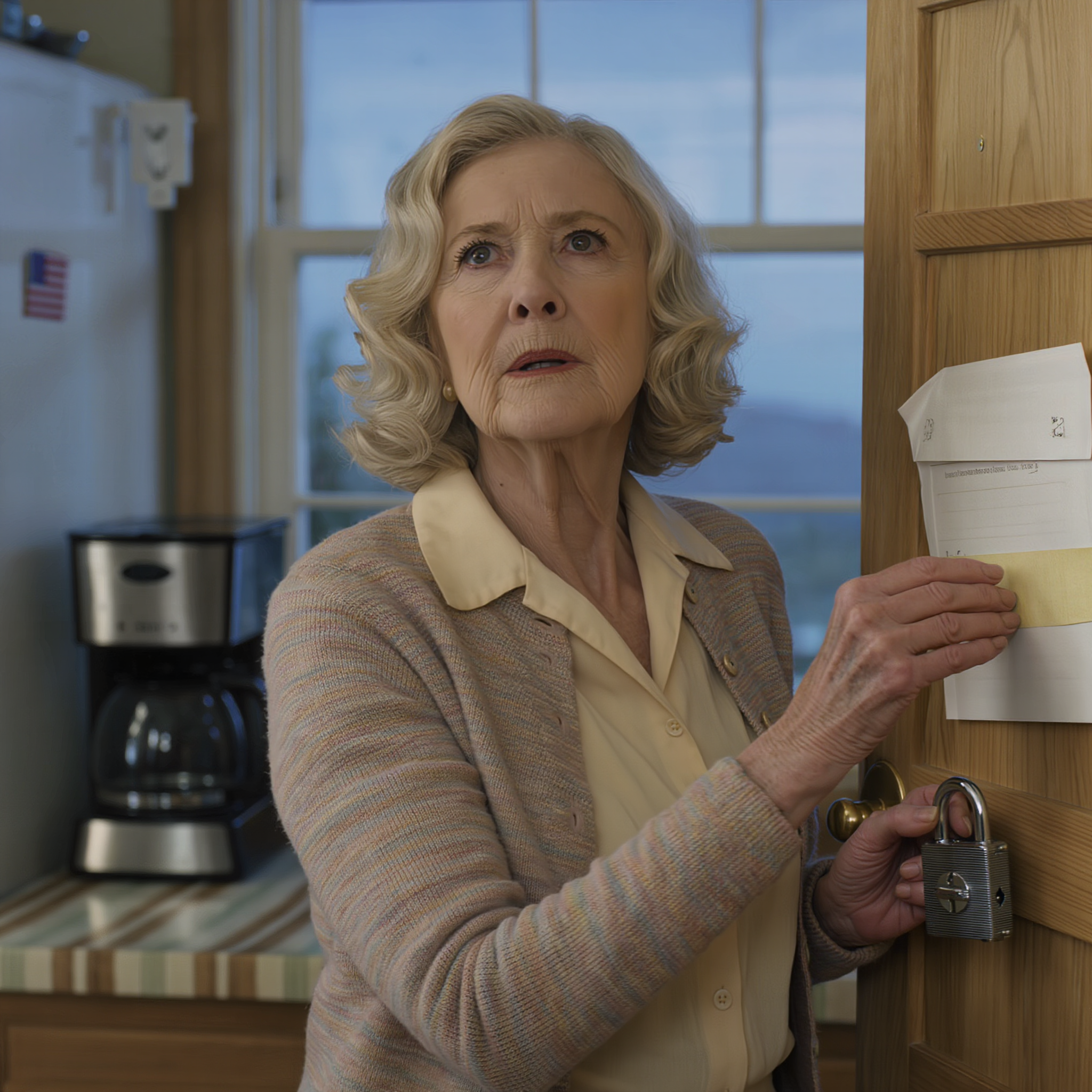
After a full day of teaching at the public school in Denver, I came home exhausted. My knees ached from standing on the playground asphalt at Lincoln Elementary, my voice was rough from reading aloud to twenty-eight third-graders, and all I wanted in the world was a cup of tea and two vanilla wafers.
I walked into my kitchen—the same narrow, sunlit kitchen in the Jefferson Park neighborhood where I’d cooked thousands of meals—and stopped cold.
There was a new lock on the pantry.
A shiny silver padlock dangled from the door like it had always belonged there.
I stared at it, not really understanding what I was seeing.
My purse slipped from my shoulder and thumped onto the tile. For a split second I honestly thought I’d come into the wrong house. But then I saw the cracked tile by the stove that Arthur never got around to fixing, the basil plants in the window over the sink, and the dent in the old oak table where Sarah dropped a casserole dish when she was fifteen.
It was my kitchen. My house.
Then I heard her voice behind me.
“Oh, you’re home.”
Clare walked into the kitchen, drying her hands on a dish towel. She was wearing that pale pink silk blouse she loved to brag about—”two hundred fifty dollars at a boutique downtown”—the same amount of money I spent on groceries for an entire week at King Soopers.
“What is this?” I asked, pointing at the lock. My voice came out softer than I intended, thin and papery.
She didn’t even look up at first.
“It’s so you don’t touch our things,” she said lightly. Then, as if remembering her script, she added, “Ryan and I bought some special items for ourselves. Imported goods, organic olive oil, that sort of thing. We don’t want them getting mixed up with the other stuff. It’s just to avoid problems.”
To avoid problems.
As if I were the problem.
“But, Clare,” I said slowly, “this is my pantry. This is my house.”
She finally looked at me, and in those brown eyes I had once thought were gentle, I saw only a cool, flat distance.
“Oh, Eleanor, don’t take it personally,” she said, with a little laugh. “It’s just organization. You have your space, we have ours. It’s the healthiest way to live together, don’t you think?”
My space.
In my own house.
As if I were a tenant they were graciously tolerating.
I wanted to scream. I wanted to rip that lock off the door and throw it out into the street. I wanted to tell her that I had paid off this mortgage with forty-two years of lesson plans and parent-teacher conferences and long, bone-tired evenings grading papers at the very table she now used for her yoga mat.
But the part of me that had always been a teacher—the part that knew how to measure every word, how to keep my voice calm even when a child was breaking my heart—made me swallow it down.
I smiled instead.
“Of course, dear,” I said. “Whatever you think is best.”
Then I picked up my purse, walked down the hall, and went to my room.
I didn’t cry that night.
I was too furious to cry.
I sat on the edge of the bed I had shared with Arthur for thirty-eight years and, for the first time in three years, I let myself see clearly what I had been refusing to acknowledge.
My house was no longer mine.
It hadn’t happened overnight. It had been like mold growing inside the walls of an old Denver bungalow—you don’t see it until you suddenly realize it’s everywhere.
If this story is stirring something inside you, you’re not alone. But let me go back to the beginning, because it didn’t start with a lock.
It started long before, when I still believed that being a good mother meant giving everything without expecting anything in return.
My name is Eleanor Monica Reynolds. I am sixty-seven years old, and for forty-two of those years I was an elementary school teacher at Lincoln Elementary in the Jefferson Park neighborhood of Denver, Colorado. I taught more than eight hundred children how to read. I wiped their tears, tied their shoes, slipped extra snacks into their backpacks when I knew there was no food at home.
I gave them kindness when their own houses didn’t.
And I never, ever imagined that my own son would one day make me feel like an intruder in the place where I raised three children and buried a husband.
That Tuesday, I had arrived home more tired than usual. My legs ached from supervising recess on the cracked blacktop, and the November air carried that thin, early-winter chill that seeps into your bones. I was sixty-five then, just about to retire. I came in through the back door, as I always did, and went straight toward the pantry for the vanilla wafers I kept for my afternoon tea.
My one little treat after a long day.
And there it was—the new, shiny silver padlock hanging from the door as if it had every right to be there.
I froze.
For a few seconds, I truly thought I must have stepped into the wrong life.
But no. There was Arthur’s favorite mug on the counter, the one nobody else used. There were the magnets from our road trip to Mount Rushmore and the Grand Canyon pinned to the fridge. This was my kitchen. My history. My home.
And someone had put a lock on my pantry.
That night, lying in the dark, I remembered something I had told one of my students years ago. Her name was Daisy, a quiet girl with big eyes and a sister who made her life miserable—taking her things, mocking her clothes, making her feel invisible in her own house.
“Daisy,” I told her one afternoon in the reading corner, “never let anyone make you feel small in your own life. Not even for love.”
And there I was, sixty-five years old, realizing that I had done exactly that.
The shadows from the streetlamp outside moved across my ceiling like slow, restless ghosts. Somewhere in the house, the refrigerator hummed. Ryan’s footsteps crossed the hall. I lay there, staring at the patterns of light, and for the first time in a long while I felt something stronger than grief.
I felt rage.
And that rage, I would soon discover, was exactly what I needed to finally wake up.
Because what Clare didn’t know is that teachers learn to read between the lines.
And I had just read her message perfectly.
What she also didn’t know was that I knew how to write, too.
Wait until you see what I did with that lock—and what I later discovered on my son’s laptop.
Three years earlier, when Arthur died of a heart attack while watering his geraniums in the small backyard off Federal Boulevard, my world had collapsed.
I didn’t just lose my husband. I lost the sound of his heavy boots on the stairs in the morning, the smell of his aftershave when he got ready for his job at the post office, the way he would hug me from behind while I cooked Sunday breakfast and sway slowly to whatever old Motown song was playing on the radio.
The house became an echo chamber.
Ryan, my youngest, flew in from his apartment in Capitol Hill with his wife, Clare. They had been married for two years. He hugged me tightly at the funeral, right there in the cold light of St. James Catholic Church, and said, “Mom, we’re not going to leave you alone. We’ll move in with you until you’re feeling better.”
“Temporary,” he said. “Just until you get back on your feet.”
Temporary turned into a month.
Then six.
Then a year.
And suddenly three years had passed, and not only had they not left—they had taken complete possession.
At first, it was subtle.
Clare started helping by “reorganizing” the kitchen.
“It’s just more practical this way, Eleanor,” she would say.
My grandmother’s Blue Ridge china ended up shoved into a top cabinet I couldn’t reach even with the step stool. My old, perfectly seasoned cast-iron skillets were quietly replaced with shiny nonstick pans she declared “healthier”.
Then came the furniture.
“That armchair is so old, Eleanor. We’re going to donate it,” she said casually one Saturday.
And just like that, my brown armchair—the one where Arthur read the Sunday paper every week, where he fell asleep with his glasses sliding down his nose—disappeared. In its place appeared a modern gray sofa that looked like it had been pulled straight from a minimalist showroom in downtown Denver.
Nice, yes.
But it wasn’t mine.
The living room slowly became their home office, full of Clare’s ring light and laptop stands and yoga mats. My sewing room filled with boxes of her clothes and seasonal décor. The dining room, where we had celebrated every birthday, every Christmas, every graduation, was redecorated with abstract art I had never chosen and didn’t recognize.
And I, like a fool, let it happen.
I told myself it was love. That they were helping me modernize. That this was simply life with young people.
But the lock was different.
The lock was a message.
The next morning, I woke with a clarity I hadn’t felt in years—like taking off dirty glasses and realizing how sharp the world really is.
I got up early, as I always did. I made my coffee in the old drip coffee maker they still “allowed” me to use because the sleek Italian pod machine on the counter was “just for them”. I sat in the little space left for me at the breakfast table and let my mind drift back over the last three years.
It hadn’t been sudden. It had been erosion.
Drop by drop, decision by decision, until I no longer recognized my own life.
It had been unbearably hot that November the year Arthur died. St. James Church was packed with people—fellow teachers, neighbors from the block, Arthur’s buddies from his poker nights, the ladies at the corner grocery on 32nd where he liked to sneak cigars I always complained about.
Ryan arrived with Clare. She wore a simple black dress and had her hair pulled back neatly. She hugged me gently and said, “I’m here for whatever you need, Eleanor.” Her voice sounded sincere.
Or maybe I just needed to believe it was.
After the burial, when everyone had gone and the house had fallen into that suffocating silence only the newly widowed truly understand, Ryan took my hands in his.
“Mom, you can’t stay here alone. Not now.”
“I’ll be fine, son,” I said. “Your father taught me to be strong.”
“I know,” he answered. “But we’re going to stay with you for a while. Just until you get back on your feet. The house is big. We have plenty of space.”
Clare nodded beside him with that soft smile I wanted so badly to trust.
“It’s temporary, Eleanor. A few months, tops,” she added. “Besides, this way we can save for a down payment on a house of our own, and you won’t be alone. It’s perfect for everyone.”
Perfect for everyone.
What a beautifully wrapped lie.
The first few weeks were good. Clare cooked, cleaned, and came with me to parent-teacher conferences when I didn’t have the strength to face certain parents alone. Ryan fixed things around the house that had been broken for years—the water heater, the lock on the garden gate, the leak in the upstairs bathroom.
I felt accompanied. Less empty.
But in the third week, Clare started in with her “suggestions”.
“Oh, Eleanor, these curtains are so old,” she said, running her fingers over the terracotta-colored drapes Arthur and I had chosen when we remodeled the living room. “What if we buy new ones? I have a really good eye for decorating.”
I was so emotionally exhausted that I just murmured, “Fine, dear. Whatever you think.”
A week later, my terracotta curtains were in the trash. In their place were minimalist white panels that let in too much light and made the room feel cold and bland.
Then came the dining room.
“These landscapes are so dated,” she said, already taking the frames off the wall. “Look, I bought these at a gallery—modern art. It gives the room personality.”
The landscapes were paintings we’d picked up on our honeymoon drive up the coast to Maine—Arthur and I, a borrowed car, a map that kept folding in on itself, and a tiny inn where we got lost trying to find the main square. Every time I looked at those paintings, I remembered him laughing with rain in his hair and my heart bursting with something that felt like forever.
When I protested, weakly, Clare had already packed them.
“Don’t worry, I put them in a box,” she said. “Maybe you’ll want to see them someday.”
Someday.
As if my own history were optional in my own house.
The changes kept coming like waves.
My collection of china? “It takes up too much space, Eleanor. Let’s put it up top.” My plants in the garden? “They’re too messy. I’m going to reorganize them.” The bookcase in the living room, full of Arthur’s old novels? “These books are ancient. Should we donate them?”
And I, still stunned by grief, just nodded. I told myself I was being difficult, old-fashioned, clinging to the past.
But the real change came when they started to modify routines.
Sundays had always been sacred in this house.
My two daughters, Sarah and Emily, would come over with their children. We’d make a big pot roast or chili, whatever we felt like. The house would fill with the kind of joyful chaos that only happens when family is together—kids running around, someone laughing in the kitchen, Arthur pretending he didn’t like all the noise while secretly loving every second.
Three weeks after Ryan and Clare moved in, she made her first suggestion.
“What if we do family dinners every other Sunday instead of every week?” she said casually, sipping green juice at the kitchen island. “Ryan and I really need our Sundays to rest.”
Then, a month later: “What if we make them once a month?”
And then, they just… stopped.
One Sunday, Sarah showed up unannounced with a cake from the bakery on 38th and a bouquet of grocery-store flowers. Clare opened the door in pajamas, looking annoyed.
“Oh, Sarah, we didn’t know you were coming. We don’t have anything prepared,” she said.
Ryan stood behind her, silent.
“Ryan and I were just about to head out,” Clare added, already halfway out the door.
Sarah looked past her, searching for me. I was in the kitchen, embarrassed, wiping my hands on a dish towel, not sure whether I should step forward or stay where I was.
“I thought we still did Sunday dinners,” Sarah said, her voice tight.
“Well, we all live together now,” Clare replied. “We just need to coordinate better, don’t you think?”
Coordinate.
As if seeing my own daughter required an appointment.
Sarah left the cake on the table, gave me a quick, stiff kiss on the cheek, and walked out without sitting down.
She didn’t come back for two months.
My friends received the same treatment.
My best friend Carol, with whom I’d had coffee every Thursday afternoon for twenty years at a little café near Sloan’s Lake, stopped coming over.
The last time she visited, Clare was doing yoga in the living room with loud techno music blasting from a portable speaker.
“Oh, sorry, Carol,” she said without pausing her stretch. “I didn’t know you were coming. This is my workout time.”
Carol, uncomfortable among the yoga mats and the incense Clare had lit, drank her coffee quickly at the corner of the dining table and left early.
“You should let me know when your friends are coming,” Clare told me later, not lifting her eyes from her phone. “So I don’t have to interrupt my schedule.”
Her schedule.
In my living room.
In my house.
Little by little, my social life vanished. And with it disappeared the witnesses to what was happening.
But the worst part wasn’t the furniture or the curtains or the lost dinners.
The worst was when I started to realize Clare wasn’t just changing the house.
She was changing my son.
Ryan had always been affectionate. Before he moved in, he used to call me every other day from his small apartment near Colfax Avenue. He’d ask how I was, tell me about his job at the hardware store, make bad jokes that made me laugh out loud in my quiet kitchen.
Now, living under the same roof, he barely spoke to me.
He came home late from work, went straight to their bedroom, and if I tried to ask about his day, he would answer in monosyllables.
“Fine. Tired. We’ll talk later.”
But “later” never came.
One night, I heard them arguing in their room. The wall between our bedrooms was thin, and voices filtered through.
“Your mom asked if we can take her to the doctor on Tuesday,” Ryan said.
“Why? She’s a grown woman. She can go by herself,” Clare replied.
“Clare, she’s my mom.”
“Exactly. She’s your mom, not mine. I have enough to do working and keeping this house in order. I’m not going to be her nurse, too.”
There was a long silence.
I waited for Ryan to defend me. To say something. Anything.
He said nothing.
In that silence, something broke inside me.
My son was choosing her over me—not dramatically, not with shouting, but with absence. With silence. With letting her speak for him and never contradicting her.
The next day, I went to the doctor alone.
And then to the grocery store alone. And to the retirement paperwork meetings alone.
I was alone in that crowded house.
Clare started cooking only for herself and Ryan. She claimed they were on a “special diet”. They left their dirty dishes in the sink for me to wash. They monopolized the living room TV for their shows and their streaming series. They played music I didn’t recognize. They had visitors they didn’t bother introducing me to.
And I just got smaller. A little more invisible each day in my own life.
Until the lock.
The lock was the last straw, because in that moment I finally understood.
They weren’t sharing my house.
They were taking it from me.
You might not believe it. You might be thinking I exaggerate. But I promise you—what they did next would prove I was right.
What they didn’t know was that I still had an ace up my sleeve.
Something not even Ryan knew about.
My son had started looking at me like I was a piece of old furniture he couldn’t wait to replace.
And that hurt more than a thousand locks.
Ryan was born at dawn in July, during a thunderstorm that rattled the windows of St. Joseph Hospital. I squeezed Arthur’s hand so hard his fingers turned purple. Thirty-six hours of labor. But when they finally laid that squirming, red-faced boy on my chest, with his little eyes barely open and that hungry cry tearing through me, I swore I would protect him from everything.
I never imagined that one day I would need to protect myself from him—or rather, from his silence.
It was a Wednesday. I remember because on Wednesdays I got home from school early, at two in the afternoon. Back when I was still teaching, I used to find Ryan already in the kitchen eating a sandwich, happy to talk about everything.
But that Wednesday, three days after the lock incident, I came home to a strangely quiet house.
Clare wasn’t there.
Ryan was.
I saw him sitting in the living room, hunched over, scowling at his phone.
“Son,” I said from the doorway. “Have you eaten? I can make us some eggs and bacon.”
He barely looked up.
“Not hungry, Mom. Thanks.”
He went right back to scrolling.
I stood there, my purse still on my shoulder, feeling like I had just spoken to a wall.
“Are you okay?” I asked.
“Yeah.”
“Did something happen at work?”
“No.”
“Ryan, look at me.”
He let out that long, exasperated sigh people use when someone is bothering them. He put his phone down on the couch and finally looked at me—but his eyes were distant, like he was seeing me through a fog.
“What is it, Mom?” he asked.
“That’s what I’m asking you,” I said quietly. “We don’t talk anymore. You don’t tell me anything. You live here, but it’s like you’re not here.”
He ran a hand through his hair—a gesture he’d had since he was a boy whenever he was uncomfortable.
“I’m just tired,” he muttered. “Work is tough. Don’t take it personally.”
Don’t take it personally.
The same words Clare had used about the lock.
“What about Sunday?” I asked. “Sarah told me you invited her and her family for lunch—but you didn’t tell me.”
His face changed. He tensed.
“It was a last-minute thing,” he said. “I thought you had plans.”
“What plans would I have?” I asked. “I live here. This is my house.”
“Mom, don’t start,” he said.
“Start what?” I asked. “Wanting to talk to my own son?”
He stood up from the couch. He wouldn’t meet my eyes.
“Look, Clare and I are trying to build our life,” he said. “We need space. We can’t always be thinking about… you know, about you.”
“You can’t be thinking about me,” I repeated.
“It’s not that,” he said quickly.
“Then what is it?” I asked.
Silence.
That damned silence that had become his answer for everything.
“I have to go,” he finally muttered. “Clare’s waiting for me.”
And he left. Just like that.
Leaving me with words stuck in my throat and my heart in pieces.
That night I couldn’t sleep.
I stared at the ceiling, remembering the boy Ryan used to be—the one who crawled into my bed when he had nightmares, who drew pictures for me in elementary school and proudly taped them to the fridge, who hugged me tight and said, “When I grow up, I’m going to build you a huge house, Mom. With a big yard and everything.”
Where had that boy gone?
In the days that followed, things got worse.
Ryan started avoiding me altogether. He’d leave the house before I woke up. He’d come home when I was already in my room. When we did cross paths in the kitchen or the hallway, he’d look down and hurry past as if I were an inconvenient stranger.
But what finally broke something inside me was what I discovered a week later.
It was a Saturday morning. Clare had left early for the salon, that weekly ritual she insisted was “essential” and that cost two hundred dollars every single time. Ryan was in the shower. I was tidying the living room, as I always did, picking up cups and folding the throw blanket they never folded.
That’s when I found it.
A manila envelope, forgotten between the sofa cushions.
I didn’t want to snoop.
Not really.
But the envelope had the bank’s logo on it, and it was open.
Inside was a bank statement.
My son’s.
And there was also a piece of paper in his handwriting—a note he had written to me two years earlier when he’d asked to borrow money.
My hands started to tremble as I unfolded it and read.
“Mom, I promise I’ll pay you back the $80,000 as soon as we get the loan approved. It’s for the down payment on our house. Clare and I already found the perfect place out in Highlands Ranch. We’re so excited to start. I swear on Dad’s memory I’ll pay you back. Love, Ryan.”
Eighty thousand dollars.
The savings Arthur and I had spent years putting aside for our retirement. The money I was keeping for emergencies so I wouldn’t be a burden on anyone in my old age.
I had lent it to him because he was my son.
Because I trusted him.
Because he told me it was for his house.
But according to the bank statement dated just one month prior, there was no house.
There was, however, a charge for $70,000 to “Premium Auto Group”.
A car.
They had bought a luxury SUV with my money and the bank’s money, and they had never told me.
I felt the floor tilt beneath me. I sat down on the gray sofa they loved so much because my legs wouldn’t hold me.
I read the statement over and over, looking for some mistake, some explanation other than the obvious one.
There was no mistake.
My son had lied to me.
He had used me.
He had taken my life’s savings and spent them on a whim to please his wife.
I heard the shower turn off, Ryan’s footsteps crossing the hall. I slid the papers carefully back into the envelope and left it where I’d found it.
When he came into the living room, his hair still damp, a towel slung around his neck, he froze for a second when he saw me.
“Oh, you’re here,” he said.
“Yes,” I answered. “Just tidying up.”
He nodded, uneasy, walked over to the sofa, grabbed the envelope without a word, and went straight to his room.
He didn’t pretend. He didn’t explain.
That afternoon, when Clare returned with her hair freshly styled and her nails painted bright red, I saw her differently.
I watched her slide behind the wheel of that brand-new gray SUV parked in front of my house—the one they had “bought with their savings”.
My savings.
Something inside me broke for good.
It wasn’t just the money.
It was the betrayal.
It was knowing that my own son saw me as a bank. As someone he could take from without giving back. As someone whose needs did not matter.
That night, while they ate dinner in the kitchen, talking and laughing as if nothing were wrong, I stayed in my room.
I didn’t cry.
I was out of tears.
Instead, I felt something cold and sharp take shape inside my chest—a decision forming like ice.
I opened my closet, moved the old shoeboxes, and pulled out the blue tin box my mother had left me before she died.
Inside that box were things Ryan didn’t know about.
Things Clare couldn’t even imagine.
Documents.
Deeds.
And a will that was still under my control.
It turned out my son had forgotten something very important.
This house had an owner.
And that owner was very much alive, very much in her right mind—and now, very, very angry.
What came next, none of us saw coming.
But when I finally acted, it changed everything.
The blue tin box was barely a foot long, with faded flowers painted on the lid and a small dent in the corner. It had fallen during the move into this house twenty-five years earlier, when Arthur and I first left our cramped two-bedroom rental near Colfax and bought this little brick place with the maple tree in front.
To anyone else, that box would have looked like junk.
To me, it was a war chest.
I placed it carefully on my bed, like someone unearthing something sacred. My hands trembled as I lifted the rusty lid.
The smell of old paper rose up, dry and sweet.
Inside were yellowed envelopes, carefully folded documents, photographs, and a black notebook with frayed corners—my mother’s notebook.
In her slanted, precise handwriting were all the lessons she had given me before she died.
“Eleanor,” she had told me on her last lucid day in her small room at the hospice center off Speer Boulevard, her eyes already dimmed by cancer but her voice still firm, “never, ever let anyone think you’re stupid just because you’re kind. Kindness is not weakness. And a woman who knows when to stay silent is more dangerous than a hundred screaming men.”
I smiled, remembering her.
My mother had been a teacher too. She taught me that information is power.
I pulled out the first document: the deed to the house.
Original. Sealed. Notarized.
In my name: Eleanor Monica Reynolds, widow.
Not a single letter mentioned Ryan or Clare or anyone else.
This house was mine, free and clear. No debt, no mortgage, no conditions. I had inherited the land from my parents when they passed, and Arthur and I had built and remodeled this place with our own savings. Every brick, every window, every tile in the bathroom had been paid for with the sweat of two teachers who had worked for forty years without stopping.
Ryan knew that.
Or at least, he used to.
Maybe Clare had helped him forget.
Or maybe he had chosen to forget, because it was more convenient to believe this house would be his someday.
I pulled out the second document: my will.
We had drawn it up five years earlier, when Arthur and I decided it was time to get our affairs in order. Back then, it left the house divided equally among my three children: Ryan, Sarah, and Emily.
But wills, I reminded myself, can be changed.
And a dark part of me, one that had been dormant for too long, began to consider that possibility very seriously.
I kept going.
Copies of the utility bills—water, gas, property taxes—all in my name. All paid by me for the last three years, despite the two hundred dollars a month Ryan and Clare contributed.
Two hundred dollars.
A joke.
The property taxes alone were eight hundred dollars every quarter. The electric bill hovered around two hundred. Gas was another hundred. Maintenance, repairs, unexpected costs—all of it had been coming out of my teacher’s pension.
My $2,500-a-month pension, evaporating to support a household of three where I was the only one contributing real money.
But the most interesting thing in the box was at the bottom—a white business card with blue lettering.
Patrick Nolan, Attorney at Law. Family and Estate Law.
Patrick had been my student in third grade, over thirty years earlier. A skinny, serious boy who always had his nose in a book during recess.
Now he was one of the most respected lawyers in Colorado.
And he owed me.
At Arthur’s funeral, Patrick had come up to me in a dark suit that didn’t quite fit his lanky frame, his eyes shining with unshed tears.
“Miss Reynolds,” he’d said, still calling me by my maiden name, still sounding like that little boy who used to stay behind to help me stack chairs. “Anything you need. Whatever it is. Just call. You changed my life.”
Sitting on my bed with the blue tin box open in front of me, I looked from the deed to the will to the business card.
For the first time in weeks, I felt something other than sadness or rage.
I felt control.
The next morning, Sunday, I waited until Ryan and Clare left for brunch with her parents in the suburbs—another gathering I was never invited to. As soon as I heard the SUV pull away from the curb, I picked up the phone and dialed Patrick’s number.
He answered on the third ring.
“Miss Reynolds,” he said. “Are you okay? Did something happen?”
The genuine concern in his voice almost made me cry.
“I need your help,” I said instead. “I need to review some documents and maybe… make some changes.”
There was a pause on the line.
“Changes to your will?” he asked gently.
“Among other things,” I said.
“May I ask what’s going on?” he asked.
So I told him.
Sitting there on my bed, with the blue box open in front of me, I told him everything.
The lock.
The humiliations.
The eighty thousand dollars.
The way my own home had become a prison where I was the unwanted guest.
Patrick listened without interrupting. When I finished, his silence on the other end of the line felt different.
It wasn’t discomfort.
It was calculation.
“Miss Reynolds, do you have proof of all this?” he asked at last.
“I have receipts,” I said. “I have the bank statement. I found text messages where Ryan promised to pay me back. And the house is entirely in my name.”
“Completely? No second mortgage, no joint ownership?” he pressed.
“Completely,” I said.
“Perfect,” he replied, his voice turning firm. “Then here’s what we’re going to do.”
For the next hour, Patrick laid out a plan.
It wasn’t revenge.
It was protection.
It was about drawing lines that Clare and Ryan couldn’t cross.
First: update my will with a different notary, one they didn’t know. Leave everything to my daughters, Sarah and Emily, with a special clause that Ryan could only inherit if he repaid the eighty thousand dollars before my death. If he didn’t, his share would be divided between his sisters.
Second: get a notarized inventory of all my assets inside the house—furniture, appliances, jewelry, everything—to make it clear what belonged to me and what belonged to them.
Third: prepare a legal ultimatum. If they didn’t start paying a fair rent—calculated at $5,000 a month, which, for a three-bedroom brick house ten minutes from downtown Denver, was still cheap—or move out within three months, I could start eviction proceedings.
“But Patrick,” I whispered, my voice breaking, “he’s my son.”
“I know, Miss Reynolds,” he replied gently. “And that’s why I’m giving him options that don’t involve throwing him out on the street tomorrow. But you have to protect yourself. What they’re doing to you—it’s not love. It’s abuse.”
That word hit me like cold water.
Abuse.
Was that what this was?
Could you call it abuse when it came from your own child?
“Think about it,” Patrick said. “But don’t take too long. The longer you wait, the harder it will be to get your house and your peace back.”
We hung up.
I sat there for a long time, surrounded by papers, feeling like I had just crossed an invisible line.
But the truth was, the line had already been crossed.
Just not by me.
I put everything back in the blue box and hid it in the back of the closet, behind the winter clothes no one ever touched.
When Ryan and Clare came home that afternoon, they found me in the kitchen making chicken soup as always, looking for all the world like the harmless old woman they thought I was.
“Smells good,” Ryan said, surprised to see me cooking.
“I thought we were on a diet,” Clare said sharply.
I smiled—a smile I had perfected over forty years of dealing with difficult parents at school.
“It’s just for me,” I said calmly. “You two can do your own thing.”
Clare blinked, thrown off by my neutral tone. Ryan looked at me with something that almost resembled guilt. But neither of them said anything, and I kept stirring my soup, outwardly serene.
In my mind, the pieces of a chessboard they didn’t even know existed were already moving.
Because I had finally learned something important.
The person who shouts the loudest doesn’t always win.
Sometimes the winner is the one who knows how to wait in silence—with a teacher’s patience and a surgeon’s precision.
And I had waited long enough.
But before I could make my next move, something happened that almost ruined everything.
Something that made me question whether I really knew the people I was living with at all.
That day, in front of the whole family, they treated me like I was nothing.
I let them talk.
Every word they said was just more rope for them to hang themselves with.
It was Ryan’s birthday.
Thirty-five years old.
In the old days, those birthdays had been sacred. Arthur would wake up early to hang colorful streamers in the dining room. I would bake his favorite angel food cake with fresh strawberries from the farmer’s market. Sarah and Emily would show up with brightly wrapped gifts and hugs that lasted forever.
But this year was different.
“I’m organizing something small,” Clare had told me two weeks before, painting her nails at the coffee table while some reality show hummed in the background. “Just us and my family. Something intimate.”
“What about the girls?” I asked quietly, meaning Sarah and Emily.
“Oh, Eleanor, you know how they are,” she said, rolling her eyes. “They always end up arguing over silly things. Better to avoid the drama.”
They didn’t argue over silly things.
They argued because Clare treated them with the same cool contempt she treated me—and Ryan never defended us.
“And the food?” I tried again. “Can I make the lasagna Ryan loves? Or maybe his favorite chicken casserole?”
“Don’t worry,” she said, already scrolling through her phone. “I’m catering everything. You just relax.”
Relax.
As if I were a guest in my own home at my own son’s birthday.
The day arrived. Saturday, April 23rd. That sticky mid-spring heat where Denver can’t decide if it wants to be winter or summer.
Early that morning, Clare started “transforming” the house.
She took down the paintings I had quietly rehung. She set out modern centerpieces with artificial flowers from some fancy store at Cherry Creek. She changed the tablecloths to minimalist gray ones that “matched the décor.”
I watched from the kitchen doorway, invisible, as she commanded and organized in my house like it was her stage.
“Ryan, move that chair. No, not there—more to the corner. Perfect,” she said.
My son obeyed without a word, moving furniture from one side of the room to the other, sweating in his white t-shirt.
“Do you need help?” I asked softly.
Clare didn’t even turn around.
“No, we’re almost done,” she said. Then she glanced over her shoulder. “Oh, actually, could you go to your room while we set up? We’re using the living room and we don’t want anything in the way.”
Anything in the way.
Or anyone.
I went to my room like a scolded child. I closed the door and sat on the bed, feeling the heat climb the back of my neck—the humiliation, the anger, all of it pressing down.
But I stayed quiet.
I opened the drawer of my nightstand, took out my cell phone, and set it on silent. Then I propped it carefully against a book on top of the dresser, with the camera aimed toward the door I left slightly ajar.
I hit “Record.”
If forty-two years in the classroom had taught me anything, it was this: when someone is hurting you, document it.
Words are forgotten.
Witnesses change their stories.
But video doesn’t lie.
At six in the evening, the guests started arriving.
First, Clare’s parents, Walter and Beatrice. Yes, that was her name, and believe me, it suited her perfectly.
Beatrice walked in wearing a floral dress and expensive sunglasses, carrying a cake from an upscale bakery in Cherry Creek. She looked around the living room with a critical eye, as if judging whether the décor met her standards.
“Oh, honey, it looks wonderful,” she said, kissing Clare’s cheek. “You can tell you have great taste.”
Her great taste.
In my house.
With my furniture shoved into corners.
Then Clare’s sister, Megan, arrived with her husband and their two over-indulged children, who immediately began racing through the house, screaming.
One of them knocked over my African violet.
No one said a word.
No one picked it up.
I stood in the hallway in my Sunday blouse and pearl earrings, waiting for someone to greet me.
No one did.
Clare walked right past me as if I were part of the wallpaper. Walter nodded once but didn’t bother with words. Beatrice didn’t even glance my way.
Ryan was too busy opening bottles of wine and fiddling with the music on Clare’s phone.
I sat in the one armchair they’d shoved into the corner by the bookcase and watched.
The dining room table was covered with food I hadn’t cooked: sushi trays, fine cuts of meat, gourmet salads, bottles of wine that probably cost more than fifty dollars each, artisanal bread, French desserts with names I couldn’t pronounce.
All paid for with the money they supposedly didn’t have.
The same lack of money that “explained” why they couldn’t pay fair rent.
“A toast to my husband,” Clare announced, glass in hand. “To his thirty-five years and to this being the start of our best chapter together.”
Our best chapter.
As if I hadn’t been there for his first thirty-five.
As if I hadn’t given birth to him, raised him, educated him, supported him when he was unemployed, and held him when girlfriends broke his heart.
Everyone toasted. Glasses clinked. Laughter filled the room.
No one toasted me.
Then Beatrice, three glasses of wine in and sporting that condescending tone of people convinced of their own superiority, dropped the bomb.
“Oh, Clare, it’s so good you two are so patient,” she said. “Not everyone can stand living with their mother-in-law, right?” She let out a fake laugh that made my skin crawl. “They must be so grateful to you. Not all modern couples sacrifice like this—taking care of their parents instead of… you know… putting them somewhere.”
Sacrifice.
Taking care of.
As if I were a burden they had nobly chosen to shoulder.
Clare smiled, lowering her gaze with practiced modesty.
“Oh, my mother-in-law… she does what she can,” she answered. “It’s hard at her age, right? But we manage with patience.”
“Mother-in-law.”
That word, which had sounded affectionate in the first few months, now dripped with poison.
“It’s just,” Megan chimed in, refilling her wineglass, “I told my husband, when his mom gets old, no way is she moving in with us. Straight to a nursing home. It’s healthier for everyone.”
Laughter erupted.
Ryan smiled awkwardly—but he didn’t say anything.
Nothing.
“Well, I think it’s fine to help up to a point,” Walter added. “But there comes a time when the old folks have to understand their cycle is over. Let the young people live.”
The old folks.
They talked about me like I wasn’t even there—as if I were an object they’d eventually have to deal with.
Beatrice finally turned to look directly at me for the first time all night.
“Right, Eleanor?” she said, her tone syrupy. “You understand they need their space. They’re young. They have dreams. They can’t be burdened with… well, you understand.”
I stayed quiet.
I smiled that tight, tired smile I had perfected over weeks of enduring insults disguised as advice.
And I let them keep talking.
Because my phone was still recording.
Every word.
Every cruel laugh.
Every dismissive comment.
Clare brought out the cake. They sang “Happy Birthday”. Ryan blew out the candles. Someone asked him what he’d wished for.
Looking at Clare with soft eyes, he said, “I wish we’ll have our own house soon. So we can start our real life.”
Our real life.
As if the last three years had been a holding pattern.
As if I were merely an obstacle on his road to something better.
I stood up from my corner chair. My legs were shaking, but I kept my back straight. Forty-two years of standing in front of thirty children had taught me how to have presence.
“I’m going to my room,” I said calmly. “Enjoy your party.”
No one stopped me.
No one said, “Don’t go.”
No one asked if I was okay.
“Rest well,” Clare muttered.
I closed my bedroom door and stopped the recording.
Three hours and forty minutes of documented humiliation.
I sat on the bed with the phone in my hands and hit play.
I listened to it all again.
This time, I didn’t feel sadness.
I felt clarity.
Because they had just given me exactly what I needed.
Irrefutable proof.
Proof that I wasn’t imagining things.
Proof that it wasn’t my fault.
Proof that this was abuse disguised as “living together”.
I saved the video to the cloud. I made three backup copies. I emailed one to Patrick Nolan with the subject line: “Urgent – Additional Evidence”.
Then I lay down.
For the first time in months, I slept soundly.
I wasn’t alone in this war anymore.
I had allies.
I had proof.
And, above all, I had a plan.
What they didn’t know was that they had already dug their own graves.
I was just going to hand them the shovels.
The next day, I did something Clare will never forget.
Something as simple as a letter—but as devastating as an earthquake.
When Clare read that letter, I watched the color drain from her face.
Because the right words, at the right time, are more powerful than a thousand screams.
Sunday morning was quiet.
Too quiet.
That uncomfortable stillness after a storm, when the air still smells like electricity and broken branches.
Ryan and Clare didn’t come out of their room until eleven. I had already been up for hours. I’d had my coffee, watered the few plants they hadn’t “reorganized,” and done what I had been planning all night.
On the dining room table, amid the remains of the party no one had bothered to clean up, I saw the padlock.
They had left it there—next to empty bottles and dirty plates.
As if it were trash.
As if it hadn’t been the symbol of my humiliation just days before.
I picked it up.
It was light and cheap, the kind of lock you can buy at any hardware store on Colfax for five dollars.
Nothing special.
But to me, it represented a line that had been crossed.
I went to the kitchen drawer where I kept Arthur’s old tools. I took out a pair of pliers that had seen better days.
The lock gave way easily.
Too easily.
With a little pressure and the right angle, the shackle popped open.
I smiled.
The lock that had seemed so powerful in Clare’s mind was nothing.
It was theater.
An illusion of control—just like everything else she had built in this house.
I left the broken lock on the kitchen counter where she couldn’t miss it.
But that wasn’t enough.
I needed to send a message Clare would remember.
A permanent one.
I went to my room and took out a pen and a stack of stationery. Not the computer. Not a text. A handwritten letter.
There is something about handwriting that makes words heavier, harder to ignore.
I sat at my old desk—the same one where I had graded thousands of spelling tests—and I wrote.
Not with rage.
With surgical precision.
“Clare,” I began.
“I’ve decided not to say anything about the lock, because I understand you come from a family where distrust is normal. I don’t blame you for that. Everyone carries their own baggage and ways of seeing the world.
“But I want you to know something very important. Something you may have forgotten—or perhaps were never told clearly.
“This house has an owner.
“And that owner is me.
“The documents are in my name. Original, notarized deeds, impossible to change without my physical presence, my valid ID, and my thumbprint. My lawyer, Mr. Patrick Nolan, has certified copies of everything. And believe me when I say he is very good at what he does.
“I know about the power of attorney you wanted me to sign six months ago. That paper you ‘accidentally’ left on the table with the most important parts highlighted in yellow.
“I am not stupid, Clare. I am a teacher. I taught more than eight hundred children to read. I can read between the lines better than you imagine.
“I also know about the $80,000 my son borrowed from me for a down payment on a house—the house that never existed. The money that became the car you drive every day.
“And I know what you said about me last night. I recorded every word.
“This is not a threat. It is information.
“Information you need in order to make better decisions from now on.
“This is your only warning.
“If you ever try to put another lock on me—literally or metaphorically—you will meet the Eleanor you do not want to meet. The one who does not smile. The one who does not stay silent. The one who has documents, lawyers, and the truth on her side.
“Think very carefully before your next move.
“With the politeness I have left,
“Eleanor Monica Reynolds,
“Legal owner of this property.”
I folded the letter into three neat sections and slid it into a large manila envelope. In clear handwriting, I wrote on the front: “For Clare – Personal and Confidential.”
I went to the pantry.
The door was there, open, without a lock—as it should always have been.
I taped the envelope right in the center at eye level with thick packing tape.
Impossible to miss.
Then I went back to the kitchen. I made myself a cup of chamomile tea and sat down to wait.
I didn’t have to wait long.
Around eleven-thirty, I heard footsteps.
Clare shuffled into the kitchen, hair messy, looking hungover from too much wine and too little sleep.
She went straight for the coffee maker.
Then she saw it.
The broken lock on the counter.
She stopped.
She picked it up, examined the twisted metal, frowned.
Then she turned toward the pantry.
There it was—the manila envelope, her name written in large, dark letters.
I watched the blood drain from her face even before she opened it.
She grabbed the envelope with trembling hands. She tore it open, ripping the paper. She pulled out the letter and began to read.
I kept drinking my tea, staring out the window at the small backyard, seemingly uninterested.
But I watched her reflection in the glass.
I saw her eyes widen line by line.
I saw her mouth form a small “O” of shock.
I saw her hands start to shake.
When she finished, she folded the letter slowly, as if buying time. Then she looked at me.
I didn’t look away.
“Eleanor,” she said in a small, frightened voice. “This is a misunderstanding.”
I turned my head, met her eyes, and—for the first time in three years—did not smile.
“Which part is a misunderstanding?” I asked quietly. “The lock I saw with my own eyes? The money, for which I have your husband’s bank statement as proof? Or the things you said about me last night—recorded on video, with date and timestamp?”
She didn’t answer.
The letter shook in her hands.
“We… we were just—” she began.
“Save it,” I cut in.
My voice was firm and cold.
“I don’t want explanations. I want you to understand that this house is mine. That I decide who lives here and under what conditions. And if you ever disrespect me again in any way, you’re gone. No discussion. No second chances.
“Ryan is my son,” I continued. “He will always have my love. But this house is mine. And in my house, you will be respectful—or you will find somewhere else to live.”
The silence that followed was thick and electric.
Clare clutched the letter to her chest.
For a moment I thought she would cry, or scream, or stage one of her dramatic scenes.
She did none of those things.
She just nodded—barely—and walked out of the kitchen without another word.
I heard their bedroom door close, then muffled voices. Ryan asking what was wrong. Clare crying, explaining, twisting.
I didn’t care.
For the first time in years, I felt like I had taken something back.
Not my whole house.
Not my whole life.
But a small, vital piece of my dignity.
I finished my tea, washed my cup, and went for a walk in the neighborhood park, where no one knew me, where no one judged me, where I could breathe.
When I came back two hours later, the manila envelope was gone from the pantry.
The broken lock was still on the counter.
Next to it, there was a note in Ryan’s handwriting.
“Mom, we need to talk.”
I picked up the note, crumpled it in my fist, and smiled.
Because finally—after three years of silence—my son wanted to talk.
And I had a lot to say.
That conversation changed everything.
Just not in the way I expected.
They thought I was scared.
They didn’t realize I was just waiting for the perfect moment.
Ryan’s note stayed on the counter for two days.
Two full days where none of us said a word beyond the strictly necessary.
“Good morning.”
“Good night.”
“Do you need the bathroom?”
Nothing more.
The house became a minefield. Every step had to be measured. Every closing door sounded like a gunshot. The silence was so dense it felt like walking through fog.
Clare avoided my eyes. When we crossed paths in the kitchen, she grabbed what she needed and fled like a frightened mouse. The loud music stopped. The yoga sessions moved to their bedroom. She no longer reorganized my drawers or made cutting jokes.
For the first time in three years, there was fear in her eyes when she looked at me.
I won’t lie: a dark part of me enjoyed that fear.
But I knew it wouldn’t last.
Shock fades.
Shock turns into resentment.
Resentment becomes strategy.
Clare was not the type to give up easily.
So I didn’t give up either.
I started documenting everything.
Everything.
I bought a new spiral-bound composition notebook at the corner store. On the first page, I wrote, in neat letters:
HOUSEHOLD EXPENSE LEDGER – APRIL 2025.
Then I started writing down every dollar that came out of my pocket.
Electric: $212.
Water: $84.
Gas: $120.
Property tax (quarterly, averaged monthly): $266.
Groceries: $600.
Internet: $79.
Phone: $30.
Total: over $1,800 a month.
Ryan and Clare’s contribution: $200.
The numbers didn’t lie.
I was subsidizing their life to the tune of at least $1,600 a month.
And that didn’t even count the space, the furniture, the appliances—everything they used freely without a second thought.
But numbers weren’t enough.
I started recording certain conversations, too.
Not always.
Just when something important was happening.
My phone lived in the pocket of my apron, with the audio recorder app one tap away.
Like that Thursday afternoon when I heard Clare talking on the phone out on the back patio.
She thought I had gone out.
She didn’t know I had come back in for my sweater.
“No, Mom, I’m not exaggerating,” she said, pacing. “She’s insufferable. Now she’s playing the victim. Like she’s the queen of—”
She paused. Whoever was on the other end said something.
“Well, yes, legally she’s the owner,” Clare continued. “But after everything we’ve done for her, right? We’ve been caring for her for three years. Putting up with her old-lady habits.”
I saved the recording with the date and time.
“Caring for.”
“Putting up with.”
Those were her words.
I also started making copies of everything: receipts, bank statements, text messages. I put them all in a yellow folder that I took to Carol’s house.
“Are you okay, Eleanor?” she asked as we sat at her kitchen table in Lakewood, sipping coffee. She looked at the deep shadows under my eyes. “You seem… different.”
“I’m preparing,” I said simply. “For something big.”
I didn’t tell her everything. Not yet.
But I left her the folder.
“If anything happens to me,” I said, “you give this to Patrick Nolan. He’ll know what to do.”
Carol grabbed my hand, scared.
“Don’t say things like that,” she whispered. “Nothing’s going to happen to you.”
“I know,” I said. “But it’s always better to be prepared.”
Back at home, I continued my performance.
I started faking it.
Faking mild dementia.
Strategic forgetfulness.
Calculated confusion.
“Oh, have I eaten dinner already?” I’d ask at the table, even though I had eaten a full meal two hours earlier.
“What day is it today?” I’d murmur, frowning at the calendar.
“Where did I leave my glasses?” I’d say, searching all over the room when they were hanging from a chain around my neck.
I saw the looks Clare and Ryan exchanged.
See? their eyes said. It’s starting.
Perfect.
That was exactly what I wanted them to think.
Because while they believed I was confused and weak, I was moving chess pieces they couldn’t even see.
I called Patrick three times that week.
“I want to change my will,” I told him on the first call.
“Are you sure, Miss Reynolds?” he asked.
“Completely,” I said.
On the second call, I asked him to research whether it was legal for me to record conversations in my own home.
“Yes,” he said. “Anything recorded on your private property where you are a participant—or even simply present—is admissible as evidence in Colorado.”
On the third call, I told him my plan.
“It’s risky,” Patrick warned me. “But if you’re determined, I support you. Just promise me you won’t do anything without consulting me first.”
“I promise,” I said.
I lied.
Because I already had my next step planned.
On Friday night, Ryan finally knocked on my door.
“Mom, can we talk?” he asked.
“Come in,” I said.
He walked in slowly, hands deep in his pockets, shoulders slumped. He sat on the edge of my bed—the same spot where he had sat as a child when he had nightmares.
“About the letter,” he began. “Clare showed me. I… I didn’t know you felt that way.”
That sentence almost made me laugh.
Or maybe cry.
I couldn’t tell which.
“Ryan, look at me,” I said.
He lifted his eyes. They’re Arthur’s eyes—all warm brown with tiny golden flecks.
“Did you really not know,” I asked quietly, “or did you not want to know?”
He didn’t answer.
His silence was answer enough.
“The eighty thousand dollars,” he started.
“I don’t want to talk about that right now,” I interrupted.
“Mom, I’ll pay you back, I swear,” he said quickly. “It’s just that—”
“Ryan,” I said, and my voice came out stronger than I felt, “I didn’t bring you into this world so you could ‘pay me back.’ I raised you to be a decent man. What I need isn’t money. I need respect. In my own house, I don’t feel respected. Do you understand the difference?”
He nodded slowly. His eyes were shiny.
“I’m sorry,” he whispered.
“I know,” I said. “But ‘I’m sorry’ isn’t enough anymore. I need to see changes. Real changes.”
“What do you want me to do?” he asked.
There it was.
The question I had been waiting for.
“I want to live in peace in my house,” I said. “I want your wife to treat me with basic respect. And I want you to start contributing fairly to the expenses—or find your own place.”
He shot up from the bed.
“Are you kicking us out?” he asked.
“No,” I said calmly. “I’m giving you options. Five thousand dollars a month in rent—which, for this house in this neighborhood, is cheap—or you can save up and move out like you always said you would.”
“Mom, we don’t have that kind of money right now,” he protested.
“You have money for a luxury car,” I replied. “For expensive clothes. For salons and restaurants. You have money. You just don’t want to spend it on me.”
He stood in the middle of the room, torn between two loyalties. Once again, he chose silence.
“Think about it,” I said softly. “You have one month.”
He left my room without another word.
I didn’t sleep that night. I lay awake, wondering if I had been too harsh, if I had crossed a line I couldn’t uncross.
But when dawn crept in and the sun lit up the photo of Arthur on my nightstand, I knew I had done the right thing.
Love without respect isn’t love.
It’s habit.
And I had been a habit for far too long.
It was time to make a choice.
What happened next surprised even me.
Because it turned out I wasn’t the only one with secrets in that house.
When I opened that velvet-lined chest in front of Clare, her eyes filled with greed.
She had no idea it was a trap.
The one-month deadline I’d given Ryan slipped by like sand through open fingers.
Thirty days in which the tension in the house was so thick it was hard to breathe.
Clare continued to avoid me, but there was something new in her gaze when she thought I wasn’t looking.
She was calculating.
Planning.
Waiting.
So was I.
It was a Sunday afternoon in May, one of those hot Front Range days when the air doesn’t move and even the trees look sleepy.
I was in my bedroom reorganizing my summer clothes. I pulled out old boxes, dresses I no longer wore, shoes I hadn’t touched since long before Arthur died.
And then I “accidentally” left my bedroom door slightly ajar.
I heard Clare’s footsteps in the hallway. I heard them stop.
That soft, held breath of someone who is seeing something they shouldn’t—but can’t look away from.
In my hands, I held the velvet-lined chest.
It was beautiful, even after all these years. About sixteen inches long, ten inches wide. The burgundy velvet was worn at the corners, but it still held that deep, almost blood-red color that gave it an air of mystery. The lid was decorated with faint gold engravings—intertwined initials from another generation.
It had been my grandmother’s. She had passed it to my mother. My mother had passed it to me.
Inside were the family jewels.
We were never rich, but each piece had history. Weight. Value—emotional and monetary.
I opened the chest slowly, like someone unveiling a treasure.
Knowing full well Clare was watching from the hallway.
I took out the pearl necklace. Thirty-six natural pearls, irregular, with that creamy luster only real pearls have. Arthur had given it to me for our twentieth anniversary, after saving every spare dollar for two years.
Then the gold earrings with small genuine emeralds—heirlooms from my grandmother, who had received them from her own mother.
The art-deco brooch in silver and onyx, a piece from the 1930s that my mother used to wear on special occasions. The last appraisal, ten years ago, had valued it around two thousand dollars.
And finally, the ring—the engagement ring Arthur presented to me under the cherry blossoms in Washington Park. White gold, a modest but bright diamond in the center, surrounded by tiny sapphires.
I laid each piece on the bed, one by one, admiring how they caught the afternoon light.
Then, as if only just noticing, I turned my head toward the door.
“Oh, Clare,” I said. “I didn’t see you there.”
She took a step inside, her eyes locked on the jewelry. She didn’t even pretend to be subtle.
“Is that… real?” she asked.
I smiled, the proud smile of a grandmother showing off her treasures.
“Yes, dear,” I said. “They’re family heirlooms. They’ve been with us for generations.”
I picked up the pearl necklace and let it slide through my fingers.
“This necklace is almost fifty years old,” I said. “The pearls are natural, see? Not like the cultivated ones they sell now, all perfect and identical.”
Clare moved closer, hypnotized.
“Can I?” she asked, holding out her hand.
I placed the necklace in her palm.
She took it with exaggerated care, like someone holding something priceless—which, for our family, it was.
“It’s beautiful,” she murmured.
Her eyes shone the way a child’s do in front of a candy store window.
“It must be worth a lot,” she added.
“Well, I’ve never had it appraised to sell,” I said. “But yes, I suppose so. The old appraisal said that altogether, the jewelry is worth about twenty thousand dollars. But that was ten years ago. Who knows now?”
I saw her swallow hard.
I watched her fingers caress the pearls with a reverence laced with greed.
“And this will someday be Ryan’s…” she began.
“Well,” I finished for her gently, “yours, when I’m gone, of course. It’s for the family.”
Something shifted in her expression.
A light switched on behind her eyes.
A dangerous light I recognized.
“Where do you keep something so valuable?” she asked, trying to sound casual.
“Right here in my closet,” I said. “I’ve always kept it here.” I let a hint of worry cross my face. “Although lately I’ve been thinking maybe I should put it in a safe-deposit box downtown. You know, just in case.”
“Yes, that would be safer,” she said quickly. “I can help you take it to the bank if you want.”
I bet she could.
“Oh, dear, that’s so kind,” I said. “Yes, maybe one of these days we’ll do that together.”
I gently took the necklace back from her and placed it with the other pieces in the chest. Then I locked it with the small brass key that hung from a thin chain.
Clare watched my every movement.
“Well, I’ll let you rest,” she said finally.
But her feet stayed rooted to the floor.
Her eyes were still glued to the chest.
When she finally left the room, I waited five minutes, then walked casually down the hall toward the living room.
Clare was on the sofa with her phone.
She wasn’t watching videos.
She wasn’t on social media.
She was on Google.
I could see the screen reflected in the hall mirror.
“natural pearl necklace price”
“antique jewelry value”
“family heirloom inheritance law”
I smiled to myself and kept walking.
Over the next few days, Clare changed completely.
Suddenly, she was kind. Helpful. Attentive.
She asked if I needed help with the groceries.
She offered to make me tea.
She even tried to cook something “special” for me, though she was a terrible cook when she wasn’t following a viral recipe.
“Eleanor,” she said one Wednesday afternoon, her voice sweet as honey poured over poison, “have you thought more about the bank? I have time tomorrow. We could go together to open the safe-deposit box.”
“Oh, yes,” I replied, frowning slightly. “But I don’t know. I’m worried they’ll ask for a lot of paperwork.”
“Don’t you worry,” she said. “I’ll help you with everything. I can even put my name on the box too so that if anything happens to you, we’ll have access—you know, for Ryan.”
There it was.
The real motive.
“What a good idea,” I said softly. “Let me think about it.”
But I didn’t think.
I called Patrick.
“She took the bait,” I told him on the phone that night, locked in my bathroom with the shower running so they wouldn’t hear.
“Are you sure you want to go through with this?” he asked. “It’s a risk.”
“I know,” I said. “But I need her to show her true colors. And this is perfect.”
“Do you want me to prepare the documents?” he asked.
“Yes,” I said. “With the clause we discussed.”
The next day, I told Clare I’d made an appointment at the bank on Speer for Friday.
Her face lit up like a Christmas tree.
“Perfect,” she said. “I’ll go with you. Don’t you worry about a thing.”
Friday came.
We went to the bank.
We opened a safe-deposit box.
We placed the velvet chest of jewelry inside and signed the papers.
What Clare didn’t know—because she didn’t bother to read the fine print the bank officer explained quickly, and she signed without paying attention—was that this box required two keys to open.
I had one.
Patrick Nolan had the other.
With very specific legal instructions.
The box could only be opened if I died of natural causes, certified by doctors, and after a complete notary review of my final will. If anything about my death was suspicious, the box would automatically be frozen, and its contents would become part of a legal investigation.
Clare had access to the box. Technically, her name was on the papers. But she couldn’t open it without me.
And if I died, she couldn’t open it without jumping through enough legal hoops to strangle any “accident” that might conveniently happen to me.
It was the perfect trap.
We left the bank.
Clare was practically glowing, convinced she had secured her future.
She had no idea she had just signed her own sentence.
Because I wasn’t just protecting myself from her.
I was protecting myself from any “accident”.
And above all, I was creating undeniable evidence of her true character—evidence I would need very soon.
What happened next unfolded so fast that even I wasn’t fully prepared for it.
Because Clare made a mistake.
A mistake that changed everything.
It was a Saturday morning when it all exploded.
And I made sure there were witnesses.
The calm after the bank visit lasted exactly twelve days.
Twelve days in which Clare acted like the perfect daughter-in-law.
She asked about my health.
She offered to drive me to the doctor.
She even gave me a wool shawl “so you don’t get cold at night.”
I accepted it all with polite smiles and thank-yous.
Inside, I was bracing myself.
Because I knew this was the eye of the hurricane—the deceptive stillness before all hell breaks loose.
And I was right.
On Thursday night, while I was pretending to be asleep, I heard voices coming from Ryan and Clare’s room.
They were arguing quietly, but loud enough that words slipped through the thin wall.
“We can’t go on like this,” Clare was saying. “This house should be ours. She’s old. How much longer—”
My heart sped up. I slid out of bed, barefoot, and pressed my phone against the wall, the recording app running. Patrick had recommended an app that amplified sound.
What I heard made my blood run cold.
“My cousin works at a nursing home,” Clare said. “He says with a doctor’s certificate saying she can’t take care of herself anymore, we can commit her. Then the house would be free.”
“I don’t know, Clare,” Ryan said. “She’s my mom.”
“So what?” Clare snapped. “She’s been in the way for years. Look at us, Ryan. We can’t have kids because we live with your mother. We can’t have our own life. This house should have been ours when your dad died. But legally—”
She dropped her voice. I pressed harder against the wall.
“Legally, there are ways,” she continued. “My uncle is a lawyer. He says with a power of attorney and a diagnosis of senile dementia, we can take control of her assets. And you’ve seen how she is lately. She forgets things. She confuses days. Even the doctor could certify she’s not well.”
I felt nauseous.
Not because of what they were planning.
Because my performance had worked.
Too well.
“I don’t know if I can do that,” Ryan said.
His voice was weak, hesitant…but not horrified.
Not outraged the way a son should sound when someone talks about locking his mother away.
“Oh, Ryan, don’t be a coward,” Clare hissed. “It’s for our own good. For our future. Besides, she’ll be taken care of in the home. It’s better for everyone.”
The silence that followed was worse than any words.
Because it meant Ryan was considering it.
My own son was considering locking me up to get my house.
I stopped the recording and saved it. Then I uploaded it to the cloud, to three different email addresses.
And I knew the time for patience was over.
I couldn’t wait any longer.
Friday morning, I called my two daughters.
“Sarah, Emily, I need you to come to the house tomorrow at ten,” I said. “It’s urgent.”
“Are you okay, Mom?” Sarah asked immediately.
“I’m fine,” I said. “But I need you here. And bring your husbands. It’s important.”
Then I called Patrick.
“It’s time,” I told him.
“Are you sure?” he asked.
“Completely,” I said. “Prepare everything we discussed. The full documentation. All of it. And I need you here tomorrow at ten—with the notary, if possible.”
“Understood, Miss Reynolds,” he said.
Finally, I called Carol.
“I need you here tomorrow as a witness,” I told her. “And bring your phone. Fully charged.”
“What are you going to do, Eleanor?” she asked.
“I’m going to get my life back,” I said.
Saturday dawned bright and clear, the kind of Colorado sky so blue it almost hurts to look at.
I got up early. I put on my best blouse—the blue one with white flowers Arthur had given me for our last anniversary. I put on my pearl earrings. I did my hair carefully in front of the mirror.
If this was going to be a battle, I was going to enter it like a queen.
At nine-thirty, they started to arrive.
First Sarah with her husband, Robert. My eldest daughter, with that worried line between her eyebrows she’d had since she was a little girl.
“Mom, what’s going on?” she asked.
“Wait until everyone is here,” I said.
Then Emily with her husband, Javier, and my two grandchildren. The kids ran in, straight into my arms.
“Grandma, we haven’t seen you in so long!” they said.
“I know, my loves,” I answered, squeezing them tight. “I know.”
Carol arrived with a box of pastries from a bakery in Lakewood, which she set on the dining room table. Patrick showed up in a dark suit with a leather briefcase, accompanied by an older gentleman in a gray jacket and glasses.
“This is Mr. Mendes, the notary,” Patrick said. “He’ll be witnessing everything.”
Ryan and Clare were in the kitchen, eating breakfast.
When they saw so many people walk through the door, their faces changed.
“What is this?” Clare demanded, standing up, her voice sharp.
“It’s a family meeting,” I said calmly. “Sit down. I have something important to say.”
We all gathered in the living room.
I took the main armchair—the one that had been Arthur’s.
My daughters sat on either side of me. Patrick and the notary stood beside us. The others sat on chairs brought in from the dining room.
Clare and Ryan remained standing, tense, like cornered animals.
“You can sit,” I repeated.
It wasn’t a suggestion.
They sat on the gray sofa.
I took a deep breath.
“I’ve gathered you all here,” I began, “because I need you to hear this. And I need witnesses to what I’m about to say.”
I took out my phone, connected it to the Bluetooth speaker, and pressed play.
Clare’s voice filled the room.
“With a doctor’s certificate, we can commit her…” she was saying. “Then the house would be free…”
I watched the color drain from Ryan’s face.
I watched Clare’s mouth drop open.
Sarah covered her mouth with her hand. Emily started to cry.
I let the recording play to the end—to the part where Ryan didn’t say no.
To the part where he stayed silent.
When it ended, the silence in the room was absolute.
“Mom—” Ryan began.
I lifted my hand.
“I’m not finished,” I said.
“This isn’t all.”
I took out the yellow folder Carol had been keeping and opened it on the coffee table.
“Here are all the receipts for this house for the last three years,” I said. “Electric. Water. Gas. Property taxes. Maintenance. All paid by me. With my $2,500-a-month pension.”
I placed another document on top.
“Here is the bank statement that proves the $80,000 I lent for a down payment on a house was used to buy a luxury car,” I said. “A car I have never ridden in.”
Another document.
“And here are screenshots of text messages between Clare and her sister,” I continued, “where she says—and I quote—‘Just a few more months of putting up with the old woman and this house is ours.’”
Clare jumped to her feet.
“You spied on my phone! That’s illegal!” she shouted.
“Actually,” Patrick said coolly, “everything in this folder was obtained legally. The recordings were made on Miss Reynolds’s private property, where she has every right to record. The documents are copies of originals. The messages were photographed on a laptop your husband left open in a common area of the house.”
Clare turned to Ryan.
“Say something! Don’t just sit there!” she demanded.
But Ryan said nothing.
He stared at the carpet.
“Because I am not done,” I said quietly.
“I want you to know,” I continued, looking straight at Ryan, “that this house will never be yours as long as I live. I have already modified my will. If anything happens to me, the house will be divided only between Sarah and Emily.
“Ryan can only inherit his share,” I said, “if he first repays the $80,000 he owes me. If he does not repay it before my death, his share is nullified.”
Mr. Mendes held up a document.
“Here is the updated will,” he said. “Signed and certified three days ago. It is fully legal and binding.”
Ryan finally looked up.
His eyes were wet.
“Mom, I never wanted—” he began.
“Never wanted what, Ryan?” I cut in. “Never wanted to sit quietly while your wife talked about locking me away? Never wanted to lie to me about the money? Never wanted to make me feel invisible in my own home?”
My voice cracked, but I kept going.
“I’m going to give you one option,” I said. “One. You have thirty days to get out of this house. I can lend you $5,000 for a deposit on an apartment. It’s more than you deserve. But I am your mother. I won’t leave you on the street.”
“This is ridiculous!” Clare shouted. “You can’t just kick us out!”
“She can,” Patrick said calmly. “This is her house. You have no lease. You pay almost no rent. Legally, you are guests who have overstayed your welcome. If you are not gone voluntarily in thirty days, we will proceed with legal eviction. And with this evidence, I can assure you it will be swift.”
Clare opened her mouth, closed it, opened it again—but no coherent words came out.
Ryan, my son—the boy who once promised to build me a huge house—broke down and cried.
“Mom, forgive me,” he sobbed. “Please.”
Watching my son cry broke something in me, too.
But there was no going back.
What they had failed to understand was simple.
Love isn’t something you can beg for.
It’s earned.
And it can be lost.
They had lost it long ago.
I was just finally acting accordingly.
What happened in those thirty days is something I will never forget.
For better and for worse.
I gave them one last chance.
Leave with dignity… or leave in shame.
They chose.
But it was already too late for pride.
The thirty days after that meeting were some of the strangest of my life.
The house became a divided territory, split by an invisible line.
They stayed mostly in their room.
I stayed mostly in mine.
Between us stretched a silence so heavy it hurt to breathe.
Clare never spoke another word to me.
Not one.
When we crossed paths in the kitchen, she’d snatch what she needed from the fridge and hurry out. Every glance she threw my way was full of hate.
She no longer pretended.
No more fake kindness.
No more masks.
In a twisted way, that honesty gave me a strange sense of peace.
At least we were finally done pretending.
Ryan was different.
My son turned into a ghost.
He drifted through the house with slumped shoulders and a haunted look in his eyes. He lost weight. He stopped shaving regularly. Sometimes I’d find him sitting in the backyard, staring at Arthur’s old geraniums without really seeing them.
One afternoon, eleven days after the meeting, he knocked on my door.
“Mom, can I come in?” he asked.
I was embroidering a tablecloth—an old habit that always calmed my nerves.
I set the needle down.
“Come in,” I said.
He stepped inside and closed the door, then just stood there in the middle of the room, hands in his pockets.
“I want you to know we found an apartment,” he said. “In Capitol Hill. Two bedrooms. It’s… nice.”
“I’m glad,” I said.
He nodded, but didn’t leave.
There was more.
“Mom, I… I never wanted things to get to this point,” he said.
I placed the embroidery in my lap and looked him in the eyes.
“But they did, didn’t they?” I said.
“Yes,” he whispered. “And it’s my fault. Not Clare’s. Mine. Because I failed you. I let it all happen. I stayed quiet when I should’ve defended you.”
Something in my chest loosened. Just a little.
“Why, Ryan?” I asked. “Why did you do this to me?”
He sat down on the floor, just like he used to when he was eight and needed to confess that he’d broken something.
Tears rolled down his cheeks.
“Because I was scared,” he said. “Scared of losing her. Clare’s always been… intense. Demanding. And I thought if I didn’t do what she wanted, she’d leave me.”
He wiped his face on his sleeve.
“I know it sounds pathetic,” he said. “I know it’s not an excuse. But it’s the truth.”
“And me?” I asked quietly. “You weren’t afraid of losing me?”
He flinched.
“I thought you’d always be there,” he said. “That mothers always forgive. That I could do anything and… you’d still love me.”
The brutal honesty of that admission hit me hard.
Because he was right.
I had let him believe that.
I had taught him that my love was unconditional—so unconditional there would never be consequences.
“A mother’s love is big, Ryan,” I said. “But it isn’t infinite. It has limits. And you crossed all of mine.”
He sobbed—a deep, broken sob, like a child finally understanding that actions have consequences.
“Will you… will you ever be able to forgive me?” he asked.
The question hung between us.
The truth was, I didn’t know.
“I don’t know, son,” I said. “What I do know is this: forgiveness doesn’t erase what happened. Even if I forgive you one day, things will never go back to the way they were. Because I’ve changed. And you’ll have to change too, if you want to regain any part of what you lost.”
He just sat there on my bedroom floor, crying like I hadn’t seen him cry since he was eight and fell off his bike.
I let him cry.
Those tears were necessary.
They were part of his education.
The next days were filled with boxes and packing tape.
Ryan and Clare moved through the house like shadows, carrying their things out little by little.
I stayed in my room most of the time, letting the process unfold without inserting myself.
Sarah and Emily came over to help me put the house back together once they were gone.
We got rid of the gray furniture.
We brought my old, story-filled furniture out of the garage.
We put the terracotta curtains back up.
We rehung the paintings from Maine.
“Are you okay, Mom?” Emily asked as we hung the family photos Clare had taken down.
“I’m sad,” I admitted. “But I’m also at peace. For the first time in years, I am at peace.”
On the twenty-ninth day—one day before the deadline—a moving truck pulled up in front of the house.
Ryan and two movers carried out the last of their things: clothes, boxes, that gray sofa I had hated from the moment it arrived.
Clare supervised with a face like carved stone.
She didn’t say goodbye.
She didn’t even look at me.
She climbed into the SUV—the one bought with my money—and drove away without a backward glance.
Ryan was the last one to leave.
He carried a box of photographs.
He stopped at the door.
“Thank you for the $5,000,” he said quietly. “I deposited it today. I’ll pay you back. Along with the other eighty thousand. I don’t know when. But I will.”
“Don’t do it for me, Ryan,” I said. “Do it for yourself. So you can learn that debts are paid and promises are kept.”
He nodded.
“Can I… can I come visit you?” he asked. “Someday. When things are calmer.”
I thought about it.
I really did.
“Call me in six months,” I said at last. “If by then you’ve started keeping your word—if you’ve shown you’re changing—we can try to rebuild something. But it will be different. With boundaries. With respect.”
“I understand,” he said.
He moved as if to hug me.
I tensed.
I wasn’t ready.
He noticed.
He stopped and instead leaned forward and kissed my forehead.
“I love you, Mom,” he whispered. “And I’m sorry. I’m really sorry.”
And then he left.
I closed the door behind him, leaned my forehead against the wood, and finally—after months of being strong and strategic—I let myself cry.
I didn’t cry for Ryan.
Or for Clare.
Or even for the money.
I cried for the illusion of what could have been and never was.
For the son I raised to be a good man who somehow got lost along the way.
For the years I would never get back.
But I also cried with relief.
Because my house was finally mine again.
The months that followed were for healing.
I started inviting my friends over again on Thursdays. Carol, Linda from church, Susan from down the street. We had coffee and pastries at my own kitchen table without having to ask permission, without feeling like we were in the way.
Sarah and Emily came over on Sundays with the grandkids. The house filled once more with laughter, the smell of pot roast, the clatter of board games, the kind of loud, comfortable noise that means a home is alive.
I adopted a cat.
A stray orange tabby that showed up in my garden one afternoon and decided to stay. I named him Arty, because he had the same golden eyes as my husband and the same calm, watchful way of observing the world.
Little by little, I began to remember who I was before I became the invisible woman in my own life.
Six months later, Ryan called.
“Mom,” he said. “I paid back the $5,000. I deposited it today. And I have $3,000 saved for the rest. I know it’s a long way to go, but… I’m working on it.”
“How are you, son?” I asked.
There was a pause.
“I’m better,” he said. “Clare and I are in therapy. She’s still angry with you… but at least she’s trying to understand why she did what she did. And so am I. I’m learning to set boundaries. To not be so afraid.”
“I’m glad,” I said.
“Can I… can I see you for coffee?” he asked. “Just for half an hour.”
I thought about it.
This time, the answer came easier.
“Yes,” I said. “But just you. And at a coffee shop—not here. I’m not ready for you to be in this house yet.”
“I understand,” he said softly. “I love you, Mom.”
“I love you too, son,” I answered. “But loving doesn’t mean forgetting. It means remembering and still choosing every day to rebuild what was broken.”
A year after that family meeting that changed everything, I sit in my backyard garden.
The afternoon sun is warm on my face. Arty the cat sleeps on my lap, purring. My plants are blooming because I finally have time—and peace—to care for them.
Not everything is perfect.
I still have hard days. Days when I miss the idea of what could have been. Days when I wonder if I was too harsh.
But then I remember the lock.
The humiliations.
The nights I lay awake in my own bed feeling like a stranger in my own home.
And I know I did the right thing.
Because I got back something more valuable than a house.
I got back my dignity.
My peace.
My right to live without fear.
Ryan visits once a month now.
We meet for coffee at a little place near downtown. We talk. We’re on our fourth visit, and each one is a little less awkward than the last.
I don’t know if we’ll ever have the relationship we once had.
Probably not.
But we’re building something new.
Something based on mutual respect.
On clear boundaries.
On a love that is no longer blind—but aware.
And that’s enough.
Because I finally learned something I should have learned long ago.
True wealth isn’t what you own.
It’s what you refuse to let them take from you.
Your peace.
Your dignity.
Your right to exist without apologizing for taking up space.
And that, I will never give up again.
I share this story not for you to judge me or applaud me.
I share it because I know there are so many women living the same thing—feeling invisible in their own homes, putting up with it because they think that’s what they’re supposed to do.
And I want you to know this.
You don’t have to put up with it.
You don’t have to be a martyr.
You can set boundaries.
You can say no.
You can take your life back.
It is never too late to defend yourself.
It is never too late to choose yourself.
I did it at sixty-seven years old.
And if I could do it, you can too.
Don’t let anyone make you feel small.
Not your son.
Not your daughter-in-law.
Not anyone.
You are enough.
You have always been enough.
And you deserve respect—especially in your own home, and especially in your own life.
If this story struck a chord in your heart, if it made you think, if it gave you even a little strength to do what you need to do, you’re not alone.
Tell me where you’re reading from.
Tell me if you’re fighting your own battle.
Give this story a like if it reminded you of your own worth.
Because our voices matter.
Our stories matter.
And as long as there is someone willing to tell them—and someone willing to listen—there is hope for all of us.
With love and respect,
Eleanor.
News

My husband said, ‘You should move somewhere else to live.’ With no money, I was forced to go to my husband’s company to work as a cleaner to support my children. Until one day, the secretary hurried over and whispered, “Hurry, hide under the desk. You need to hear the truth!”
Serena Hayes dipped her mop into the gray, soapy mess. The water was hot, but her hands had been freezing…

‘She’ll learn a lesson,’ my dad said after leaving my 8-year-old daughter alone at the airport while my entire family flew to Disney. In the family group chat, the message was simply: ‘Come pick her up. We’re about to board.’ My mother added coldly, ‘Don’t make us feel guilty.’ The moment their plane landed…
“She’ll learn a lesson,” my dad said, like he was talking about forgetting a homework assignment and not abandoning…

At my son’s 35th birthday party, he grabbed the microphone and announced in front of everyone: ‘This party was paid for entirely by my future father-in-law, my mother didn’t contribute anything at all.’ I calmly stood up and walked out. That night, I quietly rearranged my entire financial plan, transferring the company I had painstakingly built to someone else. The next morning, when I woke up, I saw… ’76 missed calls.’
My son humiliated me in front of two hundred people by saying I had not even paid for his cake….

This Christmas, my name is not on my family’s guest list. In their eyes, I am just an “invisible” daughter. I quietly booked first-class tickets to take my grandmother to Paris. On Christmas Eve, I calmly informed them and presented the family trust papers that I had rearranged.
This Christmas, I am not on the guest list of my own family. In their eyes, I am still the…

‘Sir, that boy lives with me,’ I said loudly when I saw the portrait in the mansion. I work as a cleaner in New York. I know him!
I clean houses for a living. Not the life I imagined when I left Wyoming for the East Coast with…

‘Move out. You have two days.’ – My parents gave my apartment to my brother right at his engagement party… I used to think my parents truly cared about me, until they publicly gave my apartment to my twin brother – the apartment I had put $30,000 into, which was my entire savings. The moment everyone applauded to congratulate them was also the moment I realized that, for them, everything between us had ended from that day on.
My parents gave my apartment to my brother at his engagement party in a leafy suburb just outside Chicago, without…
End of content
No more pages to load