
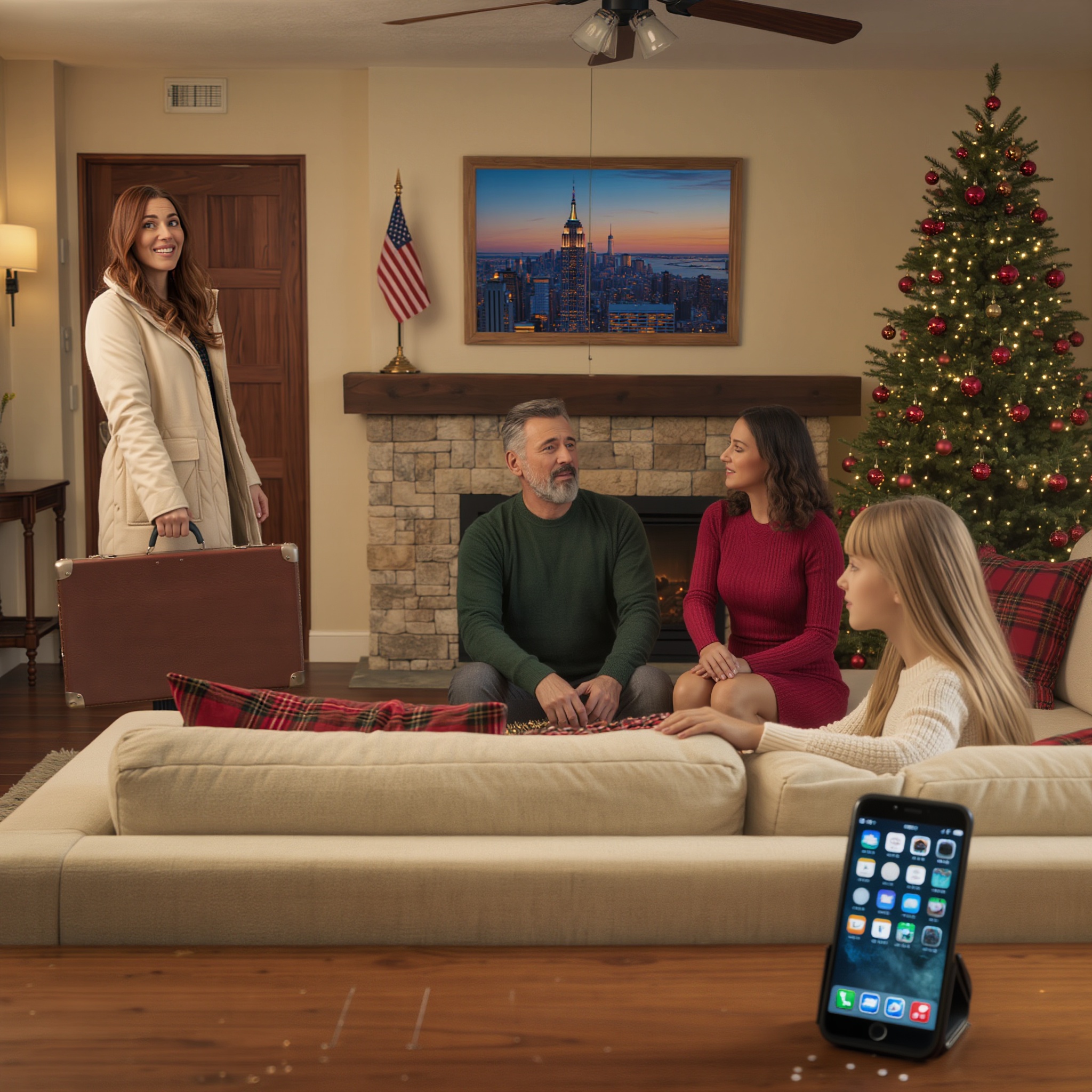
I walked through the front door and the entire house went silent—not the warm, cozy kind of silence you expect on Christmas Eve in a small American town, but the heavy, choking kind that feels like a warning.
My parents froze on the sofa. My younger sister, Jenna, sat between them like some crowned princess waiting for a spotlight. Their eyes weren’t on me; they were on each other, trading quick, anxious glances like they were hiding something.
My father finally spoke, his voice low and rehearsed.
“We need to talk.”
My mother added with a mocking breath, “Your time is over, Marissa. Your sister can provide this family a better life now.”
I just stood there, my suitcase still in my hand, the Colorado cold still clinging to my coat. The next day, I’d wake up to over a hundred missed calls. But in that moment, staring at the three people who were supposed to love me most, I felt the ground shift in a way I had never felt in my thirty years.
Something was deeply, horribly wrong.
I set my suitcase down slowly, my fingers tightening around the handle as if letting go would make everything worse. The house smelled like cinnamon and pine—my mother’s signature Christmas scent—but it felt nothing like home.
The tree glittered in the corner, wrapped in gold ribbons, but I wasn’t fooled. The warmth was a lie. The decorations were a disguise.
My father sat forward, elbows on his knees, studying me like I was a stranger. My mother pretended to fix a crease in her skirt, avoiding my eyes entirely.
Jenna didn’t bother pretending. She looked straight at me with a smile so small and smug it felt like a slap. Her glossy hair was perfectly curled, cascading over a cashmere sweater I definitely didn’t remember buying her last year.
She crossed her legs slowly, deliberately, as if positioning herself to receive praise.
This wasn’t normal. This wasn’t family.
This felt like an ambush.
“What’s going on?” I finally asked, forcing my voice to stay steady.
“Sit,” my father said, motioning toward the armchair across from him.
But I didn’t move. Not yet. I needed a second to breathe, to understand why every muscle in my body was tensing with a sense of danger.
My mother let out a dramatic sigh, as if my hesitation was ruining her evening.
“Marissa, don’t make this difficult. It’s Christmas.”
As if that word still meant anything here.
I stepped closer, taking in every detail. The fireplace was lit too high, flames leaping as if they were part of the performance. Stockings hung neatly across the mantle—except mine.
My stocking—the one I’d embroidered with my name when I was ten—wasn’t there at all. Instead, a new monogrammed stocking with Jenna’s initials hung in the center, like she was the star of the Hale family’s grand production.
“Where’s my stocking?” I asked quietly.
My mother blinked. “Oh, that old thing? It didn’t match the new décor. We’re trying something fresh this year.”
Fresh.
As if erasing me from the wall was some kind of interior design choice.
My father cleared his throat. “Marissa, this is serious. Things have changed, and we need to be honest about the direction of this family.”
Direction.
He said it like he was running a corporation, not a house in a quiet Midwestern-style suburb tucked at the base of Black Feather Mountain.
I glanced at Jenna again. She didn’t look nervous. She didn’t look confused.
She looked pleased. As if this entire moment existed for her benefit.
“What direction?” I asked. “Because the last time I checked, we were celebrating Christmas, not holding a board meeting.”
Jenna gave a soft laugh under her breath.
“Maybe if you visited more, you’d know what’s going on.”
The tone wasn’t playful. It was a reprimand. A jab.
She was enjoying this.
My jaw tightened. “I visit every Christmas. Every Thanksgiving. Every birthday. I flew home from Denver at least four times this year to help you when you said you needed me. I rearranged work schedules, missed events, postponed dates, bent over backwards to be present.”
I looked at her sharply.
“And now you’re lecturing me about showing up?”
Jenna rolled her eyes.
“You live states away, Riss. Some of us are actually here.”
She still lived twenty minutes away and rarely lifted a finger unless there was something in it for her.
My father leaned back, lacing his fingers together.
“We’ve made some decisions about the business, about the family estate, about roles and responsibilities moving forward.”
My pulse thudded in my ears.
“What decisions?”
My mother straightened, her voice taking on that familiar condescending tone I’d heard since childhood.
“It’s not personal, dear. It’s practical. You’ve always been independent. You don’t rely on us the way Jenna does.”
Jenna blinked innocently.
“I just want to help. This family needs someone who’s actually available.”
My throat tightened.
Available.
The word stung.
I had built my life from scratch. Fought through setbacks. Worked eighty-hour weeks in Denver to make something for myself. But somehow, being self-sufficient had become a flaw—something they could hold against me.
“What exactly are you saying?” I asked.
My father sighed dramatically.
“You’re not the one who’s going to take this family into the future.” He gestured to Jenna. “She is. She’s stepping up. She’s taking responsibility. She’s already been helping us with things—real things that matter.”
I looked at Jenna. She lifted her chin proudly, eyes sparkling with something far too triumphant to be mistaken for humility.
“You’re replacing me,” I whispered.
“We’re not replacing anyone,” my mother lied smoothly. “We’re reorganizing. For the good of the family.”
My stomach twisted.
I’d heard those same sugar-coated phrases my entire childhood.
Don’t make this about you. We’re doing what’s best for everyone. Be the mature one, Marissa.
It was always the same message: sacrifice yourself for Jenna’s comfort.
My father continued, “There’s paperwork we need to go over tomorrow morning. Early. Before the bank closes.”
Paperwork.
Bank.
Tomorrow.
Something icy slid down my spine.
“What paperwork?” I asked, each word slow and cautious.
Jenna reached for a red envelope on the coffee table—thick, sealed, formal. The kind used for wills, contracts, legal documents. I didn’t breathe as she handed it to me.
“It explains everything,” she said sweetly. “You’ll understand when you read it.”
I didn’t take it. I couldn’t. My hands refused to move.
My mother crossed her legs and folded her hands over her knee.
“This isn’t something you need to overthink. Just trust us. Tomorrow morning, we’ll all sit down and make it official. Christmas is about unity, after all.”
Unity.
My stocking gone. My seat replaced. My name disappearing from every corner of the house.
What they were calling unity felt a lot like exile.
“And if I don’t agree?” I asked.
My father’s face hardened.
“Don’t make this harder than it needs to be.”
Jenna tilted her head.
“Resistance won’t change anything. It’ll just complicate things.”
For a moment, it felt like the room shrank, as if the walls themselves were leaning in, listening. I felt like I was standing on the edge of something enormous, something I wasn’t prepared for.
But even then—even in that moment of dread—I felt something else stir inside me.
Something sharp.
Something awake.
“I’m tired,” I said finally. “It was a long flight. We can talk in the morning.”
My mother waved her hand dismissively.
“Fine. Go rest. It’ll be easier to process all this when you’re calm.”
As I picked up my suitcase and walked toward my old bedroom, I felt their eyes burning into my back. Jenna’s whisper followed me down the hallway.
“Tomorrow changes everything.”
I didn’t look back.
I closed the bedroom door behind me and pressed my forehead against the wood, my pulse racing.
Tomorrow morning, they said. Tomorrow morning they would try to take something from me.
But they should have remembered one thing.
I don’t break as easily as they think.
I barely slept.
Every time I closed my eyes, I saw that red envelope on the coffee table, thick and heavy like a threat wrapped in holiday paper.
The whole house was quiet, but not peacefully so. It was the silence of people who didn’t want to be overheard.
Around three in the morning, I finally gave up trying to rest. I sat on the edge of the unfamiliar bed, staring at the shadows stretching across the walls of the room I grew up in.
Except it didn’t look like my room anymore.
Half the furniture was new—white, glossy, feminine—nothing like the heavy oak pieces I’d chosen in high school with money from my first part-time job at a local diner.
The walls, once filled with my old artwork and photos—me at high school graduation, me at my first apartment, me and my college friends on a road trip along the Pacific Coast Highway—were bare. Except for one framed picture of Jenna and my parents at some local charity gala. I wasn’t in it.
I wasn’t in the room at all, really.
It felt like a staged guest space, like they were erasing me one wall at a time.
When I finally stepped into the hallway, the floorboards groaned softly under my feet. I froze.
Downstairs, faint voices floated upward. Whispered. Urgent.
My name hissed through the air.
I moved quietly, careful not to announce myself, every step slow and deliberate until I reached the landing.
The living room was faintly lit by the glow of the Christmas tree, twinkling like it was mocking me. Beneath the lights, I caught the silhouettes of my parents and Jenna. They weren’t laughing or celebrating or talking about Christmas morning.
They were huddled together like conspirators.
“I’m telling you, we can’t delay this,” my father whispered harshly. “If she tries to leave before signing—”
“She won’t,” my mother whispered back. “She’s always been so agreeable when she’s tired. She’ll go along with it. She knows what’s expected. She’s not stupid.”
“Mom,” Jenna muttered, “she saw the envelope. What if she puts the pieces together?”
My mother exhaled sharply.
“Jenna, don’t start panicking now. Everything is prepared. The bank approved the paperwork. The notary did what we needed. She’ll sign it in the morning.”
Sign what?
My fingers curled into fists.
The air felt thick, like the house itself didn’t want me hearing any more.
“We need unity tomorrow,” my father said. “We need her quiet. Calm. Compliant. If she pushes back at all—”
“She won’t,” my mother insisted. “She’s always been the strong one. Jenna’s the delicate one. She’ll do what’s best for her sister.”
The words hit me like a familiar bruise.
I stepped back silently, trembling with a mixture of fury and disbelief. The betrayal wasn’t sudden.
It had just finally matured.
Back in my room, I shut the door slowly and leaned against it hard enough that my spine ached. My heart thudded violently.
I felt fourteen again—ignored, made responsible, always told to sacrifice for the good of the family while Jenna was praised for breathing.
I rubbed my hands over my face, forcing myself to stay grounded.
My room was dimly lit by the single lamp on the dresser.
That’s when I noticed something I had completely missed earlier—a faint smear of red glitter on the edge of my pillowcase.
Glitter from the red envelope Jenna had been handling.
She’d been in my room before I got home.
My pulse quickened.
I scanned the room more carefully. My backpack sat on the chair, but it was unzipped several inches. I hadn’t left it that way.
I knelt down and checked the contents. Some of my documents had clearly been moved—not stolen, just handled, inspected.
And then I saw it: a tiny torn corner of paper underneath the chair, almost invisible unless you were searching.
I pulled it out and unfolded what little remained of it. Only a few words were visible, typed in bold:
ESTATE RESTRUCTURING DRAFT.
My stomach twisted.
My family didn’t own some massive empire, but they did own a chain of hardware stores—Hale Home & Hardware—passed down from my grandparents. My father always said someday it would belong to me and Jenna equally.
But I suddenly understood.
They weren’t dividing anything equally.
They were dividing me out.
I was still staring at the scrap when the doorknob clicked.
I jerked upright just as Jenna poked her head inside without knocking.
“Riss,” she said, her voice honeyed and fake, “you’re awake.”
I straightened my shoulders. “You were listening,” she added lightly, like it was nothing. “It’s rude to eavesdrop.”
“I wasn’t,” I replied. “I was getting water.”
Her smile didn’t waver.
“Well, you really shouldn’t worry so much. Mom and Dad told you everything will make sense tomorrow.”
The way she said tomorrow made my skin crawl.
“What exactly is supposed to make sense?” I asked.
She shrugged, sauntering further into the room uninvited.
“You’re so dramatic. It’s only paperwork. Adult stuff.”
Her gaze flicked to the backpack. To the chair. Too quickly. Too knowingly.
I swallowed hard.
“You’ve been in here.”
Jenna blinked innocently.
“What? Why would I go through your things?”
“You tell me,” I said.
She tilted her head, still smiling, but the smile didn’t reach her eyes.
“Marissa, you’ve always been the wanderer. The one who left. The one who built her own life somewhere else. Mom and Dad need stability. They’re getting older.”
I stared at her.
“And you think you’re stability?”
Her smile widened.
“I’m the one who stayed.”
There it was. The line she’d been practicing for years.
She moved toward the door but paused.
“Look, don’t make tomorrow harder than it needs to be. Everything is already set. Everyone knows.”
Everyone.
It hit me then—the neighbors, the extended family, people in town. There must have been whispers, plans, discussions happening behind my back for months.
She left the room, the door clicking softly behind her, but I couldn’t breathe.
I paced to the window, staring out at the snow-covered street. Christmas lights glimmered on the houses across from ours—typical American suburbia, inflatable snowmen and plastic reindeer glowing in the cold.
One of the neighbors, Mrs. Alden, carried a tray of cookies toward our sidewalk, bundled in a red puffer coat and a knitted hat with a tiny American flag pin on the brim.
Out of habit, I stepped outside to greet her.
She smiled warmly.
“Oh, Marissa, you’re home for Christmas. How lovely. Your parents must be thrilled.”
I forced a smile.
“Something like that.”
She lowered her voice.
“And congratulations to Jenna. Such a big responsibility she’s taking on. The whole neighborhood is buzzing about it.”
My heartbeat stumbled.
“Responsibility?” I asked. “What do you mean?”
Mrs. Alden blinked, realizing she’d revealed too much.
“Oh, I might have misheard. Forget I said anything. Enjoy your evening, dear.”
She hurried off, leaving me standing in the freezing air.
Back inside, I looked around with new eyes.
My stocking was gone. My pictures were missing. My room had been changed. The red envelope had been in my room. My parents were whispering in the night. The neighbor already knew something I didn’t.
This wasn’t about Christmas.
This was about removing me.
I walked slowly through the house again, noticing details I had overlooked earlier. The mantle had been rearranged. Jenna’s monogrammed stocking was centered. The gifts under the tree were nearly all addressed to her.
A small box with “Marissa” written on it was pushed behind the stand like an afterthought.
Then I saw it—
A gold gift tag sticking out from Jenna’s pile, the writing elegant and bold:
CONGRATULATIONS ON YOUR NEW ROLE.
My throat tightened. Everything inside me stilled.
Tomorrow morning, they weren’t just giving her something.
They were taking something from me.
As I headed back to my room, I heard footsteps outside the door. My parents’ voices, low and hurried.
“First thing tomorrow,” my father whispered. “Before she can leave the house.”
“She needs to sign it quietly,” my mother added. “It’s already notarized anyway.”
Notarized.
Signed before I can leave.
My breath caught. I stepped away from the door, my heart pounding so loudly it drowned out everything else.
They were going to corner me. Pressure me. Force me.
But as fear surged, something else rose to meet it.
Something harder.
Something colder.
If they thought I was just going to let them take everything, they were about to learn they never really knew me at all.
I woke to the sound of footsteps in the hall—soft, deliberate, too careful to be casual. The kind of footsteps people take when they’re approaching something they want to control.
Pale morning light leaked through the blinds, the sky outside still gray-blue with early winter.
My heart thudded in anticipation.
This was it.
Christmas morning.
The moment they’d been plotting.
The moment they expected me to sit quietly and let them dismantle my life.
I forced myself to move slowly, deliberately. I wasn’t going to let them see fear.
I washed my face, brushed my hair, and stared at myself in the mirror. I barely recognized the reflection—tired but alert, uncertain but sharper than last night. Something inside me had settled overnight, like the cold clarity of stepping onto frozen ground.
When I stepped into the hallway, the smell of bacon and cinnamon rolls filled the air—my mother’s annual Christmas breakfast. Normally, it would stir nostalgia: Macy’s Thanksgiving Day Parade reruns, football on TV, everybody in flannel pajamas from some Target Black Friday sale.
Today, it felt like camouflage.
Downstairs, the house was warm and glowing, the tree lights flickering like they were putting on a show. My parents stood near the dining table, Jenna hovering between them like a perfectly placed ornament.
They were already dressed—rich fabrics, camera-ready smiles. I was suddenly aware that they had been preparing long before I walked downstairs.
My father smiled, but it wasn’t real.
“Morning, sweetheart. Merry Christmas.”
“Merry Christmas,” I replied, my voice steady.
Jenna shot me a sugary smile.
“Did you sleep okay? Big day ahead.”
I didn’t answer.
My mother gestured to the table.
“Sit. Eat something first. We have things to discuss.”
The red envelope sat in the middle of the table like a centerpiece.
My father cleared his throat and reached for it.
“Let’s start, shall we? I think it’s best to handle important matters before celebrations.”
Important matters.
I took the seat farthest from them, choosing my distance with intention.
The red envelope slid across the table toward me.
“Open it,” my father said.
I didn’t.
“Why don’t you tell me what it is?” I asked.
My mother sighed.
“Marissa, darling, don’t make this dramatic. Just open it.”
Jenna leaned in, her excitement barely concealed.
“It’s not as bad as you think.”
My eyebrows lifted.
“So it is bad.”
Jenna’s smirk twitched.
My father’s jaw tightened.
“It is the future of this family. Something we all need to agree on.”
I let the silence stretch just long enough that they grew uncomfortable. Then I slowly opened the envelope.
Inside were several documents, clipped neatly. Legal formatting. Signatures. Notary stamps.
My name appeared on nearly every page.
My father began explaining, his voice calm and rehearsed.
“Your mother and I have decided it’s time to transition leadership of Hale Home & Hardware. Jenna has been working closely with us for months now, and she’s ready to assume a larger role.”
Assume a role.
The words were crafted carefully, like this was an opportunity for Jenna—not a removal of me.
I turned a page, my fingers trembling slightly.
The next paragraph hit me like a blow.
I was to voluntarily resign any future claim to the business, to the estate, to the family financial structure.
“Voluntarily?” I asked.
My mother folded her hands, giving me her signature pitying look.
“You’ve built your own life in Denver. You have your own career, your own independence. This business belongs to someone who is here. Someone committed.”
“Someone you can control,” I murmured.
Jenna bristled.
“I’m not controlling anything. I’m taking responsibility. Something you never wanted.”
I laughed quietly, bitterly.
“I didn’t want responsibility, Jenna? You haven’t had a job longer than six months.”
“Marissa,” my mother gasped. “Today is not the day to be unkind.”
“Funny,” I said softly, “that’s the same thing you said when Jenna crashed my first car and told everyone it was my fault.”
Jenna rolled her eyes.
“God, you’re so dramatic sometimes.”
My father’s voice hardened.
“Enough. This isn’t about the past. This is about moving forward. For the good of the family.”
“And if I don’t sign?” I asked.
My mother gave a sympathetic smile that was anything but.
“Let’s not be childish. You will.”
My chest tightened as I read further.
There it was, buried near the middle—a clause stating I would have no decision-making power, no right to contest future transfers, no access to the business accounts.
In exchange, they offered me a token gift—a small sum of money that barely covered a few months of rent in Denver.
Insulting.
Then something strange caught my eye.
A date.
The notary stamp was from two days ago.
They’d notarized documents requiring my signature before I was even home.
Meaning one thing:
They had forged my signature somewhere.
My breath hitched, but I kept my face calm.
Jenna interpreted my silence as capitulation.
“I know this seems sudden,” she said, “but it’s really not a big deal. You don’t even like the business stuff. And honestly, Riss, we just need someone who’s invested. Someone who cares.”
I looked up sharply.
“Someone who cares? Are you kidding me? I flew here every time you all needed something. I paid bills you didn’t tell me about. I helped when Dad was in the hospital. I flew home for every emergency.”
Jenna blinked innocently.
“And now you can finally rest.”
My father slid a pen toward me.
“Just sign. We’ve arranged everything.”
I stared at it for a moment. The room felt unreal—warm light, cinnamon rolls on the counter, snow falling softly outside. A perfect Christmas morning on the surface.
Underneath, a knife pressed to my throat.
I heard my mother’s voice in my head from the night before.
She’s always been the strong one. Jenna’s the delicate one. She’ll do what’s best for her sister.
I set the pen back down.
“No.”
The air snapped like a rubber band.
My father blinked. Jenna’s smile evaporated.
“What did you say?” my mother demanded.
“I said no,” I repeated calmly. “I’m not signing anything.”
My father’s voice grew cold.
“Marissa, don’t make this difficult. It’s already decided.”
“By who?” I asked. “Because it sure wasn’t me.”
Jenna’s composure cracked.
“You have no idea how much work I’ve put into this. Mom and Dad trust me. I deserve this.”
“You deserve something,” I murmured, “but it’s not this.”
My father slammed his hand on the table.
“We are your parents. You will respect our decision.”
I met his eyes.
“And I am your daughter. Not a pawn.”
The tension was thick enough to choke on.
My mother crossed her arms.
“Where will you go if you don’t sign?” she asked. “You’ll isolate yourself. Again.”
I inhaled slowly.
“Maybe. But I’d rather stand alone than be pushed aside in my own family.”
Silence.
Then my phone buzzed on the table—a single message.
Don’t sign anything. Please call me.
It was Jason, the quiet neighbor who used to help my dad at the store. I hadn’t spoken to him in years, but the urgency in the message was unmistakable.
Jenna snatched a breath.
“Who’s that?”
“No one you need to worry about,” I said.
My father pointed to the papers again.
“You have one chance to cooperate.”
“Or what?” I asked. “You’ll disown me? Stop speaking to me? Pretend I never existed?”
My mother stiffened.
“Don’t be cruel.”
I stood up slowly.
“Cruel? You removed my stocking. You took down my photos. You replaced my room. You plotted behind my back with people outside this house.”
My father opened his mouth to object, but I continued.
“And you asked a notary to validate documents before I even arrived. You were never waiting for my agreement. You were waiting for my weakness.”
Jenna’s face flushed.
“You’re overreacting. You always do.”
“No,” I said quietly. “For the first time, I’m reacting exactly right.”
I grabbed the red envelope and walked toward the stairs.
“Where are you going?” my father barked.
“To breathe.”
“Don’t walk away from us,” my mother said sharply.
I turned on the staircase, looking down at the three of them—the family who claimed to value unity while conspiring behind my back.
“You already walked away,” I said. “I’m just catching up.”
I went upstairs before they could say more.
My hands shook as I reached my room, but not from fear.
From clarity.
Jason’s message appeared again on my screen, the words like a rope thrown toward someone sinking.
I sat on the edge of the bed, opened his text, and typed:
I’m listening.
Whatever they planned for me, whatever they thought I would accept—they were wrong.
The future they imagined wasn’t mine.
And I wasn’t going to let them write me out of it.
I dialed Jason’s number with trembling fingers, still sitting on the edge of my childhood bed. The red envelope lay beside me like a loaded weapon.
My heart thudded in my throat as the call rang once, twice.
He answered immediately.
“Marissa.”
His voice was low and tense, like he’d been waiting by the phone.
“Are you alone?”
“Yes,” I whispered. “What’s going on? What did you mean by ‘Don’t sign anything’?”
A long breath crackled through the receiver.
“I can’t say much on the phone,” he said. “But you need to know your family is hiding things. Big things.”
My pulse quickened.
“What are you talking about?”
“Not over the phone,” he repeated, his voice firm. “Meet me at Ridgeview Coffee Shop in thirty minutes. Side booth. Don’t tell anyone you’re leaving.”
“Jason, please, just tell me—”
“Marissa,” he cut in, his voice sharpening with urgency. “Trust me. If you sign those papers, you lose everything.”
The call ended.
I stared at the phone screen, my breath shaking.
Jason wasn’t dramatic. He wasn’t the type to involve himself in anything messy. If he was warning me, it meant whatever my family was hiding was worse than I imagined.
I grabbed my coat, quietly slipped the envelope into my bag, and crept down the stairs. The house was silent again—an ominous, watchful silence.
I heard the clatter of dishes in the kitchen. They thought I was upstairs, reflecting, breaking, preparing to surrender.
I slipped out the back door unnoticed.
The winter air slapped my face with a blast of icy sharpness. Snow crunched under my boots as I made my way to my car in the driveway, where my Colorado plates looked almost foreign against the row of familiar local trucks and SUVs.
Every step felt heavier, like gravity itself was trying to hold me back.
But whoever my family thought I was—the obedient daughter, the reliable caretaker—they didn’t know me anymore.
Not after this.
I drove through quiet streets still asleep under Christmas morning frost. The only movement came from the occasional pickup already dusted in snow, or the distant glow of a gas station sign.
Ridgeview Coffee Shop’s sign glowed dimly in the hazy dawn. It was one of those cozy, slightly worn American coffee shops with mismatched chairs, chalkboard menus, and a U.S. flag sticker in the window.
Inside, it was almost empty—just a few early risers and Jason, hunched in the corner booth, a hood pulled over his baseball cap.
He looked up when he saw me, his eyes shadowed by something dark—fear maybe, or regret.
“Sit,” he said.
I slid into the booth opposite him.
“Tell me everything.”
He rubbed a hand over his jaw.
“Okay. First, your dad isn’t being honest about the business.”
My stomach tightened.
“What do you mean?”
“I mean,” he said quietly, leaning closer, “they’ve been moving money. A lot of money. And not into the company. Not into legitimate accounts.”
“What?” I breathed. “Why would they—?”
“Because the business is failing,” he said. “Hale Home & Hardware is drowning. Your dad’s made bad deals, bad loans, wrong partnerships. And instead of fixing them, he’s hiding them.”
My chest hollowed out.
“That can’t be right,” I whispered. “Dad never told me—”
“Of course he didn’t tell you,” Jason said. “Telling you would mean admitting he needs you. And that doesn’t fit the narrative they’ve created.”
“Narrative?” I asked.
“That Jenna’s the savior,” Jason said. “The chosen one. The future of the family.”
I flinched.
He continued.
“I’ve been doing inventory for the business for months. Things weren’t adding up. Missing shipments. Payments going to shell companies. Contractors not getting paid. Your dad blamed system errors, but it wasn’t errors. He was diverting funds.”
I stared at him, struggling to breathe.
“Diverting them where?”
Jason reached into his jacket and pulled out a folded paper—the piece of evidence he’d hinted at.
He slid it across the table.
“This,” he said, “is one of the transfers. Fifteen thousand dollars, sent to an LLC under Jenna’s name two months ago.”
Cold spread through my veins.
“Why would he send business funds to Jenna?”
“Because,” Jason said carefully, “they’ve been preparing for months to take the business out from under you. And they’re funding her to do it.”
A tremor shot through my hands.
“And that restructuring document?” he said. “It’s not a restructuring. It’s a transfer. A full transfer of ownership. They want you to sign away your rights because if it goes bankrupt after they take it, you won’t be able to fight back.”
I felt sick.
Jason continued.
“There’s more. Someone forged your signature on vendor approvals, on bank forms, on supply purchases.” He pointed at the paper in my hands. “That’s why I texted you. Once you sign their documents, everything becomes legal. You’ll have no claim, no voice, no protection.”
I swallowed hard.
“I can’t believe they’d go this far.”
“Your dad is desperate,” Jason said. “And Jenna—she’s hungry. She wants to be the center of everything. And your mom? She’ll justify anything if it keeps peace in her version of the family.”
I slumped back in the booth, the weight of his words sinking deep.
My family wasn’t just trying to exclude me.
They were trying to erase me.
Jason hesitated, then leaned in further.
“There’s something else.”
My heart stuttered.
“What now?”
He lowered his voice.
“Your mother has been telling people you’re unstable.”
The air left my lungs.
“What?”
“Not you know… not outright,” he said. “But hinting. Suggesting Denver’s been rough on you. Saying you’ve been emotionally distant and overwhelmed with stress. Stuff that makes people think you’re not in the right state of mind to make decisions.”
My chest tightened.
“Why would she do that? Why would she tell people that?”
“Because if you refuse to sign anything,” Jason said, “they want an argument to invalidate you—legally or socially.”
Tears pressed behind my eyes, but I didn’t let them fall. I wasn’t going to cry in a coffee shop booth on Christmas morning.
“They really want me out,” I whispered.
“They do,” Jason said softly. “And if you hadn’t refused yesterday—if you hadn’t questioned them—they would have taken everything and left you with nothing.”
Silence stretched between us like a chasm.
Finally, I found my voice.
“What do I do now?”
Jason looked at me with a mix of sympathy and determination I hadn’t seen in years.
“You fight,” he said. “Starting today.”
“How?” My voice cracked. “It’s three of them and just one of me.”
“No,” he said firmly. “Not just you.”
He reached into his jacket again and pulled out a small flash drive.
“There’s a man who can help you,” he said. “He knows the business world better than your father. He’s seen corruption before. He’s been tracking irregularities with the Hales for months.”
“Who?” I whispered.
Jason hesitated, then spoke the name like it carried weight.
“Owen Whitlock.”
I blinked.
“Owen Whitlock? As in—”
“Yes,” Jason said. “That Owen Whitlock. The most respected, most formidable businessman in the region. A man with billions in holdings. A man your father despises for reasons no one fully understands. A man who apparently knows something about your family.”
He continued.
“He told me that if you ever felt cornered, he’d help you. He gave me this for you. Said you’d know when the time was right to use it.”
I stared at the flash drive—small and unassuming, yet powerful enough to burn my entire world down.
Jason pushed it toward me.
“I know you feel alone,” he said. “But you’re not. Not anymore.”
Outside, snow drifted softly against the windows, covering the town in a white, deceptive peace.
Inside me, something was beginning to stir.
Not fear.
Not confusion.
Something sharper.
Something colder.
Something awake.
I placed my hand over the flash drive.
“Jason,” I whispered, “tell me how to reach Owen Whitlock.”
His relief was palpable.
“I’ll text you his office line. But be ready—he doesn’t sugarcoat.”
I nodded slowly.
“Good,” I said. “I’ve had enough sugarcoating to last a lifetime.”
When I stepped out into the cold again, the sky had brightened just slightly—a hint of sunlight pushing through the clouds.
I pulled my coat tighter around me and breathed in the freezing morning air.
My family thought this Christmas would be the end of me.
But they were wrong.
It was the beginning.
The number Jason sent me looked too clean, too polished to be real—just ten digits on my screen, no name attached. But something in my chest told me to trust it.
I stood in the corner of the coffee shop parking lot, my breath fogging in the icy air, my thumb hovering above the call button.
If I pressed it, everything would change.
If I didn’t, everything would still change—just not in my favor.
So I hit call.
The line rang twice before a woman answered, crisp and professional.
“Whitlock Industries, executive office.”
My voice shook despite my best efforts.
“Hi, um… this is Marissa Hale. I—I need to speak with Mr. Whitlock.”
A pause. Not long, but long enough for my heart to jump.
“Please hold.”
The line clicked, then silence.
I could hear my own breathing—too loud, too uneven. I tried to steady myself, but before I could, a deep, steady voice came through.
“Miss Hale.”
It wasn’t a question.
It was recognition.
I swallowed hard.
“Mr. Whitlock, I—I’m sorry for calling on Christmas. I just—”
“I’ve been expecting your call,” he said.
My pulse stuttered.
“Expecting?”
“Yes. Jason warned me last night you were in trouble.”
His tone stayed calm, sharp, analytical.
“So tell me, Marissa—what did your father do this time?”
I froze.
Not if he did something.
What he did this time.
I stood straighter.
“He tried to force me to sign away my rights to the family business and the estate. “He tried to force me to sign away my rights to the family business and the estate,” I said. “There’s a ‘restructuring’ document—actually, it’s more like a transfer.”
“Of course it is,” Owen said. “Keep going.”
Words spilled out of me like water breaking through a dam—everything from the forged notary date to the late-night whispering, the red envelope, the neighbor’s comment, Jason’s warning about missing funds and Jenna’s mysterious LLC.
Owen didn’t interrupt. Didn’t gasp. Didn’t question.
When I finally finished, breathless and shaking, he spoke with chilling clarity.
“They’re preparing to liquidate.”
“Liquidate?” I echoed. The word stabbed straight into my gut. “What does that mean?”
“It means,” he replied, “your father intends to sell everything he can before bankruptcy exposes him.”
My knees weakened. I leaned against my car, one hand pressed against the cold metal.
“I didn’t know the business was failing,” I whispered.
“He didn’t want you to know,” Owen said. “You’re not designed to be the scapegoat. But Jenna is. She’ll sign anything he puts in front of her.”
“I think they forged my signature already,” I said softly.
“I know they did.”
My heart froze.
“How?”
“Because,” he said, “I’ve been watching them.”
I blinked at the snow-covered asphalt.
“Watching them? Why?”
“Because your father has been lying to investors,” Owen said. “He tried to push a false valuation past my office two months ago, and I don’t take kindly to attempts at manipulation.”
I swallowed.
“So why help me?”
“Because you’re not your father,” Owen replied simply. “You never have been.”
A long pause stretched between us. For a moment, I wondered how much he actually knew about me—about my family, about my life in Denver.
“What do I do now?” I finally asked. “They’re going to ambush me when I get back.”
“You meet me,” Owen said. “Now.”
My pulse jumped.
“Meet you where?”
“I’m sending you an address,” he said. “It’s one of my workshops on the north edge of town. A private one—no staff, no cameras.”
Workshops.
Not offices.
What kind of billionaire preferred workshops?
A message pinged on my phone—coordinates, and a time.
“Come alone,” he said. “Bring every document you have.”
“I don’t have much,” I admitted.
“You have enough,” he said. “And whatever’s missing, I can find.”
And then the line clicked.
The sudden silence felt like a cold gust of wind slamming into my chest. But beneath the fear was something else.
Purpose.
Owen wasn’t surprised by any of this. He wasn’t hesitant. He wasn’t skeptical.
He believed me immediately.
And he was prepared.
I slid into my car and turned the heat on full blast, gripping the steering wheel until my knuckles whitened.
The drive to the outskirts of town was slow and eerie. The streets were nearly empty, Christmas lights blinking through falling snow. The whole world looked peaceful, despite the storm brewing in my life.
Owen’s workshop appeared at the end of a long gravel path, warm light glowing through wide industrial windows. Sawdust-scented air poured out when I opened the door.
Inside stood Owen Whitlock.
He wasn’t anything like I expected.
No tailored suit. No billionaire theatrics. No polished arrogance.
He wore worn jeans, a dark Henley shirt, and work boots dusted with sawdust. A half-sanded wooden table sat behind him. His hands were rough, like he actually worked with them.
He looked up, eyes sharp and assessing. Gray streaked his dark hair, and there was a quiet strength in the way he carried himself.
“Miss Hale,” he said. “Come in.”
I stepped forward hesitantly.
“Thank you for meeting me.”
He waved off the gratitude.
“Sit.”
I took a seat on a wooden stool near the workbench. Owen stood opposite me, studying my face like he was reading something written between my expressions.
“You look like you haven’t slept,” he said.
“I haven’t,” I admitted.
“Good,” he said. “Fear wakes us up. Now it’s time to use it.”
A shiver ran through me—not from fear, but from the sudden understanding that this man was not someone people ignored.
“Tell me everything from the beginning,” he said.
I repeated every detail carefully, step by step—the illegitimate notarized documents, the missing stocking, the new room, the whispered conversations, the transfer paperwork, the neighbor’s comment, Jason’s evidence, the LLC, the feeling of being erased.
Owen listened without blinking.
When I finished, he picked up a manila file from the workbench and slid it in front of me.
“What’s this?” I asked.
“Confirmation,” he said.
Inside were documents—copies of vendor complaints, financial inconsistencies, late payments, and email exchanges between my father and someone named C. Ward, the same last name as a local contractor.
“What am I looking at?” I breathed.
“The reason your father wants you gone,” Owen said. “He hid the wrong things from the wrong people, and one of those people was me.”
I looked up sharply.
“Why did he hide things from you?”
Owen smiled without warmth.
“He wanted my money. He didn’t want my oversight.”
“He tried to get investment from you?” I asked.
“He tried,” Owen said. “But I don’t invest in lies. And your father has been lying for a long time.”
I sifted through the papers again. The numbers were a disaster—missing funds, redirected payments, balances that made no sense.
“Why didn’t he tell me?” I whispered.
Owen’s gaze softened just slightly.
“Because you would’ve asked the right questions.”
I looked away.
He continued.
“Your father is trying to offload liability before everything collapses. Giving the business to Jenna puts all responsibility on her.”
My head snapped up.
“On her?”
“Yes,” he said. “And if you sign their documents, you’re legally severed from the fallout.”
My stomach dropped.
“They want me gone so when everything burns down, I don’t have grounds to fight.”
“Exactly.”
I swallowed hard.
“What do I do?” I whispered.
Owen stepped closer, his presence commanding, grounded—someone who had built power, not inherited it.
“You let them think you’re broken,” he said. “You let them think you’re backing down.”
“I can’t do that,” I said, shaking my head.
“You can,” he corrected, “because you must.”
His voice was firm, certain—the kind of certainty I’d never seen in my father.
“Act defeated,” he said. “Pretend to sign. Ask for copies. Stay quiet. Cry if you have to.”
I blinked.
“Cry?”
“People underestimate crying women,” he said. “That’s how you slip the knife in.”
A startled laugh broke from me despite myself.
Owen didn’t smile, but his eyes warmed with understanding.
“You don’t have to destroy them today,” he said. “You only have to let them show their hand.”
“And then what?” I whispered.
“Then,” he said slowly, “I help you take everything back.”
The air between us shifted.
This wasn’t just help.
This was war.
“And Marissa,” he added, his voice quieter now, “when we’re done, they’ll wish they’d treated you like family.”
I stared at him, my heart pounding with something I hadn’t felt since this nightmare began.
Confidence.
Hope.
Strength.
“I’ll do it,” I said.
Owen nodded once.
“Good. Then let’s begin.”
When I pulled into the driveway that evening, the house looked almost peaceful. Snow drifted softly from the dark sky, blanketing the roof and lawn in a quiet white glow. Warm light shimmered through the windows, casting golden patterns across the snow.
It looked like a scene from a holiday postcard—beautiful, serene, harmless.
But I wasn’t fooled.
There was nothing peaceful about this house. Not anymore.
I sat in my car for a long moment, gripping the steering wheel and replaying Owen’s final words before I’d left his workshop.
Let them believe you’re defeated. Step into the role they want you to play. Then we build the trap.
I inhaled slowly, feeling the cold air from the vent sting my lungs.
Defeated.
Weak.
Broken.
I could play that.
I’d played it my whole life for them—just not intentionally.
This time, I’d use their expectations against them.
I stepped out of the car, my boots crunching on the icy driveway. My breath rose in pale clouds. Every footstep felt loud, echoing through the stillness of the neighborhood.
Before I reached the door, it swung open.
My mother stood there with a tight, polished smile plastered across her face.
“There you are,” she said. “We were wondering when you’d come back.”
Wondering, or monitoring.
I forced myself to shrink slightly, letting my shoulders slump.
“I just needed air,” I murmured.
Her smile softened—condescending, relieved.
She took the bait immediately.
“Of course you did, dear. This morning was overwhelming. We understand.”
No, they didn’t understand anything.
But they thought they did.
That was good.
I stepped inside, letting the warmth hit me. My father sat on the sofa, arms crossed, staring at me like I might bolt. Jenna perched at his side, wearing a silk blouse and smug satisfaction.
A small stack of Christmas gifts sat neatly arranged near her feet, all wrapped in gold paper.
Not one was mine.
“Sit, Marissa,” my father said.
I lowered myself into the armchair, deliberately avoiding eye contact. My fingers trembled slightly—just enough to look vulnerable, not enough to betray the anger simmering under my skin.
Jenna leaned forward.
“We need to finish what we started.”
I nodded slowly, eyes down.
“I know.”
They relaxed—all three of them.
I watched their guard melt away like snow under sunlight.
My mother clapped her hands lightly.
“Good. It’s better this way. We just need your signature, darling.”
My father produced a neatly organized stack of documents from a folder on the coffee table—the same documents from the red envelope, only now placed deliberately in front of me like a script.
He slid them closer.
“This is for you. Read through it carefully.”
I didn’t touch it.
“I… I’m not sure I understand everything,” I murmured. “Can you just explain it again?”
My father’s posture straightened, pleased to be the authority again.
“It’s simple. Jenna will be assuming control of the business. You’ll be stepping aside. You’ll still be part of the family, of course, but the operations and future decisions will fall under Jenna’s leadership.”
Jenna beamed.
My stomach twisted at the smugness.
My father continued.
“This gives you freedom to focus on your life in Denver. You’re so busy, always on the go. This makes things easier for everyone.”
My mother nodded.
“We want you to be happy, dear.”
Happy.
Erased.
Same thing to them.
I nodded slowly, letting my voice wobble.
“I… I just don’t want to lose you all.”
Jenna gave a rehearsed gasp.
“Oh my God, Marissa, you’re not losing anyone. Why would you even think that?”
Because you removed my stocking. Because you took down my photos. Because you forged my signature.
But I said none of that.
Instead, I whispered, “I just want what’s best.”
My father softened, then sighed.
“Sweetheart.”
I reached for the pen with a shaking hand. My fingers brushed it, then hesitated.
“Can I… can I ask something?” I looked up timidly.
My mother leaned in, concerned and condescending.
“Yes, of course.”
“Can I have copies of everything I’m signing?” I asked.
My father blinked.
“Copies?”
“Yes,” I whispered. “Just so I can look over them later. For my records.”
He hesitated—just for a second.
Then Jenna laughed lightly.
“Dad, it’s fine. She can have copies. It won’t change anything.” She waved her manicured hand. “Just give her a folder.”
He nodded.
“All right.”
My heart thudded.
That was Step One.
Owen’s Step One.
“Okay,” I said softly. “Then I’ll sign.”
They all relaxed again, visibly, like a weight had lifted off their shoulders.
My father leaned back. My mother sighed with relief. Jenna even reached for her phone, texting someone—probably Colton—telling him victory was near.
I picked up the pen and signed slowly, shakily, believably defeated.
I signed the decoy documents exactly as Owen had instructed—the subtle ink that would fade just enough to prove tampering later, the additional clause he’d embedded, disguised as boilerplate, that invalidated the entire agreement in the presence of fraud.
Once my father gathered the papers with unwavering confidence, he smiled—actually smiled.
“Well done,” he said.
Jenna exhaled dramatically.
“Thank God. I thought you were going to make this harder.”
I forced a weak smile.
“I’m just tired of fighting.”
My mother reached out and patted my hand.
“We knew you’d be the mature one.”
Jenna leaned back in her seat, triumphant.
“We can finally move forward. This is going to make the family so much stronger.”
Stronger.
For them.
They thought.
I kept my gaze lowered, hiding the cold fire building in my chest.
My father placed the signed documents into his folder.
“Tomorrow morning, we’ll finalize things at the bank.”
Tomorrow.
Exactly as Owen planned.
My mother perked up.
“Now that all of that is out of the way, we can finally enjoy Christmas.”
She reached behind the sofa and grabbed a tiny gift bag—lavender, no ribbon. Clearly an afterthought.
“This is for you, darling.”
I opened it.
A cheap candle. Unscented. Dollar-store quality.
It was almost laughable.
Jenna received a designer handbag, a gold bracelet, and a pair of luxury boots. My father gifted her a car key fob wrapped in a bow, and my mother hugged her like she was the only daughter she had.
I held my candle and offered a quiet, “Thank you.”
Jenna smiled at me sweetly—the victor granting mercy to the loser.
“This is good for you, Riss,” she said. “You can finally focus on your little Denver life.”
Little Denver life.
I stood, slipping the candle into my coat pocket.
“I’m going to go lie down. It’s been a long day.”
My father nodded approvingly.
“Rest. Tomorrow is important.”
I walked toward the stairs, the folder of copies tucked under my arm.
Just before I reached the top step, Jenna called softly.
“Marissa.”
I turned.
“Thanks for stepping aside,” she said, with a gentle, poisonous smile.
I returned the smile—equally soft and equally false.
“Of course.”
Her victory tasted sweet to her.
Mine would taste sweeter.
In my room, I locked the door and collapsed onto the bed, my heart pounding with the adrenaline of deception.
I pulled out my phone and typed a message.
Copy secured. Signed as planned. They think I’m broken.
Owen responded instantly.
Good. Get sleep if you can. Phase Two starts at dawn.
I placed the phone on the nightstand and stared at the ceiling, the faint glow of Christmas lights creeping under the door.
For the first time since stepping foot in this house, I smiled—not weakly, not painfully, but with certainty.
Tomorrow, everything would begin to unravel.
The sun had barely risen when my phone vibrated on the nightstand. The room was still dark, lit only by the faint glow of the Christmas tree lights seeping under the door.
My eyes felt gritty from lack of sleep, but adrenaline carried me as soon as I saw the message.
Downstairs in 10. Don’t let them stall you.
—Owen.
I sat up, my heartbeat steady and cold.
Today was the day everything shifted.
I grabbed the folder of copies I’d secured last night and slipped it into my bag. My hands were shaking—but not from fear.
From readiness.
From finally having something sharper than hope.
Strategy.
The house was unusually quiet for Christmas morning. No Christmas music, no smell of cinnamon rolls, no laughter. Just silence thick enough to cut.
When I stepped into the kitchen, Jenna was already there, holding a steaming mug of coffee like she was starring in her own holiday commercial. The TV on the wall played a muted morning show from some New York studio, anchors in ugly Christmas sweaters smiling too brightly.
She looked up at me, smiling far too sweetly.
“Morning, Riss. Did you sleep okay?”
“Fine,” I said.
Her brows lifted.
“Really? You look tired.”
So do venomous snakes, I thought.
Before I could respond, my father walked in holding a stack of files. He looked nervous. That alone sent a ripple of satisfaction through me.
“The bank’s expecting us at nine,” he said, glancing at me. “Let’s not make this more complicated than it needs to be.”
I forced myself to nod quietly.
“I’m ready.”
He relaxed visibly.
He thought he’d won.
They all did.
Only my mother looked slightly uneasy, like some small part of her sensed I shouldn’t be this calm. She touched my arm awkwardly.
“Marissa, dear, thank you for being reasonable. Families work best when we stick together.”
I stepped back.
“Is that what we’re doing?” I asked.
She frowned slightly, but didn’t answer.
We drove in silence. Snow fell gently, covering the streets in a white hush. My father drove like a man on a mission. Jenna sat in the front seat, adjusting her makeup in the visor mirror, even though she was already perfectly polished. My mother kept glancing at me in the rearview mirror, as if trying to gauge whether I would break again.
I gave them nothing. No fear. No anger.
Just quiet.
When we reached the bank, I stepped out and pulled my coat tighter around me. The crisp winter air bit my cheeks as we walked toward the glass doors. Everything inside me felt sharp.
Owen’s voice echoed in my mind.
Let them think you’re small. People lower their guard around someone they believe can’t fight.
The moment we stepped inside, a bank representative—a stiff man in a gray suit—approached us with a polite but strained smile.
“Mr. Hale,” he said. “This way.”
His eyes flicked to me briefly, then away, like he already knew more than he was allowed to reveal.
We followed him into a small conference room. My father set his folder down and exhaled dramatically, like this was the final stretch of a long burden.
“Let’s get this done,” he said, rolling up his sleeves.
“This is going to be such a relief for all of us,” Jenna said, smiling.
I said nothing.
The bank representative cleared his throat.
“Before we begin, there’s been an update this morning.”
My father stiffened.
“Update?”
“Yes,” the representative said carefully. “Some irregular activity was flagged overnight, and for legal reasons, we must freeze all accounts associated with Hale Home & Hardware until the investigation is complete.”
Jenna’s voice pitched upward.
“Freeze? What do you mean, freeze?”
“Just a temporary procedure,” the man said, but his tone was clearly uneasy. “We’ve discovered transfers that need verification.”
My father went pale.
“What transfers?”
The representative opened his laptop.
“Several payments to a private LLC under the name Jenna Hale,” he said.
The color drained from Jenna’s face.
“W-what? That must be a mistake. Dad—”
“And,” the man continued, “a set of notarized documents with inconsistent signatures. Some appear to be copies rather than originals.”
I swallowed a smirk.
My father’s jaw clenched.
“This is ridiculous,” he snapped. “Those documents were notarized legally.”
The representative looked uncomfortable.
“Yes, but we’ve been contacted by an external party requesting a fraud review.”
My heartbeat spiked.
Owen.
Right on cue.
“An external party?” my father demanded. “Who the hell—who is it?”
“Mister Owen Whitlock,” the representative said.
The room froze.
Jenna blinked rapidly.
“Whitlock? Why would he—?”
My father slammed his fist on the table.
“This is a personal attack. He has no right to interfere.”
“That’s not accurate,” the representative said. “Whitlock Industries submitted evidence that directly affects our compliance obligations. We have no choice but to halt all proceedings.”
I watched my father’s confidence crack, fracture, then crumble.
He turned to me sharply.
“What did you do?”
I met his eyes, calm and steady.
“Nothing you didn’t do first.”
My mother whispered, “Marissa, what is happening?”
Before I could answer, there was a knock—a firm, commanding knock.
The door opened.
Owen stepped inside.
He wasn’t dressed like a businessman today. More like a man who had no need to prove anything. Dark coat, boots dusted with snow, expression carved from stone.
My father shot to his feet.
“You have no right to be here.”
Owen simply looked at him, unfazed.
“Actually, I do,” he said. “When your fraudulent documents cross state lines, it becomes my business.”
Jenna flinched.
My mother’s hand flew to her mouth.
Owen stepped beside me—a quiet but unmistakable message of alliance.
The bank representative nearly bowed.
“Mister Whitlock, we were just reviewing—”
“No need,” Owen said. “We’re moving on to the next phase.”
My father barked, “This is a family matter.”
“No,” Owen replied calmly. “It’s a criminal one.”
He placed a folder on the table and slid it toward the representative.
“Full audit trail,” he said. “Bank statements. Vendor complaints. Forged signatures. All tied to the Hale accounts. And the notarized documents your family attempted to push through yesterday.” His eyes flicked to me. “Including the ones meant to strip your daughter of her rights.”
My parents froze.
Jenna’s lips trembled.
The representative opened the folder, his eyes widening with every page.
Owen continued.
“This meeting is over. No transfers. No restructuring. No signing away anyone’s inheritance.”
Then he looked at my father.
“You thought you could erase your daughter from her own legacy. You forged documents. You manipulated finances. You involved third parties. And you did it all under the assumption she was isolated.”
My father swallowed hard.
Owen stepped closer to him.
“But she wasn’t alone,” he said softly. “Not anymore.”
Jenna burst into tears.
“Dad, what do we do?”
My father didn’t answer.
He was staring at Owen like a man realizing the fire he’d started was now burning his entire house down.
I rose slowly from my chair.
“I gave you every chance to treat me fairly,” I said quietly. “Every chance to talk to me. To include me. To trust me.”
My voice didn’t shake—not anymore.
“But you wanted me gone so you could hide your mistakes. And you thought I’d let you.”
My mother reached out weakly.
“Marissa, please, we can fix this—”
But I stepped back.
“No,” I said. “You already chose your side.”
Then I walked toward the door.
Owen followed, pausing only to say one last thing to the room behind us.
“An injunction is already in motion. The audit begins in an hour. I’d suggest you hire counsel.”
The silence that followed us out was the loudest sound I’d ever heard.
Outside, the cold air hit my face like a cleansing slap. My lungs filled with something I hadn’t felt in days—oxygen, clarity, control.
Owen opened the passenger door of his truck for me.
“Ready?” he asked.
I looked back at the bank—the place where my family’s lies had finally cracked open.
“Yes,” I said. “Let’s finish what they started.”
Snow fell softly around us as we drove away.
Christmas had never felt colder.
Or more freeing.
I woke up the next morning before the sun had even reached over the ridge of Black Feather Mountain.
My alarm hadn’t gone off yet, but my body jolted awake like it had been waiting for the moment. My heart was still thudding with the echo of yesterday—my father’s panic, Jenna’s tears, my mother’s stunned silence, and Owen stepping into that meeting like a storm they never saw coming.
For a few seconds, I just stared at the ceiling of the small guest room I’d been staying in. The winter light filtered in pale and blue, brushing across the quilt my grandmother had sewn decades ago.
I pressed the heels of my palms against my eyes, trying to chase away the exhaustion that had woven itself deep into my bones.
But rest wasn’t an option.
Not today.
Not with everything Joel Hale had set in motion finally tearing down around him.
Today, the audit began.
I pushed myself out of bed, pulled on a thick sweater, and stepped into the hallway. The house was quiet except for the soft hum of the heater.
Somewhere downstairs, I heard the faint glug of a coffee machine finishing its brew.
Owen was already awake.
I paused at the top of the stairs, grounding myself before going down. I wasn’t prepared for gratitude—his or mine—and yet, the more this unfolded, the clearer it became that none of this would be happening without him.
When I reached the kitchen, he was leaning against the counter with a mug in hand, staring out the window at the snow-covered pines.
He didn’t look like the ruthless executive who’d shut down my father yesterday.
He looked like Owen—quiet, focused, steady.
He turned when he heard me.
“Morning.”
“Morning,” I said, reaching for a mug. My hands were steadier today.
“You slept a little,” he said.
“You?”
He shook his head.
“Not really.”
“Normal?” I asked.
“That’s normal,” he answered. “It’s a lot.”
I nodded, leaning against the counter across from him.
“Are you heading over to the office today?”
“Yeah,” he said. “The auditors are arriving at nine. I want to walk them through the packet we sent and make sure they don’t get stonewalled by your father. He’ll try.”
“He will fail,” I said.
“He will,” Owen agreed calmly.
I didn’t doubt him.
I wrapped my hands around my mug, letting the heat seep into my fingers.
“What about the police?” I asked quietly. “Timeline-wise?”
“The investigation will open officially once the auditors file their preliminary report,” he said. “But with what we found—with the forged documents, the fake transfers, the shell accounts…” He raised an eyebrow. “It won’t take long.”
A shiver rolled through me, and it wasn’t from the cold.
“My father isn’t going to take this quietly.”
“No,” Owen agreed softly. “But that’s not your burden anymore.”
I stared down at the swirling steam rising from my coffee.
He was right. But letting go of that burden—untangling myself from thirty years of habit—was harder than facing my father in that bank.
Owen must have sensed the shift in my expression, because he set his mug down and moved closer. Not touching, just close enough to steady the room around me.
“You don’t have to confront him again,” he said. “Not today. Not until you’re ready.”
“I know,” I exhaled. “But I also know he’s not done. He’s going to come after me. Not legally, but emotionally. He’ll reach out. He’ll twist everything. He’ll try to make me doubt myself.”
“And what will you do when he does?” Owen asked.
I swallowed.
“Not answer.”
Owen allowed the faintest hint of a smile.
“Good.”
We finished our coffee quietly, the weight of what was ahead pressing in, but not crushing me the way it used to.
When the clock hit eight, he grabbed his coat. Before he left, he paused in the doorway.
“Marissa?”
“Hmm?”
“You did everything right yesterday.”
I blinked, surprised by the sting in my chest.
“Thank you.”
Then he was gone, his footsteps crunching through the snow outside until the house fell silent again.
I paced for a long moment before forcing myself into motion. If today was the beginning of the collapse, I needed to be centered, grounded, ready.
I showered. Dressed. Tried to eat something.
Failed.
It was almost ten when my phone buzzed once, then again, then again. The notifications stacked like falling dominoes.
Dad.
Mom.
Mom.
Jenna.
Dad.
Jenna.
Dad.
Unknown number.
Unknown number.
Dad.
Mom.
My chest tightened, but I forced myself not to open any of the messages.
Not yet.
Instead, I grabbed my coat and stepped out onto the porch. The air was sharp with pine and cold enough to cut. I breathed deeply and let it burn through my lungs.
Then the door slammed open behind me.
“Marissa!”
I turned and froze.
It was my mother.
Her hair was half done, her makeup smudged from tears, and she wasn’t wearing a coat, even though snow drifted lazily from the sky.
She looked frantic, disoriented—like she had run straight from the car.
“What are you doing here?” I asked, my voice low.
She stepped toward me, gripping the porch railing for balance.
“I—I need to talk to you,” she said. Her voice cracked. “Sweetheart, please.”
That word used to undo me.
Today, it barely registered.
“What do you want?” I asked.
She pressed a trembling hand to her chest.
“Your father… the auditors froze everything. They’re saying he could lose the business, the house. We—he—he’s panicking, and he needs you to clear this up.”
A hollow laugh escaped me.
“Clear it up, Mom? He forged my signature. Signed away assets. Lied on financial forms. You expect me to fix that?”
Her eyes filled with tears.
“He thought he was doing the right thing,” she said. “He thought you didn’t want to help the family anymore.”
“No,” I said, my voice sharpening. “He thought I was easy to silence. He thought I was weak enough to let him.”
She flinched like I’d slapped her.
“Marissa, honey, please. This will ruin us. It will ruin him.”
“It will ruin him,” I corrected. “Not me.”
She wiped her face with the back of her hand.
“I know he made mistakes,” she said. “But he was scared. Scared of losing the only thing he ever built. Scared of you leaving.”
“He pushed me out,” I said. “Not the other way around.”
She shook her head helplessly.
“He’s not thinking clearly. And Jenna—poor Jenna—she’s falling apart.”
“Jenna helped him do this,” I said. “She didn’t understand,” my mother whispered.
“That’s the problem,” I snapped. “She never has.”
My mother stepped forward, tears streaming now.
“If you don’t help him, they will take everything—everything he spent his entire life building.”
I stared at her, then said the words I thought I’d never be brave enough to say.
“He didn’t build it alone.”
My mother froze.
“He built it on me—on my work, my sacrifices, my time. And when it no longer served him, he tried to bury me under it.”
She shook her head over and over.
“You’re blowing this out of proportion.”
“No,” I whispered. “I’m finally seeing it clearly.”
Her face twisted with desperation.
“If not for him,” she said, “then for me. Marissa, I’m your mother.”
“You stood beside him while he did it,” I said quietly. “Don’t ask me to save you now.”
Her breath caught. For a moment, there was nothing but snowfall and silence.
Then she whispered,
“He’s going to lose everything.”
“That’s what happens,” I said, “when you destroy the wrong daughter.”
She staggered back, like the words had physically struck her.
And then she said the thing she always said when she was out of arguments and out of empathy.
“You’re being cruel.”
I inhaled sharply.
“No,” I said. “Just finally fair.”
She covered her mouth with a shaking hand, then turned and hurried down the porch steps toward her car, slipping once on the ice.
She didn’t look back.
I watched her go until the red taillights disappeared through the trees. My knees felt weak—but for the first time in my life, not from guilt.
From release.
The burden wasn’t mine anymore.
I stayed outside a long time after she left, letting the cold settle around me, letting the world become quiet again.
Then my phone buzzed.
This time it was one message from Owen.
Audit underway. Brace yourself. This is the beginning.
I stared at the screen, then slipped the phone back into my pocket.
A new beginning.
For once, on my terms.
The first sign that things were unraveling faster than anyone expected came at noon, when my phone buzzed with a single message from Owen.
You should get down here.
Nothing else. No details. No explanation.
Which meant it was bad.
I grabbed my coat, locked the cabin door behind me, and drove down the mountain road toward the Hale offices. The sky was gray and heavy, threatening a storm that hadn’t yet broken. Pines blurred past my windows as the tires hissed over patches of half-frozen slush.
By the time I reached the town outskirts, my chest was tight, my pulse thudding in my throat.
Part of me still expected my father to find a way out of it.
He always did.
He always wriggled through loopholes, smoothed things over, spun lies into silk ribbons.
But something told me this time was different.
The parking lot was full—too full.
News vans lined the outer row, satellite dishes pointed at the winter sky like metal flowers. Local journalists stood behind tripods, rehearsing lines into microphones embroidered with station logos.
My stomach dropped.
This wasn’t just an audit anymore.
It was spectacle.
I parked near the back, pulled my hood up, and made my way toward the side entrance. Reporters didn’t know me by name or face. Not yet. And I wanted to keep it that way.
Inside, the lobby buzzed with frantic energy. Employees huddled in small groups, whispering anxiously. Some were crying. Others were pacing.
Phones rang nonstop at the front desk.
And sitting in the middle of the chaos, wearing a powdered pink coat with fur trim and mascara streaking down her cheeks, was my sister.
Jenna.
She spotted me instantly—of course she did—and practically leapt to her feet.
“Marissa, thank God,” she cried, rushing toward me. “You have to stop them. You have to tell them this is all a misunderstanding.”
I stared at her, stunned by the sheer audacity.
“A misunderstanding, Jenna? They’re here because the company is under investigation.”
A sob burst from her throat.
“Dad’s in his office, he’s losing it in there. They just told him his accounts are frozen and—and they’re grilling him like he’s some sort of criminal.”
“He forged documents,” I said coolly. “That’s a crime.”
Jenna’s jaw dropped.
“How can you say that? How can you even look at him that way? He’s your father.”
I pulled my hood down, meeting her gaze directly.
“He tried to erase me so you could take my place. That’s not being a father. That’s being a thief.”
Her expression hardened.
“This is all because of you,” she hissed. “If you hadn’t—”
“No,” I cut in. “This is because he got sloppy and you helped him.”
“I didn’t help,” she snapped, eyes wide. “I just did what he asked.”
“That is helping.”
She recoiled like I’d struck her.
Before she could recover, a door opened down the hallway and Owen stepped out, a grim look on his face. The investigators followed behind him, their expressions unreadable.
My pulse quickened.
He caught sight of me and motioned for me to come closer.
The moment I stepped toward him, Jenna latched onto my arm.
“No. No, you’re not going in there. You’re not talking to them about us.”
I peeled her fingers off.
Owen stepped between us, his voice like steel.
“She’s coming with me.”
Jenna’s face crumpled, and she sank back into a chair, sobbing loudly enough for the whole lobby to hear.
I ignored her.
Owen led me down the hall toward the conference room.
He glanced at me over his shoulder.
“Brace yourself. It’s getting ugly.”
“My mother?” I asked.
“She’s not here,” he said. “But she’s been calling nonstop. She tried to barge in on the auditors’ meeting earlier.”
I sighed.
“Of course she did.”
We reached the conference room. Through the glass wall, I could see three auditors around the table, stacks of documents in front of them. At the far end of the table sat my father.
Somehow, he looked smaller than I remembered.
His shoulders were slumped, his hair disheveled, his tie loosened, his eyes red from either anger or lack of sleep. Maybe both.
Owen opened the door. All eyes swung to us.
My father stood instantly, pointing at me with a shaking hand.
“You,” he spat. “You did this.”
I stepped inside calmly.
“No, Dad,” I said. “You did.”
One of the auditors, a woman with sharp glasses and sharper eyes, lifted a hand.
“Miss Hale, please sit. We need to clarify several items.”
My father’s voice cracked.
“You don’t need her. She doesn’t know anything about the business.”
The auditor didn’t flinch.
“On the contrary,” she said, “Miss Hale’s name appears on multiple documents supposedly signed by her. Given her claim that she did not sign them, she is now a relevant witness.”
My father’s pallor shifted from white to ash gray.
I sat.
Owen remained standing near the door, like a silent sentinel.
The lead auditor cleared his throat.
“Miss Hale, can you confirm whether this is your signature?”
He slid a document across the table.
It was a deed transfer from Hale Home & Hardware to a shell LLC.
Signed: Marissa Hale.
Joel Hale.
My jaw tightened.
“No,” I said. “It’s not mine.”
Another document.
A loan agreement.
Same signature.
Another.
Then another.
The more they pushed toward me, the more my father crumbled.
Finally, he snapped.
He slammed his fist onto the table.
“She told me I could sign for her,” he shouted. “She said it didn’t matter.”
I looked at him slowly.
“No,” I said. “I didn’t.”
“You weren’t around!” he shouted. “You left us. You abandoned this family, and I had to keep things running somehow.”
Owen’s jaw ticked.
The auditor raised an eyebrow.
“Miss Hale,” she said, “did you leave the business voluntarily?”
I met her eyes.
“I was pushed out,” I said.
My father barked a damaged laugh.
“You were emotional. Dramatic. You couldn’t handle the stress.”
“No,” I said quietly. “You replaced me with Jenna because she obeyed you. Because she never argued. Because she made you feel important.”
His eye twitched.
The auditor cleared her throat.
“Mister Hale,” she said, “your daughter’s testimony is consistent with the irregularities we’ve identified. Unless you can provide documentation confirming her consent, these actions constitute unauthorized transfers.”
My father sagged forward, gripping the back of his chair like he needed it to hold him upright.
“This isn’t happening,” he whispered.
The woman continued.
“Additionally, we have identified multiple personal expenditures written off as business expenses.”
“I’m sure there’s an explanation,” he muttered.
“There isn’t,” she said bluntly.
Silence fell—a soft, choking silence.
My father’s eyes lifted to mine.
For the first time, he didn’t look angry.
He looked terrified.
“Marissa,” he whispered. “Fix this.”
My throat tightened.
This was the moment he expected me to become his daughter again—the fixer, the peacekeeper, the quiet, obedient solution to every problem he created.
But that girl didn’t exist anymore.
“I can’t fix this,” I said softly. “And I wouldn’t, even if I could.”
He staggered back, like the ground had given way beneath him.
“Please,” he rasped. “Everything I built—”
“You didn’t build it alone,” I said. “And you don’t get to destroy the people who helped you.”
He pressed a shaking hand against his forehead.
“I didn’t mean for it to go this far.”
“But it did,” I whispered.
The auditors resumed their questions. My father answered in broken pieces.
I sat there, unmoving, as the entire foundation of my childhood collapsed under the weight of his own decisions.
After an hour, the auditors called a recess. They stepped out into the hallway, their voices low and clinical.
My father remained seated, staring blankly at the table.
I stood slowly. He didn’t look up.
I walked toward the door, pausing just long enough to say the last truth he needed to hear.
“I deserved better than what you gave me.”
He didn’t respond.
Outside, Owen closed the door behind us.
“How are you holding up?” he asked.
I exhaled shakily.
“I’m not sure.”
“Then this is your reminder,” he said softly. “He did this to himself. Not you.”
I nodded.
But deep down, I knew this wasn’t over.
The audit was only the beginning.
The real storm was still coming.
Snow was falling harder by the time I left the conference room, thick flakes collecting on the window sills and turning the parking lot into a white blur.
The building felt colder too, like the heat had slipped out through the cracks created by the audit. Conversations were hushed and tense—fragments of fear and confusion drifting through the air.
I walked with Owen toward an empty office so we could talk privately, but before we reached the door, someone stood abruptly from a bench in the hallway.
“Marissa.”
I froze.
It was Ethan.
He looked completely out of place in the chaos—expensive coat, perfect hair, that polished confidence he’d always carried like a second suit. But there was something new in his eyes.
Worry.
Hesitation.
Owen stiffened beside me, but I raised a hand slightly, signaling him to give me a moment.
Ethan stepped closer, lowering his voice.
“I came as soon as I heard,” he said. “I didn’t believe it at first.” His gaze flicked past me, toward the conference room where the auditors were still poring over documents. “Is it really that bad?”
I folded my arms.
“Worse,” I said.
He inhaled sharply.
“Your mother called me last night,” he said. “She said the investigators were targeting your father unfairly. That someone had set him up.”
I felt my jaw tighten.
Of course she did.
“She said you had something to do with it,” he added quietly.
Of course she did.
“I didn’t believe her,” Ethan said quickly. “Not after everything I know about you.”
A pang shot through me—unexpected and unwelcome.
Ethan had been a part of my life once, years ago, before he’d ended things because my family didn’t have the kind of pedigree his parents approved of. Before he’d chosen their expectations over whatever we’d had.
Right now, none of that mattered.
“Why are you here, Ethan?” I asked.
He swallowed.
“Because I realized I still care,” he said. “And because I thought you might need someone.”
“I don’t,” I said, sharper than I intended.
He flinched slightly but recovered.
“I’m not here to make this harder,” he said. “I just want to help.”
Owen stepped closer then, making his presence very clear.
“We’ve got it handled,” he said.
Ethan glanced at him, then back at me.
“Is that true?” he asked. “Are you really okay?”
“No,” I said honestly. “But I’m not falling apart either.”
He nodded slowly.
“If you need anything—anything at all—call me.”
I didn’t respond.
After a long moment, Ethan turned and walked away, his expensive shoes clicking against the tile floor until the sound faded.
Owen looked at me, one eyebrow raised.
“Friend?” he asked.
“Old mistake,” I said. “Let’s keep going.”
We slipped into the empty office. The lights were dim, the room smelling faintly of old paper and stale coffee. I sank into one of the chairs while Owen paced slowly, hands on his hips.
“The auditors are escalating,” he said. “They’ve already flagged a dozen major violations. But there’s something else.”
I straightened.
“What?”
He moved closer and lowered his voice.
“They found vendor invoices—fake ones,” he said. “Money routed through dummy businesses. And a few of those accounts…” His jaw clenched. “They lead directly to your mother.”
My breath caught painfully.
“What?”
He nodded.
“Transfers dating back at least six years. At first, small—five hundred here, a thousand there. But the last eighteen months…” He exhaled. “Tens of thousands. Consistently.”
I pressed a hand to my forehead.
The ground felt like it was tilting.
“So she… she wasn’t just enabling him,” I whispered. “She was benefiting. Actively.”
“Which means she’s a participant,” Owen said. “Not a bystander.”
I shook my head—not in denial, but in heartbreak.
“She never worked a day at the store,” I said. “She told everyone she didn’t want to meddle in the men’s responsibilities.”
Owen sat on the edge of the desk.
“Turns out she was meddling plenty.”
A bitter laugh escaped me.
“She always said she supported us through ‘emotional labor.’ I guess she meant something else.”
Before he could respond, my phone buzzed.
A call from Mom.
I turned it face down on the desk.
It buzzed again.
Then again.
Owen touched my arm gently.
“You don’t have to answer,” he said.
“I know,” I whispered. “I don’t want to.”
He studied me.
“But part of you does.”
The truth stung.
“She’s still my mother,” I said quietly. “Even if she’s… even if she chose him.”
He nodded slowly.
“And you’re still her daughter,” he said. “But that doesn’t mean you owe her protection from consequences.”
I leaned back in the chair, closing my eyes for a moment. When I opened them, tears threatened, but I refused to let them fall.
“I can’t fix this for her,” I whispered. “Not this time.”
“Good,” Owen said softly.
The door opened suddenly, and one of the auditors—the woman with sharp glasses—stepped inside.
“Miss Hale,” she said crisply. “We need a word.”
I rose immediately.
“Of course.”
She glanced at Owen.
“Mister Whitlock, you may stay if she permits.”
I nodded.
“He stays.”
She came closer, lowering her voice so only we could hear.
“We’ve completed our initial findings,” she said. “Your father is facing multiple counts of fraudulent transfers, tax evasion, and misuse of company funds.”
My chest tightened.
“We also have substantial evidence implicating your sister,” she continued. “Some transactions were conducted through accounts she controlled.”
I swallowed hard.
“And my mother?”
The auditor paused. Her eyes softened barely, but enough that I noticed.
“Your mother’s involvement is significant,” she said. “But we don’t yet know if she understood the extent of the fraud.”
I rubbed my forehead.
“Even if she did,” I said, “she’d never admit it.”
“She may not need to,” the auditor replied. “The evidence will speak for itself.”
A coldness settled deep inside me.
“Law enforcement will be notified by the end of the day,” she said. “If you wish to provide your statement voluntarily, it could help clarify your position and avoid complications.”
I nodded.
“I’ll cooperate fully.”
She gave a small, approving nod.
“We appreciate that.”
As soon as she left, I grabbed the edge of the desk, gripping it hard enough that my knuckles turned white.
Owen stepped behind me, his voice low.
“Breathe,” he said. “You’re okay.”
I shook my head.
“They’re going to be arrested,” I said. “All of them. My own family.”
“They did this,” he reminded me. “Not you.”
I looked up at him, tears finally spilling.
“But I opened the door for it to happen.”
“You opened the door,” he said softly, “because they locked you out of your own life.”
A sharp sob tore from my throat before I could stop it. I covered my mouth to quiet the sound.
Owen gently guided me into a chair.
“Let yourself feel it,” he said. “Just for a minute.”
I did.
Because guilt was a stubborn ghost—one that lived in the ribcage and clung to old instincts. It didn’t matter that I was right. It didn’t matter that they’d been cruel, manipulative, reckless.
It still hurt.
After a long moment, I wiped my face and straightened.
“This ends today,” I whispered.
“Yes,” Owen agreed. “It does.”
My phone buzzed again.
Another call.
Dad.
Then a text.
Answer the phone. Now.
Then another.
You need to fix what you started. They’re saying jail, Marissa. Jail.
Then another.
If you don’t help us, you’re done in this family.
I stared at the words.
They didn’t burn.
They didn’t wound.
They just clarified.
“I’m already done in this family,” I said quietly.
Owen took my phone gently and set it aside.
“You have a new one now,” he said.
“A new what?” I asked.
He looked at me with that same steady, unshakable certainty he’d walked into the bank with.
“A new family,” he said. “A chosen one. One that doesn’t take from you. One that isn’t threatened by your strength.”
My breath hitched.
Behind us, down the hall, voices were rising—my father’s bark, Jenna’s shrill panic, the auditors’ calm responses.
The storm was breaking.
And for the first time in my life, I wasn’t standing underneath it.
I was walking out of it.
The sheriff’s cruisers arrived just after sunset, their red and blue lights flashing across the frosted storefront windows like a silent alarm only I could feel in my bones.
The sky was a deep slate gray, heavy with the promise of more snow, and the cold was sharp enough to sting my lungs when I stepped outside.
Employees gathered near the entrance in thick coats, murmuring in fear and disbelief. The town was small. No one ever expected to see law enforcement swarm a local business—let alone the Hale family business, the one that had been held up as a pillar of community pride for decades.
Owen stood beside me, hands in the pockets of his coat, watchful and steady.
Behind us, the auditors were packing up their folders while detectives consulted with them quietly.
The moment felt suspended in time.
Then the sheriff’s door opened, and everything moved.
Sheriff Colton Ramirez stepped out, his expression grave. I’d known him since high school. He knew the Hale family well. He’d been to our barbecues, our holiday parties, our charity events.
But tonight, there was no familiarity in his eyes.
Only duty.
“Miss Hale,” he said gently, nodding to me. “Are you okay to proceed?”
I swallowed.
“Yes.”
He gave a curt nod, then gestured for his deputies to follow him inside.
Owen touched my arm lightly.
“You don’t have to watch,” he said.
“I do,” I said, surprising myself with the calm in my voice. “I want to see this through.”
He didn’t argue.
He just stayed next to me—silent support warming the cold edges of the moment.
Inside, the deputies moved with efficient precision. Voices echoed—firm, controlled, unmistakably authoritative.
Then came the first shout.
“No. Absolutely not. You can’t—get your hands off of me!”
My stomach tightened.
My father.
Seconds later, the conference room door burst open and two deputies stepped out, flanking him.
He was pale, sweating, his tie crooked, his hair disheveled. He looked nothing like the imposing man who had spent his life commanding every room he walked into.
He wasn’t a king anymore.
He was a cornered animal.
“Joel Hale,” Sheriff Ramirez announced, his voice carrying down the hallway. “You are under arrest for multiple counts of fraud, embezzlement, tax evasion, and forgery. You have the right to remain silent—”
“This is ridiculous!” my father barked, struggling against the cuffs. “I built this town! I paid for half its fundraisers! You think I just—”
“Joel,” Ramirez said firmly. “Don’t make this harder.”
My father looked around wildly, searching for a lifeline.
His eyes found me.
He froze.
And in that split second, everything he’d done in the last year flickered across his face—every forged signature, every manipulation, every attempt to erase me.
“Marissa,” he rasped. “Please don’t let them do this. They don’t understand. You can fix this. You’re the only one who—”
“I can’t,” I said quietly.
He shook his head like he couldn’t comprehend the answer.
“You’re my daughter.”
“Not when it mattered,” I said.
He stared at me, something inside him breaking open.
And then he was pulled toward the exit.
Jenna appeared next, escorted from the office with tears streaming down her face. She wore a bright red coat too thin for the weather, and mascara streaked down her cheeks like war paint melting.
“Marissa!” she cried, reaching for me as a deputy blocked her path. “Please. I didn’t know. I swear, I didn’t know.”
“Yes, you did,” I said softly. “You just didn’t care.”
She sobbed harder.
“Dad said you wouldn’t actually go through with this. He said you’d forgive us.”
Owen stepped forward then, his voice like steel.
“You don’t get to beg from the person you betrayed,” he said.
Jenna flinched as though struck.
“I’m sorry,” she wailed. “Please, Riss. Please.”
I closed my eyes for a moment, then opened them.
“I hope someday you learn what loyalty actually means,” I said.
The deputies guided her out to another cruiser.
The lobby slowly emptied until only a few remaining employees lingered in shocked silence. I could feel their eyes on me—some sympathetic, some confused, some wary.
And then—
“Marissa.”
I turned.
My mother stood near the doorway, wrapped in a thick shawl, her face streaked with tears. She looked older than she had just hours ago, smaller, like someone who had lost her map and didn’t know which direction to walk.
She hesitated, then approached slowly.
Owen stiffened slightly, but I gave him a small nod to let her through.
She stopped an arm’s length away.
For a long moment, she couldn’t speak. Her lips trembled, her hands twisted in her shawl, and her breath came out in uneven bursts.
“I don’t know what to say,” she whispered.
“You don’t have to say anything,” I replied.
But she shook her head.
“No. I—I need to. I thought I was doing the right thing. I thought he was protecting us. I thought you were just angry or ungrateful or…”
Her voice cracked.
“I was wrong,” she whispered. “So terribly wrong.”
My throat tightened, but I stayed silent.
“I loved him,” she said. “I trusted him. And I trusted your sister. I never imagined they could do something like this.”
“But when I told you they were hurting me,” I said evenly, “you didn’t listen.”
Tears spilled down her cheeks.
“I know,” she said. “And that’s my greatest regret.”
We stood there quietly, the chaos around us fading into background noise.
“Can you ever forgive me?” she finally asked, her voice breaking.
I exhaled—slow and heavy.
“I don’t know,” I said honestly. “Not tonight.”
She closed her eyes, nodding through her tears.
“I understand.”
She tried to reach for my hand, but I stepped back.
She froze.
“Mom,” I whispered. “You chose him. You always chose him—even when he was hurting me. Even when I begged you to see it. Forgiveness isn’t a switch I can flip. It’s going to take time. And right now, I need space.”
Her face crumpled in devastation, but she didn’t protest. She simply nodded again, turned slowly, and walked away—the sound of her quiet sobbing fading with each step.
The last patrol car pulled away, and silence settled over the parking lot like fresh snow.
I let out a long breath.
It was over.
Not the aftermath.
Not the healing.
Not the rebuilding.
But the part where I kept shrinking to protect people who would have gladly destroyed me.
That part was finished.
Owen stepped beside me.
“You did the right thing,” he said.
“I know,” I whispered. “It just doesn’t feel good.”
“Doing the right thing rarely does,” he said. “But it will.”
We stood there together, watching the snow swallow the tire tracks of the departing cruisers. For the first time in months—maybe years—I felt something unfamiliar.
Not joy.
Not triumph.
Something quieter.
Something steadier.
Freedom.
And beneath it, the first warmth of something new beginning, even as winter pressed close around us.
“Come on,” Owen said gently, opening his truck door. “Let’s go home.”
I climbed in beside him, the night closing softly behind us as he drove us away from the ruins of everything I used to believe in—and toward whatever came next.
Snow melted slowly as February crept into Colorado, the days stretching a little longer, the light returning in soft increments.
Winter wasn’t gone—not yet—but it had loosened its grip on the world.
And on me.
I didn’t realize how much I’d changed until the morning I walked into the new office for the first time—the one I’d chosen, the one I’d built with my own two hands, not inherited from a man who believed ownership meant domination.
My name was on the frosted glass door now.
MARISSA HALE CONSULTING
Real Estate Strategy & Development.
It wasn’t a legacy built on theft or fear or manipulation.
It was mine.
Owen was already inside when I arrived, finalizing the last of the computer setups. He glanced up when the door clicked behind me, his smile warming the space more effectively than the heater humming by the vent.
“You’re early,” he said.
“So are you,” I replied.
“I had a feeling you’d want a moment to yourself before the contractors arrive,” he said.
He wasn’t wrong.
I walked deeper into the office, running my fingers over the new desks, the blank whiteboards, the architectural plans pinned neatly to the walls.
No ghosts lived here.
No shadows of decisions made in my absence.
No weight of secrets piled in corners.
Just possibility.
I stood at the window overlooking downtown Denver—high enough to see the city stretch toward the mountains, low enough to still hear faint hints of life below. Cars passed. People walked dogs. Someone carried a cardboard tray of coffees from a Starbucks on the corner.
For years, I couldn’t imagine a life past the limits of my family’s expectations.
Now the horizon felt wider than I knew what to do with.
“Ready for today?” Owen asked, stepping beside me.
I nodded.
“More than I expected.”
He studied me with an expression so soft it startled me.
“You’ve come a long way,” he said.
“So have you,” I teased lightly.
He chuckled.
“Maybe. But I didn’t walk into a storm that would’ve knocked most people flat.”
“Not most people,” I said. “Just the person I used to be.”
He didn’t correct me.
He didn’t tell me I was strong or brave.
He didn’t need to.
The air between us held everything already said.
A knock broke the silence—a timid one.
I turned, and my breath caught when I saw who stood in the doorway.
“Hi,” said Jenna softly.
Her hair was tied back in a low ponytail, her makeup barely there. There were dark circles beneath her eyes, and she held her purse with both hands like it was a fragile object.
Owen glanced at me.
I nodded for him to give us space, and he slipped out quietly.
Jenna stepped inside slowly, like the floor might disappear beneath her.
“I wasn’t sure you’d want to see me,” she said.
“I wasn’t sure either,” I admitted.
She winced, but didn’t turn away.
“I’m taking a plea deal,” she said, her voice barely above a whisper. “Three years probation. Community service. Financial restitution. I… I got off easier than Dad.”
My chest tightened.
“How is he?” I asked, before I could stop myself.
Jenna swallowed.
“Not good,” she said. “Mom visits every week. I haven’t been yet.”
I nodded slowly.
She twisted her purse strap.
“I know forgiveness isn’t something I can ask for,” she said. “I know I don’t deserve it. But I didn’t come here to ask for that.”
“Then why are you here?” I asked quietly.
She looked up, eyes full of a raw vulnerability I’d never seen in her before.
“To thank you,” she said.
I blinked.
“For what?”
“For saving me,” she said. “If this hadn’t exploded, I would’ve kept going down the path Dad paved. I would’ve turned into him—manipulating, lying, entitled. You stopped all of that.”
Her voice shook.
“You saved me from myself.”
A long silence settled between us—not heavy, not tense, just full.
“I don’t know what comes next for us,” I finally said. “But… I’m willing to see what happens.”
Jenna nodded, tears slipping down her cheeks.
“That’s more than I expected,” she whispered.
She reached into her purse and pulled out a worn photo—one of us as kids, sitting beside the Christmas tree in matching pajamas, grinning gap-toothed smiles.
“I thought you should have this,” she said.
My throat tightened painfully as I took it.
“Thank you,” I said.
We didn’t hug.
Not yet.
But when she left, the door closed gently—not sharply.
And that felt like a beginning.
Owen returned a minute later.
“You okay?” he asked.
I looked down at the photo in my hand.
“Yeah,” I said, surprised at how true it felt. “I think I am.”
He smiled—that quiet, steady smile I’d come to rely on.
“Then let’s get this place running,” he said.
We walked around the office together as the contractors arrived—installing shelving, bringing in new filing cabinets, adjusting the lighting. Laughter filled the space. Movement. Purpose.
It felt like life.
Later that afternoon, I stepped onto the balcony to get some fresh air. The sun had finally broken through the clouds, melting patches of snow and turning them into shimmering rivulets that glided down the railing.
Owen joined me, leaning beside me on the railing.
“You ever think about what would’ve happened if none of this had come out?” he asked.
“All the time,” I said. “And every time, I realize I’d still be shrinking myself to fit a space that was never meant for me.”
He nodded.
“Then maybe this wasn’t destruction,” he said.
“What was it, then?” I asked.
He looked at me, eyes warm.
“A foundation,” he said.
I exhaled, something deep and old releasing with the breath.
Maybe he was right.
Maybe all of this—every betrayal, every loss, every painful truth—had cleared the ground for something new.
Something strong.
Something mine.
And maybe, for the first time in my life, I wasn’t afraid of the future.
I was excited for it.
As the sun dipped low over the mountains, I felt something I hadn’t felt in a long time.
Hope.
The real kind—not the fragile kind you whisper to yourself in the dark, but the kind you build a life on.
News

My husband said, ‘You should move somewhere else to live.’ With no money, I was forced to go to my husband’s company to work as a cleaner to support my children. Until one day, the secretary hurried over and whispered, “Hurry, hide under the desk. You need to hear the truth!”
Serena Hayes dipped her mop into the gray, soapy mess. The water was hot, but her hands had been freezing…

‘She’ll learn a lesson,’ my dad said after leaving my 8-year-old daughter alone at the airport while my entire family flew to Disney. In the family group chat, the message was simply: ‘Come pick her up. We’re about to board.’ My mother added coldly, ‘Don’t make us feel guilty.’ The moment their plane landed…
“She’ll learn a lesson,” my dad said, like he was talking about forgetting a homework assignment and not abandoning…
At my son’s 35th birthday party, he grabbed the microphone and announced in front of everyone: ‘This party was paid for entirely by my future father-in-law, my mother didn’t contribute anything at all.’ I calmly stood up and walked out. That night, I quietly rearranged my entire financial plan, transferring the company I had painstakingly built to someone else. The next morning, when I woke up, I saw… ’76 missed calls.’
My son humiliated me in front of two hundred people by saying I had not even paid for his cake….

This Christmas, my name is not on my family’s guest list. In their eyes, I am just an “invisible” daughter. I quietly booked first-class tickets to take my grandmother to Paris. On Christmas Eve, I calmly informed them and presented the family trust papers that I had rearranged.
This Christmas, I am not on the guest list of my own family. In their eyes, I am still the…

‘Sir, that boy lives with me,’ I said loudly when I saw the portrait in the mansion. I work as a cleaner in New York. I know him!
I clean houses for a living. Not the life I imagined when I left Wyoming for the East Coast with…

‘Move out. You have two days.’ – My parents gave my apartment to my brother right at his engagement party… I used to think my parents truly cared about me, until they publicly gave my apartment to my twin brother – the apartment I had put $30,000 into, which was my entire savings. The moment everyone applauded to congratulate them was also the moment I realized that, for them, everything between us had ended from that day on.
My parents gave my apartment to my brother at his engagement party in a leafy suburb just outside Chicago, without…
End of content
No more pages to load