
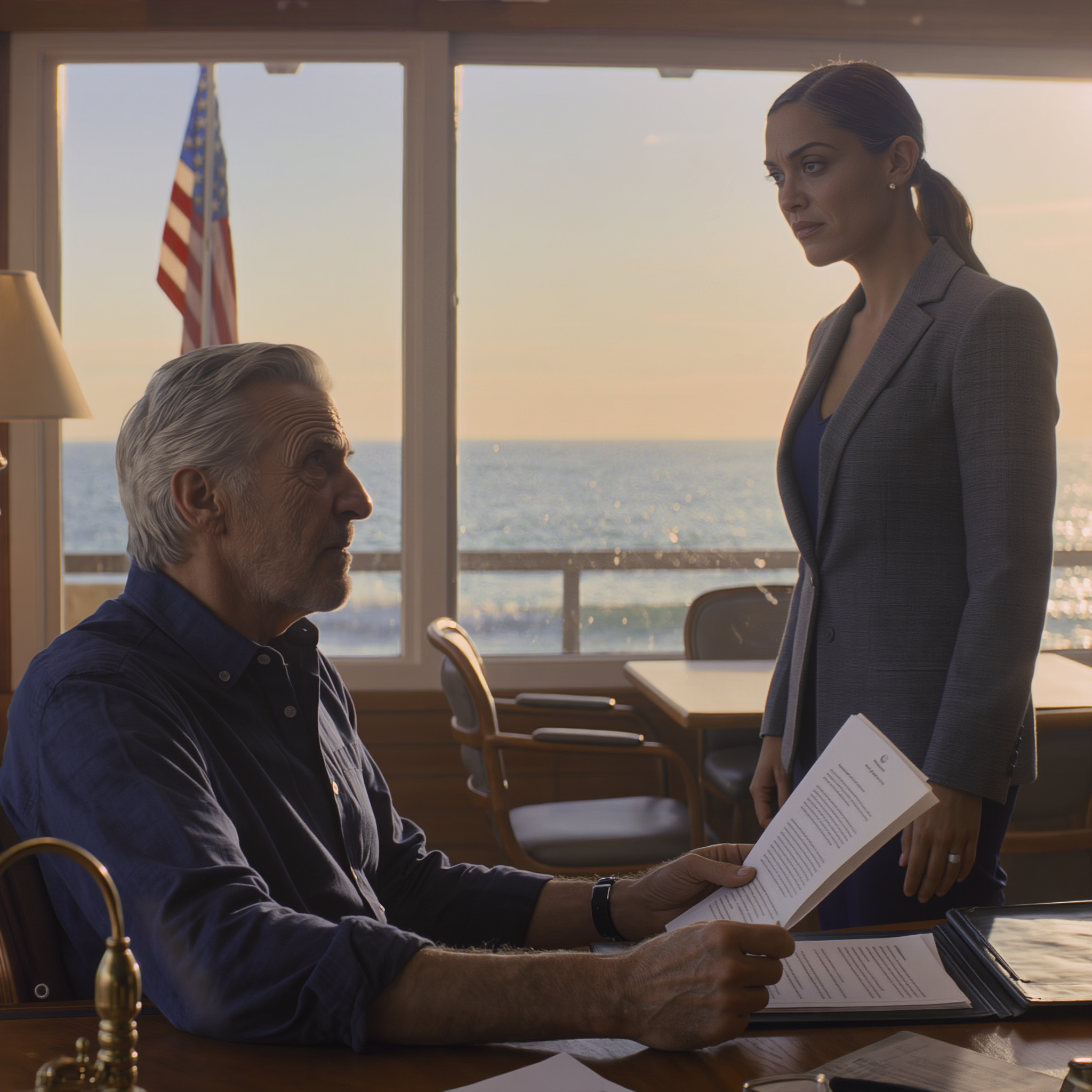
My daughter didn’t let me attend her wedding. Just a few days later, she turned around and demanded that I give her my $2.6 million beach house to “help” her struggling husband. She looked me straight in the eye and said, “You owe me this, Dad.” I didn’t argue, I didn’t raise my voice. I simply, quietly decided: this time, don’t blame me.
My daughter called me “peasant stock” at her rehearsal dinner in front of two hundred guests at a waterfront hotel in Boston. She looked me dead in the eye, champagne flute in hand, and said I was “embarrassing peasant stock who didn’t belong with real people like us.”
I said nothing.
I didn’t throw the drink in her fiancé’s face. I didn’t flip the table or lecture her in front of her new in‑laws. I just set my fork down, folded my napkin, and walked out into the cold New England night.
But I remembered every word.
Three days later, the wedding already a blur on social media and society pages I wasn’t welcome in, she called me.
Not to apologize.
She called because she wanted my $2.6 million beach house.
She said she needed it “temporarily” to help her new husband through some financial trouble—just a small family favor. The same daughter who banned me from her wedding for being too poor was now demanding my most valuable asset.
Her exact words were:
“You owe me this, Dad.”
I didn’t argue. I didn’t raise my voice. I listened. I remembered. And I quietly decided: this time, don’t blame me.
Before I tell you what I did next—and trust me, it gets wild—let me take you back to where this really started.
My name is Martin Harris.
Thirty‑seven years ago, I was an eight‑year‑old kid living at St. Mary’s Children’s Home in Dorchester, just outside Boston. No parents. No family. No money. Just me and forty‑six other forgotten kids in a red‑brick building that always smelled like boiled cabbage, bleach, and old radiators.
The nuns fed us oatmeal for breakfast, peanut butter sandwiches for lunch, and whatever donations came in for dinner. Sometimes that meant a pot of chili from a church cookout. Sometimes that meant cold pizza from a local restaurant.
Sometimes that meant nothing.
I learned early that nobody was coming to save me.
So I saved myself.
When I was twenty‑two, I scraped together fifty dollars and bought a used hot‑dog cart off a guy who was moving down to Florida. I dragged that cart to a corner near Fenway Park in Boston, where the air always smells like beer, car exhaust, and hope right before first pitch.
I sold hot dogs and soda to Red Sox fans.
I made thirty‑seven dollars my first day.
I thought I was rich.
Twenty‑eight years later, I owned Harris Family Kitchen—eight casual family restaurants scattered across Massachusetts: Dorchester, Quincy, South Shore, Worcester, a couple in greater Boston. We did $2.1 million in profit last year alone.
Not bad for “peasant stock.”
But here’s what really matters.
I never forgot where I came from.
Every month, like clockwork, I write a check to St. Mary’s Children’s Home. Five thousand dollars. No publicity. No photo ops. No social media posts. I don’t even bother with the tax write‑offs most of the time. I just write the check, stick it in the mail, and go back to work.
Giving back is the only debt I still believe in.
My daughter, Madison, never knew about any of this.
See, I made a mistake that a lot of first‑generation success stories make. I gave her everything I never had.
Private schools in the suburbs west of Boston. Designer clothes from Newbury Street. Summer camps in Switzerland and Colorado. Ski trips to Aspen. A trust fund that kicked in at twenty‑five with four hundred thousand dollars sitting there waiting for her.
I thought I was being a good father.
Turns out I was creating a monster.
Madison grew up thinking money just appeared.
That success was normal.
That struggle was something that happened to other people in other states, not in nice neighborhoods with stone walls and manicured lawns outside of Boston.
Then she met Preston Blackwood III at Harvard Business School.
Old money. Trust fund baby. The kind of Boston Brahmin family whose last name shows up on the side of library buildings and on the plaques of old hospitals.
His great‑grandfather owned textile mills in Lowell. His grandfather owned steel plants in Pennsylvania. His father owns what feels like half of Boston’s commercial real estate—Back Bay office buildings, high‑end condos in the Seaport, retail blocks near Faneuil Hall.
Preston took one look at my daughter and saw exactly what she was: new money trying to buy class.
But Madison?
She saw him as her ticket to the life she thought she deserved.
They got engaged after six months. She called me from Cambridge, crying with joy under the yellow streetlights near the Charles River, telling me she’d finally “found her real family.”
She said the Blackwoods understood her in ways I never could.
That should have been my first warning.
The wedding planning started immediately. Venue at the exclusive Chatham Yacht Club down on Cape Cod, a place where the air smells like salt and old money. Eighty‑five thousand dollars just for the location. Flowers flown in from some famous designer in New York. Dress from Paris. Menu designed by a celebrity chef out of San Francisco.
Two weeks before the wedding, Madison called.
“Dad, we need to talk.”
I knew that tone. It was the same tone she used when she wrecked her BMW at seventeen. When she maxed out her credit cards at twenty‑three. When she needed me to fix something she’d broken.
“What’s wrong, sweetheart?” I asked. “Did something happen with the venue? The catering? I can write another check if—”
“No, Dad,” she said. “It’s about you.”
The silence stretched between us. I could hear her breathing—nervous, guilty. I could hear the faint sounds of traffic on Storrow Drive behind her, Boston humming along like it always does.
“Preston’s family has some concerns,” she said.
“What kind of concerns?” I asked.
“About your background,” she said quietly. “Your… circumstances.”
Circumstances.
Like being an orphan was a character flaw.
“Madison, what are you trying to say?” I asked.
She took a breath.
“They think it might be better if you didn’t attend the ceremony.”
The words hit me like a physical blow.
“My own daughter,” I said slowly. “The girl I raised, fed, clothed, educated, loved… You’re uninviting me from your wedding?”
“It’s not uninviting, Dad,” she rushed to say. “It’s just… the Blackwoods have a certain image to maintain. Their friends, their business associates, they’ll all be there. And with your history—”
“My history of what?” I asked. “Working hard? Building a business from nothing?”
“Dad, please don’t make this harder than it has to be,” she said.
“How much harder can it get, Madison?” I asked. “You’re choosing them over me.”
“I’m choosing my future,” she said.
“What about your past?” I asked quietly. “What about the man who raised you?”
“You gave me money, Dad,” she said.
That one cut deep.
“That’s not the same as raising me.”
Another blow, straight to the heart.
“I see,” I said.
“Do you?” she asked. “Because I need you to understand something. The Blackwoods don’t just have money. They have breeding. Class. History. Things you can’t buy.”
“And I don’t have those things,” I said.
“Dad… you’re a food‑cart guy who got lucky,” she said.
Lucky.
Thirty years of eighteen‑hour days and she called it luck.
“I worked for everything I gave you, Madison,” I said.
“And I’m grateful,” she said quickly. “But gratitude doesn’t change what you are.”
“What am I?” I asked.
“You’re not their kind of people,” she said, almost whispering.
There it was.
The truth she’d been dancing around since the engagement.
“I see,” I said again. “And what kind of people are they?”
“Better people, Dad,” she said. “Accomplished people. People who matter.”
I stayed quiet for a long moment, processing, planning.
“Okay,” I said finally. “Okay. If that’s what you want, I won’t attend.”
“Really?” she asked. “You’re not going to fight me on this?”
“No,” I said. “Oh, sweetheart, I want you to be happy.”
“Thank you, Dad,” she breathed. “You don’t know how much this means to me.”
I knew exactly how much it meant to her.
Everything.
So I didn’t go to my daughter’s wedding.
Instead, on that bright Cape Cod Saturday, while yachts bobbed in the harbor and a string quartet played for people in pastel suits and designer sunglasses, I spent the afternoon at St. Mary’s in Dorchester, reading stories to kids who had nobody.
Kids like I used to be.
I thought maybe she’d call after the honeymoon. Maybe apologize. Maybe remember that I’m her father.
She didn’t call.
But three days after she got back, my phone rang.
“Dad, it’s Madison. We need to talk.”
Her voice was different this time.
Shaky. None of the bright, brittle confidence she’d had when she uninvited me from her wedding.
“What can I do for you, Madison?” I asked.
“Can we meet in person? It’s important,” she said.
“I’m listening,” I said.
“Not over the phone,” she insisted. “This is… sensitive.”
“Sensitive.”
Another word she used when she needed something.
“I’m at the restaurant,” I said. “South Shore location. You know where it is.”
Twenty minutes later, she walked through the doors of Harris Family Kitchen, the same South Shore restaurant she once called “embarrassingly middle class.”
When she’d brought Preston by for dinner months earlier, she’d looked around like she’d never seen the place before—red vinyl booths, checkered floors, black‑and‑white photos of regular families on the walls. Real people. Not “her people.”
“Dad,” she said now.
“Madison,” I replied.
She sat across from me in Booth 7, the same booth where I’d taught her to count money from the register when she was six, where we’d eaten countless dinners together before she decided I wasn’t good enough.
“You look tired,” I said.
“I haven’t been sleeping well,” she admitted.
“Wedding blues?” I asked.
“Something like that,” she said, twisting her new wedding ring—a twenty‑thousand‑dollar Harry Winston piece. I knew the exact number because I’d seen the receipt. Preston had charged it to a credit card that was already maxed out.
“How’s married life?” I asked.
“Dad, I need to tell you something about Preston. About us,” she said.
“I’m listening,” I said.
“We’re having some financial difficulties,” she said.
Financial difficulties.
Rich people never say they’re broke. They have “difficulties.”
“What kind of difficulties?” I asked.
“Preston made some investments that didn’t work out,” she said.
“What kind of investments?”
“Cryptocurrency, mostly. And some tech startups that folded,” she said.
“How much?” I asked.
She didn’t answer right away. She started picking at her cuticles, a nervous habit she’d had since childhood.
“Madison,” I said. “How much did he lose?”
“Three hundred and twenty thousand in crypto,” she whispered.
My restaurant chain makes more than that in two months.
“For trust fund babies, that must be devastating,” I said.
“That’s unfortunate,” I added.
“There’s more,” she said.
Of course there was.
“He invested in a company called Virtue Signal Technologies. It was supposed to revolutionize social media advertising,” she said.
“Supposed to,” I repeated.
“It was a Ponzi scheme,” she said. “Preston lost four hundred and ten thousand.”
“Seven hundred and thirty thousand total,” I said.
Still not catastrophic for old‑money families.
“And?” I prompted.
“And there are credit cards,” she said.
“How many?”
“Seventeen different cards,” she said. “All maxed out.”
“How much?”
“Seventeen thousand on those,” she said.
“Eight hundred forty‑seven thousand in debt,” I said.
Still manageable if you had the kind of family money she thought she’d married into.
“Can’t Preston’s family help?” I asked.
She laughed. Not a happy laugh—a bitter, broken one.
“That’s the thing, Dad,” she said. “Preston’s family doesn’t have as much money as everyone thinks.”
“What do you mean?”
“His grandfather lost most of the steel money in the dot‑com crash,” she said. “His father’s been mortgaging properties for years to maintain their lifestyle. The Blackwood fortune is mostly smoke and mirrors.”
“So Preston is broke,” I said.
“We’re broke,” she corrected. “Completely broke.”
I let that sink in.
The daughter who called me “peasant stock” had married into fake aristocracy.
“What about your trust fund?” I asked.
“Gone,” she said.
“Gone?”
“Preston convinced me to invest it all in his ventures,” she said. “He said we’d double our money in six months. Four hundred thousand, just… gone.”
“I see,” I said.
“Dad, we might lose everything,” she said. “The apartment in Back Bay, the cars, everything. Preston’s talking about bankruptcy.”
“That’s rough,” I said.
“The worst part?” she said. “His family is furious. They’re saying it’s my fault, that I brought bad luck into their family, that I’m not really one of them.”
The irony was thick enough to cut with a knife.
“How does it feel?” I asked.
“What?” she said.
“Being told you don’t belong,” I said.
She stared at me.
For a moment, I thought she might understand. Might apologize. Might remember what she’d done to me.
Instead, she leaned forward.
“Dad, I need your help,” she said.
“What kind of help?” I asked.
“I need to borrow something,” she said.
“Money?”
“Not exactly,” she said.
“Then what?”
“Your beach house,” she said.
I blinked.
“My beach house in Cape Cod?” I asked.
“Yes,” she said. “The one you bought last year. Two point six million. Oceanfront, four thousand square feet.”
“My retirement dream,” I said quietly.
“What do you need my house for?”
“We need to sell it,” she said.
“Sell my house,” I repeated.
“Just temporarily,” she said quickly. “To cover our debts. We’ll buy it back when things turn around.”
“You want me to give you my house so you can sell it,” I said.
“It’s not giving, Dad,” she insisted. “It’s lending. Family helping family.”
Family.
Now we were family again.
“Madison, that house is worth $2.6 million,” I said.
“I know,” she said. “And we’ll pay you back every penny.”
“With what money?” I asked. “You just told me you’re broke.”
“Preston has some deals in the works,” she said. “Big deals. We just need time.”
“What kind of deals?”
“Import, export, international consulting,” she said. “High‑level stuff you wouldn’t understand.”
Wouldn’t understand.
More insults, wrapped in desperation.
“How long would you need the house?” I asked.
“Six months? Maybe eight,” she said. “A year at most.”
“A year,” I repeated. “And if these deals don’t work out?”
“They will,” she insisted.
“But if they don’t?”
“Dad, you have to trust me,” she said.
Trust.
From the daughter who uninvited me from her wedding because I wasn’t good enough for her new family.
“Let me understand this correctly,” I said. “You need me to hand over my most valuable asset to cover debts from investments I had no part in making.”
“When you put it like that, it sounds…” she began.
“It sounds like what, Madison?” I asked.
“Look,” she said, “I know I hurt you with the wedding thing, but family is family. Blood is blood.”
“Where was that blood,” I asked, “when you called me peasant stock?”
“Dad, please. We’re desperate,” she said.
“How desperate?” I asked.
“Preston’s family will disown him if he files for bankruptcy,” she said. “His business connections will dry up. We’ll have nothing.”
“You’ll have what I had at your age,” I said. “Nothing.”
“That’s different,” she said.
“How is it different?”
“You didn’t have anything to lose,” she said.
“I had my dignity,” I said quietly.
“Dad, please,” she whispered. “You owe me this.”
There it was.
The entitlement that had been building for years.
“I owe you,” I repeated.
“After everything,” she said. “After all the sacrifices I made growing up with a working‑class father.”
Sacrifices.
She called being my daughter a sacrifice.
“What sacrifices, Madison?” I asked. “Having to explain why your father owned restaurants instead of companies? Why we lived in a normal house instead of an estate? Why you couldn’t bring friends over because I might embarrass you?”
Every word was a knife.
“I see,” I said finally. “So. Will you help us?”
I looked at my daughter. Really looked at her. The girl I’d raised was gone. In her place sat a stranger who saw me as an ATM with legs.
“I’ll think about it,” I said.
“How long?” she asked.
“I’ll call you,” I said.
“Dad, we don’t have long,” she said. “The creditors are already calling.”
“I said I’ll call you,” I repeated.
She left without saying goodbye.
Just like she’d left my life when she found “better” people.
But she’d made one mistake.
She’d shown me exactly who she really was.
Now it was time to show her who I really was.
That night, I couldn’t sleep, so I did what I always do when I need to think clearly.
I went to work.
My office sits above the original Harris Family Kitchen location in Dorchester, on a busy Boston street where sirens, buses, and late‑night laughter mix with the smell of fried onions and cold air off the harbor. Same building where I started with that fifty‑dollar food cart.
I keep it simple. Metal desk. Two chairs. File cabinet. No fancy art. No leather furniture. Just a place to get things done.
I pulled Madison’s financial records. As her father, I still had access to her accounts until she turned thirty. She’d forgotten about that detail.
What I found made my stomach turn.
While Preston was losing their money on crypto and Ponzi schemes, they were spending like royalty.
Fifteen thousand dollar handbags. Eight thousand dollar dinners in the Back Bay. Thirty thousand dollar weekend trips to Paris. In the six months before their wedding, they’d blown through two hundred twelve thousand dollars on luxury items while crying poverty.
But that wasn’t the worst part.
I found the credit card statements from their honeymoon.
Twelve days in Italy. Presidential suite at the Hotel Danieli in Venice—three thousand dollars per night. Private yacht tours along the Amalfi Coast. Michelin‑star restaurants every meal. First‑class flights from Boston to Rome and back.
Total cost: sixty‑seven thousand dollars.
The same daughter who uninvited me from her wedding had spent more on her honeymoon than most people in this country make in a year.
I printed everything. Bank statements. Credit card bills. Investment records. Shopping receipts. I built a file thick as a Boston phone book used to be.
Then I made a decision.
I picked up my phone and dialed a number I hadn’t called in fifteen years.
St. Mary’s Children’s Home.
“St. Mary’s,” a familiar voice answered. “This is Sister Catherine.”
Her voice was exactly the same—warm, patient, kind. The voice that had comforted me through nightmares when I was eight years old.
“Sister Catherine, this is Martin Harris,” I said.
“Martin, my goodness,” she said. “How are you, child?”
Child.
I was fifty‑five years old. But to Sister Catherine, I’d always be that scared eight‑year‑old who arrived with nothing but the clothes on his back.
“I’m well, Sister,” I said. “And you?”
“Oh, you know,” she said. “Same as always. Trying to keep forty‑seven children fed and happy with not enough money and too many needs.”
“Forty‑seven children,” I repeated.
Just like when I was there.
“How’s the funding situation?” I asked.
“Tight,” she said with a tired laugh. “Always tight. The state gives us just enough to keep the lights on. Everything else comes from donations, and those have been scarce lately.”
“What would make the biggest difference right now?” I asked.
She hesitated.
“Well, if I’m being honest,” she said, “we desperately need a new building. This old place is falling apart. The roof leaks when it rains. The heating system is from the 1960s. The children deserve better.”
“How much would a new building cost?” I asked.
“Oh, Martin, we could never afford something like that,” she said. “We’d need at least two million dollars, maybe more. It’s just a dream.”
Two million dollars.
Less than my beach house was worth.
“Sister Catherine,” I said softly, “what if someone wanted to make a substantial donation? What would be the process?”
“Well, we’re a registered 501(c)(3) charity,” she said. “All donations are tax‑deductible. But Martin, we’re not talking about your usual monthly check, are we?”
“No, Sister,” I said. “We’re not.”
“How substantial are we talking?” she asked.
“Substantial enough to buy land and build that new facility,” I said. “With a playground and a library and individual bedrooms for every child.”
The line went quiet for a long moment.
“Martin… are you serious?” she whispered.
“Dead serious,” I said.
“That would be… that would change everything,” she said. “These children could have real homes, real futures.”
“Real futures,” I repeated.
Just like Sister Catherine had given me.
“Sister,” I said, “I want to make this donation publicly, with media present. I want the world to see how important this work is.”
“Of course,” she said. “We’d be honored to have the recognition. Can you be available tomorrow afternoon?”
“Tomorrow?” she asked. “My goodness, Martin, what’s the rush?”
“Let’s just say I need to make a point,” I said.
“What kind of point?”
“About what really matters in life,” I said.
I spent the rest of the night making arrangements.
I called my lawyer, David Chen, whose office sits in a glass tower in downtown Boston overlooking the Common. I had him draft the donation papers and make sure everything would be legal and binding. I called Channel 7 News and told them I had a major philanthropic announcement that would interest their viewers. In a city that loves a good story about redemption and charity, they agreed to send a crew.
Then I called Madison.
“Dad, it’s late,” she said when she picked up.
“I’ve made my decision about the house,” I said.
“Yes?” she asked quickly.
“And I want to discuss it in person,” I said. “Can you and Preston come to my office tomorrow at two‑thirty?”
“Your office?” she said. “Dad, can’t we just handle this over the phone?”
“This is a $2.6 million decision, Madison,” I said. “I think it deserves an in‑person conversation.”
There was a pause.
“Okay,” she said finally. “We’ll be there.”
“Good,” I said. “And Madison?”
“Yes?”
“Bring your checkbook.”
“My checkbook?” she repeated. “Why?”
“You’ll see,” I said.
I hung up before she could ask more questions.
Then I sat back in my chair and looked out the window at the street where I’d sold hot dogs thirty‑three years ago, where I’d learned that hard work could overcome anything.
Tomorrow, I was going to teach my daughter that same lesson, whether she wanted to learn it or not.
But first, I had one more call to make—
But first, I had one more call to make—one more person who would understand what I was about to do better than anyone.
“Sister Catherine, it’s Martin again,” I said when she picked up.
“Oh? Twice in one night,” she said. “That can’t be good.”
“I have one more question,” I said.
“Of course, child,” she replied.
“When we do this tomorrow, when we make this donation official, I want you to tell the cameras about the children,” I said. “About what this will mean for them.”
“I’d be happy to,” she said. “The world needs to remember them.”
“And, Sister?” I added.
“Yes?”
“I want you to tell them about a little boy who lived there once,” I said. “A boy who had nothing and no one, but who learned that giving back is the only thing that really matters.”
“Martin,” she said softly, voice thick with emotion, “will you do that for me?”
“Of course,” I said. “It would be my honor.”
“Then tomorrow,” she said, “we’ll change some lives.”
“Tomorrow,” I said, “is going to be interesting.”
The next morning, I met my attorney, David Chen, at his office in downtown Boston. From his windows you could see the State House dome and the traffic crawling along Tremont Street.
David has been handling my legal affairs for twelve years—corporate contracts, real estate deals, business acquisitions. He’d seen me sign plenty of big papers, but nothing like this.
“Martin, let me make sure I understand what you’re asking me to do,” he said, sitting behind his mahogany desk with three different documents spread across a leather blotter.
“You want to donate your Cape Cod property to St. Mary’s Children’s Home,” he said.
“That’s correct,” I replied.
“The property currently valued at $2.6 million,” he said.
“Yes.”
“And you want this donation to be irrevocable. Once you sign these papers, you can never change your mind.”
“Exactly,” I said.
“Martin, this is your retirement home,” he said. “Your biggest single asset outside the restaurants.”
“I’m aware,” I said.
David leaned back and studied me over his reading glasses.
“Can I ask why?” he said.
“Personal reasons,” I said.
“This wouldn’t have anything to do with your daughter, would it?” he asked.
David knew about the wedding situation. He’d been invited before Madison decided I wasn’t welcome.
“It has everything to do with my daughter,” I said.
“Martin, if this is about revenge—” he began.
“This isn’t revenge, David,” I cut in. “This is about values.”
“What kind of values are worth $2.6 million?” he asked.
“The kind you can’t put a price on,” I said.
He sighed and picked up his pen.
“Okay,” he said. “Let’s go through this step by step. The donation papers will transfer full ownership of the property to St. Mary’s Children’s Home, effective immediately upon signing.”
“Good,” I said.
“The tax implications are actually favorable,” he continued. “As a charitable donation, you’ll receive a large deduction against your income.”
“I don’t care about the tax benefits,” I said.
“You should,” he replied. “This will save you roughly eight hundred thousand in federal and state taxes over the next three years.”
Eight hundred thousand.
Almost exactly what Madison and Preston owed in debts.
“What about the media component?” I asked.
“I’ve contacted Channel 7,” he said. “They’ll have a crew at your office at two o’clock. That gives us thirty minutes to handle the legal formalities before your guests arrive. And yes, everything will be recorded.”
“And the donation?” I asked.
“Legally binding the moment you sign,” he said. “Regardless of who’s watching.”
“Perfect,” I said.
David pulled out another document.
“This is the press release we’ll distribute after the signing,” he said. “It announces the donation and explains the impact on the children’s home.”
I read through it quickly. Standard language about charitable giving and community support.
“Add something,” I said.
“What?” he asked.
“Add that this donation was inspired by my own experience as a child at St. Mary’s from 1977 to 1985,” I said.
David made a note.
“Anything else?” he asked.
“Yes,” I said. “Include a quote from Sister Catherine about how many children this will help.”
“Already done,” he said. “She mentioned forty‑seven current residents plus room for expansion.”
“Good,” I said.
David stacked the papers neatly.
“Martin, I have to ask one more time,” he said. “Are you absolutely certain about this? Once these papers are signed, there’s no going back.”
“David, let me tell you something,” I said. “I’ve made a lot of decisions in my life, some good, some bad. But this? This is the rightest thing I’ve ever done.”
“Even knowing your daughter will be devastated?” he asked.
“Especially knowing that,” I said.
“Why?”
“Because maybe losing something she never earned will teach her the value of what she threw away,” I said.
David nodded slowly.
“In that case,” he said, “I’ll see you at one‑thirty. We’ll have everything ready to go.”
I stood to leave, then turned back.
“David,” I said.
“Yes?”
“When this hits the news tonight, my phone’s going to ring off the hook—family members, friends, reporters. Everyone’s going to want to know why I did this. What should I tell them?”
He thought for a moment.
“Tell them sometimes the best way to help someone is to stop helping them,” he said.
I nodded.
“And if they ask about Madison specifically?” I asked.
“Tell them you’re teaching your daughter that there are two kinds of people in this world,” he said. “Those who lift others up and those who tear others down.”
“Today,” I said, “she’s going to learn which kind her father is.”
I left David’s office and drove straight to St. Mary’s. I wanted to see Sister Catherine before everything went public. Wanted to see the children who would benefit from this decision. Wanted to remember why I was doing this.
The old brick building looked exactly the same as it had forty years ago. Same cracked sidewalk. Same rusty fence. Same battered swings out front. Same feeling of hope mixed with desperation hanging in the cool Boston air.
But soon, everything would change—for forty‑seven children who deserved better.
And for one daughter who needed to learn what “better” actually meant.
By noon, my phone started ringing.
First call was from Madison’s cousin Jennifer—my brother’s daughter. She’d always thought she was smarter than everyone else because she’d moved to California and worked in tech.
“Uncle Martin,” she said. “Madison called me crying. She says you’re being unreasonable about the house.”
“Is that what she said?” I asked.
“She told me about Preston’s financial troubles,” Jennifer said. “How they need family support right now.”
“Did she tell you why they need support?” I asked.
“Something about bad investments,” Jennifer said. “Uncle Martin, these things happen. Families should stick together.”
“Did she tell you she uninvited me from her wedding?” I asked.
Silence.
“What?” she said.
“Madison banned me from her own wedding because I wasn’t good enough for Preston’s family,” I said.
“That—that can’t be true,” Jennifer stammered.
“Ask her,” I said.
“But Uncle Martin, even if that happened, family is family,” she said. “You can’t hold grudges forever.”
“This isn’t a grudge, Jennifer,” I said. “This is about consequences.”
“You’re going to let your pride destroy your relationship with your daughter?” she snapped.
“My pride isn’t the problem here,” I said calmly.
She hung up.
Twenty minutes later, my ex‑wife called.
Linda and I divorced when Madison was sixteen, but we’d managed to stay civil for our daughter’s sake. She’d moved to New Hampshire with a man who liked boats more than responsibilities.
“Martin, what the hell are you doing?” she demanded the second I answered.
“Hello, Linda,” I said.
“Madison is hysterical,” she said. “She says you’re refusing to help her when she needs you most.”
“Did she explain why she needs help?” I asked.
“Her husband made some bad investments,” Linda said. “So what? That’s what family does. We help each other.”
“Like she helped me when I wanted to attend her wedding?” I asked.
“Oh, for God’s sake, Martin, you’re still upset about that?” she said.
“Upset?” I repeated. “No, Linda. I’m educated.”
“What’s that supposed to mean?” she snapped.
“It means I learned something about my daughter that day,” I said. “Something important.”
“What could be more important than helping your child?” she demanded.
“Teaching your child,” I said.
“Teaching her what?” Linda asked.
“That actions have consequences,” I said.
“You’re being ridiculous,” she said.
“Am I?” I asked. “Tell me, Linda, what did Madison say when she asked for the house?”
“She said it was temporary,” Linda said. “That they’d pay you back.”
“With what money?” I asked. “They’re broke.”
“They’ll figure something out,” she said.
“Like they figured out those investments?” I asked.
Linda’s voice sharpened.
“Martin, if you don’t help her, she could lose everything,” she said.
“Good,” I said.
“Good?” she shouted. “How can you say that about your own daughter?”
“Because maybe losing everything is exactly what she needs,” I said. “You know what I’ve never heard her say, Linda? ‘How can I help someone who has less than me?’ Not once.”
“You’re heartless,” she said.
“No, Linda,” I replied. “I’m finally learning to say no.”
She hung up, too.
The third call came from Preston himself.
His voice was very different from the smooth confidence he’d displayed when we first met at that fancy Back Bay restaurant.
“Martin, we need to talk,” he said.
“I thought I wasn’t sophisticated enough to understand your business dealings,” I said.
“Look, I know I may have come across as dismissive at the wedding,” he said.
“Dismissive,” I repeated.
“Okay, I was rude,” he admitted. “I was nervous about the marriage and I took it out on you. I’m sorry.”
“Too little, too late,” I said. “What do you want, Preston?”
“I want to make this right between us,” he said. “Between our families.”
“How?” I asked.
“By being honest about everything,” he said.
“I’m listening,” I said.
“The truth is, my family isn’t as wealthy as people think,” he said.
“I gathered that,” I said.
“My grandfather made some bad investments in the ’90s,” Preston continued. “My father’s been borrowing against properties for years. We’re… not as liquid as we appear.”
“Liquid,” I said. “You mean you’re broke.”
“Not broke,” he protested. “Just not liquid.”
Even desperate, he couldn’t say the word “poor.”
“And now you need my house,” I said.
“We need a bridge loan,” he said. “Something to cover our debts until my consulting business takes off.”
“What consulting business?” I asked.
“I’m starting an international trade consulting firm,” he said. “High‑end clients, multinational corporations.”
“With what credentials?” I asked.
“I have my MBA from Harvard,” he said.
“So do fifty thousand other people,” I said.
“Martin, please,” he said. “I’m trying to be reasonable here.”
“Are you?” I asked.
“Yes,” he said. “And I’m prepared to offer you something in return.”
“What?” I asked.
“A partnership in my new business,” he said. “Twenty percent equity.”
“Twenty percent of nothing is still nothing,” I said.
“That’s generous,” he insisted. “I thought you’d appreciate it.”
“Preston, let me ask you something,” I said. “When you decided I wasn’t good enough for your wedding, did you think about what that would do to me?”
“Look, that wasn’t personal,” he said.
“What was it then?” I asked.
“It was about optics,” he said. “Image. My family has certain expectations, and I—”
“And I didn’t meet those expectations,” I finished.
“You have to understand,” he said. “My family moves in very specific circles. There are protocols, social dynamics you might not understand.”
There it was again—the condescension. Even now, begging, he couldn’t help himself.
“I see,” I said. “So you’ll consider the partnership?”
“Preston,” I said slowly, “I want you to listen very carefully to what I’m about to tell you.”
“Okay,” he said.
“Tomorrow at two‑thirty, come to my office,” I said. “Bring Madison. We’ll settle this once and for all.”
“Really?” he said, relief flooding his voice. “You’ll transfer the house?”
“We’ll settle it,” I repeated.
“Thank you, Martin,” he said. “You won’t regret this.”
“You’re right about that,” I said.
“What?”
“I won’t regret it at all,” I said.
After I hung up, I sat in my car outside St. Mary’s and watched children playing in the cracked asphalt courtyard. Forty‑seven kids who had nothing but hope.
Tomorrow they’d have more than hope.
They’d have a future.
And Madison would finally understand the difference between family and blood.
One call to go. The most important one.
“Sister Catherine, it’s Martin,” I said when she picked up again. “Everything’s set for tomorrow. Are you ready?”
“Ready as I’ll ever be, child,” she said.
“Good,” I said. “Because tomorrow we’re going to change some lives.”
“Including yours,” she added.
“Especially mine,” I said.
The next day, everything fell into place like clockwork.
At one‑thirty sharp, David arrived at my office with the donation papers—three copies, each one notarized and ready for signatures.
The Channel 7 news van pulled up five minutes later. A cameraman and a reporter in a navy blazer came up the narrow stairs.
“Mr. Harris, I’m Janet Morrison from Channel 7,” she said, extending her hand. “We spoke yesterday about your philanthropic announcement.”
Janet was a veteran reporter—forties, sharp suit, no‑nonsense attitude, the kind of journalist who can smell a story before anyone else.
“Thank you for coming, Janet,” I said.
“Can you give us a preview of what we’re announcing today?” she asked as her cameraman unpacked equipment.
“It’s better if you experience it in real time,” I said. “Trust me, you’ll want to be rolling when it happens.”
Her eyes lit up. Reporters love genuine surprise.
“How substantial are we talking?” she asked.
“Life‑changing,” I said.
“For who?” she asked.
“For forty‑seven children who deserve better than they’re getting,” I said.
At two o’clock, Sister Catherine arrived. She looked nervous but excited, wearing her best habit and carrying a folder full of photos from St. Mary’s—kids on the playground, kids doing homework at old wooden tables, kids sleeping in narrow dorm beds.
“Martin, I still can’t believe this is really happening,” she said.
“It’s happening, Sister,” I said. “Are you ready to tell the world about those children?”
“More ready than I’ve ever been,” she said.
At two‑fifteen, my phone buzzed.
Running a few minutes late. Preston had to stop at the bank.
Perfect.
Let them think this was about money changing hands.
At two‑twenty‑five, Madison and Preston walked through my office door. Madison looked hopeful but anxious. Preston looked like he’d rather be anywhere else.
That’s when they noticed the camera crew.
“Dad, what’s going on?” Madison asked. “Why are there cameras here?”
“Sit down, Madison,” I said. “Both of you.”
They took the chairs across from my desk—the same chairs where I’d fired employees for stealing, where I’d negotiated million‑dollar deals, where I’d made the hardest decisions of my business life.
“Preston, Madison,” I said, “I want you to meet some people.”
I gestured toward Sister Catherine.
“This is Sister Catherine,” I said. “She runs St. Mary’s Children’s Home in Dorchester.”
Madison looked confused. Preston looked annoyed.
“And this,” I said, “is Janet Morrison from Channel 7 News.”
Now Preston looked alarmed.
“Martin, what exactly is going on here?” he asked.
“We’re here to make an announcement,” I said. “About my Cape Cod property.”
Madison perked up.
“You’re transferring it to us?” she asked.
“In a manner of speaking,” I said.
Janet positioned herself with the camera.
“Mr. Harris,” she said, “whenever you’re ready.”
I stood behind my desk.
“Madison, Preston, three days ago you asked me for help,” I said. “You asked me to give you my beach house to cover debts from investments I had nothing to do with.”
“Dad, we discussed this,” Madison said. “It’s temporary.”
“You also told me I owed you this help,” I said. “After everything.”
“Well, yes,” she said. “You do.”
“You were right about one thing,” I said. “I do owe someone something after everything.”
Preston shifted in his chair.
“What do you mean?” he asked.
“I owe it to the children who are growing up the way I did,” I said. “With nothing. With no one. With no hope except what kind strangers are willing to give them.”
Sister Catherine smiled. She was beginning to understand.
Madison wasn’t.
“Dad, what are you talking about?” she asked.
“I’m talking about real family,” I said. “Not the kind of family that uninvites you from weddings because you’re ‘embarrassing,’ but the kind of family that lifts each other up.”
“I don’t understand,” she said.
“You will,” I replied.
I picked up the donation papers David had prepared. Three copies, each one identical, each one binding.
“Janet, are you recording?” I asked.
“Rolling now, Mr. Harris,” she said.
“Perfect,” I said.
I looked directly into the camera.
“My name is Martin Harris,” I said. “Thirty‑seven years ago, I was a homeless eight‑year‑old living at St. Mary’s Children’s Home in Dorchester, Massachusetts. Today, I’m the owner of eight successful restaurants and a $2.6 million beach house in Cape Cod.”
Madison’s face went white.
“Today,” I continued, “I’m donating that house to Sister Catherine and the children of St. Mary’s so they can build a new facility—so forty‑seven children can have real bedrooms instead of dormitories, so they can have hope instead of just survival.”
Preston shot to his feet.
“What on earth are you doing?” he shouted.
Madison stared at me in shock.
“Dad, you can’t be serious,” she said.
I picked up my pen.
“I’ve never been more serious about anything in my life,” I said.
And I signed the first paper—the one that would change everything for everyone.
“Stop!” Madison cried.
She lunged forward, reaching for the papers.
But it was too late.
My signature was already dry on the first copy.
“Dad, what have you done?” she demanded.
“I’ve done what I should have done years ago,” I said.
Preston grabbed Madison’s arm, pulling her back. His face was red with rage.
“You stubborn old man,” he snapped. “Do you have any idea what you just did?”
“I donated my house to charity on camera in front of witnesses,” I said.
“That was our house!” he shouted.
“Your house?” I repeated.
I looked directly into the camera.
“Janet, did you catch that?” I asked. “Preston just called my house ‘their’ house.”
Janet nodded, eyes bright. She knew this was gold.
“Preston, when exactly did my house become your house?” I asked.
“We had an understanding,” he said.
“We had a conversation,” I corrected. “There’s a difference.”
Madison was almost hyperventilating.
“Dad, stop,” she said. “You can undo this. Call your lawyer. Stop the transfer.”
“David,” I said, looking toward my attorney, who stood quietly in the corner. “Can this be undone?”
“Not a chance,” he said. “The moment you signed that document, ownership transferred to St. Mary’s Children’s Home. It’s irrevocable.”
“Irrevocable,” I repeated. “Do you know what that means, Madison?”
“It means you’ve lost your mind,” she said.
“It means I can’t change my mind,” I said. “Even if I wanted to, which I don’t.”
Sister Catherine stepped forward.
“Perhaps I should explain what this donation means for the children,” she said gently.
“Nobody cares about your children!” Preston exploded.
The room went dead quiet.
Janet’s camera was still rolling.
Sister Catherine looked stunned. Even Madison stared at her husband in horror.
“What did you just say?” I asked quietly.
“I—I didn’t mean—” Preston stammered.
“You said nobody cares about orphaned children on camera, in front of a nun,” I said.
“I was upset,” he said. “I misspoke.”
“No, Preston,” I said. “You spoke honestly for the first time since I met you.”
I signed the second copy of the donation papers.
“Dad, stop,” Madison cried. “You’re destroying our lives.”
“Am I?” I asked. “Or am I finally teaching you what lives are actually worth?”
“What’s that supposed to mean?” she asked.
“Sister Catherine, would you please tell the camera about the children who will benefit from this donation?” I asked.
Sister Catherine composed herself and looked directly into the lens.
“St. Mary’s currently houses forty‑seven children, ages six to seventeen,” she said. “Most have been abandoned by their families. All of them have experienced trauma, neglect, or abuse.”
“And what will this donation allow you to do?” I asked.
“We’ll be able to build a new facility,” she said. “Individual bedrooms for each child. A proper library. A playground. A computer lab. Most importantly, we’ll be able to expand our capacity to help even more children.”
“How many more?” I asked.
“With a new building, we could help up to seventy‑five children at any given time,” she said.
I turned back to Madison and Preston.
“Seventy‑five children who will have hope because of this decision,” I said.
“We don’t care about other people’s children!” Madison screamed.
Another honest moment.
Another moment caught on camera.
“Madison, do you remember when you were six years old and you asked me why some kids didn’t have daddies?” I asked.
“What does that have to do with anything?” she demanded.
“I told you that sometimes daddies get lost,” I said. “But I promised you that your daddy would never get lost—that I would always be there for you.”
“You were there,” she said bitterly, “until you decided to throw your money away.”
“I was there when you graduated high school,” I said. “I was there when you graduated college. I was there when you needed money for your apartment, for your car, for your credit cards.”
“So?” she said.
“But you weren’t there when I needed you,” I said.
“When did you ever need me?” she asked.
“At your wedding, Madison,” I said. “I needed my daughter to want me there.”
She went quiet.
“Instead, you told me I was ‘embarrassing peasant stock,’” I said. “You told me I wasn’t good enough for your new family.”
“That was different,” she said.
“How was it different?” I asked.
“Preston’s family has standards,” she said.
“What kind of standards?” I asked.
Preston tried to interrupt.
“Madison, don’t—” he began.
“Standards about breeding,” she said. “About class. About the kind of people who matter.”
I signed the third and final copy.
“There it is,” I said quietly. “The truth.”
“What truth?” she demanded.
“You’re ashamed of me,” I said. “You’re ashamed of where you came from. You’re ashamed of the man who raised you.”
“I never said that,” she protested.
“You didn’t have to,” I replied. “Your actions said it for you.”
Janet stepped forward with her microphone.
“Mr. Harris,” she said, “why was it important to you to make this donation publicly?”
“Because I wanted my daughter to see what real values look like,” I said.
“And what are those values?” she asked.
“That you lift people up,” I said. “You don’t tear them down. That you help those who can’t help themselves. That blood doesn’t make you family—character does.”
I looked directly at Madison.
“You called me ‘peasant stock,’ sweetheart,” I said. “And you know what? You were right.”
Her face crumpled.
“Peasants work the land,” I said. “They feed people. They build things from nothing. They give more than they take.”
I stood up and walked around my desk.
“I’m proud to be peasant stock,” I said, “because peasants like me understand something that people like you never will.”
“What’s that?” she whispered.
“That the only wealth that matters is what you give away,” I said.
Preston was shaking with rage.
“You’ve destroyed us,” he said. “We’ll lose everything.”
“Good,” I said. “Maybe losing everything will teach you what ‘everything’ actually means.”
Sister Catherine approached Madison gently.
“My dear, your father has just given forty‑seven children a chance at life,” she said. “That’s not destruction. That’s creation.”
Madison looked at the nun like she was speaking another language.
“Those children don’t matter to me,” she said.
“Then you’ve learned nothing from the man who raised you,” Sister Catherine said softly.
I picked up all three signed copies of the donation papers and handed them to Sister Catherine.
“It’s done,” I said.
“Martin, how can I ever thank you?” she whispered.
“Take care of those kids,” I said. “The way you took care of me.”
Janet lowered her camera.
“Mr. Harris, do you have any final words for your daughter?” she asked.
I looked at Madison one last time.
“I love you,” I said. “I always will. But I won’t enable you anymore.”
“Dad, please,” she said, tears running down her face.
“Madison, you have two choices,” I said. “You can learn from this, or you can keep blaming everyone else for your problems.”
“What am I supposed to do now?” she asked.
“What I did when I had nothing,” I said. “Figure it out.”
Preston grabbed Madison’s arm.
“Come on,” he said. “We’re leaving.”
As they reached the door, Madison turned back.
“I’ll never forgive you for this,” she said.
“I know,” I said. “But maybe someday you’ll thank me.”
The door slammed behind them.
Sister Catherine squeezed my hand.
“You did the right thing, Martin,” she said.
“I hope so,” I replied.
Janet packed up her camera equipment.
“Mr. Harris,” she said, “this story is going to be everywhere by tonight.”
“Good,” I said. “Maybe it’ll inspire other people to help children who need it.”
As everyone left, I sat alone in my office. For the first time in years, I felt truly at peace.
Outside my window, the sun was setting over the city where I’d built my life from nothing.
Tomorrow, forty‑seven children would wake up knowing their lives were about to change.
And my daughter would wake up knowing hers already had.
The story broke on Channel 7’s six o’clock news that same evening.
I was having dinner at my South Shore restaurant when every TV in the place switched to Janet Morrison’s report. Boston sports highlights faded to a shot of my office.
“A local businessman made headlines today,” Janet said, “when he donated his $2.6 million Cape Cod beach house to charity live on camera, in front of his own daughter—who had asked to borrow the property to cover massive debts.”
The footage rolled.
Preston screaming about “our house.”
Madison crying that I was destroying their lives.
Preston’s comment about “your children.”
The restaurant went completely silent. Every customer, every employee, watched the screens.
Then something unexpected happened.
Applause.
It started with one customer—an elderly woman sitting alone at Table 12, near the window that looked out onto a strip mall parking lot and a busy Massachusetts roadway.
She started clapping.
Then the couple next to her joined in.
Then the entire restaurant erupted.
“That’s our boss!” shouted Maria, my head waitress, waving her order pad in the air. “That’s Mr. Harris!”
My phone started buzzing.
Text after text after text.
Saw you on the news. You’re a hero. — Tom, my kitchen manager.
Don’t cry at work… too late. Those lucky kids. — Susan, my accountant.
About time someone stood up to entitled brats. — Unknown number.
But not all the messages were supportive.
How could you do that to your own daughter? — Linda.
Family first, Martin. Always. — Jennifer.
You’ll regret this. — Preston.
I deleted that one without reading it twice.
By seven, the story had gone viral on social media. Janet forwarded me screenshots from Twitter and Facebook.
Father donates $2.6M house to orphans instead of entitled daughter.
This is what accountability looks like.
Did you see the daughter’s reaction? “Those children don’t matter to me.” Disgusting.
The son‑in‑law saying “Nobody cares about your children” to a nun on camera. Career suicide.
That last comment made me smile.
Preston’s consulting business would be dead before it started.
At eight‑thirty, Sister Catherine called.
“Martin, you need to see this,” she said.
“What’s happening?” I asked.
“The phones at St. Mary’s haven’t stopped ringing,” she said. “We’ve received over forty thousand dollars in donations just since the story aired.”
“Forty thousand in two hours?” I said.
“That’s wonderful, Sister.”
“There’s more,” she said. “A construction company in Quincy called. They want to donate labor for the new building. A furniture store in Newton wants to donate beds and desks for every room.”
“The story is having an impact,” I said.
“Martin, this isn’t just about the house anymore,” she said. “This is about inspiration. People are seeing what’s possible when someone chooses principle over profit.”
At nine, my phone rang again.
Unknown number. California area code.
“Mr. Harris, this is Rebecca Chen from Good Morning America,” a bright voice said. “We’d like to have you on the show tomorrow to discuss your donation.”
“Good Morning America,” I repeated.
National television.
“I appreciate the interest,” I said, “but this isn’t about publicity.”
“Mr. Harris, your story is resonating with people across the country,” she said. “Parents who feel taken advantage of by entitled children. People who want to make a difference but don’t know how.”
“What would you want me to discuss?” I asked.
“The decision‑making process,” she said. “How you found the courage to choose charity over family pressure.”
“I’ll think about it,” I said.
“We can have a car pick you up at five a.m.,” she added.
“I said I’ll think about it,” I repeated.
At nine‑forty‑five, Madison called.
Her voice was smaller now. Defeated.
“Dad,” she said.
“Madison,” I replied.
“I saw the news coverage,” she said. “People are saying terrible things about me online.”
“What kind of things?” I asked.
“That I’m spoiled. Entitled. That I don’t deserve to be your daughter,” she said.
“Do you disagree with them?” I asked.
Long pause.
“I… I don’t know anymore,” she whispered.
“Madison, for the first time in this conversation, you’re being honest,” I said.
“Dad, I’m scared,” she said.
“Of what?” I asked.
“Of losing everything,” she said. “My friends. My social circle. My reputation. Preston’s family is already talking about annulment.”
“Because of the bankruptcy?” I asked.
“Because of the video,” she said. “Preston’s comment about the children. My reaction. They’re saying we embarrassed the family name.”
The irony was perfect.
The same family that rejected me for being “embarrassing” was now rejecting Madison for the same reason.
“What are you going to do?” I asked.
“I don’t know,” she said. “Preston’s talking about moving to his uncle’s place in Florida. Starting over.”
“And you?” I asked.
“I don’t want to run away, Dad,” she said. “But I don’t know how to face this.”
“Madison, do you remember what I taught you about falling off your bike when you were seven?” I asked.
“You said the only way to stop being afraid was to get back on,” she said.
“That’s right,” I said.
“But this is different,” she said. “This isn’t just falling. This is crashing.”
“Sometimes crashing is the only way to learn how to ride properly,” I said.
“Dad, can I ask you something?” she said.
“Of course,” I said.
“Do you really think I’m a terrible person?” she asked.
I thought about my answer.
“I think you’re a person who lost her way,” I said. “There’s a difference.”
“Can I find my way back?” she asked.
“That depends,” I said.
“On what?”
“On whether you want to be the kind of person who lifts others up or the kind who tears them down,” I said.
“I want to be better, Dad,” she said. “I just don’t know how.”
“Start with one small thing,” I said. “Help one person who can’t help themselves.”
“Like what?” she asked.
“Figure it out, Madison,” I said. “That’s how you learn.”
After I hung up, I sat in my office until midnight, reading messages from strangers who’d seen the story.
Parents who were setting boundaries with entitled children.
People who were inspired to volunteer at local charities.
Families who were having hard conversations about values and sacrifice at their kitchen tables from Boston to Dallas to Seattle.
One message stood out from the rest.
Mr. Harris, I’m eight years old and I live at a children’s home in Texas. Sister Mary showed us your story on the news. Thank you for helping kids like me. Maybe someday I can help kids, too. Your friend, Timothy.
I printed that message and put it in my wallet.
Tomorrow, the world would keep talking about what I’d done.
But tonight, I knew I’d done the right thing—for Timothy, for the forty‑seven children at St. Mary’s.
And maybe, just maybe, for Madison, too.
Six months later, I stood in the courtyard of the new St. Mary’s Children’s Home.
The building was beautiful. Three stories of red brick and hope on a quiet street not far from where the old building had stood. Seventy‑five individual bedrooms. A library with ten thousand books. A computer lab with thirty stations. A playground that looked like something from a dream.
Sister Catherine walked up beside me, beaming.
“The children moved in yesterday,” she said. “Would you like to see their rooms?”
“I’d love to,” I said.
We walked through hallways filled with laughter and the sound of sneakers squeaking on polished floors. Real bedrooms with real doors and real privacy. Children who’d never owned anything now had spaces to call their own.
“Room 14,” Sister Catherine said, stopping at an open door. “This is Timothy’s room.”
I looked inside.
The eight‑year‑old from Texas—who’d written me that letter six months ago—sat at a small desk, writing in a notebook.
“What are you working on?” I asked.
He looked up, recognizing me immediately from the news footage Sister Mary had shown him.
“Mr. Harris,” he said. “I’m writing thank‑you letters to people who donated money for our new home.”
“How many have you written?” I asked.
“Forty‑seven so far,” he said proudly. “One for each kid who was here when you gave us the house.”
Forty‑seven letters.
This kid understood gratitude better than my own daughter had.
“Timothy, what do you want to be when you grow up?” I asked.
“I want to help kids like me,” he said. “Maybe run a place like this.”
“I think you’d be good at that,” I said.
As we walked back toward the lobby, Sister Catherine handed me an envelope.
“This came for you yesterday,” she said.
I recognized the handwriting immediately.
Madison.
Inside was a check for five thousand dollars, made out to St. Mary’s Children’s Home, and a note.
Dad,
I’ve been volunteering at a food kitchen in Boston for the past four months. Preston and I divorced three months ago. I’m living in a studio apartment and working as a server at a restaurant downtown. It’s hard, but I’m learning what real work feels like.
This donation is from my own savings. Not much, but it’s mine.
I hope someday you’ll be proud of me again.
Love,
Madison.
I folded the letter carefully and put it in my wallet next to Timothy’s message.
“Will you see her?” Sister Catherine asked.
“When she’s ready,” I said. “Really ready.”
“How will you know?” she asked.
“When she stops asking for things,” I said, “and starts giving them.”
That evening, I appeared in a PBS documentary about charitable giving, filmed partly in Boston and partly down on the Cape.
The producer asked me the same question everyone asked.
“Mr. Harris, do you ever regret giving away $2.6 million?”
I thought about Timothy, writing thank‑you letters.
About seventy‑five children sleeping in real beds.
About Madison learning to work for what she wanted.
“I didn’t give away $2.6 million,” I said.
“What did you give away?” he asked.
“A house,” I said. “Just a house.”
“And what did you get in return?” he asked.
I smiled.
“Everything that matters,” I said.
Six months after that, Madison called.
“Dad, I know you’re probably busy, but I wanted to tell you something,” she said.
“I’m listening,” I said.
“I got promoted to assistant manager at the restaurant,” she said. “And I’ve been accepted into a program that trains people to run nonprofit organizations.”
“That’s wonderful, sweetheart,” I said.
“Dad,” she said quietly, “I understand now what you were trying to teach me.”
“What’s that?” I asked.
“That the only wealth that matters is what you give away,” she said.
“I’m proud of you, Madison,” I said.
“Does this mean you’ll have dinner with me sometime?” she asked.
“I’d like that very much,” I said.
“There’s a little place near my apartment,” she said. “Nothing fancy. Just good food and honest prices.”
“Sounds perfect,” I said.
“Dad?” she added.
“Yes?”
“Thank you for not giving up on me,” she said.
“I never gave up on you, Madison,” I said. “I just stopped enabling you.”
“I love you,” she said.
“I love you, too,” I replied.
After I hung up, I walked outside and looked up at the stars over the Boston skyline.
Somewhere in the city, seventy‑five children were sleeping safely in beds they’d never dreamed they could have.
Somewhere else, my daughter was learning that the best way to find yourself is to lose everything you thought you needed.
And somewhere in between, a father had finally figured out the difference between helping and healing.
It had cost me a house.
But it had given me back my daughter.
And that was worth more than all the money in the world.
News

My husband said, ‘You should move somewhere else to live.’ With no money, I was forced to go to my husband’s company to work as a cleaner to support my children. Until one day, the secretary hurried over and whispered, “Hurry, hide under the desk. You need to hear the truth!”
Serena Hayes dipped her mop into the gray, soapy mess. The water was hot, but her hands had been freezing…

‘She’ll learn a lesson,’ my dad said after leaving my 8-year-old daughter alone at the airport while my entire family flew to Disney. In the family group chat, the message was simply: ‘Come pick her up. We’re about to board.’ My mother added coldly, ‘Don’t make us feel guilty.’ The moment their plane landed…
“She’ll learn a lesson,” my dad said, like he was talking about forgetting a homework assignment and not abandoning…
At my son’s 35th birthday party, he grabbed the microphone and announced in front of everyone: ‘This party was paid for entirely by my future father-in-law, my mother didn’t contribute anything at all.’ I calmly stood up and walked out. That night, I quietly rearranged my entire financial plan, transferring the company I had painstakingly built to someone else. The next morning, when I woke up, I saw… ’76 missed calls.’
My son humiliated me in front of two hundred people by saying I had not even paid for his cake….

This Christmas, my name is not on my family’s guest list. In their eyes, I am just an “invisible” daughter. I quietly booked first-class tickets to take my grandmother to Paris. On Christmas Eve, I calmly informed them and presented the family trust papers that I had rearranged.
This Christmas, I am not on the guest list of my own family. In their eyes, I am still the…

‘Sir, that boy lives with me,’ I said loudly when I saw the portrait in the mansion. I work as a cleaner in New York. I know him!
I clean houses for a living. Not the life I imagined when I left Wyoming for the East Coast with…

‘Move out. You have two days.’ – My parents gave my apartment to my brother right at his engagement party… I used to think my parents truly cared about me, until they publicly gave my apartment to my twin brother – the apartment I had put $30,000 into, which was my entire savings. The moment everyone applauded to congratulate them was also the moment I realized that, for them, everything between us had ended from that day on.
My parents gave my apartment to my brother at his engagement party in a leafy suburb just outside Chicago, without…
End of content
No more pages to load