
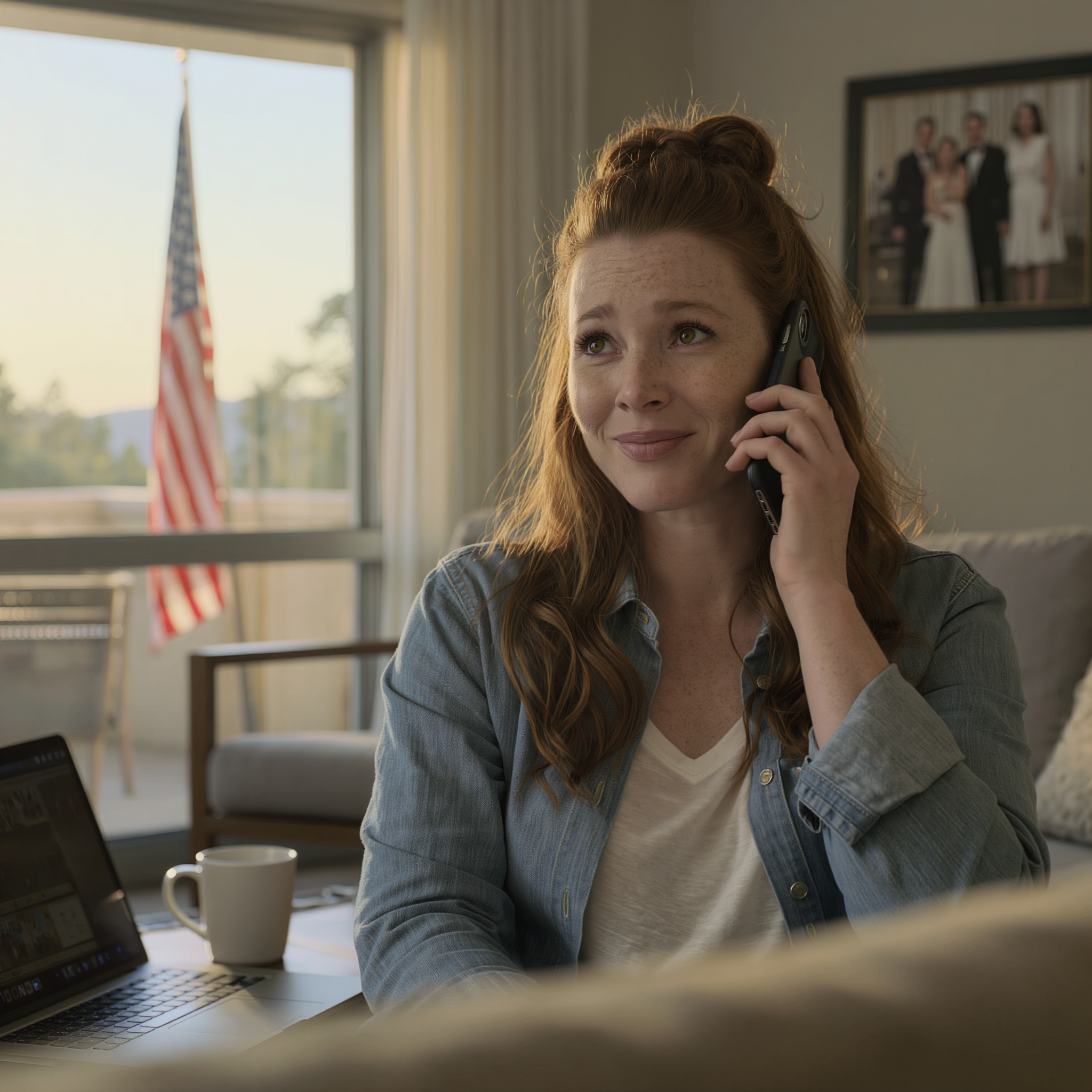
My family didn’t even notice when I quietly moved 3,000 miles away and built a new life for myself in California, but now that their golden-boy son is about to get married and the bride’s family has started asking why the “missing sister” never appears in any photos, my father has suddenly begun calling me over and over, demanding that I fly back immediately and play the perfect, obedient little sister — or else my name will never appear in his will.
Four minutes and thirty‑seven seconds.
That’s how long it took my father to threaten to cut me out of his will.
I know because when the call finally dropped, I glanced at the timer on my phone and actually laughed until tears blurred the mountains outside my living‑room window. There I was, barefoot in my sun‑washed apartment in San Jose, California, a standing desk pushed up against the glass, two monitors full of code, making more money at twenty‑eight than my parents had ever seen in one place… and three thousand miles away from the family in suburban Pennsylvania that had spent twenty‑seven years looking through me instead of at me.
The ridiculous part wasn’t even the threat.
It was that they had only just noticed I was gone.
Six months. That’s how long I’d been out of the state before someone in my family realized the quiet, forgettable daughter had literally disappeared.
By then, my life on the West Coast already felt more like home than the split‑level house on a sleepy cul‑de‑sac outside Pittsburgh where I’d grown up. Out here, my mornings started with sunlight spilling over the Diablo Range and the smell of good coffee, not with my dad yelling at the morning sports segment on TV while my mom fussed over Elliot’s schedule.
The last day in Pennsylvania had been nothing special from the outside—no big family send‑off, no dramatic airport goodbye. Just boxes.
They’d lined the walls of my old third‑floor walk‑up in the city like cardboard skyscrapers. Not shrines to childhood memories or precious family heirlooms—there weren’t many of those anyway—just practical containers holding the life I’d built entirely on my own in Pittsburgh: thrift‑store dishes, mismatched mugs from college, the cheap IKEA desk where I’d written a thousand lines of code and eaten a thousand bowls of instant noodles.
My friend Julia staggered down the narrow hallway with a box hugged to her chest, her face flushed and curls sticking to her forehead.
“Josephine, this weighs a ton,” she groaned, dropping it near the front door with a heavy thud that made the old hardwood tremble. “Are you sure you need all these?”
“I’m selling most of them anyway,” I said, tearing off a strip of packing tape. The harsh rip sliced through the hollow quiet of the half‑empty apartment. “Thanks for helping with all this.”
She flopped onto my secondhand gray couch—the only piece of furniture still standing in the living room—like a rag doll that had reached the end of its shift.
“I still can’t believe you’re actually doing this,” she said, pushing a strand of hair behind her ear. “Are you absolutely sure you don’t want to tell your parents?”
That question again.
Everyone kept asking it like informing people who treated you like wallpaper was some kind of moral obligation.
I laughed. Not the warm, bubbling kind that comes from joy, but the sharp, hollow kind that echoes around in the empty spaces where love should have been.
“Julia, they don’t even know where I live now,” I said. “Why would I tell them I’m moving across the country?”
The tiny galley kitchen door banged open and Simon walked in, wiping his hands on a dish towel. He’d been deep‑cleaning cabinets I was never going to see again, because that’s the kind of person he is.
“All clean in there,” he announced. His dark eyes carried that soft, steady concern he never quite hid. “So remind me again why your family doesn’t know about any of this?”
I sank down onto the bare hardwood floor next to an open box, the cold seeping through my jeans. The sensation grounded me as old memories rose like a tide I’d spent years trying to outrun.
“Because they’ve never cared about my life,” I said quietly. “And I’m not being dramatic. I’m being factual.”
Julia and Simon exchanged one of those looks people share when they’re watching something uncomfortable and sacred at the same time and have no idea what to say. They’d heard fragments of my family story over the years, but I’d never laid it all out.
Something about the echo of my own footsteps in that empty apartment, the finality of the lease ending, made me want to say the whole truth out loud for once.
“Look,” I began, picking at a bit of packing tape stuck to my fingers, peeling it back slowly. “When I was a kid, everything revolved around Elliot. From day one, he was the golden child. He’s two years older and, in my parents’ eyes, infinitely more valuable.”
“That’s messed up,” Simon said, sliding down the opposite wall so we were eye‑level across the cardboard canyon between us.
“When I was eight,” I continued, “I won first place at the school science fair.”
The memory slammed into me in full color.
The fluorescent‑lit gym at Lincoln Elementary. Rows of trifold posters. The smell of poster paint and Elmer’s glue. Kids in crooked name tags standing stiffly beside sagging projects. My volcano had not been the usual baking‑soda‑and‑vinegar explosion that left a sticky mess and bored judges.
I’d spent weeks tucked away in a corner of the Carnegie Library downtown, hunched over library books about tectonic plates and magma chambers. I’d built a working model that mimicked actual eruption patterns using food coloring, tubing, and a ridiculous amount of trial and error.
The judges had been impressed. My teacher had called my parents specifically to tell them how exceptional it was, how proud they must be.
“I remember standing by the dinner table that night,” I said, “certificate in hand, just… waiting for someone to notice.”
“What did they say?” Julia asked, even though I could tell she already dreaded the answer.
“You know what my parents said?” I let out a brief, humorless laugh. “My mom glanced at the certificate while she was refilling Elliot’s plate and said, ‘That’s nice, honey.’ And then they spent the rest of dinner talking about Elliot’s soccer practice. Not a championship game. Not a college scout. Just a regular Tuesday practice where he apparently made one decent pass.”
The apartment seemed to chill around us, as if the draft from the old windows had finally found a way in.
“It got worse as we got older,” I said. “When I was twelve, I made honor roll every single semester. Straight As. My parents barely glanced at my report cards. But when Elliot made varsity football as a sophomore, they threw him a party.”
I could see it like a scene from somebody else’s childhood.
Our cul‑de‑sac jammed with cars. Neighbors in Steelers jerseys stepping over extension cords in the yard. My dad grinning over a brand‑new stainless‑steel grill he’d bought just for the occasion, flipping burgers like he’d personally coached my brother to the NFL. My mom buzzing around with trays of store‑bought cupcakes frosted in school colors.
“People I’d never even seen before were in our backyard taking photos with Elliot,” I said. “Meanwhile, my honor‑roll certificates were shoved into a drawer next to old takeout menus.”
Simon shook his head slowly.
“Your parents suck,” he said simply.
“The real kicker came when we were teenagers,” I went on.
Elliot decided he wanted to go to this postcard‑perfect private college in New England—the kind with ivy‑covered brick buildings, a Latin motto, and sweatshirts that cost more than my entire middle‑school wardrobe. My parents practically levitated with joy.
“They were absolutely thrilled to pay for it,” I said. “Full tuition. Fancy off‑campus apartment. Meal plans, game tickets, spending money. Whatever he wanted.”
I could still see the glossy brochures spread across the kitchen table, their faces lit up by dreams of framed diplomas and tailgate parties.
“When I turned eighteen,” I said, “they sat me down for what my dad called a ‘financial reality talk.’ We were at that same kitchen table. My mom had her serious face on, like someone had died. My dad folded his hands and looked at me like a bank manager about to deny a loan.”
I mimicked his voice without meaning to.
“‘We’ve already spent the college fund on Elliot,’” I quoted, “‘so you’ll have to figure something else out for yourself.’”
Julia’s mouth fell open.
“Wait. They actually said it like that?” she demanded. “Just… ‘we spent it all on your brother, good luck’?”
“Pretty much,” I said.
The thing about being overlooked your entire life is that eventually, you stop waiting to be chosen and start building exits.
“Turns out I have a brain for more than model volcanoes,” I said. “I’d always loved computers—the logic of code, the way things either worked or they didn’t. No favoritism in a compiler.”
I pulled in a breath.
“So I got a full scholarship to study computer science at a state university outside Philadelphia,” I said. “Lived in the dorms. Worked two part‑time jobs for everything else. And basically stopped going home.”
The silence that followed wasn’t uncomfortable. It was heavy. Solid. The kind of quiet that says: I hear you. I believe you.
“They stopped inviting me for holidays,” I continued. “Just sent generic ‘Happy birthday!’ texts once a year. No calls. No visits. Just radio silence unless they needed someone to like a post about Elliot.”
I reached for my phone, opened Instagram, and scrolled to my mother’s profile. They didn’t follow me, of course, but her account was public. It always was—what’s the point of bragging if the whole world can’t see?
“Meanwhile,” I said, turning the screen so they could see, “my mom posts about Elliot constantly.”
There he was at a promotion party at his firm in downtown Pittsburgh three months ago—Elliot in a tailored navy suit, my parents beaming on either side of him. There he was at an engagement party last month in their perfectly staged backyard, string lights and mason jars and a catered charcuterie board arranged like a magazine spread.
“They didn’t invite you to his engagement party?” Simon asked, his voice dropping into that low register he used when something genuinely shocked him.
“Nope,” I said. “Found out the same way I found out about his promotion party—from social media. I saw the photos. Recognized the backyard.”
I paused.
“But it’s fine,” I added. “I figured out a long time ago that I’m not really part of their family. Elliot is their son. I’m just a person who happens to share their DNA.”
Julia got up, crossed the room, and folded herself down beside me. She wrapped me in a hug that smelled like vanilla perfume and drugstore shampoo and felt more like family than any embrace I’d ever gotten on that cul‑de‑sac.
“I’m so sorry, Josephine,” she whispered. “That really, really sucks.”
“It’s okay,” I said, and for the first time, I realized it was mostly true. “I’m over it. That’s why I’m excited about this move.”
I pulled back and wiped my eyes with the heels of my hands, more out of habit than necessity.
“I got an amazing job offer from a tech company in Silicon Valley,” I said. “Their office is just outside San Jose, near the 101. The salary is almost double what I’m making now, the work is cutting edge, and I never have to shovel snow again. It’s a reset button with palm trees.”
“That’s awesome,” Simon said, a slow grin spreading across his face. “You deserve every bit of that.”
“Thanks,” I said. “And the best part? I didn’t have to ask anyone for help. I hunted down the job posting myself, did all the interviews over Zoom, negotiated the salary, signed the offer, found an apartment, and arranged the entire move—all by myself.”
Julia grinned.
“Look at you,” she said. “Main‑character energy.”
“I am proud of myself,” I admitted.
The words felt new and shiny and a little dangerous on my tongue.
“I’ve been saving for years,” I added, “and with this new salary, I should be able to buy my own house within a year or two. Somewhere quiet, with good internet and a little yard. That’s all I really need.”
We finished packing in a comfortable, companionable silence. We taped the last boxes, argued briefly about whether I should keep my ugly but beloved lamp, and then, when there was nothing left to do, we ordered pizza from the corner place that always smelled like garlic and melted cheese half a block away.
We sat on the floor in the middle of the empty living room, eating straight from the greasy cardboard box, soda cans sweating on the bare wood.
The apartment felt like shed skin. Strange. A little raw. But suddenly lighter.
“So, what’s your plan for tomorrow?” Julia asked, wiping sauce from her chin with a napkin.
“Flight leaves at two,” I said. “These last few boxes are coming as luggage. Everything else is already shipped. The new apartment’s nothing fancy, but it has a balcony and a view of the mountains. I start work on Monday.”
“Have you told your grandmother about the move?” Simon asked.
My chest softened.
“Yeah,” I said. “I called her last week. She’s the only family member who’s ever actually cared about what I’m doing.”
My grandmother—my dad’s mom—lived in a little red‑brick house outside Scranton with a front yard full of roses and a kitchen that always smelled like coffee. Somehow, the compassion gene had skipped a generation. She listened when I talked. She remembered the details of my life. When my parents refused to help with college, she was the one who printed out scholarship applications at the public library and mailed them to me, deadlines circled in red pen.
“She calls to congratulate me on every accomplishment,” I said. “No matter how small. She knows exactly what’s going on with my parents, but she’s too classy to say it out loud.”
“That’s sweet,” Julia said. “I’m glad you have her.”
“Me too,” I said. “She’s seventy‑five, but she’s sharper than most people our age. She asked more questions about my stock options than anyone else.”
We stayed there until midnight, talking about California, my new job, the future that suddenly felt close enough to touch. These were my real family—the people who noticed when I walked into a room, who saved my moving date in their phones, who actually knew my address.
After they left, I sat cross‑legged in the center of my empty apartment, my breath echoing in the bare space.
Tomorrow, I’d board a plane at Pittsburgh International, fly to San Francisco, and drive down the 101 to a life nobody in my blood family knew existed.
No more feeling like an intruder at gatherings I wasn’t invited to. No more watching my parents orbit Elliot like he was the sun and I was a shadow.
Just me, my career, and the future I was building with my own two hands.
Six months later, I learned that sometimes the best revenge really is a life well lived.
It was a random Tuesday morning. My laptop hummed on my standing desk. The mountains east of San Jose cut against a sky so blue it looked edited. I could see them from my desk while I worked, from my tiny kitchen while I made coffee, from my balcony where I stood most evenings watching the sunset paint them gold and then purple.
The job was everything they’d promised and then some. My boss actually listened when I spoke in meetings. My coworkers were brilliant and weird in the best way—people who rode electric bikes to the office, argued about frameworks over tacos in downtown, and invited me to trivia nights without making me feel like an afterthought.
The salary meant I was saving money at a rate that sometimes made me refresh my banking app twice to make sure there wasn’t a mistake. I’d paid off the last of my student loan interest in a single click and then stared at the “balance: $0.00” screen until my eyes filled with tears.
On my lunch breaks, I’d sit at the kitchen counter with leftover pasta and scroll through real‑estate listings—actual houses with yards and updated kitchens in quiet Bay Area neighborhoods east of the city. Streets lined with palm trees and lemon trees, kids’ bikes abandoned on lawns, neighbors who waved when you pulled into the driveway.
For the first time in my life, I felt like I was moving toward something instead of just away.
My phone buzzed on the counter.
Unknown number.
I almost declined it—spam calls were as common as coffee runs—but something made me swipe to answer.
“Hello?”
“Josephine.”
My father’s voice.
It hit like a bucket of ice water poured down my spine. Sharp. Irritated. Not surprised. Just annoyed, as if I’d kept him waiting.
I couldn’t remember the last time he’d actually called me.
“You need to come home for dinner next Saturday,” he said.
No hello. No how are you. Just a command, delivered with the same easy authority he used when telling my mom to grab him another beer during a Steelers game.
Classic Dad.
“What dinner?” I asked, already certain I wouldn’t like the answer.
“Elliot’s fiancée’s parents want to meet you,” he said. “They’re traditional people. Family is important to them. They found out Elliot has a sister, and they want to get to know you. This is important for Elliot’s future.”
I had to bite my tongue to keep from laughing in his ear.
Of course. It always came back to Elliot’s future.
“I’m not coming,” I said.
Silence crackled on the line.
“What do you mean you’re not coming?” he demanded, anger taking shape in his voice like a storm cloud. “You can’t just refuse.”
“I mean exactly what I said,” I replied, leaning against the counter. “I’m not coming to your dinner party.”
“Why not?” he snapped.
Something in me loosened—some tiny knot that had been pulled tight since childhood. It wasn’t anger that rushed in to fill the space. It was something wilder. Freer. A kind of hysterical amusement at the absurdity of it all.
I started laughing.
Not politely. Not nervously. The kind of laugh that doubles you over, that feels like it might shake something loose that’s been stuck for years.
“What’s so funny?” Dad demanded.
“This whole situation,” I said, wiping at my eyes. “You want to know why I’m not coming? Fine. I’ll give you three reasons.”
I straightened, shoulders back, feet planted firmly on California tile.
“First,” I said, “we don’t have a perfect family. You have a beloved son—that’s Elliot—and an afterthought—that’s me. Let’s not pretend otherwise for people you want to impress.”
He sucked in a breath, but I kept going.
“Second, I’m not going to play a supporting role in some fake happy‑family performance for strangers just because it’s convenient for you now.”
“Josephine—”
“And third,” I said, savoring it, “I can’t come to dinner because I moved to California six months ago.”
The silence that followed was absolute.
I could practically hear the gears grinding in his head.
“You moved to California?” he said finally, each word clipped. “Without telling us? Why would you do that?”
“Why would I tell you?” I countered. “You never asked where I lived before.”
“How dare you move across the country without telling your family,” he exploded. “What’s your address? We need to know where you are.”
I was still laughing.
“Dad, do you remember my old address?” I asked. “The one where I lived for three years?”
He hesitated.
“Josephine, that’s not the point,” he said.
“Actually, it’s exactly the point,” I replied. “You don’t remember because you never cared enough to know. You’ve never been interested in my life. So why, exactly, would I keep you updated on it now?”
“Josephine, you can’t just—”
I hung up.
My phone lit up immediately.
Dad. Decline.
Mom. Decline.
Elliot. Decline.
I let them all roll to voicemail.
Then the texts started.
Mom: Josephine, family is important. We shouldn’t fight like this.
Elliot: Come on, Jo, just show up for one dinner. You can go back to California right after.
Dad: This is ridiculous. Call me back.
More messages. More missed calls. More demands disguised as concern.
It was like they’d suddenly remembered I existed and were furious I wasn’t jumping when they snapped their fingers.
I set my phone to silent, dropped it on the counter, and made myself dinner—salmon with roasted Brussels sprouts, the kind of meal I’d never had time or money to cook back when I was juggling class and two jobs.
As I squeezed lemon over the fish, my phone lit up again and again, buzzing itself toward the edge of the counter. I watched it for a moment, then slid it away from the edge like you’d move a noisy appliance into another room.
The entitlement in their messages was staggering.
Elliot needed his fiancée’s parents to believe he came from a picture‑perfect American family: loving parents, close siblings, a cozy house in a nice suburb. Suddenly, I was useful. A missing puzzle piece they hadn’t cared about until the box said the puzzle should be complete.
Where was this urgency for “family” when I was eating gas‑station ramen in my dorm room because I couldn’t afford anything else?
The calls and texts continued for three days. Some were guilt trips. Some sounded like bribes—promises of plane tickets, shopping trips, “quality time.” A few slipped and let the anger show.
I read them all.
I answered none.
On the third day, my grandmother called.
“Hello, sweetheart,” she said when I picked up. “How are you settling into California?”
Her voice was like stepping into a warm kitchen in winter.
“Really well, actually,” I said, pulling my knees up onto the couch. “I love it here.”
“I’m so glad to hear that,” she said. “Listen, your parents asked me to call you.”
I sighed.
“Let me guess,” I said. “They want you to convince me to come to Elliot’s fancy dinner.”
“They do,” she admitted. “But before I say anything, I want you to know I’m not going to pressure you. I understand your family situation. I understand why you don’t want to go.”
“Thank you, Grandma,” I said, my throat tight. “That means a lot.”
“Your parents are upset that you moved without telling them,” she said gently.
“Grandma,” I said, “they didn’t even know where I lived before. How exactly is that my fault?”
“It’s not your fault,” she said firmly. “I’ve watched this family dynamic for years, and I know how they’ve treated you. I’ve tried to talk to your father, but he doesn’t want to hear it.”
After we hung up, I felt lighter. Still hurt, maybe. But less crazy.
At least someone had been paying attention.
Saturday came and went.
Instead of flying east, I spent the day hiking a trail in one of the regional parks in the hills, the kind where the city drops away behind you and all you can see is dry golden grass, oak trees, and sky. I took pictures of wildflowers and cows, sent them to Julia and Simon, and let my phone stay blissfully quiet.
I felt free in a way I hadn’t known was possible.
Sunday morning, my dad called again.
“Josephine,” he said, his voice stiff. “We had to tell Elliot’s future in‑laws that you were sick and couldn’t make it to dinner.”
“Okay,” I said.
I kept my tone neutral, offering nothing.
“The wedding is in a month,” he said. “You need to be there.”
“I’m not coming to the wedding either,” I said.
There was a beat of shocked silence.
“Josephine, this is Elliot’s wedding,” he said slowly, as if I’d forgotten who my brother was. “You have to come.”
“No,” I said. “I don’t.”
His voice dropped into that dangerous register I remembered from childhood—the low, controlled tone that always came before punishment.
“If you don’t come to this wedding and show Elliot’s in‑laws that we’re a normal, loving family,” he said, “I’ll disinherit you. I’ll cut you off completely.”
I nearly dropped the phone because I was laughing so hard.
“You’ll disinherit me?” I repeated, incredulous. “Dad, I make more money than you, Mom, and Elliot combined. I don’t need your money.”
The silence this time felt different.
“Is that true?” he asked finally. “About your salary?”
“If you’d ever bothered to ask about my life,” I said, “you’d already know I work for a major tech company in Silicon Valley and make a very good living.”
His tone shifted in an instant, like someone had flipped a switch.
“Josephine,” he said, suddenly warm, almost jovial, “we’ve always been proud of you. We just want you to come home so we can be together as a family again.”
I hung up without another word.
An hour later, the messages from Elliot started.
Hey, Jo. Dad told me about your job. I’m really proud of you. I’ve always thought about you. I’ve missed you. Can we talk?
Then:
Look, I know things weren’t perfect growing up, but we’re adults now. We can fix this. Please just call me.
Message after message.
Now that they knew I was successful, they suddenly wanted me back in their narrative. Nothing about their behavior had changed. The only new detail was the size of my paycheck.
I blocked their numbers and deleted their contacts.
I was done.
A month slid by—a quiet, golden California month that started to feel like the baseline for how life was supposed to be.
No calls from my parents. No guilt‑drenched texts. No demands wrapped in the language of “family.”
Just me, my work, my friends, and the slow, steady process of turning a new city into home.
I narrowed my house search to a handful of serious contenders—single‑story ranches east of San Jose with lemon trees in the yard, decent school districts (just in case), and fiber internet. Every time I ran the numbers, they came back the same: I could actually do this. I could put twenty percent down, keep an emergency fund, and still sleep at night.
On a Sunday afternoon, my phone rang.
Grandma.
“Hello, sweetheart,” she said. “How are you doing?”
“Really good,” I said, pacing between my couch and the balcony door. “I’m looking at houses online. I think I found a few I want to see in person.”
“That’s wonderful, Josephine,” she said. “I wanted to tell you about the wedding. I have some photos to send you.”
“Oh?” I said, lowering myself onto the arm of the couch. “How did it go?”
“It was… tense,” she said frankly. “Your parents were not happy that you didn’t come. They kept making excuses for why you weren’t there, and it was obvious they were uncomfortable.”
“What kind of excuses?” I asked.
“First they told the bride’s parents you were still sick,” she said. “Then they said you had to work. Then they claimed you were traveling for business. The bride’s parents didn’t look like they believed any of it.”
I let out a slow breath.
“That must have been awkward,” I said.
“It was,” Grandma said. “And Elliot looked disappointed the whole time. He kept checking his phone, probably hoping you’d change your mind and show up.”
“Well, that’s not my problem,” I said.
“No, it’s not,” she agreed. “But, Josephine, there’s something else you should know.”
I sat up straighter.
“What kind of something else?” I asked.
“A few days before the wedding,” she said, “the bride’s parents had a very unpleasant conversation with your parents.”
My heart did a strange little flip.
“What kind of conversation?” I asked.
“Apparently, they did some digging,” she said. “They talked to people. Looked at social media. They figured out that your parents have basically ignored you for years and treated Elliot as the favorite. They were not happy about it.”
“Seriously?” I asked, unable to keep the shock—or the satisfaction—out of my voice.
“Seriously,” she said. “From what I heard, they told your parents they were disappointed in how you’d been treated and questioned whether Elliot came from the kind of family they wanted their daughter to marry into.”
Warm, electric vindication flooded my body.
“Wow,” I said. “That is… actually kind of satisfying.”
“Your parents and the bride’s parents ended up having a pretty significant argument,” Grandma continued. “The whole wedding had this uncomfortable atmosphere. Everyone could tell there was tension.”
“Did the bride’s parents say anything to Elliot?” I asked.
“I think they did,” she said. “I heard from your cousin that they asked him why he’d never mentioned having a sister, and why you weren’t involved in his life at all.”
“What did he say?” I asked.
“I don’t know exactly,” she said, “but apparently it didn’t go well. The bride looked upset during the entire ceremony.”
Later that day, Grandma texted me the photos.
I opened them on my laptop, one after another.
My parents stood in front of a flower arch, their smiles pulled tight and brittle. Elliot’s eyes kept darting to the side in different shots, like he was still searching the crowd for someone who wasn’t there. The bride’s parents looked stern in almost every photo, mouths pressed into flat lines.
I couldn’t have scripted a better consequence if I tried.
The next morning, Grandma called again.
“Josephine,” she said, “I wanted to update you on the family situation.”
“What’s happening now?” I asked, pouring coffee into my favorite mug.
“Well,” she said, “the bride’s parents are still asking questions about why you weren’t at the wedding, and they’re not satisfied with any of the answers they’re getting.”
“Good,” I said, before I could stop myself.
“Your parents are starting to panic,” she went on. “They’ve realized their treatment of you might actually affect Elliot’s marriage and his relationship with his new in‑laws.”
“That’s their problem,” I said. “Not mine.”
“I know, sweetheart,” she said. “But I think it’s important you know they’re finally starting to understand that their actions have consequences.”
She was right.
Meanwhile, my life was everything I used to daydream about lying awake in my childhood bedroom, listening to Elliot’s framed trophies rattle whenever our dad slammed a door.
My career was thriving. My apartment felt like my space, not just a place to sleep. My savings account quietly grew month after month. My weekends were full of farmers’ markets, new hiking trails, and spontaneous road trips down Highway 1 with friends from work.
“How are you doing with all of this?” I asked her.
“I’m fine,” she said. “I’ve watched this family dynamic for years, and I always knew it would catch up with them eventually. I just wish it hadn’t taken so long.”
“You were always good to me,” I said. “You’re the only one who ever really cared about what I was doing.”
“You’re a good person, Josephine,” she said, her voice warm. “You always have been. Your parents just couldn’t see it.”
After we hung up, I walked slowly around my apartment, fingertips trailing over furniture I’d bought with my own money.
My living room with the big, ridiculously unnecessary TV I’d splurged on.
The corner where I planned to put a reading chair when I finally moved into a house.
My desk, where my life kept expanding every time my code compiled.
A year later, that house wasn’t just a listing in my bookmarks.
It was mine.
It had been a year since I left Pennsylvania when I stood in the kitchen of my very own house, barefoot on cool tile, waiting for my coffee machine to finish.
Sometimes I still couldn’t believe any of it was real.
Three bedrooms. Two bathrooms. A yard with fruit trees and a little concrete patio. The fastest internet connection money could buy routed straight into a dedicated home office. A quiet neighborhood east of San Jose where kids rode scooters in the cul‑de‑sac and someone still put up too many inflatables at Christmas.
My grandmother called as the coffee finished dripping.
“Hi, Grandma,” I said, smiling as I answered. “How are you?”
“I’m doing well, sweetheart,” she said. “How’s the new house?”
“It’s perfect,” I said, looking around at the clean white cabinets I’d picked from a sample wall. “I love it here. I’ve got my office set up the way I like it, and I can work from home most days. The neighbors are really nice. One of them brought me a casserole my first week here. I thought stuff like that only happened on TV.”
“I’m so happy for you, Josephine,” she said. “You deserve all of this.”
“Thanks,” I said, leaning against the counter. “I still can’t believe I actually own a house. At twenty‑eight, I’m doing better than I ever let myself imagine.”
“You should be proud of yourself,” she said. “You’ve done so much, and you did it on your own.”
“I am proud,” I said. “And I’m planning to stay here for a long time. Maybe forever.”
“That sounds wonderful,” she said. “I have some news about your family, if you want to hear it.”
I sat down at the kitchen table I’d bought secondhand and refinished myself.
“Sure,” I said. “Hit me.”
“Well,” she began, “Elliot’s marriage isn’t going very well. The bride’s parents never really got over the whole situation with you not being at the wedding. They keep bringing it up, and it’s causing problems.”
“That’s unfortunate for Elliot,” I said. And it was. But my voice stayed flat.
“Your parents are still trying to figure out how to contact you,” she continued. “They’ve been asking everyone in the family if they have your new address or phone number.”
“I hope nobody’s giving it to them,” I said.
“Of course not,” Grandma said. “I told everyone you deserve your privacy, and if you want to talk to your parents, you’ll reach out yourself.”
“Thank you,” I said. “Really.”
“Your father calls me every few weeks,” she added, “asking me to convince you to come home for a visit. I keep telling him that’s not my job. He says they miss you and want to make things right, but then he always mentions how successful you are and how proud they are of you now.”
“So they still don’t get it,” I said.
“No, they don’t,” she agreed. “They think this is about money or success. They don’t understand that it’s about how they treated you your entire life.”
After we hung up, I wandered through my house.
My living room, with its oversized couch and throw blanket Julia had mailed me from a Target in Pittsburgh “so it feels like we’re still having movie nights together.”
My office, with dual monitors, a row of succulents that somehow weren’t dead yet, and a framed photo of the Golden Gate Bridge I’d taken on a fogless day.
My guest room, where Julia and Simon would sleep when they flew out next month. I’d already picked up extra toothbrushes and left fluffy towels folded at the end of the bed.
I thought about everything Grandma had just told me. A year earlier, I might have felt a tangle of anger or guilt or sadness about Elliot’s marriage problems and my parents’ sudden worry.
Now, I felt… nothing.
No boiling rage. No aching hurt.
Just a clear, quiet certainty that I had made the right choice.
Moving here. Cutting contact. Building something that belonged entirely to me.
My life was immeasurably better without their drama, demands, and last‑minute performances of parental concern.
That evening, I sat on my back porch while the sun slid behind the hills and painted the sky in layers of pink and gold and soft violet. Somewhere a neighbor’s dog barked. A sprinkler sputtered to life. Someone down the street laughed.
My phone buzzed on the table beside me.
Unknown number.
Josephine, this is Mom. I got a new phone number. Please call me. We need to talk.
I stared at the message for a full minute, feeling… nothing.
Then I deleted it.
Two hours later:
Josephine, I know you’re getting these messages. Your father and I realize we made mistakes. We want to fix things.
Delete.
We know you’re successful now and we’re proud of you. We should have been better parents.
Delete.
Please just give us one chance to explain.
Delete.
Elliot’s marriage is in trouble because of this situation. You’re our daughter and we love you.
I actually laughed out loud at that one, the sound snapping the quiet evening in half, before I hit delete again.
Over the next few days, the messages kept coming. Mom. Dad. Elliot. Second cousins I barely remembered from childhood Christmases in someone else’s living room. They tried different angles.
Guilt: Family is everything. Blood is thicker than water.
Pride: We brag about you all the time now. People are so impressed.
Obligation: You owe it to your brother to help fix this.
Vague threats: You’ll regret this one day.
I didn’t answer a single one.
I blocked numbers as they appeared. I changed my phone number and only gave the new one to people whose names made me smile when they popped up on my screen.
I checked to make sure my address wasn’t listed anywhere online. I locked my social media down so tightly it might as well have been buried in the desert.
The quiet that followed was… beautiful.
A month later, I was having dinner with coworkers at a trendy spot in downtown San Jose where the menu was all small plates and the lighting made everyone look like they’d slept nine hours.
We were halfway through a sizzling platter of fajitas when one of the women at the table asked, “So, do you have any siblings?”
“Nope,” I said easily, scooping peppers onto my tortilla. “Just me.”
She blinked.
“Oh,” she said. “What about your parents?”
“They’re not really part of my life anymore,” I said, taking a bite.
“I’m sorry,” she said immediately. “That must be really hard.”
I swallowed, took a sip of my margarita, and smiled.
“Actually,” I said, “it’s not hard at all. Cutting them off was the best decision I’ve ever made.”
And for the first time, saying it out loud in front of people who barely knew me, I realized how completely true it was.
I didn’t miss them. I didn’t wonder what they were doing. I didn’t lie awake feeling guilty.
I was just… living.
Six months later, my manager called me into a conference room with floor‑to‑ceiling windows and a view of the freeway.
I walked out with a promotion.
My salary jumped by another thirty percent. I was now leading a small team of developers, owning features that would roll out to tens of thousands of users across the country.
“You’re one of the most talented engineers I’ve ever worked with,” my boss said. “You have a real gift for seeing the big picture.”
On the drive home, I sat in ridiculous traffic on the 280 with the windows down and the radio up, grinning like an idiot at nothing.
I celebrated by buying myself a new car—a sensible hybrid with heated seats and Apple CarPlay—and booking a solo vacation to Japan.
In Tokyo, I walked under neon billboards and crossed Shibuya with a sea of strangers. I rode bullet trains past rice fields and low mountains. I ate ramen so rich and complex it made every microwaved packet from my college days feel almost insulting.
I sent Grandma photos from shrines in Kyoto and vending machines that sold hot coffee in cans. She texted back a string of heart emojis and then called me from her floral‑wallpapered kitchen in Scranton.
“You’re living your best life, sweetheart,” she said, her voice tiny through the international connection but full of pride. “I’m so happy for you.”
“I really am, Grandma,” I said, watching city lights flicker outside my hotel window. “I’m happier than I’ve ever been.”
“That’s all I ever wanted for you,” she said.
When I flew back to California and rolled my suitcase up the short walkway to my front door, there was a small stack of mail waiting in the box.
Junk. A couple of bills. A glossy catalog I definitely didn’t remember signing up for.
And one plain white envelope with my name and address written in painfully familiar block letters.
My father’s handwriting.
I turned it over in my hands.
For a second—just one—I wondered what was inside. An apology? An explanation? A list of conditions?
I walked into the kitchen, lifted the trash can lid, and dropped the envelope in.
I didn’t need to read anything he had to say.
I didn’t need their explanations or their regrets.
I didn’t need their money, their approval, or their late, conditional love.
I had my house, my career, my friends, my grandmother, and a future I’d built from scratch.
I had everything I needed.
Over the next year, my life kept expanding in directions that had nothing to do with my parents or my brother.
I drew up plans to knock down a wall and expand my office, maybe add built‑in bookshelves along one side. I started saving for a backyard project—raised garden beds, a little pergola, maybe a small home gym tucked into a corner of the yard so I could lift weights while the sun came up.
I bookmarked pages for local rescues and debated dog names with Julia and Simon over FaceTime. I looked at online catalogs for graduate‑level computer science courses I could take just because I wanted to know more.
My life was full. Busy in the best way. Peaceful in the quiet moments in between.
I made my own choices. I solved my own problems. I dealt with my own consequences.
No one else’s drama bled over into my space.
Sometimes, usually late at night when the house was still and the only sound was the soft hum of the fridge, I caught myself thinking about an alternate version of my life.
One where my parents had been different.
What if they’d supported me when I was a kid? If they’d shown up to the science fair with handmade signs and embarrassing enthusiasm? If they’d thrown a tiny party for every report card with straight As the way they’d thrown a huge one for Elliot’s varsity letter?
What if they’d split the college fund fairly, or insisted on helping me find my own path instead of quietly sliding it all toward my brother and shrugging?
Would I still have fought this hard? Would I still be this independent, this stubbornly self‑reliant? Would I still be the woman who moved across the country alone and built a life from nothing in a city where nobody knew her last name?
Maybe. Maybe not.
But eventually, every time, I reached the same conclusion.
Their neglect forced me to become someone who could survive without them.
It pushed me to build my own life, to find my own worth, to create my own happiness in a world where no one was going to hand it to me.
And standing in my kitchen in California, coffee in hand, morning sun on my face, my calendar full of work I loved and dinners with people who chose me on purpose, I realized something simple and solid:
I wouldn’t change a thing.
Not because what they did was okay.
But because I refused to let the worst parts of my story rewrite the best.
If you’re reading this and seeing pieces of yourself between these lines, maybe you need to hear it too:
Family is the people who notice when you’re gone, who care where you live, who show up when you succeed and when you fail—not just the ones who share your DNA.
Sometimes the greatest inheritance isn’t money in a will or a house on a cul‑de‑sac.
Sometimes it’s the strength to walk away, move states, build a life entirely your own… and never look back.
News

My husband said, ‘You should move somewhere else to live.’ With no money, I was forced to go to my husband’s company to work as a cleaner to support my children. Until one day, the secretary hurried over and whispered, “Hurry, hide under the desk. You need to hear the truth!”
Serena Hayes dipped her mop into the gray, soapy mess. The water was hot, but her hands had been freezing…

‘She’ll learn a lesson,’ my dad said after leaving my 8-year-old daughter alone at the airport while my entire family flew to Disney. In the family group chat, the message was simply: ‘Come pick her up. We’re about to board.’ My mother added coldly, ‘Don’t make us feel guilty.’ The moment their plane landed…
“She’ll learn a lesson,” my dad said, like he was talking about forgetting a homework assignment and not abandoning…
At my son’s 35th birthday party, he grabbed the microphone and announced in front of everyone: ‘This party was paid for entirely by my future father-in-law, my mother didn’t contribute anything at all.’ I calmly stood up and walked out. That night, I quietly rearranged my entire financial plan, transferring the company I had painstakingly built to someone else. The next morning, when I woke up, I saw… ’76 missed calls.’
My son humiliated me in front of two hundred people by saying I had not even paid for his cake….

This Christmas, my name is not on my family’s guest list. In their eyes, I am just an “invisible” daughter. I quietly booked first-class tickets to take my grandmother to Paris. On Christmas Eve, I calmly informed them and presented the family trust papers that I had rearranged.
This Christmas, I am not on the guest list of my own family. In their eyes, I am still the…

‘Sir, that boy lives with me,’ I said loudly when I saw the portrait in the mansion. I work as a cleaner in New York. I know him!
I clean houses for a living. Not the life I imagined when I left Wyoming for the East Coast with…

‘Move out. You have two days.’ – My parents gave my apartment to my brother right at his engagement party… I used to think my parents truly cared about me, until they publicly gave my apartment to my twin brother – the apartment I had put $30,000 into, which was my entire savings. The moment everyone applauded to congratulate them was also the moment I realized that, for them, everything between us had ended from that day on.
My parents gave my apartment to my brother at his engagement party in a leafy suburb just outside Chicago, without…
End of content
No more pages to load