
I used to get forgotten on December twenty‑fifth so often that I finally stopped reminding them the holiday existed.
This year, I bought myself peace.
On paper, it was an old stone manor in upstate New York, tucked outside a postcard town called Glenn Haven, where the streets were lined with flag‑draped porches and the diner still handed you a bottomless mug of coffee. In reality, it was a four‑acre no‑contact order built out of limestone, iron, and my entire savings.
They think I bought this place just to live in it.
They are wrong.
I bought this estate to finally end their game of forgetting me.
My name is Clare Lopez. At thirty‑five, I’d become a statistician of my own misery, calculating the probability of parental affection with the same cold detachment I brought to my work at Hian Risk and Compliance, a Manhattan firm whose offices overlook lower Broadway and the Statue of Liberty, as if patriotism could be itemized on a balance sheet.
In my profession, we deal in the currency of liability and exposure. We tell massive American conglomerates which safety corners they can cut without getting sued into oblivion, and which hairline cracks in the foundation will eventually bring the whole structure downs. It’s a job that requires a certain numbness—an ability to look at a disaster and see only paperwork.
It was a skill set I’d unknowingly been honing since I was seven years old.
The first year my parents “forgot” me, they forgot to set a place for me at the Christmas dinner table.
Back then, we lived in a colonial‑style house in Westport, Connecticut—picture‑perfect clapboard, a wreath on every window, the sort of place that looked like it should be on the front of a Hallmark card. My father, Graham Caldwell, worked in commercial real estate in Manhattan. My mother, Marilyn, stayed home and floated through charity luncheons and PTA meetings like a suburban minor celebrity. My younger brother Derek—two years younger but ten times louder—was the sun everything revolved around.
That year, the house smelled like roast beef and rosemary and the cinnamon candles my mother bought at the mall. Relatives filled the dining room, their laughter echoing down the polished hallway. I sat on the stairs, clutching a plastic reindeer I’d pulled from my stocking that morning, watching them eat.
There was no plate for me. No chair. My name card—calligraphed in looping ink like everyone else’s—was missing.
I watched them for a full hour.
When they finally noticed me, the excuses came in a flustered rush.
“Oh, Clare, we thought you were napping!” my mother cried, hand to her chest.
“You’re so quiet, honey,” my father added, already topping off his scotch. “We simply lost track of you.”
They squeezed a folding chair onto the corner of the table. Someone shoved a plate toward me with half‑cold potatoes and a sliver of meat. I was seven. I accepted the story because I had no other currency but their approval.
But the “accidents” kept happening.
They became a tradition as reliable as the tree or the stockings.
I was forgotten when they booked plane tickets to Aspen for a family ski vacation when I was sixteen and there somehow weren’t enough seats for me. I stayed home alone in Connecticut that New Year’s, watching the ball drop in Times Square on television while the house stayed dark and the driveway stayed empty.
I was forgotten when they planned a graduation dinner for Derek at a steakhouse in midtown and posted the pictures all over Facebook, but somehow missed my own college ceremony two years earlier, claiming a last‑minute business crisis.
The forgetting wasn’t a lapse in memory.
It was a weapon.
It was how they told me exactly where I stood in the Caldwell family hierarchy without ever saying the words out loud.
I was the safety net. I was the ghost. I was the one they called when Derek crashed his leased BMW on the FDR Drive and needed bail money, or when Graham needed a signature on a loan document because his own credit was leveraged to the hilt. They remembered me perfectly when they needed something signed, wired, or quietly fixed.
It was only when it came time to offer love, space, or even a simple seat at the table that my existence became hazy to them.
Last year was the breaking point.
It was the night the numbness finally hardened into something useful.
I had driven four hours through a sleet storm on I‑95 to get from my tiny walk‑up in Queens to their house in Connecticut. It was December twenty‑fourth. I hadn’t been invited, but I hadn’t been explicitly uninvited either. That gray area—that assumption that family was the default setting—was where we always lived.
I pulled my salt‑stained sedan into their circular driveway. My trunk was packed with gifts I’d spent two months’ salary on—New York boutique sweaters, a Knicks jersey Derek had once mentioned in passing, a set of Waterford wineglasses my mother had circled in a magazine.
The windows of the house glowed warm amber, the way Christmas is supposed to look in American greeting cards. I could see silhouettes moving inside. I could hear Bing Crosby drifting through the thick glass.
I walked to the front door, my wool coat heavy with freezing rain, and looked through the side pane.
They were all there.
Graham stood by the fireplace in his navy blazer, holding court with a tumbler of good single‑malt in his hand. Marilyn was laughing, her head thrown back, wearing the diamond earrings I’d bought her the year before on a Black Friday sale. Derek lounged near the bar, one arm casually around his newest girlfriend. A dozen relatives and friends crowded around a table set with china and candles.
There was no empty chair.
I knocked.
The sound seemed to kill the music instantly. After a moment, Marilyn opened the door. She didn’t look delighted or surprised. She looked inconvenienced.
“Oh, Clare,” she said, clutching her wineglass against her chest as if I might snatch it away. “We thought you were working. You’re always working.”
She didn’t step aside.
She stood in the doorway, blocking the warmth while sleet hit my face behind her.
Over her shoulder, I saw Graham glance toward us. Our eyes met for a second. Then he turned his back and refilled his drink.
They hadn’t forgotten I existed.
They had decided the picture of their perfect American family looked better without me in the frame.
I didn’t yell. I didn’t cry. I handed Marilyn the bag of gifts, turned around, walked back to my car, and drove four hours back to my empty apartment in Queens.
That was the night I realized that hoping for them to change was a liability I could no longer afford.
In my line of work, when a client refuses to mitigate a risk, you drop the client.
So this year, I dropped them.
The preparation took eleven months. It was a forensic dismantling of my former life.
I changed my phone number and registered the new one through a burner app that routed through three different servers in three different states. I set up a post office box in a town forty miles from where I actually lived. I scrubbed my social media presence—locking down every account, removing every tag, vanishing from the digital world as thoroughly as I had vanished from their dinner table.
I instructed HR at Hian to flag any external inquiries about my employment as security threats. No “Can we confirm her salary?” No “Is she still with the company?” They were to be treated like phishing attempts.
And then I bought the house.
The manor was in Glenn Haven, a town that smelled of pine needles and old money that had long since stopped flaunting itself. Two hours north of Manhattan, past the last commuter rail stop, you crossed a steel truss bridge over a black river and the world shifted from glass and steel to clapboard and stone.
The house itself was an architectural beast built in the 1920s—a mix of Tudor and Gothic revival that some long‑dead industrialist had commissioned as a hunting lodge. It sat on four acres of land bordered by a dense, uninviting forest. Stone walls two feet thick. Leaded‑glass windows. Iron gates that groaned like dying animals when you pushed them.
It was not a cozy house.
It was a fortress.
I bought it for $1.2 million. I did not buy it as Clare Lopez.
I formed a limited liability company called Nemesis Holdings, paying the filing fees in cash at a dingy storefront near Penn Station. I hired a Manhattan attorney who specialized in privacy trusts and told him I wanted my name nowhere near the deed. He set up the Glenn Haven Preservation Trust, a shell designed to “protect the property’s historic character,” which in practice meant it protected me. On local tax records, the owner was a faceless entity. The trustee of record was the trust itself.
To the world—and specifically to Graham and Marilyn Caldwell—Clare Lopez was a ghost.
I told no one about the house. Not my few friends from Hian, not my colleagues, not the barista who always wrote my name with a heart over the i even though there is no i in Clare.
Silence was the most expensive thing I had ever bought, and I savored it.
On December twenty‑third, the air in Glenn Haven was sharp enough to cut glass. I stood at the end of the long driveway, looking up at the house. It loomed against a gray sky, a silhouette of sharp angles and dark slate rooflines.
The windows were dark because I hadn’t turned the lights on yet. I liked the darkness. It felt honest.
I was wearing a heavy wool coat and leather gloves, my breath pluming in front of me. I’d spent three days here alone. The pantry was full. I had a freezer full of steaks and good California wine. The library was stacked with the serious novels and non‑fiction books I’d been meaning to read for five years but never had time for in the city. The main hall had a fireplace big enough to roast a whole hog.
I planned to use it only to burn the few remaining photographs I had of my childhood.
For the first time in my life, the silence around me wasn’t the result of exclusion.
It was the result of selection.
I chose this. I built this wall.
I walked up the stone steps to the front door. The key was heavy brass, cold in my hand. When I unlocked the door and stepped inside, the air smelled faintly of cedar and dust.
I did not feel lonely.
I felt fortified.
My boots clicked on the marble as I crossed the foyer. I passed the dining room, where a long mahogany table sat empty. I ran my hand along the back of one of the high‑backed chairs.
There would be no turkey here. No forced laughter. No parents looking through me as if I were made of glass.
In the kitchen—a cavernous space with industrial‑grade stainless‑steel appliances that belonged in a Brooklyn restaurant, not someone’s home—I poured myself a glass of New York tap water and leaned against the granite island.
I thought about what they were doing that very moment.
It was the twenty‑third, which meant that in their Connecticut colonial, Marilyn was probably micromanaging the placement of ornaments on their twelve‑foot fake tree from Costco. Graham was likely hiding in his study, pretending to check the S&P 500 while really watching sports, a glass of bourbon sweating on a coaster. Derek was almost certainly already drunk or high or both, breaking something expensive and blaming the maid.
Maybe they were wondering why I hadn’t called.
Or maybe they were relieved.
Maybe they were telling their friends that “Clare has gone off the rails again” and “Clare is having one of her episodes” in that long‑suffering martyr tone Marilyn loved to adopt.
Let them talk.
Their words couldn’t reach me here.
I was behind stone walls and a trust‑fund shield.
I finished my water and decided to inspect the perimeter. Old habits die hard. In risk and compliance, you always assess the vulnerabilities first. Check the exits. Identify the choke points.
I walked out the back door onto the terrace that overlooked an overgrown garden. Snow fell softly, big flakes sticking to the stone balustrade. Beyond the yard, the woods rose up in a wall of black trunks and white branches.
It was beautiful in a stark, brutal way.
This was what I wanted—a Christmas that belonged to me, in a house that owed nothing to anyone.
I had spent thirty‑five years waiting for someone to give me permission to be happy, to take up space. Standing there, in the shadow of this massive house I’d bought with my own money cleaning up other people’s disasters, I realized a simple truth.
You do not ask for permission.
You take it.
You sign the deed. You wire the funds. You lock the gate.
I filled my lungs with icy air. A strange sensation bloomed in my chest.
It took me a moment to name it.
Pride.
Cold, hard, solitary pride.
I turned to go back inside, planning to light the fire in the library and open a bottle of Napa Cabernet that cost more than my first car. I was going to sit in a leather chair and read until my eyes burned. I was going to sleep until noon. I was going to exist loudly and unapologetically in this empty house.
Then I heard it.
At first, it was a faint vibration under the silence, carried on the wind that blew down the valley—the low, steady hum of engines.
I froze, my hand on the doorknob.
The road that led to my driveway was a dead end. The nearest neighbor was two miles away, a retired couple from New Jersey who only came up in the summer. In December, nobody had any reason to be on Blackwood Lane unless they were coming to this house.
The sound grew louder. It wasn’t the rattle of a UPS truck or the high whine of a compact sedan.
It was the throaty rumble of large SUVs.
I stepped back into the shadow of the doorway, my heart kicking a sudden, violent rhythm against my ribs. I checked my watch. Four in the afternoon. The winter light was already failing.
Keeping the interior lights off, I moved through the house to the front foyer and edged one of the heavy velvet curtains aside.
Through the iron bars of the main gate at the end of the snow‑covered drive, I saw headlights cutting through the gloom.
Not one pair.
Two.
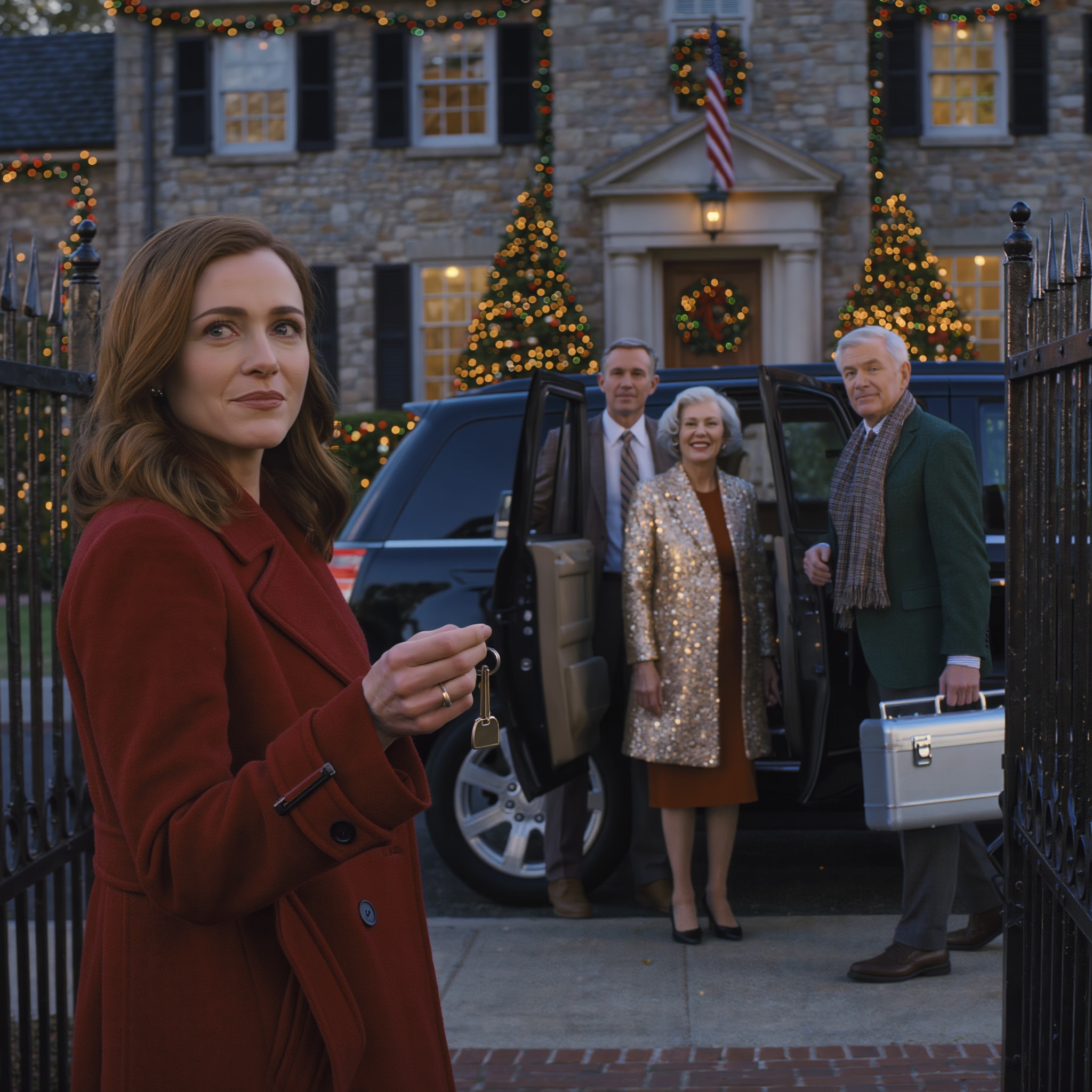
Two black SUVs rolled to a stop in front of my gate. Their engines idled, exhaust pumping gray clouds into the bitter New York air. A white utility van with PRECISION LOCK & KEY stenciled on the side pulled in behind them.
The driver’s door of the lead SUV opened.
Even at a distance, even through falling snow, I knew the shape of that coat and the arrogant tilt of that head.
Graham.
My stomach dropped—not with fear, but with a sudden hot rage.
How?
How had they found me?
I had covered every track. I had sealed every leak.
The passenger door opened.
Marilyn stepped out, wrapped in a fur coat, looking up at the manor not with awe but with a critical, possessive squint, as if she were inspecting a hotel suite she might complain about.
The back door of the second SUV opened.
Derek stumbled out in an expensive hoodie under a blazer—his idea of “tech founder” chic. He didn’t look at the house. He looked at his phone, then at the utility pole down the road, then at the thick conduit line running along the stone wall.
From the utility van, a man in blue coveralls climbed out and walked around to the back. He pulled out a heavy red toolbox.
Precision Lock & Key.
A locksmith.
They had not come to knock.
They had not come to ring the bell and hold a Hallmark‑style intervention.
They had brought a locksmith.
They were not here to visit.
They were here to break in.
I let the curtain fall back into place. The silence of the house was no longer peaceful. It was the silence of held breath before a scream.
For the first time in a year, I felt that old familiar sensation of being small.
Then I looked at the deed to the house sitting on the hall table. I looked at the security panel on the wall, blinking a steady red.
They thought I was still the daughter who waited on the stairs for scraps.
They thought this was a family dispute.
I reached into my pocket and pulled out my phone.
I did not call them.
I did not go out to greet them.
I watched the tiny red light on the security panel blink.
“Let them try,” I whispered to the empty foyer. “They have no idea who lives here now.”
I went to the smaller pedestrian gate near the driveway, staying on my side of the bars. Snow crunched under my boots as I walked through the freezing air.
Graham saw me first. He walked up to the main iron gate, stopping two feet away.
He didn’t say hello.
He didn’t say, “Merry Christmas.”
He nodded as if acknowledging a late employee.
“Open it up, Clare,” he said. “It’s freezing out here.”
“How did you find me?” I asked. My voice came out calm, which surprised me.
Graham sighed, a puff of white air escaping his lips. He looked annoyed that I’d asked a question that required effort.
“You’re not a ghost, Clare. You’re sloppy,” he said. “You posted a photo on that architecture forum three months ago. The gargoyle on the east cornice? You asked about limestone restoration.”
A cold pit opened in my stomach.
I remembered the post. I’d used a burner account. I’d cropped the background.
“You didn’t scrub the metadata,” Graham said with a thin smile. “And even if you had, that gargoyle is unique to the old Vanderhoeven estate. It took Derek about ten minutes to cross‑reference it. You really should be more careful if you’re trying to hide from the people who love you.”
Love.
The word hung in the air like a foul smell.
“Why are you here?” I asked.
Marilyn stepped forward, flanking Graham like a well‑rehearsed duo.
She reached through the bars, fingertips stretching toward my arm.
“Oh, Clare,” she choked, her voice wobbling with a vibrato that would have won awards on daytime television. “How can you ask that? It’s Christmas. Families belong together at Christmas. We couldn’t let you spend it all alone in this mausoleum.”
Her eyes darted past me, taking in the façade of the manor, the tall windows, the broad stone steps. The grief in her expression flickered into appraisal.
“It’s very big, isn’t it?” she murmured. “Much too big for one person. You must be terrified.”
“I’m not terrified,” I said. “And I’m not alone. I’m solitary. There’s a difference. Go away.”
I turned to walk back toward the house.
“Hey, the voltage here is industrial, right?” Derek’s voice cut across the cold air.
He had wandered toward the electrical panel by the gate, phone in one hand, the other tracing the conduit lines.
“The listing said the previous owner had a kiln. That means three‑phase power.”
“What are you doing?” I demanded.
Derek didn’t answer. He waved a hand toward the second SUV. The trunk popped open.
Inside sat three open‑frame server racks packed with graphics cards and cooling fans. Mining rigs. The kind of high‑density crypto hardware that gets you evicted from Brooklyn lofts and sets off ConEd transformers.
Graham answered for him.
“Derek needs a place to set up his hardware,” he said smoothly. “His startup is in a critical phase. He needs a stable environment with high amperage and low ambient temperature. A stone basement in winter is perfect.”
“He’s not setting up anything here,” I said, walking back to the bars. “This is my property. You’re trespassing. Leave.”
Graham chuckled.
He reached into the inside pocket of his cashmere coat and pulled out a folded document—legal‑size paper, thick enough that I could see the texture even from two feet away.
“Actually,” he said, smoothing it against the iron bars so I could read. “We’re not trespassing. We’re tenants.”
I squinted at the header. Standard boilerplate for a residential lease. My eyes dropped to the terms.
Tenant: Derek Caldwell and Graham Caldwell.
Premises: Basement level and auxiliary power grid of 440 Blackwood Lane.
Rent: One dollar per month.
Term: Ninety‑nine years.
And at the bottom, my signature.
Or something that looked exactly like it.
The looping C, the sharp strike of the L, the trailing E—it was a perfect copy of the signature I’d used on my college loan documents.
“I never signed that,” I said, my breath fogging in the air.
Graham shrugged, folding the paper and sliding it back into his coat.
“It’s right here, Clare. Signed and dated last week. Maybe you forgot. You’ve been under a lot of stress lately.”
“This is insanity,” I said, my voice rising. “That’s a forgery. I’m calling the police.”
“Go ahead,” Graham said, his tone dropping into something darker. “Call them. Show them your deed. Show them this lease. It’s a civil matter, Clare. Do you know how long it takes to evict a tenant with a signed lease in this state? Especially family members at the holidays?”
He smiled.
“Months. Maybe a year. By the time a judge looks at this, Derek will have mined enough crypto to buy this town. Or he’ll have burned the house down. Either way, we’re moving in.”
He turned toward the white van.
“Let’s get started,” he told the locksmith.
The man in blue coveralls shifted his weight, the red toolbox hanging from his hand.
“Mr. Caldwell?” the locksmith said, looking from the gate to me. “The lady says she didn’t sign anything.”
Graham walked over to him, laying a hand on his shoulder in a gesture of paternal concern.
“I’m so sorry you have to see this, son,” Graham said, his voice suddenly soft and heavy with grief. “My daughter… she’s having an episode. She’s struggled with mental health issues for years. She goes off her medication, she disappears, she buys these strange places and locks herself in. We’re just trying to get her home. We have a lease. We have the medical power of attorney pending. We just need to get inside before she hurts herself.”
The locksmith looked at me. I stood there behind the bars, rage burning through my veins, fists clenched in my gloves.
To a stranger, I probably did look rigid. I probably did look like the unstable one—standing alone in a dark manor, refusing to open the gate for my crying mother on Christmas.
Marilyn pressed two fingers to her lips, summoning fresh tears.
“Please,” she whispered to the locksmith. “She’s all alone in there. She thinks we’re the enemy. It’s the paranoia talking. Please, just open the gate so we can take care of our little girl.”
The locksmith looked at Marilyn’s tears, at Graham’s expensive coat and calm demeanor, then at me.
He made his choice.
“I’m sorry, ma’am,” he said to me, apologetic but firm. “I’ve got to listen to the legal guardians. If you’re sick, you need help.”
He walked to the control box, raised his drill, and pressed the bit to the metal housing.
The whine of the drill bit upshifting into a scream snapped me into motion.
I stepped back from the gate.
I did not scream. I did not beg.
I pulled out my phone and dialed 911.
“This is 440 Blackwood Lane,” I told the dispatcher, my tone steady. “There’s an active break‑in. Four intruders are attempting to bypass my security gate using fraudulent documents and a locksmith.”
I did not tell her they were my parents. I did not mention Christmas.
Trespass is trespass.
Five minutes later, the blue and red flash of a county sheriff cruiser washed over the snow‑covered trees as it rolled up the lane.
The officer who stepped out was young, maybe late twenties, cheeks flushed from the cold, Midwestern‑looking in his standard tan uniform. He adjusted his belt as he approached the gate.
By the time he reached them, I’d retreated to the interior side of the bars.
Graham intercepted him first.
He had a way of talking to men in uniform, a blend of deference and entitlement honed over decades of traffic stops and zoning hearings. He adopted a posture of respectful authority—the I pay the taxes that fund your salary, officer stance.
“Thank God you’re here,” Graham said, his voice smooth and reasonable. “We were about to call you ourselves. We’ve got a bit of a domestic crisis.”
The officer’s gaze flicked from Graham to the locksmith, to the white van, and finally to me.
“Ma’am,” he said, addressing me. “Is this your property?”
“Yes,” I said. “My name is Clare Lopez. I am the sole resident. These people are trespassing. I want them removed.”
Marilyn let out a sob so perfectly strangled it could have been scripted.
“Officer, please,” she said, stepping closer, clutching a handkerchief. “That’s our daughter. She’s not well. She stopped answering her phone, she stopped taking her medication, she cut off everyone. We just want to make sure she’s safe.”
“I am not on medication,” I said evenly. “I am perfectly safe. I am being harassed.”
Graham shook his head sadly.
“See?” he said to the officer. “That’s the paranoia. She thinks everyone’s out to get her. Look, we don’t want to make a scene. We just want to get our son settled in. We have a lease.”
He pulled out the folded document again and handed it over like a winning lottery ticket.
The officer unfolded it, shining his flashlight over the text. The wind whipped the corners.
“This looks like a standard lease agreement,” he said after a moment, eyes landing on the signature line. “It’s signed by a Clare Lopez. Is that you?”
“It’s a forgery,” I said. “I never signed that.”
“Clare,” Graham sighed. “You signed it last Tuesday. You were lucid then. You wanted Derek close. Please don’t do this.”
He turned to the officer.
“She has dissociative episodes,” he said. “She forgets things she’s done. It’s why we’re here. We’re just trying to move her brother into the basement unit as agreed so someone can keep an eye on her. We’re not breaking in. We’re tenants exercising our right to access the property.”
The officer looked at the lease, then at the locksmith, then at the two SUVs, then at me standing behind the bars of my own gate.
He saw a well‑to‑do family concerned for a daughter.
He saw a signed legal document.
He did not see a crime.
He saw a headache.
“Ma’am,” he said finally, handing the paper back to Graham, “if there’s a signed lease and you’re disputing the validity of the signature, that’s not something I can determine on the side of the road. That’s a matter for a judge. I can’t kick people off a property if they have documentation saying they live there.”
“They don’t live here,” I said, my composure cracking for a fraction of a second. “They don’t have a key. They never did. They’ve brought a locksmith and a truckload of illegal equipment. This is not a tenant dispute, it’s a break‑in.”
The officer’s tone cooled.
“Look,” he said. “If you’ve got a tenant dispute, you need to take it to civil court. I can’t stop them from entering if they’ve got paperwork. Keep the noise down, sort it out inside. If I have to come back out here for a disturbance, then we’re going to have problems. But right now, this is civil.”
He turned and walked back to his cruiser.
I gripped the cold iron bars and watched his tail lights fade down the road.
The law had just looked me in the eye and shrugged.
The moment the cruiser disappeared, the performance dropped.
Graham’s face shed its mask of concern and settled into smug satisfaction.
“Told you,” he said. “Civil matter.”
Derek didn’t waste a second.
While we argued, he’d been busy. He’d dragged three more server racks out of the SUV and lined them up against the brick pillar by the gate. Now he had his phone pressed to his ear, voice raised over the wind.
“Yes, this is Derek Caldwell,” he said loudly. “I’m the new tenant at 440 Blackwood Lane. I need to transfer the electric service into my name effective immediately. Yes, the basement unit. I have the lease right here.”
He was establishing a paper trail.
Electric account. Lease. Police report labeling it civil.
Every minute I stood here arguing was a minute they poured concrete around their lie.
If I screamed, I looked crazy.
If I physically blocked them, I’d be assaulting a “tenant.”
If I opened the gate, I’d be surrendering.
Cold clarity washed over me.
It was the same feeling I got at Hian when I realized a project was irretrievably broken and needed to be burned to the ground to save the client.
I let my hands fall from the bars.
I reached for my phone.
This time, I didn’t call the police.
I opened the camera app and hit record.
“State your name and the name of your company,” I said, training the camera on the locksmith.
He looked startled. “Uh… Jim Miller. Precision Lock & Key.”
I panned to the license plate of his van, capturing it clearly, then to the plates on both SUVs.
Then I turned the camera on Graham.
“Graham Caldwell,” I narrated. “Attempting unauthorized entry into 440 Blackwood Lane using a forged instrument. Date December twenty‑third. Time 4:42 p.m.”
“Stop that, Clare,” Graham snapped. “You’re being childish.”
I didn’t stop.
I zoomed in on the lease in his hand, capturing the fake signature.
Then I pivoted the camera to Derek.
“Derek Caldwell,” I said, “attempting to fraudulently transfer utility services for a property he does not own and does not reside in.”
Derek flipped me off.
I caught that, too.
I was building a file.
In my world, the person with the best documentation wins.
They were playing emotional manipulation and physical intimidation.
I was about to play liability.
“Open the gate, Clare,” Graham said, patience thinning. “The officer said we can come in. The locksmith is going to drill it anyway. You’re just costing yourself money.”
“You’re right,” I said. “The officer said it’s a civil matter. That means he won’t arrest you for entering. But it also means he won’t arrest me for what I do next.”
I turned my back on them.
“Where are you going?” Marilyn shrieked.
I didn’t answer.
I walked up the driveway, snow crunching under my boots. Behind me, the drill whined to life again.
By the time I reached the front door, they’d started on the lock mechanism of the gate.
Inside, the foyer was dim. I slammed the oak door, threw the deadbolt, and dropped the heavy iron bar across it.
My hands shook—not from cold, but from adrenaline.
They wanted to play with paper.
Fine.
I went to the library, sat at the heavy mahogany desk I’d bought at an estate sale two days earlier, and opened my laptop.
I created a new folder on the desktop.
INCIDENT_DECK_23.
I dragged in the photos and videos I’d just taken. I added screenshots of Derek’s social media where he bragged about his “mining empire.” I added a scan of the deed and trust documents.
Then I scrolled through my contacts to a number I’d hoped I’d never have to use.
Grant Halloway.
He wasn’t a family lawyer. He was a shark—a property‑litigation specialist out of midtown Manhattan whose hourly rate could pay a month’s rent on a decent SoHo apartment. He handled corporate hostile takeovers, zoning wars, and the kind of ugly real‑estate disputes that made headlines in The Wall Street Journal.
He cost six hundred dollars an hour.
He was worth every penny.
I hit call.
“Halloway,” he answered on the second ring, his voice gravel over velvet.
“Grant, it’s Clare Lopez,” I said.
“Clare,” he said, tone sharpening. “I thought you were off the grid, enjoying the new fortress.”
“The fortress has been breached,” I said.
I glanced at the security monitor mounted on the wall. The gate was swinging open. The SUVs were rolling through.
“My parents and my brother just forced entry onto the grounds. They have a forged lease with my signature. The local sheriff called it a civil matter and left. They’re bringing in industrial crypto‑mining equipment.”
There was a beat of silence.
“A forged lease,” Grant repeated. “And they’re moving in?”
“Yes.”
“That’s bold,” he said. “Stupid, but bold. Do you want me to file for an emergency eviction?”
“No,” I said. “An eviction takes too long. They know that. They want to drag this out for months.”
“Then what do you want?” he asked.
On the monitor, Graham’s SUV stopped in front of the house. I watched him step out and look up at my windows like a man claiming a prize.
“I want to destroy them,” I said quietly. “I want to use every zoning law, every preservation ordinance, every clause in the trust agreement to crush them. I want them to regret the day they learned to spell my name.”
Grant chuckled softly.
“Music to my ears,” he said. “Send me everything you have.”
I emailed him the folder.
Downstairs, a heavy fist pounded on the front door.
“Clare!” Graham’s voice boomed through the oak. “Open up. Stop being dramatic.”
I didn’t move.
I watched the monitor, saw them conferring on the porch.
My phone buzzed.
“Power’s out there?” Grant asked when I picked up. “Any neighbors close by?”
“Power is on for now,” I said. “No neighbors for two miles.”
“Good. Listen to me. They’re going to escalate,” he said. “They’ve tried the lease. Next they’ll try mental‑health law. They’ll talk about power of attorney. I’m calling the dispatch supervisor now. The sheriff who was just there made a bad call. When he comes back, I want you to open the door.”
“Open it?” I asked.
“Trust me,” Grant said. “Do you see the cruiser?”
I went to the front hall window and peeked through the curtain.
The same sheriff’s cruiser idled at the end of the drive, lights flashing this time.
“He’s back,” I said.
“Put me on speaker,” Grant said. “And open the door.”
My heart hammered.
I slid back the iron bar and turned the deadbolt. The heavy oak door swung open.
Graham stumbled forward, fist midair, suddenly off‑balance. Marilyn stood behind him, shaking theatrically in her fur. Derek hovered on the porch with his phone out.
The locksmith—Jim Miller, I saw now from his name tag—knelt on the step, drill still in hand, eyes wide.
“Finally,” Graham snapped, straightening his coat. “You’re making this incredibly difficult for everyone.”
I didn’t step aside.
I blocked the doorway with my body and held my phone up, speaker on.
“Officer,” I called past them.
The sheriff had climbed out of his cruiser and was trudging up the driveway, boots crunching in the snow.
“I thought I told you folks to settle this inside,” he said, exasperated.
“They’re breaking in,” I said. “And my lawyer would like a word.”
Graham frowned at the phone.
“Who is this?” he demanded.
“This is Grant Halloway,” Grant’s voice boomed from the speaker. “I represent the Glenn Haven Preservation Trust.”
Graham laughed, a short, dismissive bark.
“We don’t care about your trust,” he said. “We have a lease signed by the owner. Officer, my daughter—”
“Officer,” Grant cut him off, ignoring him completely. “Please ask Mr. Caldwell to show you that lease again. Specifically, look at the name of the landlord.”
The sheriff looked at Graham.
Graham, looking irritated, unfolded the paper and held it up.
“It’s signed by Clare Lopez,” he said. “My daughter. She owns the house. She leased the basement to us.”
“Now, Officer,” Grant said, “I want you to verify the deed for 440 Blackwood Lane. You can do it in your cruiser computer, or I can email you the certified copy.”
The sheriff hesitated, then stepped back toward his cruiser.
“Dispatch, run a property check on 440 Blackwood,” he said into his radio. “Need listed owner.”
We waited.
The wind howled around the eaves.
Marilyn shivered in her fur and shot me a withering glare.
The radio crackled.
“Unit Four, property owner listed as Glenn Haven Preservation Trust. Tax ID ending in 990.”
The officer frowned.
He looked at the lease again.
“Officer,” Grant said, voice like a blade. “As you just heard, Ms. Lopez does not own that house. The Glenn Haven Preservation Trust does. Ms. Lopez is the resident trustee. She has no legal authority to lease any portion of that property to a private party for commercial cryptocurrency mining. Even if that signature were real—which it is not—the contract is void from the start. You cannot lease what you do not own.”
I watched realization spread across the sheriff’s face.
Graham’s complexion went splotchy red.
“But—” he stammered, looking from me to the officer. “She bought it. She said she bought a manor.”
“I bought a controlling interest in a trust,” I said. “For privacy and protection.”
“Furthermore,” Grant continued, “since the lease is a forgery attempted to gain access to corporate property, this is no longer a domestic civil dispute. This is attempted corporate fraud and criminal trespass. The Glenn Haven Preservation Trust has no family relationship with Mr. Caldwell and does not consent to his presence. We are requesting that you remove these individuals from the premises immediately, or we will be filing charges against your department for aiding and abetting a felony.”
The sheriff’s demeanor changed.
The gray domestic area vanished. Now he was looking at a corporate crime.
He stepped forward.
“Mr. Caldwell,” he said, voice hard. “Step away from the door.”
“Now wait a minute,” Graham sputtered. “This is a technicality. She’s my daughter.”
“The deed says the trust owns this house,” the sheriff said. “Your lease is with someone who doesn’t hold title. That paper is worthless. You’re trespassing on trust property. Pack it up.”
Marilyn let out a wail, but it cut short when the sheriff turned that same hard gaze on her.
“Ma’am. Back in the car.”
Derek, who’d been silent, suddenly lunged forward.
“But my servers,” he blurted. “We moved them—this temperature is perfect—”
“Get them off the road,” the sheriff said. “If they’re not gone in ten minutes, I’m calling a tow truck for the vehicles and I’m arresting all three of you.”
Jim Miller, realizing just how close he’d come to committing a felony, packed his drill into his case with lightning speed.
“Sorry, ma’am,” he mumbled to me, not meeting my eyes, and almost jogged to his van.
I stood in the doorway and watched them unravel.
For the first time in my life, Graham looked at me not with bored disappointment but with hate.
“You’d do this to your family?” he hissed. “On Christmas? Hide behind a lawyer and a trust just to keep your brother from getting back on his feet?”
“I’m not hiding,” I said. “I’m evicting.”
“Talk to my lawyer,” I added, echoing a phrase he’d used on his own business partners a thousand times.
He stared at me for a long moment, then spat on the stone step at my feet.
“Let’s go,” he snarled.
They left in a storm of slammed doors and spinning tires, the SUVs fishtailing slightly on the icy drive.
The sheriff gave me a curt nod, then followed them out.
The gate clanged shut behind them.
The house was quiet again.
I leaned against the doorframe and let out a breath I felt like I’d been holding for twenty years.
I did it, I thought.
Grant was still on the line.
“They gone?” he asked.
“Yes,” I said. “They’re gone.”
“Good,” he replied. “I’ll draft a cease‑and‑desist and have it served tomorrow. Lock the door and check the perimeter.”
I hung up.
I closed the heavy door and threw the deadbolt.
The click of the lock was the most satisfying sound I’d ever heard.
I had taken three steps toward the main hall when the world went black.
The lights didn’t flicker.
They died.
The refrigerator hum cut off in the kitchen. The security panel by the door went dark. The radiators, which had just begun to warm, groaned and fell silent.
Total, absolute darkness.
I stood in the pitch‑black foyer, heart pounding.
The silence was suddenly heavy.
I pulled out my phone and turned on the flashlight. The thin beam cut a tunnel through the dark, illuminating dust motes in the air.
I walked to the window and peeled back the curtain.
Down at the edge of the property, where the main utility pole stood, I saw the tail lights of Derek’s SUV pause.
Then, with a spray of snow, it sped away.
I knew exactly what he’d done.
He hadn’t just been admiring the power lines earlier. He’d been casing them.
On his way out, in a last petty act of vindictive rage, he had pulled the main disconnect or smashed the breaker.
I checked the thermostat. The digital display was blank.
The house—built of stone and vast empty rooms—was already starting to inhale the cold.
No heat. No lights. Security cameras dead. The iron gate frozen open.
I was alone in a four‑thousand‑square‑foot manor in the middle of an upstate New York snowstorm with no power and a wide‑open gate.
I wrapped my coat tighter around myself.
The cold seeped up through the floorboards.
It felt familiar. It felt like every Christmas Eve I’d spent in my Queens apartment staring at a phone that never rang, or in the driveway of their Connecticut house staring at a lit window I couldn’t enter.
They couldn’t stay, so they made sure I couldn’t stay comfortably either.
They wanted to punish me.
They wanted me freezing and scared in the dark so I’d come crawling back, begging them to let me into the warmth of their toxic orbit.
I did not call an electrician.
It was Christmas Eve. Nobody was coming.
I did not cry.
I went to the library.
By the light of my phone, I found the box of heavy beeswax pillar candles I’d bought at a Vermont farm stand off I‑87, “just in case.”
I lit them one by one. The room filled with flickering gold, shadows dancing across the paneling.
I stacked oak logs in the fireplace, struck a match, and watched the kindling catch.
The fire roared to life, casting a warm glow over the leather‑bound books and dark wood.
It was primitive. It was imperfect. But it was mine.
I sat at the desk. My laptop still had four hours of battery life. I tethered it to my phone’s data plan, thankful for New York’s cell coverage.
I opened INCIDENT_DECK_23.
I added a new folder: UTILITY_SABOTAGE.
I typed a note to Grant.
Derek pulled the mains on his way out. No heat, no power, gate stuck open. Add malicious destruction of property and endangerment to the list.
I hit send.
Then I opened a blank document.
Not a diary entry.
A timeline.
December 23, 16:00 – Trespass initiated.
December 23, 16:15 – Forged lease presented to law enforcement.
December 23, 17:10 – Utility sabotage confirmed.
I looked at the fire. Its reflection flickered in the window glass.
“Merry Christmas, Clare,” I said to myself.
Then I cracked my knuckles.
I had plenty of battery and a lot of work to do.
By morning, the temperature in the library had dropped to forty‑eight degrees despite the fire. I hadn’t slept. I’d spent the night feeding the flames and feeding my file, documenting everything.
At 8:15 a.m., my phone rang.
The caller ID showed an 800 number.
“This is Clare Lopez,” I answered.
“Good morning, Ms. Lopez,” a chipper automated‑sounding voice replied. “This is Sarah from AlPower & Electric customer service. We’re calling to verify the transfer request for 440 Blackwood Lane. We just need final voice authorization to move the account to the new holder.”
Cold shot through me sharper than the air.
“I did not request a transfer,” I said. “I am the account holder. The account stays in my name.”
There was a pause, the faint sound of typing.
“Oh. I see,” she said. “We have a request here submitted online at 4:30 this morning. It’s asking to transfer service to a Mr. Derek Caldwell. The application has all the requisite verification data. That’s why it was flagged for quick approval.”
“What data?” I asked.
“He provided the social security number associated with the property file, your mother’s maiden name, and the previous two addresses on file for the primary resident,” she said. “It all matches our records for you.”
Of course.
Marilyn kept a fireproof box in the walk‑in closet of the master bedroom in Connecticut. It held birth certificates, social security cards, vaccination records, old report cards—paper trophies of motherhood.
Years ago, when I’d moved out, I asked her for my documents.
She’d claimed they were lost “in the last move.”
I’d stood in line at the DMV and mailed forms to state agencies to get duplicates. Derek, apparently, had just needed to dig through a box.
She hadn’t lost my identity.
She’d kept it as an asset.
Now she’d handed it to her golden boy.
“Cancel the request, Sarah,” I said. My voice was very calm. “That application is fraudulent. Derek Caldwell does not reside here. He has no legal claim to this property. If you switch that service, I will sue your company for facilitating identity theft.”
“Okay, ma’am,” she said quickly. “I’m flagging the account and locking it. But if he has your full information—”
“I know,” I said. “I’ll handle it.”
I hung up.
I didn’t scream.
I opened my laptop.
If they wanted a paper war, I would give them one.
I went to the websites for Equifax, Experian, and TransUnion. Ten minutes later, I had a full credit freeze in place with all three bureaus. No new loans, no new credit cards, no new utility accounts could be opened in my name without my direct involvement.
Then I went to the Federal Trade Commission’s identity theft portal. I filed a report. I named Derek as the perpetrator and Marilyn as the accomplice who’d provided my sensitive data. I detailed the attempt to transfer utilities to his name.
When I hit submit, the site generated a recovery plan and, more importantly, an FTC case number.
I wrote it on a sticky note and stuck it to my laptop screen.
The next time anyone tried to tell me this was a “family misunderstanding,” I would give them a federal case file.
My phone pinged.
Then pinged again.
Then buzzed continuously.
I glanced down.
Six missed calls from unfamiliar numbers. Twelve text messages from relatives I hadn’t spoken to in a decade.
Clare, how could you? one read. Your mother is distraught.
Call her, said another.
I opened Facebook.
I hadn’t posted in years, but my account still existed so I could monitor the world like every other American insomniac.
There it was.
Marilyn had posted a photo.
It was a picture of me from five years ago, taken on my couch in Queens after a bad flu. My hair was unwashed. My eyes were red. In the photo, I looked unhinged.
The caption was a masterpiece of weaponized victimhood.
Please pray for our family this Christmas, she’d written. We drove all the way to Glenn Haven to surprise our daughter Clare with gifts and love. We found her in a dark, empty mansion, completely out of touch with reality. She refused to let us in. She even called the police on her own father and brother, who were just trying to fix her heater. We stood in the snow for hours begging her to let us help, but she has shut us out. We are heartbroken. Mental illness is a silent thief. Please, if anyone knows how to reach her, tell her we love her and just want her to be safe.
It had one hundred forty likes.
The comments were a river of toxic sympathy.
So ungrateful, wrote a woman named Beatrice.
After all you’ve done for her, another clucked.
Kids these days have no respect, wrote a man I didn’t know. Leaving her parents in the snow. Shameful.
Stay strong, Marilyn. You’re a saint for trying.
I tasted bile.
She had taken my boundary—my refusal to be abused—and twisted it into a symptom.
She was using the stigma of mental illness to discredit me, to make sure that if I ever spoke up, no one would believe the crazy daughter in the big empty house.
I hovered over the reply box.
I wanted to upload the video of Jim Miller at the gate, drill in hand. I wanted to post the forged lease and the FTC case number.
But I stopped.
In compliance, we have a saying.
Never wrestle with a pig. You both get dirty, and the pig likes it.
If I argued, I’d look defensive.
If I fought back in the comments, I’d look unstable.
Instead, I took screenshots—of the post, of every comment that mentioned my address, of every veiled threat—and dropped them into a new subfolder.
DEFAMATION_SOCIAL.
This wasn’t gossip. It was a coordinated campaign to damage my reputation in the small, tight‑knit ecosystem of Glenn Haven.
My phone buzzed again.
A text from a blocked number.
You will regret this. We’re not leaving until we get what is ours.
Derek.
He was too cowardly to use his own line, but the cadence was his.
“What is ours.” Not what is yours.
To them, everything I achieved was community property, available for harvest.
I did not reply.
I screenshot the text and forwarded it to Grant and to the sheriff’s department email that handled my case.
Received threat from suspect Derek Caldwell following identity theft attempt, I wrote. Please add to file. If anything happens to this property, you have the suspect on record.
It was 10:00 a.m.
The house was still freezing.
Darkness was a liability.
I called an emergency electrician service two towns over.
“My main breaker’s been smashed,” I said. “I need someone today. I’ll pay triple the holiday rate in cash.”
An hour later, a white pickup with a New York license plate pulled into my drive. A burly man with a beard climbed out, his Carhartt jacket dusted with snow.
“Name’s Dave,” he said, shaking my hand. “Let’s see what’s what.”
He inspected the breaker box on the stone wall outside and whistled.
“Someone took a hammer to this,” he said. “Main’s completely destroyed. That’s not a surge. That’s vandalism.”
“I know,” I said. “Can you bypass it?”
“I can replace it,” he said. “Got the parts in the truck. But it’ll cost you about twelve hundred for the call‑out and the hardware.”
“Do it,” I said. “And Dave? I’ve got another job for you.”
I hauled four boxes from the stack near the pantry. High‑definition night‑vision security cameras. Small, black, hard‑wired.
“I want these mounted,” I said. “One inside the vent in the foyer. One hidden in the porch eaves facing the front steps. One covering the back terrace. One aimed at the gate. No Wi‑Fi. Hard‑wired only.”
Dave looked at me, then at the smashed breaker.
“Ex‑husband?” he asked.
“Something like that,” I said.
He nodded.
“I’ll hide them so deep a spider won’t find them,” he said.
While Dave worked and the radiators slowly thumped back to life, I went back to the library.
I had stopped the financial bleeding. I’d secured the evidence. I was rebuilding the defenses.
But I still didn’t understand the desperation.
Why now?
Why risk felony charges for a basement?
Graham was greedy, but he was also risk‑averse. He liked safe, easy money. This invasion was messy. It reeked of panic.
The panic was Derek’s.
I opened a secure database Hian subscribed to, a skip‑tracing tool we used to vet high‑level corporate hires. It pulled data from court records, lien filings, and judgment dockets across all fifty states.
I typed in Derek Caldwell.
Red flags bloomed across the screen.
He wasn’t just broke. He was drowning.
A judgment in New York for forty thousand dollars in unpaid rent on a commercial loft in Brooklyn. A lien on his Tesla. Three maxed‑out credit cards in collections.
And then the smoking gun.
Six months ago, Derek had registered an LLC called Caldwell Crypto Ventures.
He’d taken out a secured business loan from a hard‑money private‑equity lender with a reputation for aggressive collections—guys who sent threats in person, not by email.
Loan amount: $200,000.
Collateral: equipment and real estate assets.
I clicked into the scanned application.
He hadn’t listed the manor. He couldn’t have—he didn’t know about it yet. He’d listed vague “future facility in upstate New York” and a “family‑owned property” he promised was coming.
The loan’s balloon payment was due January first.
If he didn’t pay, the interest rate tripled and penalties kicked in.
There was also a PDF of an investor lawsuit filed last month. In one email, Derek had promised a group of investors a “state‑of‑the‑art facility with free hydroelectric power upstate to maximize mining efficiency.”
He’d sold them a fantasy.
He’d taken their money, bought the rigs, and had nowhere to put them and no way to pay back the principal.
He needed the manor not just to save money on electricity.
He needed the address.
He needed glossy pictures of the servers humming in a stone basement to send to his creditors to buy more time.
If he couldn’t show them a facility by New Year’s Day, they’d come for him.
Hard‑money lenders in American crime dramas don’t send flowers. They send men with bats.
Graham and Marilyn probably didn’t know the full story. Derek had likely told them he just needed a launchpad for his brilliant business.
They were protecting their genius son, unaware he was dragging them into a criminal conspiracy.
Or maybe they did know and decided my house was cheaper than hiring lawyers.
Either way, they were desperate.
Desperate people make mistakes.
I looked at my timeline.
Trespass. Forgery. Utility sabotage. Identity theft. Defamation.
I could hand all of it to the district attorney and watch them drown in litigation for years.
But that wasn’t enough.
Marilyn had moved this fight into the public square by tagging the Glenn Haven Gazette and half the town in her pity‑party Facebook post.
She wanted the community on her side.
Fine.
I would give the town a show.
The thing about quaint New England‑style towns like Glenn Haven is that they care deeply about appearances.
They will tolerate a quiet scandal if everyone dresses nicely and keeps the lawns tidy. But they will not tolerate an eyesore.
And nothing is a bigger eyesore to a historic district than an illegal industrial operation.
I pulled out the thick rider attached to my deed. The Glenn Haven Preservation Ordinance. Forty pages of rules about acceptable decibel levels for lawn equipment, approved paint colors for shutters, and the exact type of mortar you could use on the original stone.
It was a bureaucratic nightmare for a homeowner.
For a woman under siege, it was a fortress.
Grant and I spent the afternoon drafting a document that was less a complaint and more a guided missile.
We weren’t filing for a restraining order—not yet.
We were filing an emergency zoning‑violation report with the Glenn Haven Preservation Council.
At 2:00 p.m., the council convened an emergency session via Zoom. I sat in the library, camera off, wrapped in a blanket, a candle flickering beside my laptop.
The council members appeared in five little squares: silver hair, stern glasses, hand‑knit sweaters. They looked like the casting call for “New England Historical Society” on an HBO miniseries.
“Ms. Lopez,” the chairwoman, Mrs. Higgins, said. “We received your urgent filing regarding unauthorized industrial modifications to Blackwood Manor. Please explain.”
I shared my screen.
I did not show them my father yelling at the gate or Marilyn crying.
I showed them the photos of the server racks lined up in the snow. I showed Derek’s rigs, each unit an energy‑sucking, heat‑belching brick of noise.
“These are high‑density cryptographic mining units,” I explained, my voice professional and detached. “Yesterday, my estranged relatives, Graham and Derek Caldwell, attempted to install twenty of them in the basement without permission. Each unit generates approximately seventy decibels of noise and significant waste heat. They also attempted to bypass the residential breaker box to draw industrial‑grade amperage.”
Mrs. Higgins leaned closer to her webcam.
“They intended to run a server farm in the Blackwood Manor?” she asked, scandalized.
“Yes, ma’am,” I said. “They also attempted to drill through the original 1920 wrought‑iron gate because they claimed to have lost the key.”
A collective gasp rustled through the Zoom squares.
To these people, drilling a historic gate was almost worse than assault.
“Are the perpetrators present on this call to defend these actions?” another member asked tightly.
“No,” I said. “I sent Mr. Caldwell the link. He declined to attend.”
Mrs. Higgins pursed her lips.
“The council takes a very dim view of commercial industrialization in the historic district,” she said. “The heat generation alone could damage the limestone foundation. The noise pollution would violate neighborhood covenants.”
They voted unanimously in four minutes.
The council issued an immediate cease‑and‑desist order against Graham and Derek Caldwell. The order prohibited the installation, operation, or storage of any industrial computing equipment on the premises. It prohibited any unauthorized modification to the electrical grid or structural elements like the gate.
Any violation, Mrs. Higgins read into the record, would incur a penalty of one thousand dollars per day per violation, retroactive to the first incident. The council also authorized law‑enforcement involvement to protect the site.
It was perfect.
This wasn’t a family dispute anymore.
If Derek plugged in a single server, he wasn’t annoying his sister. He was attacking Glenn Haven’s heritage.
I forwarded the order to three people.
First, to the local police dispatcher, with a note: Please attach to the file for 440 Blackwood. Any attempt by the Caldwells to access the property with this equipment is now a municipal zoning violation.
Second, to AlPower & Electric: Attached is a council order prohibiting transfer of service to Derek Caldwell. Any such transfer will be aiding a violation.
Third, to Grant.
We have leverage, I wrote. It’s official.
My phone buzzed an hour later.
It was Marilyn.
The name “Mom” still flashed up, but it felt like a stranger.
I let it ring out.
She called again.
Then came the text.
Clare, pick up. We need to talk privately. No lawyers. Just family.
I laughed. It came out as a harsh, dry sound in the empty room.
“Just family” was their favorite trap.
“Just family” meant no witnesses. No records. Just guilt and gaslighting.
I didn’t answer.
Instead, I opened my email.
Grant had given me the name of a reporter: Andrea Mott, of the Glenn Haven Gazette. She mostly wrote about bake sales and high‑school football, but two years ago she’d broken a story about a developer bribing the zoning board. She liked a fight.
I composed a message.
Subject: The truth about the Blackwood Manor incident.
I attached everything: the locksmith videos, the forged lease, the FTC case, the council order, screenshots of Marilyn’s post.
Ms. Mott, I wrote, you may have seen the social‑media post by Marilyn Caldwell claiming I suffered a mental break and abandoned my family in the snow. This is false. The attached documents outline a coordinated attempt by my family to commit identity theft, real‑estate fraud, and utility sabotage to cover a defaulted $200,000 loan. They are using the guise of a family reunion to occupy a historic property for commercial mining operations in direct violation of town laws. They are coming back tonight. I thought you might want to see what a real family Christmas looks like.
I hit send.
Her reply came seventeen minutes later.
Ms. Lopez, she wrote, I’ve reviewed your attachments. If these documents are authentic, you have a significant story. But I don’t run one‑sided domestic disputes. I need to verify the zoning order and the police report, and I need to see you in person. Tonight, 7 p.m.
Agreed, I wrote back.
The rest of the afternoon felt like waiting for a storm.
At seven sharp, a rusted Subaru with New York plates pulled into the back drive near the detached garage. A woman in a heavy parka and practical boots climbed out, her gray‑streaked hair pulled into a ponytail.
She did not smile when I opened the kitchen door.
She wiped her boots on the mat and headed straight to the island, where I’d laid out the documents like place settings.
“Coffee?” I offered.
“Just the facts,” she said, pulling a reporter’s notebook from her pocket.
“Why tell me this?” she asked. “Why not let your lawyers handle it?”
“Because lawyers take months,” I said, sliding the file toward her. “My family operates in the shadows. They rely on me being too embarrassed to make a scene. They rely on the assumption a daughter will always protect her parents’ reputation, no matter how much they hurt her. I’m done protecting them.”
Andrea picked up the council order, scanned it, eyebrows rising slightly. She flipped through the loan documents, the skip‑trace report on Derek. She lingered on the photos of the locksmith drilling the gate.
“This is aggressive,” she murmured.
“It’s survival,” I said.
She looked up at me.
“Your mother says you’re off your medication,” she said bluntly. “That you’re paranoid.”
“I’ve never been on psychiatric medication,” I replied. “I can give you my medical records if you like. The only thing I suffer from is a chronic inability to let people steal my house.”
Something in her face softened.
She tapped the photo of the locksmith.
“This guy,” she said. “Miller? Jim Miller? He does the locks for the school district. He’s a decent guy. If he was part of this, he was tricked.”
“That’s what I’m counting on,” I said.
As if summoned, my phone rang.
Local number.
“Ms. Lopez?” a shaky male voice said when I answered. “This is Jim Miller. The locksmith from yesterday.”
I glanced at Andrea. She raised her eyebrows and opened her notebook.
“I’m listening, Mr. Miller,” I said, putting him on speaker.
“I haven’t slept,” he blurted. “Your dad—Mr. Caldwell—he told me you were suicidal. He said you were inside with a bottle of pills and he needed to get in to save your life. He was crying. Your mom was crying. I thought I was doing the right thing.”
He drew a ragged breath.
“Then I saw that Facebook post,” he continued. “And the council order about the mining rigs. You don’t bring server racks to a suicide watch. I realized I was the tool they used.”
“You were,” I said gently. “But you can fix it.”
“How?” he asked miserably. “I don’t want to lose my license. I don’t want to go to jail.”
“Tell the truth,” I said. “I’m sitting here with Andrea Mott from the Gazette.”
There was a pause.
“I’ll tell her,” he said finally. “I’m not going down for those people.”
I handed the phone to Andrea. She spent twenty minutes interviewing him, her pen flying.
When she hung up, the skepticism was gone from her eyes.
“This changes things,” she said. “You’ve got a witness who admits he was manipulated into facilitating a break‑in. You’ve got the zoning violation. You’ve got the paper trail.”
“I’ve got one more thing,” I said.
I told her about the call I’d received earlier from Arthur Abernathy, president of the Glenn Haven Historical Society. He was a man who cared more about nineteenth‑century limestone than human feelings. When he’d heard about the drill marks on the gate and the server racks in the snow, he’d been incandescent with rage.
He’d offered to organize a perimeter watch.
“I don’t need a perimeter watch, Arthur,” I’d told him. “I need guests.”
“Guests?” Andrea echoed now, frowning.
“Tomorrow is Christmas Eve,” I said. “They’re coming back. Derek owes two hundred grand to sharks. He needs those machines running before January first. This manor is the only facility he can plausibly show them. They will try again. And this time, they won’t bring a licensed locksmith. They’ll break a window or kick down a door. They think this house is empty and weak.”
“So?” Andrea asked slowly.
“So I’m hosting a party,” I said. “A Heritage Holiday Open House. It’s a legitimate event under the trust charter. I’m inviting the historical society, the preservation council, neighbors. And you.”
Andrea stared at me.
“You’re going to fill the house with the very people who can condemn them,” she said.
“Exactly,” I said. “But the front of the house stays dark. No exterior lights, no wreaths, no cars in the front drive. To anyone watching from the road, it has to look like I gave up, turned off the heat, and fled to a hotel. I want them to think the fortress is abandoned.”
“It’s a trap,” Andrea said.
“It’s a surprise party,” I corrected.
By midafternoon on December twenty‑fourth, the plan was in motion.
Usually on Christmas Eve, I was the invisible one—lurking in corners, avoiding contact, waiting for the night to end.
This year, I was the host.
I cleaned the main hall, but not for my mother’s approval. I vacuumed the Persian rugs, polished the banister of the grand staircase, lit the gas sconces along the walls.
In the great room, I set up a live twelve‑foot spruce I’d had delivered from a farm outside Albany. Its scent filled the house—pine and winter. I decorated it with simple white lights and clear glass icicles. No childhood ornaments. No macaroni stars with Derek’s name in glitter. No fragile baubles from Marilyn’s grandmother.
The tree was cold, elegant, and strong.
At 2:00 p.m., Arthur Abernathy arrived in a sensible Volvo wagon with three members of the historical society. They brought wine and cheese and the palpable weight of civic outrage.
They walked the property, clucking over the drill scars on the gate, photographing the tire tracks on the lawn. They weren’t there to celebrate. They were there to defend the district.
At 4:00 p.m., a man in a dark peacoat and jeans arrived in an unmarked car. Officer Tate. Off duty from the county sheriff’s department, badge on his belt, sidearm holstered.
He wasn’t there as a favor. Grant had hired him as private security and a legal witness.
“I want you in the shadows of the library,” I told him. “If they breach the door, don’t engage immediately. Wait until they’re inside. Wait until they’ve committed.”
“You want them to hang themselves,” he said.
“Metaphorically,” I replied.
By 6:00 p.m., there were twelve of us in the house.
Arthur and his fellow preservationists sat in the parlor, admiring the original crown molding and sipping California merlot. Their indignation hummed under every word.
Jim Miller came, too, carrying a fruitcake as a nervous peace offering. He perched near the back door, ready to identify Graham the moment he saw him again.
Andrea took up position in the shadowy corner of the dining room, laptop open, phone recording. She had a clear line of sight to the foyer but was almost invisible herself.
I’d given everyone strict instructions.
No music yet. No loud laughter. Heavy velvet drapes drawn tight on all front‑facing windows. Cars parked behind the garage.
From the street, Blackwood Manor looked dead.
Inside, it was breathing.
I stood in the foyer, beneath the crystal chandelier, in a simple black dress and boots. I wasn’t dressed for them. I was dressed for myself, for the girl who’d watched Christmas through a window.
The motion sensor on the front gate pinged my phone at 7:00 p.m.
Target in sight, I texted to the group thread.
All conversation died.
In the parlor, Arthur set down his wineglass. In the dining room, Andrea’s fingers hovered over her keyboard. In the library alcove, Officer Tate straightened, hand near his belt.
I went to the library and pulled up the security feeds on my laptop.
The night‑vision cameras painted the snowy world in ghostly green.
On camera two, at the bend in the driveway, a dark SUV crept forward with its headlights off.
Behind it, a rental box truck followed.
They rolled through the open gate.
Derek jumped out first, a dark silhouette in the green‑tinged image. He jogged to the dummy chain I’d draped across the gate earlier—thin, decorative, secured with a cheap padlock.
With a dramatic flourish, he snapped the chain with a bolt cutter.
The symbolism wasn’t lost on me.
He signaled, and the truck rumbled up the long drive.
My phone buzzed.
A text from Marilyn.
Open the door, Clare. It’s Christmas. Don’t make us do this the hard way.
Look what you made me do.
Classic abuser language.
I screenshotted it.
On the feed, the SUV and truck stopped in front of the manor, engines idling.
No one got out for a full minute.
I imagined them inside, rehearsing.
Graham giving orders. Marilyn fixing her lipstick in the visor mirror. Derek refreshing his crypto wallet app.
Finally, the driver’s door of the SUV opened.
Graham climbed out, shoulders hunched against the cold.
He looked up at the dark windows and scowled.
He waved at the truck.
Derek hopped out, phone already in hand, camera facing him. His breath fogged in the air.
“Hey guys,” he said into the lens, voice carrying over the front steps. “We’re here at the family estate. My sister totally lost it and locked us out on Christmas Eve, but we’re not giving up. We’re taking back what belongs to the family. Justice for the Caldwells, right?”
He panned the camera to Graham and Marilyn on the porch, then to the truck.
He was live‑streaming his own crime, calling it heroism.
I motioned to Andrea. She nodded, hit record on her own phone, and angled it at the front door.
There was no knock.
No ring of the ornate bronze doorbell.
There was the scrape of metal on wood.
“Just break the pane near the latch,” Graham’s voice drifted through the oak. “It’s cheaper to replace glass than a lock.”
“The council order says you can’t alter the door,” Derek hissed. “We’ll get fined.”
“Then drill it,” Graham snapped.
A fourth figure stepped into view—a younger man in a cheap jacket, carrying a drill case.
Not Jim Miller.
A new locksmith.
He looked nervous.
“This doesn’t feel right,” he muttered. “Lights are all off. Place looks empty.”
“Just do your job,” Graham barked. “My daughter is inside and not responding. She’s a danger to herself. We have power of attorney.”
Marilyn picked up her cue, her voice breaking.
“Clare!” she wailed. “Honey, open the door. Mommy’s here. We just want to help you.”
Her eyes, caught by the porch camera, were dry.
The new locksmith hesitated, then set his drill bit against the deadbolt.
The whine of the drill vibrated the foyer.
Derek wasn’t patient.
“Forget it,” he snarled. He jammed a crowbar into the seam between the double doors and leaned his full weight on it.
“Careful!” the locksmith yelped. “You’ll break the frame.”
“I don’t care,” Derek shouted.
Inside, the wood groaned.
I stood in the center of the foyer, hands at my sides. The Christmas tree glowed softly in the corner, white lights reflecting off glass ornaments.
Behind me, in the shadows of the archway, Officer Tate watched, muscles coiled.
“Wait,” I whispered. “Let them breach.”
With a final violent shove, the frame splintered.
The heavy oak doors flew inward, slamming against the interior walls. A gust of freezing air and snow blasted into the foyer, extinguishing several candles.
Derek stumbled over the threshold, crowbar in hand, chest heaving.
“We’re in!” he shouted triumphantly, turning to the porch. “Dad, we’re in!”
Graham marched in behind him, brushing snow off his coat, his face flushed with victory. Marilyn followed, stepping delicately over the broken wood, clutching her fur at her throat.
The new locksmith hovered uncertainly on the porch, still outside.
Derek raised the crowbar like a trophy.
“Clare!” he yelled into the dark house. “Game over. Come sign the papers. We’re not leaving until—”
He stopped.
His eyes adjusted to the light.
He saw the Christmas tree.
He saw me, standing in the middle of the foyer, calm and still.
And then he saw everyone else.
From the shadows of the parlor, Arthur Abernathy stepped forward with three historical‑society members at his back, all in holiday jackets, all stone‑faced.
From the dining room, Andrea emerged, holding her phone up, recording.
From near the coat rack, Jim Miller rose from an ottoman, staring at Graham with a mix of anger and shame.
From the archway behind me, Officer Tate stepped fully into the light, badge catching the glow from the tree.
The silence that fell was heavier than the door.
Derek lowered the crowbar slowly, mouth open.
Graham’s stride faltered.
Marilyn’s hand dropped from her chest.
“Oh,” Graham said, voice thin. “We didn’t know you had company.”
He tried to smile. It was ghastly.
“We were just worried about you,” he said quickly, looking at Tate. “It’s a wellness check. A family emergency.”
Marilyn latched onto the lie.
“Yes,” she sobbed. “We thought she was unconscious. We had to break in to save her. You saw her post. She’s alone in this huge house—”
“You didn’t come to save me,” I said.
My voice was quiet, but in the hush of the foyer it carried like a bell.
I held up my phone and tapped the screen.
Derek’s live stream played, his own voice echoing back: We’re taking back what belongs to the family. Justice for the Caldwells.
“You came to rob me,” I said.
Graham’s face went pale.
“Clare, please,” he said. “This is a misunderstanding. Let’s go into the kitchen and talk. Just family.”
“Just family,” I repeated.
Grant stepped out from the side hallway, having arrived twenty minutes earlier and waited in the office with a file under his arm.
“No more talking,” I said. “It’s time to read the file.”
Grant moved to stand beside me.
“Mr. Caldwell,” he said, voice carrying. “You’re holding a power‑of‑attorney document for Clare Lopez, correct?”
Graham straightened, clutching a new sheaf of papers.
“Yes,” he snapped. “It grants us full authority over her financial and medical decisions in the event of incapacitation. And looking at this—” he gestured vaguely at the assembled guests “—she’s clearly incapacitated.”
Grant pulled a single page from his own folder and held it up.
“That’s fascinating,” he said dryly. “Because three weeks ago, this property was transferred in its entirety to the Glenn Haven Preservation Trust, a corporate entity registered in Delaware. Ms. Lopez is the resident trustee. She does not hold title.”
“So?” Graham said.
“So your power of attorney might let you meddle in her personal checking account,” Grant said, “but it doesn’t give you the right to kick down the door of a corporation. You’re not breaking into your daughter’s house. You’re breaking into a corporate headquarters. Unless you have a board resolution from the trust authorizing this entry”—he nodded at the broken doorframe—“you’re committing corporate espionage and felony trespass.”
Graham’s mouth opened and closed.
He looked at the paper in his hand as if it had betrayed him.
I stepped forward and held up a cream‑colored sheet of cardstock.
“Graham Caldwell, Marilyn Caldwell, and Derek Caldwell,” I read. “You are hereby notified that you are permanently banned from the premises of 440 Blackwood Lane. This notice serves as a formal warning. Any further attempt to enter this property or refusal to leave immediately constitutes criminal trespass under New York Penal Code Section 140.05.”
I offered the notice.
Graham didn’t take it.
It fluttered to the snow‑dusted rug at his feet.
“But we’re family,” Marilyn cried. “You can’t trespass family.”
“I just did,” I said.
From the side, Jim Miller cleared his throat and stepped toward Officer Tate.
“Officer,” he said. “I’d like to go on record. Yesterday, Mr. Caldwell and his wife hired me to drill the gate. They told me explicitly that their daughter was suicidal and unconscious inside. That was a lie. They used a fabricated emergency to trick me into bypassing a security system.”
Tate nodded slowly.
“So we’ve got a pattern,” he said. “Attempted entry by fraud yesterday. Forcible entry with a crowbar today.”
He turned his gaze to Derek.
“You,” he said. “You broke the door frame. That’s felony criminal mischief. You entered with a weapon. That’s burglary. And judging by that phone in your pocket”—he pointed—“you broadcast the whole thing.”
Derek’s hand flew to his jacket. He pulled out the phone. The screen was still live, comments scrolling.
OMG is that the cops???
Dude you’re busted.
Delete it delete it delete it.
“Don’t touch that,” Tate barked.
Derek froze.
Tate reached out, took the crowbar from Derek, and let it clatter to the floor.
“Turn around,” he said. “Hands behind your back.”
“No,” Derek yelped, stepping back. “I didn’t steal anything! I just came to check the servers!”
“What servers?” Tate asked. “The ones you were ordered by the Preservation Council to remove?”
Derek’s eyes darted around the room.
“Clare,” he pleaded. “Tell him. Tell him this is a misunderstanding. I’m your brother.”
I looked at him.
I remembered him stealing cash from my purse when we were teenagers, and my parents blaming me for “leaving money lying around.” I remembered him crashing my car and them telling me I shouldn’t have loaned it. I remembered him erasing me from family photos to make room for his trophies.
“I don’t know you,” I said. “I know a man named Derek who tried to steal my electricity and my identity. But I don’t have a brother.”
The handcuffs clicked around his wrists.
The metallic snap cut the air.
Graham lunged.
“You can’t arrest him,” he shouted. “He’s a minor.”
“He’s twenty‑eight,” Tate said. “And you’re next.”
“Me?” Graham sputtered. “I didn’t break the door. I just stood here.”
“You directed him,” Tate replied. “You hired the locksmith. You provided forged documents. That makes you a co‑conspirator. Conspiracy to commit burglary is a felony.”
He pulled out a second pair of cuffs.
“Turn around, Mr. Caldwell.”
Graham looked at the new locksmith, who was inching toward the shadows.
“Stay right there,” Tate snapped at the man without looking. “You’re an accessory. Sit on the bench.”
The man sat.
Graham Caldwell—a man who’d spent his life believing consequences were for poor people—was slowly turned around. His cashmere coat bunched awkwardly as Tate locked his wrists.
He looked at me over his shoulder.
The hate was gone.
In its place was something like baffled fear.
Marilyn was the only one left standing free.
She stood in the middle of the ruined foyer—snow blowing in, wood splintered, her husband and son in cuffs—and trembled.
She looked at Derek, sobbing. She looked at Graham, pale. She looked at the neighbors, at Andrea’s phone camera, at Arthur’s expression of cold fury.
She realized there was nowhere left to hide.
“Clare,” she whispered. “How can you do this? Look at what you’ve done. You’ve destroyed this family.”
Before I could answer, Andrea stepped forward.
“Actually, Mrs. Caldwell,” she said, her voice cutting through Marilyn’s theatrics, “you destroyed it yourself three days ago.”
Marilyn blinked at her.
“Who are you?” she demanded.
“I’m the woman you emailed,” Andrea said. “On December twentieth, you sent a tip to the Gazette claiming the new owner of Blackwood Manor was dangerously unstable and that the community should support the family’s efforts to intervene. You were seeding the narrative before you even drove up here. That’s not a wellness check. That’s premeditated character assassination.”
Marilyn’s face drained of color.
“I was just worried,” she whispered.
I pulled out my phone one last time and tapped an audio file.
Graham’s voice filled the foyer, small but clear.
We need the address, Marilyn. If Derek doesn’t show the investors a facility by the first, they’re going to break his legs. We just need to get in, set up the rigs, and take the photos. Once we’re in, Clare can’t kick us out. We’ll own the place.
The recording ended.
Derek stared at Graham.
“You told Mom about the loan sharks?” he choked.
Marilyn stared at Graham.
“You said it was just a cash‑flow problem,” she hissed. “You said we were doing this for his future.”
They turned on each other with the speed of people who had never really been united at all.
Tate spoke into his radio.
“Dispatch, I need two transport units to 440 Blackwood,” he said. “Three subjects in custody. Burglary, conspiracy, possession of burglary tools, fraud.”
“Three?” Marilyn whispered.
Tate looked at her.
“You sent the emails,” he said. “You made the false reports. That’s part of the fraud. You’re coming too.”
He didn’t cuff her yet—he’d run out of zip ties—but he gestured to the bench. She sat down hard next to the terrified new locksmith.
Minutes later, the foyer walls pulsed with blue and red as additional cruisers pulled into the drive.
They took Derek first. He cried the whole way out, begging me to fix it, promising to pay me back “with interest.”
I watched him go without a flicker.
They took Graham next. He tried to walk tall, but there’s no dignified way to be led across your own crime scene in handcuffs.
He didn’t look at me.
Finally, a female officer approached Marilyn.
Marilyn stood, mascara streaked, hair limp.
She looked at me one last time.
“Clare,” she said, voice cracking. “Please. It’s Christmas.”
I stepped closer.
“Christmas is a day for remembering,” I said softly. “But you only remember me when you need me. And I don’t need you anymore.”
I turned my back.
“Let’s go, ma’am,” the officer said behind me.
The front door opened and closed.
Engines started.
Tires crunched on snow, carrying my family—and their toxicity—down the drive and out onto the two‑lane state road that led back to their perfect Connecticut cul‑de‑sac.
The house was quiet again.
But it wasn’t empty.
Arthur cleared his throat.
“Well,” he said gently. “That was certainly a historic evening.”
I turned.
My guests, my strange little army, were looking at me—not with pity, but with respect.
Andrea snapped her notebook shut.
“Off the record,” she said, “that was incredible.”
Grant poured two fingers of wine into a glass and handed it to me.
“To the landlord,” he said.
I took the glass. My hand was steady.
I glanced at the shattered doorframe. It would cost thousands to repair the oak and the antique hardware. The rug was soaked and ruined.
But the air felt warmer than it had all day.
I walked to the stereo in the corner of the great room and pressed play.
Soft jazz drifted out of the speakers, winding around the pillars, chasing away the echoes of shouting and drills.
I walked back to the front door. The wind still howled outside, but the flashing lights were gone. The driveway was empty.
The gate hung crooked, but the threat was gone.
I pushed the heavy door closed. It wouldn’t latch properly, but the symbolic turn of the deadbolt felt good anyway.
I turned back toward the tree.
The white lights reflected in the windows, multiplying into a constellation.
It was beautiful.
It was mine.
I raised my glass.
“Merry Christmas,” I said.
For the first time in thirty‑five years, I knew I would be remembered—not as a victim, not as an afterthought, but as the woman who bought a manor, fought a war, and won her own peace.
I took a sip of wine.
It tasted like victory.
News

My husband said, ‘You should move somewhere else to live.’ With no money, I was forced to go to my husband’s company to work as a cleaner to support my children. Until one day, the secretary hurried over and whispered, “Hurry, hide under the desk. You need to hear the truth!”
Serena Hayes dipped her mop into the gray, soapy mess. The water was hot, but her hands had been freezing…

‘She’ll learn a lesson,’ my dad said after leaving my 8-year-old daughter alone at the airport while my entire family flew to Disney. In the family group chat, the message was simply: ‘Come pick her up. We’re about to board.’ My mother added coldly, ‘Don’t make us feel guilty.’ The moment their plane landed…
“She’ll learn a lesson,” my dad said, like he was talking about forgetting a homework assignment and not abandoning…
At my son’s 35th birthday party, he grabbed the microphone and announced in front of everyone: ‘This party was paid for entirely by my future father-in-law, my mother didn’t contribute anything at all.’ I calmly stood up and walked out. That night, I quietly rearranged my entire financial plan, transferring the company I had painstakingly built to someone else. The next morning, when I woke up, I saw… ’76 missed calls.’
My son humiliated me in front of two hundred people by saying I had not even paid for his cake….

This Christmas, my name is not on my family’s guest list. In their eyes, I am just an “invisible” daughter. I quietly booked first-class tickets to take my grandmother to Paris. On Christmas Eve, I calmly informed them and presented the family trust papers that I had rearranged.
This Christmas, I am not on the guest list of my own family. In their eyes, I am still the…

‘Sir, that boy lives with me,’ I said loudly when I saw the portrait in the mansion. I work as a cleaner in New York. I know him!
I clean houses for a living. Not the life I imagined when I left Wyoming for the East Coast with…

‘Move out. You have two days.’ – My parents gave my apartment to my brother right at his engagement party… I used to think my parents truly cared about me, until they publicly gave my apartment to my twin brother – the apartment I had put $30,000 into, which was my entire savings. The moment everyone applauded to congratulate them was also the moment I realized that, for them, everything between us had ended from that day on.
My parents gave my apartment to my brother at his engagement party in a leafy suburb just outside Chicago, without…
End of content
No more pages to load