
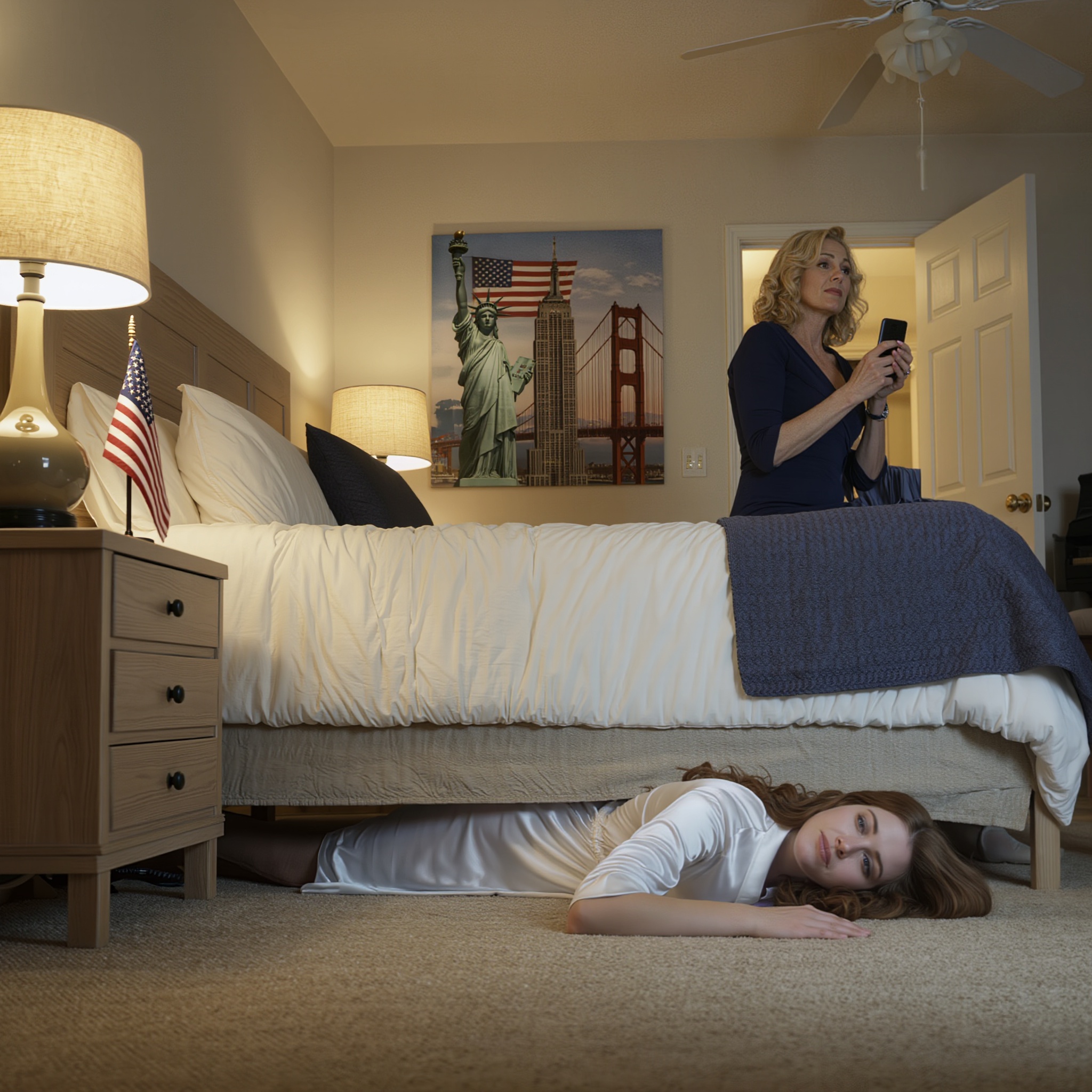
The dust under the bed was starting to tickle my nose, and I had to press my hand firmly over my mouth to keep from sneezing.
I was lying flat on my stomach, my expensive white wedding dress crushed against the hardwood floor of a luxury hotel suite in downtown Atlanta. The delicate lace was catching on the rough fibers of the rug. It was ridiculous, I knew that. A thirty‑year‑old woman hiding under a bed on her wedding night like a kid playing hide‑and‑seek.
But I wanted to see the look on Preston’s face.
In my head, I’d already played out the whole scene. He would walk into our bridal suite on the thirty‑second floor, loosen his tie, maybe call out my name in that soft, confused voice I loved so much.
“Valerie? Val?”
And then—surprise. I’d roll out from under the bed, probably looking like a mess of tulle and silk, and we’d collapse onto the mattress, laughing. It was supposed to be the silly, romantic start of our happily‑ever‑after.
We had just spent six hours downstairs in a ballroom overlooking Peachtree Street—dancing, cutting cake, taking photos with relatives who’d flown in from all over the U.S., shaking hands with people I barely knew. Outside, American flags fluttered on the streetlamps, traffic hummed, and the glow of the Atlanta skyline framed the night like a movie.
Now, finally, it was supposed to be just us.
Or so I thought.
The heavy mahogany door creaked open. I bit my lip, suppressing a giggle. My muscles tensed to spring up.
But the footsteps were wrong.
They weren’t Preston’s confident, slightly heavy strides. These were sharp, staccato clicks.
Clack. Clack. Clack.
High heels. Expensive ones.
I froze.
Through the small gap between the duvet and the floor, I saw a pair of silver designer stilettos stop right in the middle of the room. I recognized those shoes immediately. They belonged to Brenda—my brand‑new mother‑in‑law.
“Yes, Chenise. I’m in the suite now,” Brenda’s voice rang out, sharp and imperious.
She wasn’t whispering. She sounded like she owned the place.
She put her phone on speaker and tossed it onto the bed—the very bed I was hiding under. The mattress springs groaned above my head, pressing down slightly.
“Did they leave yet?” a small female voice asked from the phone.
“Preston is downstairs handling the final bill with the caterers,” Brenda said. “And the girl… well, who knows where she is. Probably in the bathroom, fixing her cheap makeup.”
She scoffed.
The girl. Cheap makeup.
Just hours ago, this same woman had hugged me in that ballroom, tears in her eyes, welcoming me into the family. She had called me a blessing.
“So, is it done?” the voice on the phone—Chenise—asked.
“It’s done,” Brenda said.
I heard the sound of a lighter flick, followed by a long exhale. Smoke drifted down to the floor, curling under the bed.
“The ring is on the finger. The license is signed,” Brenda went on. “We’ve got her locked down, and she has no idea.”
She laughed. It was a dry, cruel sound.
“Please. Valerie is a simpleton. A country mouse. She thinks she hit the jackpot landing my son. She has no idea she’s just a glorified placeholder.”
I felt the blood drain from my face. My hands turned to ice.
What was she talking about?
“But Brenda,” the voice on the phone continued, “are you sure about the condo? If they divorce, won’t she take half?”
“We have it all mapped out,” Brenda replied, her voice dropping to a conspiratorial tone that made my stomach churn. “They’ll live together for a year, maybe eighteen months tops. Enough to make it look real. Then Preston starts the complaints. We make her look unstable. Or better yet, we make her life so miserable she leaves on her own.”
She took another drag on her cigarette.
“We’ve got the receipts showing Preston paid the down payment. We’ll claim the condo in court. She won’t have the money for a decent lawyer.”
I covered my mouth with both hands now, tears burning my eyes.
The condo. Our beautiful penthouse in downtown Atlanta, with floor‑to‑ceiling glass and a view of the city lights.
It was legally in my name, but I’d let Preston handle the transaction to boost his ego, to let him feel like the provider.
“She’s practically an orphan,” Brenda continued.
She kicked off one of her shoes. It landed inches from my nose.
“Her father is some retired nobody living on a pension in Florida. She has no support system. Once we take the assets, she’ll go back to whatever trailer‑park mentality she came from, and Preston will finally be free to marry someone with actual class. Someone like Kendra.”
Kendra.
The name hit me like a physical blow.
Kendra was Preston’s childhood friend. She’d been at the wedding today, wearing a red dress that was a little too tight, smiling a little too widely whenever she stood next to my husband.
“Preston is on his way up,” Brenda said, blowing smoke toward the ceiling. “He just needed a stepping stone. And Valerie… well, she’s a very sturdy stepping stone. We’ll sell the condo, invest the money into his future, and he’ll be set for life.”
I lay there, my body trembling so hard I was terrified the floor would vibrate and give me away.
This wasn’t a prank anymore. It wasn’t a misunderstanding.
This was a heist.
My marriage, my love, my life—it was all just a long con to steal a piece of real estate.
Suddenly, Brenda stopped pacing.
“Wait,” she murmured.
Her silver heels turned toward the bed. She walked closer. I saw her feet stop right in front of me.
She crouched down.
I stopped breathing. My heart stopped beating.
Through the gap, I saw her hand reach out. Her long, manicured nails scraped against the hardwood floor, inches from my face. She picked up something small.
My pearl earring.
I must have dropped it when I crawled under.
She held it up, inspecting it.
“Cheap junk,” she muttered, tossing it onto the bedside table. “Probably plastic.”
She stood up again.
I nearly fainted from relief, but the relief was short‑lived.
The door handle turned.
“Mom?” Preston’s voice called out.
“In here, sweetheart,” Brenda cooed, her tone instantly switching from cold predator to doting mother.
My husband walked into the room. The man I had vowed to love and cherish not three hours ago.
I waited, praying—hoping against hope—that he would tell her to leave, that he would say something kind about me, something real.
Instead, he sighed and flopped onto the bed right above me.
“Is she here?” he asked.
“No,” Brenda said. “Probably lost in the hallway. Listen, we need to talk about the bank transfer before she gets back.”
“I know, Mom, I know,” Preston groaned. “But can we do this tomorrow? I have to pretend to be excited to consummate this marriage tonight, and it’s going to take a lot of energy.”
Something inside me broke.
It wasn’t a crack. It was a shattering.
The naive, happy Valerie died in that dusty darkness under the bed, and something else opened its eyes.
Very slowly, I reached into the bodice of my dress and pulled out my phone. I unlocked it with my thumb and opened the voice recorder app. I hit record.
The red line started moving.
Talk, I thought, a cold rage settling over me.
Keep talking, you two. Give me everything.
And they did.
To understand why a woman with a master’s degree in business and a trust fund that could buy this entire hotel was hiding under a bed letting people believe she was poor, you have to understand my mother.
My mother, Elena, was the kindest soul you could ever meet. She was also incredibly wealthy—heiress to a shipping fortune built out of New Orleans and Miami. She married my father, Robert, when he was just starting his construction business. They were a power couple, the kind you see on the front page of business magazines.
But my mother loved with her eyes closed.
When she passed away ten years ago, it wasn’t just the cancer that took her. It was heartbreak. She had discovered that her own sister and her best friend had been siphoning money from her charity foundation for years. They didn’t love her. They loved what she could give them.
On her deathbed in a private hospital suite overlooking Biscayne Bay, she held my hand and made me promise.
“Valerie,” she whispered, her voice frail, “find someone who loves you for you. Not for the name. Not for the accounts. Be careful, my love. Money is a magnifying glass. It shows you exactly who people are, but sometimes it burns you before you can see the truth.”
That promise became my Bible.
My father took it to the extreme. Robert Smith was a shark in the business world, the CEO of Titan Construction, a company with cranes on skylines from Atlanta to Chicago. He taught me how to read contracts before I could read fairy tales. When I started dating, he was suspicious of everyone.
“They smell the money, Val,” he warned. “They look at you and see a lottery ticket.”
So I created a test.
I moved out of the family estate in Buckhead and rented a charming, slightly run‑down apartment in a working‑class neighborhood on the edge of Atlanta. I drove a five‑year‑old Honda Civic. I worked as an administrative assistant at a logistics firm near the airport—a job I actually enjoyed because it was low stress, even though I secretly managed my own investment portfolio at night.
To the world, I was Valerie, the nice girl with student loans, a modest wardrobe from Target, and a budget for groceries.
Then I met Preston.
It was a rainy Tuesday in midtown. I was rushing into a coffee shop, juggling my umbrella and my tote bag, when I dropped my wallet in a puddle right outside. Mud splashed everywhere. I was on the verge of tears. It had been a brutal week.
A handsome man in a slightly frayed jacket scooped the wallet up. He wiped the mud off with his own sleeve.
“I think this belongs to you,” he said, smiling.
His eyes were warm—hazel, with flecks of green.
I checked the wallet. Nothing was missing.
“Let me buy you a coffee to say thank you,” I offered.
“I’d love that,” he said, checking his watch. “I’ve got about twenty minutes before I have to get back to the grind.”
We talked for two hours.
He told me he was a sales associate at a regional building supply company, struggling to meet his quotas, driving an old car that broke down every other week. He talked about his dreams of traveling, of seeing art in Italy and skylines in New York, but how he could never afford it.
“I don’t care about being rich,” he told me, looking deep into my eyes. “I just want a life that feels real. You know? Sunday barbecues, a dog, someone to share the silence with.”
It was exactly what I wanted to hear.
Over the next two years, Preston passed every test I thought I had.
He never asked to borrow money. He brought me wildflowers he picked from the side of the road because he couldn’t afford the fancy roses, but said he thought these were prettier. He clipped coupons with me. When my car “broke down”—a staged event—he drove forty minutes out of his way to pick me up every morning for a week.
I fell in love. Deeply, madly, stupidly.
I introduced him to my father, but I maintained the lie.
I told Preston my dad was a retired foreman living on a pension in Florida. Dad played along, though he grumbled about it. He flew in wearing flannel shirts and complaining about gas prices, hiding his Rolex in his pocket.
“He seems okay,” Dad admitted after dinner one night, swirling a cheap beer he hated. “But he’s soft, Val. He listens to his mother too much.”
“He respects his mother, Dad,” I defended. “That’s a good trait.”
Oh, how wrong I was.
The first time I met Brenda, she looked me up and down like I was a stain on her carpet. She lived in a small, cluttered house in a tired Atlanta suburb, but acted like she was royalty in exile.
She constantly talked about how Preston deserved better and how expensive life was.
“Valerie,” she’d say, sipping tea at her laminate kitchen table, “do you really think you can support a family on an admin salary? Preston needs a partner who can elevate him.”
I just smiled and swallowed the insults, thinking, If only you knew.
I thought once we were married, once I revealed the truth about my wealth, she would be happy. I planned to tell Preston everything on our honeymoon—maybe on a balcony in Hawaii or a terrace in Italy. I wanted to see his face light up when I told him he never had to worry about sales quotas again. I was so excited to give him the world.
I didn’t realize he was already planning to steal the little piece of it I had shown him.
The wedding planning should have been the happiest time of my life, but looking back, the red flags were waving so hard they were practically slapping me in the face.
First, there was the guest list.
Brenda insisted on inviting half the town.
“It’s about image, Valerie,” she snapped when I suggested a small, intimate ceremony. “We need to show people that the Ramos family is doing well.”
Since I was supposedly poor, Brenda and Preston assumed I couldn’t pay for much. Brenda made a big show of “chipping in,” but every time the bill came for the flowers or the venue, she conveniently left her purse in the car or her card was declined due to some mysterious bank error.
I ended up paying for almost everything using my “savings,” which was actually a black card tied to a trust fund that I kept hidden in a secret compartment of my wallet.
Then came Kendra.
“Valerie, you have to meet Kendra,” Preston said one evening three months before the wedding. “She’s like a sister to me. We grew up together.”
Kendra was stunning in a flashy, obvious way. Tight clothes, loud laugh, and a way of touching Preston’s arm every time she spoke. When we met for drinks at a trendy rooftop bar, she barely looked at me. She spent the entire night reminiscing with Preston about the good old days and inside jokes I didn’t understand.
“Remember that night in Cabo?” she giggled, leaning into him.
“I thought you said you couldn’t afford to travel,” I said to Preston later, confused.
He froze for a second.
“That was a high school trip,” he said quickly. “My parents saved up for years for it.”
Brenda adored Kendra. She would openly compare us.
“Kendra, darling, that dress is exquisite. You look like a movie star. Valerie, maybe Kendra can take you shopping. You dress so plainly.”
I brushed it off. I told myself I was secure. I had the ring. I had the man. Kendra was just a friend from the past.
The biggest issue, though, was the condo.
We needed a place to live after the wedding. Preston was renting a bachelor pad near a noisy freeway, and my apartment was too small.
I found a stunning penthouse condo in downtown Atlanta. It was a foreclosure, a steal at $600,000—but still way out of the budget of an admin assistant and a salesman.
“I have an inheritance,” I told Preston one night. It was a half‑truth. “My grandmother left me some money. It’s enough to buy this place in cash.”
Preston’s eyes nearly popped out of his head.
“In cash? Valerie, are you serious?”
“Yes. I want us to start debt‑free.”
That night, Brenda came over.
Suddenly she was very, very interested in me.
“That is wonderful news, Valerie,” she purred, looking around the empty condo with hungry eyes. “But you know, buying property is complicated—taxes, insurance, liability. You’ve never handled real estate.”
“I can handle it,” I said.
“Of course you can,” Preston said, taking my hand. “But baby, think about the optics. My mom is right. Plus, I want to feel like I’m contributing. If you put the money in my account, I can write the check. I can handle the negotiations with the HOA. It’ll make me look like the man of the house to the neighbors. Please, for my pride?”
It sounded so stupid now, but then… he looked so earnest. Brenda was nodding along.
“It’s a respect thing, Valerie. A wife shouldn’t embarrass her husband before the marriage even starts,” she added.
So I did it.
I transferred the funds, but I wasn’t an idiot. My father raised me better than that.
I had my lawyer, Justine—my best friend since college and one of the sharpest corporate attorneys in Atlanta—draft the deed. The money went through Preston’s account to show the transaction, but the deed to the property was 100% in my name.
Preston, however, didn’t read the fine print of the closing documents. He just saw the money hit his account and then leave it. He thought that because he wrote the check, he owned the condo.
He thought he had played me.
I remembered the day we got the keys. Preston spun me around in the empty living room, the Atlanta skyline blazing outside.
“Our castle,” he said.
“My castle,” I whispered into his shoulder, so quietly he never heard.
Now, lying under the bed on our wedding night, hearing Brenda talk about claiming the condo, the pieces fell into place.
They didn’t know the deed was solely mine. They thought it was a marital asset bought with his money because the check came from his account. They thought they could argue that I contributed nothing.
Brenda’s voice snapped me back to the present.
“When does the lease on Kendra’s apartment run out?” she asked on the phone.
The name jolted me.
“Her lease is up in six months,” Preston said, his voice muffled as he buried his face in a pillow above me. “That’s why we need to speed this up, Mom. I can’t have her crashing on her sister’s couch forever. Plus, the baby needs a room.”
The world stopped.
The silence under the bed was deafening.
“The baby?”
I clamped my hand over my mouth so hard I tasted blood.
“The baby?”
“Don’t worry about the baby,” Brenda said, her tone dismissive yet practical. “We’ll set up the nursery in the second bedroom once Valerie is gone. We can paint over that hideous yellow she chose.”
My stomach lurched. I thought I was going to be sick right there on the rug.
Kendra was pregnant.
Preston, my husband of less than twenty‑four hours, had gotten his “sister‑like” friend pregnant.
“I just feel bad, Mom,” Preston said.
For a second, a tiny spark of hope flared in my chest.
Maybe he had a conscience. Maybe he actually cared about me.
“Bad about what?” Brenda snapped. “About securing your future?”
“No, just… Valerie is nice,” Preston muttered. “She cooks for me. She washed my car. She looks at me like I’m a hero. It’s going to be brutal, crushing her like that.”
“Oh, spare me the tears,” Brenda scoffed. “She’s a nobody, Preston. You said it yourself. She’s boring. She reads books on weekends instead of networking. She wears clothes from Target. Do you want to be married to a coupon‑clipper for the rest of your life, or do you want to be with Kendra, who actually knows how to shine in high society?”
“Kendra is fire,” Preston agreed, his voice changing, becoming low and admiring. “Valerie is… oatmeal.”
Oatmeal.
That single word hurt more than the financial betrayal.
I had dimmed my light for him. I had hidden my designer wardrobe, my knowledge of fine wine, my connections to senators and CEOs—all to make him feel comfortable. I became oatmeal because I thought he wanted simple, wholesome love.
“Exactly,” Brenda said. “Now, did you get the bank notifications? Did the rest of the wedding cash deposits clear?”
“Yeah. About ten grand. It’s in our joint account.”
“Good. Tomorrow you transfer half of that to my account for ‘wedding reimbursement expenses.’ We need to drain that joint account slowly so when you file for divorce, there’s nothing for her to take.”
“Got it. And the condo—you have the receipts?”
“I have the transfer receipt from my bank account to the seller,” Preston said proudly. “It shows I paid the $600,000. She can’t prove where that money came from if we say it was a private loan from family that I’m paying back.”
They were so confident. So incredibly stupid and confident.
They had no idea about forensic accounting.
They had no idea that my “pensioner” father had a legal team that ate people like them for breakfast.
“All right, get up,” Brenda ordered. “Go wash your face. You look guilty. When she comes back, you need to perform. Smile. Talk about the future. Make her feel safe.”
“I really don’t want to sleep with her tonight, Mom,” Preston groaned.
“You have to consummate the marriage,” Brenda snapped. “It makes an annulment harder for her to get later if she tries that route. We need this to be a divorce so we can split assets.”
“Fine,” Preston sighed.
He stood up from the bed. The mattress lifted, relieving the pressure above me.
“I’ll go check the hallway. Maybe she’s crying in the stairwell or something.”
“I’m leaving,” Brenda said. “I took the spare key from her purse earlier. I’ll let myself out.”
She took my key.
She went through my purse.
The violation made my skin crawl.
I watched Brenda’s silver heels clack toward the door. Preston’s dress shoes followed.
“Good night, Mom. Thanks for everything.”
“Anything for my boy. Just remember the plan. One year. Then you’re free.”
The door clicked shut.
Silence returned to the room.
But it wasn’t peaceful. It was heavy, crackling with the energy of my shattered life.
I waited.
Five minutes. Ten.
I needed to be sure they were gone.
Slowly, painfully, I wiggled out from under the bed. My body ached. My beautiful dress was gray with dust.
I stood up and caught my reflection in the mirror.
My hair was disheveled. My makeup was smeared. But my eyes… my eyes were clear.
I didn’t cry. I didn’t scream.
A cold, mechanical calm took over. It was the same look I’d seen on my father’s face right before a hostile takeover.
I walked to the closet. I stripped off the wedding dress—the symbol of my stupidity—and threw it in the corner. I pulled on jeans and a hoodie I had packed for the next morning’s brunch.
I grabbed my purse.
Brenda had indeed taken the spare house key, but my car keys were still there. And my black card.
I opened the door to the hallway. It was empty.
Preston was probably downstairs in the hotel bar, working up the courage to come back and play the loving husband.
I didn’t take the elevator. I took the stairs, running down twelve flights in my sneakers.
I burst out into the cool Atlanta night, found my beat‑up Honda Civic—which secretly had a custom sports engine my father had installed as a joke—and tore out of the parking lot.
I wasn’t going back to the condo.
I wasn’t going to cry in a hotel.
I hit the call button on my steering wheel and spoke clearly.
“Dad.”
He answered on the second ring.
“Valerie? It’s one a.m. Is everything okay?”
“No,” I said, my voice steady in a way that scared even me. “You were right about everything. I need you to wake up Justine. I’m coming to the estate. We’re going to war.”
The drive to my father’s estate in Buckhead usually took forty minutes. That night, with the empty Georgia highway stretching ahead and my rage pressing the accelerator, I made it in twenty.
I pulled up to the massive iron gates. The security camera recognized my license plate, and the gates swung open.
As I drove up the winding driveway lined with century‑old oaks and soft, discreet garden lights, I felt the old version of myself—the “admin girl” with the old Civic—fall away.
I was going home.
My father was waiting on the front porch in a silk robe, a cigar unlit in his hand. Next to him stood Justine, in pajamas and a messy bun, a laptop open on the patio table.
I slammed the car door and walked up the steps.
Dad took one look at me—the dust on my hoodie, the hard set of my jaw—and he didn’t say “I told you so.”
He just opened his arms.
I hugged him, and for exactly ten seconds, I let myself be a little girl. I let one sob escape.
Then I pulled back.
“They planned it,” I said, my voice crisp. “Preston, his mother, and Kendra. They want the condo. They want to drain the accounts. Kendra is pregnant.”
Justine gasped.
“Pregnant? On your wedding day?”
“Yes.”
I placed my phone on the glass table and hit play.
In the quiet Atlanta night, Brenda’s voice poured out of the tiny speaker, every cruel word about me, about the condo, about the baby. The part where Preston called me oatmeal made Justine’s jaw clench so hard I thought she might break a tooth.
When the recording finished, my father’s face was a mask of fury. He snapped the unlit cigar in half.
“I will bury him,” Dad growled. “I will buy the company he works for and fire him. I’ll have that mother of his evicted by noon.”
“No,” I said. “That’s too fast. Too easy.”
I looked at Justine.
“If we attack now, they’ll play the victims,” I said. “They’ll say I’m a crazy, jealous wife. They might even try to fight for the condo, claiming verbal agreements or whatever story they invent. I don’t want a dramatic fight. I want a clean kill.”
Justine cracked her knuckles and smiled.
“I like where this is going,” she said. “What’s the plan?”
“First, the condo,” I said. “They think they have a claim because the money flowed through his account. We need to lock that down.”
“Easy,” Justine said, her fingers flying over the keyboard. “Since the deed is already in your name, we create a postnuptial agreement. We frame it as an insurance requirement. We tell Preston that because the building has high liability, the insurance company needs a single clear title holder to minimize risk. We slip in a clause where he waives all marital interest in the property in exchange for a lower insurance premium.”
“He’s greedy,” I added. “If we tell him it saves him five hundred dollars a month, he’ll sign it without reading.”
“Done,” Justine said. “I’ll have the papers ready by morning. You tell him it’s standard procedure.”
“Second,” my father said, “financials. You need to separate your assets.”
“I need to drain the joint account before he does,” I said, “but I can’t look suspicious.”
“Leave the joint account alone,” Justine advised. “Let him take the wedding money. Consider it bait. What we need to focus on is his work history. If he’s this dishonest with you, he’s probably dishonest elsewhere.”
Dad picked up his phone.
“I’ll have my private investigator run a deep dive into his sales numbers and expenses at Titan’s regional suppliers,” he said. “If he’s skimming, we’ll know.”
“And the baby,” I said quietly. “We need proof. DNA?”
“That takes time,” Justine said. “Honestly, Val, the adultery is already obvious. But if you want it ironclad, you’ll need them to incriminate themselves.”
“I’ll get closer to Kendra,” I said. “I’ll make her admit it herself.”
Dad looked at me, worried.
“You’re going back there?” he asked. “You can stay here. We can have him served in the morning.”
“No,” I said, standing up. “He called me oatmeal. He thinks I’m stupid, weak, and alone. I’m going to go back and act exactly like the clueless wife he thinks I am. I’m going to let him dig his own grave while I gather enough evidence to send him to prison, not just divorce court.”
I glanced toward the horizon, where the first hint of sunrise was turning the sky purple behind the Atlanta trees.
“He wanted a country mouse,” I said. “He’s about to find out he married a trap.”
I drove back to the hotel just as the sun broke over the city. I slipped up the back stairs, changed into my bridal pajamas, and tousled my hair.
Preston was sprawled on the bed, still in his dress shirt, smelling faintly of champagne.
He stirred as I slid under the covers.
“Val,” he mumbled. “Where were you?”
“I couldn’t sleep,” I whispered, giving him a dazed, dreamy smile. “I was just… so excited about our future, honey. I went downstairs and planned our life in my head.”
He groaned and rolled over, turning his back to me.
“That’s nice, babe. Go to sleep.”
I stared at the back of his head.
Sleep tight, Preston.
It’s the last peaceful night you’ll ever have.
The next morning, the performance of a lifetime began.
I woke before Preston and ordered room service—the most expensive items on the menu. Lobster Benedict, truffle fries, fresh berries, champagne. When the bill came, I signed it to our room with a flourish.
Preston woke up, rubbing his eyes.
“Whoa,” he said. “What’s all this?”
“Celebration breakfast,” I chirped. “I figured, since we have all that wedding money, we should treat ourselves.”
Preston flinched.
“Val, we need to be careful with that money,” he said. “Mom and I—uh, we agreed to save it for a rainy day.”
“Oh, don’t be a spoil sport.” I popped a strawberry into my mouth. “I also booked us a couple’s massage at the spa. Six hundred dollars. Non‑refundable.”
His jaw tightened. I could see him mentally subtracting six hundred from the money he’d planned to funnel to Brenda.
“Valerie, you should have asked me,” he snapped.
“But I’m your wife,” I said, widening my eyes. “Isn’t my money your money?”
He shut up.
By the time we checked out and drove to the condo, he’d already decided I was too naive to be a threat.
Good.
Two days later, we moved into the penthouse.
That’s when I turned the dial up to ten.
Brenda came over to “inspect” the place. She walked in like a landlord, running her finger along the white quartz countertops.
“This place is dusty,” she criticized. “Valerie, you need to be more diligent. High‑end homes require care.”
“Oh, Brenda, I’m so glad you’re here,” I said brightly. “I decided to do laundry, but the machine is so complicated.”
I led her to the laundry room.
Inside the washing machine, turning in hot water and heavy‑duty bleach, was her prized faux‑fur coat—the one she’d left at Preston’s old apartment and bragged about getting on sale in New York.
“Is that—” Brenda froze. “Is that my coat?”
“Yes!” I said. “I wanted to surprise you by cleaning it.”
She lunged for the washer and yanked it open. Water sloshed onto the tile. She pulled out a soggy, matted lump of gray that looked like a drowned animal.
“You idiot!” she yelled. “This is dry‑clean only. It cost two thousand dollars.”
“Oh no!” I started to cry. “I just wanted to help. The tag was so small.”
Preston ran in.
“What’s happening?”
“She ruined my coat,” Brenda said, shaking the dripping mess at him. “Look at this!”
“I’m sorry,” I wailed, burying my face in Preston’s chest. “I’m just a simple girl. I don’t know about fancy coats.”
Preston looked furious—but he remembered the plan. He had to keep me “happy.”
“It’s okay, Mom,” he said through gritted teeth. “It was an accident. Val didn’t know.”
“She’s a liability,” Brenda hissed, storming out with her ruined coat.
That night, while Preston sulked on the couch, I brought out the paperwork Justine had prepared.
“Honey,” I said softly, sniffling a little. “I feel so bad about the coat. I want to make sure I don’t mess anything else up. The insurance company sent this over today. They said because the condo is high‑value, the liability policy is huge. But…”
I paused.
“But what?” he asked, suspicious but also tired.
“But if you sign this waiver saying you’re not the primary owner, the premium drops by five hundred dollars a month,” I said. “Since I cost you money with the coat, I thought saving money here would help.”
Preston’s eyes lit up at “five hundred dollars a month.”
“Let me see,” he said.
He skimmed the document. It was thick, full of legal jargon. At the top, in bold, it said: INSURANCE LIABILITY WAIVER. He didn’t see the paragraph in the middle where he voluntarily relinquished all marital claims to the property in exchange for that “discount.”
“Yeah, okay,” he said, grabbing a pen. “At least you’re trying to fix your mess.”
He signed it.
I watched the ink dry.
Click.
The trap snapped shut.
Over the next two weeks, I played my role to perfection.
I burned dinner. I used salt instead of sugar in his coffee. I shrank his favorite sweaters. I “forgot” to pay the internet bill, so he couldn’t play his video games for three days. I was a tornado of incompetence.
The more annoyed he got, the more he ran to Kendra.
Dad’s investigator tracked him. Every time Preston said he was “working late,” his car’s GPS pinged at Kendra’s apartment.
One night, he came home smelling like her cheap vanilla perfume.
“Work was brutal,” he sighed, dropping onto the couch.
“You work so hard,” I said, massaging his shoulders. “You deserve a break. Why don’t we throw a dinner party? For your family. I want to show them I can be the perfect wife.”
He hesitated.
“I don’t know, Val… you’re not exactly a master chef.”
“I’ll practice,” I promised. “Please. Invite your mom. Your cousins. And Kendra, too. She’s your best friend, right?”
He smirked.
In his head, I knew what he was thinking: Let her embarrass herself. It’ll make the divorce easier.
“Fine,” he said. “Next Saturday. But don’t screw it up.”
“Oh, I won’t,” I said, smiling. “It’ll be a night no one will ever forget.”
The invitation list grew quickly. Brenda, eager to witness another one of my “failures,” invited her sister and two gossiping nieces. Kendra accepted immediately.
While Preston was at work, Justine came over.
We installed tiny cameras in the living room and dining room, hidden in the vents and on a bookshelf.
“You sure about this?” Justine asked, checking the live feed on her tablet. “It’s going to be brutal.”
“I need witnesses,” I said, chopping onions. “I need them to say the worst things possible on camera. And I need Kendra’s pregnancy out in the open.”
On the day of the party, I woke up early and went to the cheapest grocery store I could find. I bought fatty ground beef, wilted vegetables, boxed wine that cost nine dollars.
At home, I “cooked.”
I also went through Preston’s gym bag while he was in the shower—the bag he took to “work,” but really to Kendra’s. Hidden in a side pocket was a receipt from a pharmacy.
Prenatal vitamins.
Dated yesterday.
Got you.
At six p.m., the guests started arriving.
Brenda walked in first, wearing a new dress I was sure had been paid for with the wedding reimbursement money.
“Well,” she sniffed, looking around. “At least you swept the floor this time.”
“Welcome, Brenda!” I chirped, handing her a glass of boxed wine in a crystal flute.
She took a sip and gagged.
“What is this? Vinegar?”
“It’s an artisanal blend,” I lied.
Kendra arrived next, hanging on Preston’s arm. She wore a loose dress, trying to hide her small bump, but I saw the way her hand kept drifting to her stomach.
“Hi, Valerie,” she said, her voice sugary. “House looks… cozy.”
“Hi, Kendra. So glad you could come,” I said, looking straight at her belly. “You’re glowing.”
She flinched and pulled her hand away.
Preston stepped between us.
“Okay, let’s get drinks. I’m starving,” he said.
In the kitchen, I listened to the camera audio on Justine’s tablet.
“God, this wine is awful,” Brenda said. “I can’t believe he married her. Even for the money.”
“Just a few more months,” Preston whispered. “Then we get the condo, sell it, and move to the big house in the suburbs.”
“I hate hiding,” Kendra whined softly. “My back hurts. I want to post pictures of us.”
“Soon, babe,” Preston said. “As soon as we kick the country mouse back to the trailer park.”
I gripped the counter until my knuckles went white.
Country mouse.
I took a deep breath, reached for the pot of sauce, and poured in my “special seasoning”—too much salt and vinegar. Not poison. I wasn’t a criminal. Just… dramatic.
“Dinner is served!” I called.
We sat around the table. The roast was overcooked. The mashed potatoes were lumpy. The salad was mostly pale lettuce stems.
“So, Valerie,” Brenda started, stabbing at the tough beef, “Preston tells us you’re thinking of taking a cooking class. Clearly you haven’t started yet.”
The table erupted in laughter.
Preston chuckled and squeezed Kendra’s hand under the table.
“Actually,” I said, my voice shaking just a little—great acting, if I may say so—“I tried really hard on this.”
“Trying isn’t doing, honey,” Kendra said, smirking. “Some women are just built to be wives. Some aren’t.”
“Is that right?” I asked, looking her straight in the eye. “And what makes a good wife, Kendra? Sleeping with someone else’s husband?”
Silence.
“Excuse me?” Kendra gasped.
“Oh—sorry.” I laughed lightly. “I meant being supportive. Pass the potatoes?”
“Valerie, don’t be weird,” Preston snapped. “We’ll talk about this later. Go get more wine.”
“I’m not being weird,” I said sweetly.
I stood, picked up the pitcher of red wine, and walked around the table.
And then—I “tripped” on the rug.
The wine flew forward, drenching Kendra’s dress.
She screamed and jumped up. The wet fabric clung to her body, outlining her unmistakable baby bump.
“Oh my gosh!” I cried. “I’m so clumsy!”
“You—look what you did!” Kendra shouted, forgetting her sweetness. “This is silk!”
“Calm down, Kendra,” Preston said, rushing to her side, pressing napkins to her belly. “Are you okay? Is the baby okay?”
The words hung in the air like a grenade with the pin pulled.
The room went dead silent.
Preston realized what he’d just said.
He slowly turned to look at me.
Brenda stared at me. Kendra stared at me.
I wasn’t crying. I wasn’t apologizing.
I stood at the head of the table, and for the first time in months, I wasn’t smiling.
The air was thick. You could slice it.
“The baby?” I repeated softly.
“Valerie, you’re drunk,” Preston said, trying to regain control. He puffed out his chest. “Go to your room. We’ll discuss this later.”
“No,” I said. “We’ll discuss it now.”
I walked to the sideboard, where the stereo system sat. Preston loved karaoke, so we had a small microphone hooked up.
“What are you doing?” Kendra hissed.
“You’ll see,” I said.
I picked up the microphone and looked around the room.
“You see,” I began, pacing slowly like I was on a stage—which, in a way, I was. “For the last two months, I’ve listened to you all. I’ve listened to Brenda call me a peasant. I’ve listened to Preston call me oatmeal. I’ve listened to Kendra laugh about how she’s going to paint over my nursery.”
“You were listening?” Preston whispered.
“Oh, honey,” I said, smiling. “I was doing a lot more than listening.”
I reached into my pocket and pulled out the pharmacy receipt.
I slapped it onto the table.
“Prenatal vitamins,” I said. “Purchased two days ago by one Preston Ramos.”
Kendra’s face went white.
“And this,” I continued.
I pulled out the “insurance waiver” and held it up.
“Do you remember this, Preston?” I asked pleasantly.
“The insurance thing,” he muttered.
“It’s a postnuptial agreement,” I said clearly. “In it, you voluntarily waived all rights to this property. You admitted that one hundred percent of the funds used to purchase it were mine, and you have no claim to it in the event of a divorce. You signed away the condo for a five‑hundred‑dollar discount.”
“That won’t hold up,” Brenda snapped. “You tricked him. It’s invalid.”
“Oh, it will hold up,” I said. “My lawyer Justine—you know, the one you called ‘that cheap attorney friend’? She’s actually a senior partner at Darby & Associates. She drafted it. Ironclad.”
“Who cares?” Kendra burst out. “Preston is leaving you anyway. He loves me. We’re going to be a family, and you’re going to be alone with your cats.”
“Am I?” I asked.
I tilted my head.
“Preston, why don’t you tell everyone where you got the money for Kendra’s car, for your mom’s new dress, and for that wedding reimbursement?”
“I—I saved it,” he stammered. “From my commissions.”
“No,” I said. “You stole it.”
I looked him in the eye.
“You stole it from Titan Construction.”
He froze.
“You created fake vendor accounts. BR Consulting—Brenda Ramos Consulting. You approved invoices for materials that were never delivered to Titan job sites. You skimmed over fifty thousand dollars in the last six months alone.”
Brenda went pale.
“I didn’t know where the money came from,” she whispered. “He told me it was a bonus.”
“The checks were deposited directly into your account,” I said calmly. “And we have text messages where you advised him on how to structure the deposits to avoid IRS flags.”
Brenda’s mouth opened and closed.
“This is ridiculous,” she finally sputtered. “You can’t prove anything.”
“Oh, Brenda,” I said softly. “I can prove everything.”
I tapped the microphone.
“And just so we’re all on the same page,” I added, “I want you to hear exactly what I heard on my wedding night.”
I pulled out my phone and connected it to the Bluetooth speaker.
Static.
Then Brenda’s voice filled the room, sharp and cruel.
“Valerie is a simpleton. A country mouse. We’ll claim the condo. She has no idea. She’s just a glorified placeholder.”
“Turn it off!” Brenda screamed, lunging for the phone.
I pulled it away.
“Actually,” I said calmly, “Georgia is a one‑party consent state. As long as one person in the conversation knows it’s being recorded—me—it’s legal. And admissible.”
Right on cue, the front door opened.
Heavy boots thudded against the hardwood floor.
Blue lights flashed through the windows from the parking lot below.
Justine walked in first, no longer in pajamas but in a razor‑sharp charcoal suit, holding a leather folder. Behind her came two uniformed officers and a plainclothes detective.
“Preston Ramos?” the detective called.
Preston stood up so fast his chair toppled over.
“Arrest? For what? This is just a domestic argument—”
“Not for the adultery,” Justine said, her smile cold. “Though that is certainly grounds for immediate divorce. No, Mr. Ramos, you’re under arrest for grand larceny, corporate embezzlement, and fraud against Titan Construction.”
“What?” Kendra gasped.
Brenda started shouting about her rights as the officers moved toward her.
“You can’t touch me! I know people!”
The detective didn’t flinch. He presented the warrant. The officers cuffed Preston and Brenda while Brenda still ranted about being a “respectable woman.”
The sound of the handcuffs clicking shut was the sweetest sound I’d ever heard.
“Valerie, please,” Preston begged as they led him toward the door. “Talk to your dad. Tell him to drop the charges. I’ll sign whatever you want. I’ll leave town. Just don’t let them send me to jail. You know I have asthma. I’m scared.”
I looked at him.
The man who had once picked my wallet out of a puddle now looked small. Pathetic.
“I’m sorry, Preston,” I said quietly. “But oatmeal doesn’t have the power to stop a criminal investigation. You did this to yourself.”
They took him and Brenda away.
Kendra sat trembling in her wine‑stained dress.
“You have five minutes to leave,” I told her. “Take your purse. Take your lies. If you’re still here after that, I’m calling the police to have you removed.”
“He promised me,” she whispered. “He said he’d take care of us.”
“He promised me, too,” I said. “You’re just the next person in line. Run while you can.”
She ran.
The room was a disaster—overturned chairs, ruined dinner, the echo of chaos still vibrating in the air.
My heart was pounding, not with fear, but with adrenaline.
This was the moment I took my life back.
If you’re still listening at this point, please help me by liking this video and commenting the number 1 below so I know you walked through this night with me. Your support really keeps me going.
Now, let me tell you what happened after the storm.
The days after the arrests were a blur of legal motions and logistics.
While Preston sat in a holding cell, unable to make bail because his accounts were frozen, I went to work erasing him from my life.
I didn’t want the condo anymore. It was tainted.
I hired a crew to pack up everything that belonged to me. As for Preston’s things—his sneakers, his gaming console, his clothes—I had them boxed up and delivered to Brenda’s small house.
But Brenda wasn’t there to receive them.
Her financial situation was even worse than we’d thought. She had leveraged her house with second and third mortgages to fund her lifestyle. With legal fees piling up and Preston’s stolen income cut off, the bank foreclosed.
Justine called me one afternoon.
“You’re going to want to hear this,” she said. “The bank took Brenda’s house. She’s out on bail, but she has nowhere to go. She tried to check into a motel, but her cards were maxed out. She’s staying with her sister. On the pull‑out couch in the basement.”
I won’t lie—there was a dark, grim satisfaction in knowing the woman who mocked my “pensioner” father was now living the reality she tried to mock me for.
The divorce was swift.
Preston appeared via video link from the detention center, wearing an orange jumpsuit that clashed horribly with his complexion.
“Mr. Ramos,” the judge said. “You admit to signing a waiver of interest in the property at 405 Highland Avenue. You also admit to adultery. The plaintiff has provided extensive evidence. Do you contest the divorce or the agreement?”
Preston shook his head.
“No, Your Honor,” he mumbled.
“Divorce granted,” the judge said. “The plaintiff retains all assets. Defendant is ordered to pay legal fees.”
Of course, he couldn’t pay. I absorbed the cost and mentally labeled it a stupidity tax.
Kendra didn’t get off easily either.
Without Preston’s support, and with the scandal making local business news, she lost her job at the boutique. She tried to contact me once, sending a long email blaming Preston for everything and calling herself a victim too.
I didn’t respond.
I just forwarded it to his defense attorney.
The final fall came at sentencing.
My father gave a statement in court.
“Trust is the currency of business,” he told the judge. “Mr. Ramos didn’t just steal money. He stole trust. He entered my family under false pretenses, targeted my daughter, and used my company as his personal piggy bank. He is not a victim of circumstance. He is a predator who got caught.”
Preston got five years.
Brenda got probation and community service because she agreed to testify against him.
That was her final betrayal—throwing her own son under the bus to save herself.
For a moment, I almost pitied him.
Almost.
When it was all over, I walked out of the courthouse into the bright Georgia sun. The air smelled clean. I took a deep breath.
I was divorced. I was thirty. I was free.
I got into my real car—a sleek Mercedes convertible I’d kept in storage the whole time I’d played “poor”—and drove away from the courthouse, from the Ramos name, from that entire chapter of my life.
But revenge, I learned, is like a sugar rush.
Intense. Satisfying.
And then… it crashes.
Three years passed.
I threw myself into work.
I stopped hiding.
I officially joined Titan Construction, not as an admin, but as Director of Operations. The quiet girl in the Target cardigan disappeared. In her place stood a woman in tailored suits and Louboutins, who could walk into a boardroom in Dallas, or Chicago, or New York and command silence with a look.
People started calling me the Ice Queen.
Efficient. Brilliant. Untouchable.
Dating? Forget it.
Every time a man smiled at me, I wondered what he was calculating.
Did he see me… or just my last name?
My only real solace was music.
I had played piano as a child, but I had stopped when I met Preston because he said classical music was “boring.”
So I bought myself a Steinway grand for my glass‑walled house overlooking the Chattahoochee River.
Every night, after twelve‑hour days at Titan, I played.
Chopin. Rachmaninoff. Debussy.
I poured my anger, grief, and loneliness into the keys.
One evening, my father convinced me to attend a charity gala for the Atlanta Symphony.
“I don’t want to go,” I complained as my stylist pinned my hair up in soft waves and zipped me into a simple black gown.
“Just one hour,” Dad said, adjusting his tuxedo. “It’s for the arts. You love the arts.”
So I went.
The gala was held in a sleek, modern museum downtown. Crystal chandeliers, American flags in the lobby, a jazz trio playing near a bar where people whispered about tax deductions and donors.
I stood in a corner with a sparkling water, scrolling through work emails on my phone, counting the minutes until I could politely leave.
“You look like you’d rather be getting a root canal,” a voice said beside me.
I stiffened. My Ice Queen mask slid into place.
“I’d actually prefer an audit,” I said without looking up. “Root canals take too long.”
A low, warm laugh.
“That’s fair,” he said. “I’m Marshall.”
I looked up.
He was tall, with broad shoulders, messy dark hair, and amber eyes. His tuxedo fit well, but there was something a little lived‑in about it—like he owned it, but didn’t worship it.
“I’m the architect who designed the new wing of the museum,” he said. “Currently hiding from a donor who wants to talk about bathroom lighting.”
“Valerie,” I replied, shaking his hand.
His palm was calloused.
Not soft. Not office‑only.
“Well, Valerie,” he said, “since we’re both hiding, want to see something cool? The acoustics in the main hall are incredible when it’s empty.”
Against my better judgment, I followed him.
We slipped into the main concert hall between sets. It was empty. Onstage sat a lone grand piano under soft lights.
“Go on,” Marshall said, nodding toward it. “I saw your fingers twitching while the quartet was playing earlier. You play, don’t you?”
“I haven’t played in public in years,” I said.
“There’s no public here,” he replied. “Just me. And maybe the ghost of Mozart.”
So I sat.
I placed my fingers on the keys.
And I played.
I played a nocturne full of longing and sorrow, the story of a woman under a bed on her wedding night, the sound of handcuffs, the echo of a slammed jail door.
When I finished, the last notes hung in the empty hall.
Marshall was watching me, his expression raw.
“That was…” he began, his voice a little rough. “That was the saddest, most beautiful thing I’ve ever heard. Who hurt you, Valerie?”
The question hit me like cold water.
“That’s none of your business,” I snapped, standing up so fast the bench slid back.
I fled the stage.
“Wait,” he called, catching up to me in the aisle. “Let me take you to dinner. A real dinner. Not these tiny appetizers.”
“No,” I said. “I don’t date.”
“I’m not asking for a date,” he said. “I’m asking to know the person who can make a piano cry like that.”
I hesitated.
Preston had once seemed kind, too.
“I can’t,” I whispered.
I walked out of the gala into the Atlanta night like Cinderella—but instead of leaving a glass slipper, I left a cracked piece of my armor on that stage.
The next day, a package arrived at my office.
It was a book of rare sheet music—obscure pieces by nineteenth‑century female composers.
The note inside was short.
For the music.
No strings attached.
– M
I stared at it for a long time.
No strings.
Maybe… I could loosen one.
It took Marshall six months to get me to agree to dinner.
Six months of coffee runs, where we talked about architecture and structural engineering.
Six months of him not asking a single question about my net worth.
He didn’t even know who my father was for the first three months. He thought I was just a high‑level manager.
When he finally found out—by accident, at a city planning meeting where someone introduced me as “Titan’s heiress”—his reaction wasn’t excitement.
“Great,” he groaned later, putting his head on the table at the diner we frequented. “Now everyone’s going to think I’m a gold digger. Do you have any idea how hard it is to buy a birthday present for a woman who could buy a small country?”
“I don’t need presents,” I said.
“You’re getting one anyway,” he replied. “A hand‑carved birdhouse. Because that’s literally the only thing I can make that you can’t buy better.”
And he did.
It was crooked. The paint was uneven.
I put it on the mantel next to my priceless art.
It was the most valuable thing in the room.
The real test came the night my father had a minor heart attack.
I was a wreck in the hospital hallway, pacing, shaking, feeling twelve years old again.
“Go home,” I told Marshall. “You don’t have to stay. It’s going to be a long night.”
“Shut up, Val,” he said gently.
He sat me down, draped his jacket over my shoulders, brought me terrible hospital coffee, and held my hand.
For twelve hours.
He didn’t check his phone. He didn’t complain.
When Dad finally woke up, groggy and irritable, Marshall was the first to crack a joke.
“Mr. Smith,” he said, “you really went to extreme lengths to dodge our golf game.”
Dad chuckled weakly—and looked at me.
He saw the way I looked at Marshall.
Later, as I walked Marshall to his truck in the parking lot, I broke.
“Why are you so good to me?” I sobbed. “I’m difficult. I’m suspicious. I’m… damaged.”
“You’re not damaged goods,” he said, cupping my face in his hands. “You’re a survivor. You are the strongest woman I know. And I love you. Not the last name. Not the company. You. The woman who makes pianos cry and hides under beds to prank people, apparently.”
I froze.
“I never told you that part,” I whispered.
“You talk in your sleep,” he admitted, sheepish. “Something about dust bunnies and mothers‑in‑law.”
I laughed through my tears.
Two years after that night in the hospital parking lot, he proposed.
Not with a flash mob or fireworks.
On a random Tuesday, while we were making lasagna in our kitchen, he handed me a wooden spoon with a ring tied to it.
“Marry me,” he said. “I already signed a prenup. Justine has it. It says if we split, I leave with what I came with—my tools and my good looks. I just want you.”
I looked for hidden motives.
There were none.
“Yes,” I said. “But you’re not getting that birdhouse back.”
We got married in a small ceremony in Savannah. No ballroom. No half‑the‑city guest list. Just close friends, my father, Marshall’s loud, warm family, and a jazz band on a dock overlooking the river.
Five years later, we had a daughter: Haley.
She had my father’s stubborn chin and Marshall’s amber eyes.
For the first time in a long time, my life was quiet.
Not empty.
Just… full in a softer way.
I was thirty‑five when I saw Brenda again.
I was leaving Titan’s headquarters in downtown Atlanta one rainy afternoon. My driver waited at the curb under an umbrella, but something near the parking garage entrance caught my eye.
A woman was arguing with security.
She looked old—much older than I remembered. Her hair was gray and stringy. Her coat was thin. She held a plastic cleaning caddy.
“I just need to speak to her!” she shouted. “Please! Valerie Smith—Vanderbilt—whatever her name is now.”
I knew that voice.
“Brenda,” I said.
She turned.
Her shoulders sagged when she saw me: healthy, well‑dressed, successful.
“Valerie,” she said hoarsely.
“Frank, it’s okay,” I told the security guard. “I’ll handle this.”
He stepped back.
“What do you want, Brenda?” I asked. “If you’re here for a job, the service entrance is in the back.”
She flinched.
“I’m not here for a job,” she said. “I’m here to beg.”
Beg.
The word did not fit in my head next to her name.
“Beg for what?” I asked.
“It’s the boy,” she said. “Leo.”
“Who is Leo?”
“Preston’s son,” she said, staring at the wet concrete. “Kendra’s boy. He’s five. Kendra took off two years ago—met a trucker, left the kid with me, said she didn’t want the baggage. And now he’s sick. Leukemia. We don’t have insurance. Medicaid only covers so much. He needs a specialist. He needs help.”
Her voice cracked.
“Preston is still inside. He can’t help. I’m cleaning houses, but it’s not enough. I know you hate us. We deserve it. But Leo… Leo is innocent.”
I thought of Haley, my healthy little girl at home.
I thought of my mother.
“I won’t give you money,” I said.
Brenda’s face crumpled.
“I understand,” she whispered.
“I won’t give you money,” I repeated, “because I don’t trust you not to waste it. But tell me the name of the hospital.”
“Children’s Healthcare of Atlanta,” she said.
“I’ll contact them directly,” I said. “If Leo is there and if he’s sick, Titan’s charity fund will cover his treatment. It’ll be anonymous. You and Preston will never be able to touch a cent. Understood?”
She stared at me.
Then she dropped to her knees on the wet sidewalk.
“Thank you,” she sobbed, grabbing at the hem of my pants. “Thank you. I’m sorry. I’m so sorry for everything.”
I stepped back out of her reach.
“Get up, Brenda,” I said quietly. “I’m not an angel. I’m just a mother.”
I turned to go.
“He asks about you,” she blurted. “Preston. He sends letters. You never answer.”
“I burn them,” I said.
“Goodbye, Brenda.”
I walked to my car.
Helping Leo didn’t feel like forgiveness.
It felt like cutting the last strings tying us together—and choosing to be better than they had been.
A month later, I received a notification from the Department of Corrections.
Preston had requested a visit.
Normally, I ignored those. But the note attached this time was different.
Regarding Leo.
And why you never got pregnant.
You need to know.
My blood ran cold.
During our short marriage, Preston and I hadn’t used protection. I’d wanted a baby. Every month, when the test was negative, I’d cried in the bathroom while he held me.
“Don’t worry,” he’d say. “It’ll happen when it happens.”
Maybe I had been broken, I’d thought.
Maybe I wasn’t meant to be a mother.
I agreed to the visit.
The prison was gray and sterile, somewhere outside Atlanta. The air smelled like industrial cleaner and stale fear.
I sat down behind a scratched piece of plexiglass. Preston shuffled in and sat on the other side.
He looked… small.
His hair was thinner. His skin was dull. The swagger was gone, replaced by a permanent slump.
He picked up the phone. I picked up mine.
“Valerie,” he said. His voice was rough. “You look… incredible.”
“I’m happy,” I said. “Something you never wanted me to be.”
“I heard about Leo,” he said. “Mom told me. Thank you.”
“I did it for the boy,” I said. “Not for you.”
“I know.” He swallowed. “Look, I don’t have much time. I wanted to tell you something. An apology isn’t enough, but I need to clear my conscience.”
He looked down at his shackled hands.
“You remember how you wanted a baby?” he asked. “How you thought you couldn’t get pregnant?”
“Yes,” I said slowly.
“You weren’t the problem,” he said.
I stopped breathing.
“What do you mean?”
“Mom made me do it,” he said, his voice barely audible. “She crushed up emergency contraceptive pills—Plan B—and put them in your smoothies. The ones she made whenever you came over for brunch. Sometimes she’d switch your vitamins with placebos. She said if you got pregnant, it would be harder to divorce you later. A kid binds you to someone for eighteen years. She wanted a clean break once we got the condo. She said we couldn’t risk having a kid with your genes mixed with ours.”
I stared at him.
“You let her drug me,” I whispered.
“I was weak,” he said, tears in his eyes. “I was scared of her. And greedy. But look—it’s a blessing, right? Imagine if we’d had a kid together. You’d be tied to me forever. Now you’re free. You have a new life.”
He was right.
In the sickest way possible, he was right.
If I’d had a child with Preston, I would never have truly escaped Brenda.
My daughter Haley would never have existed.
“You’re right,” I said quietly. “It is a blessing. Because my children will never have a single drop of your poison in their veins.”
I stood up.
“Val, wait,” he said quickly. “I have a parole hearing in two years. Could you… put in a good word? Since you helped Leo?”
I looked at him.
“The fact that you think I’d help you after you just admitted to drugging me tells me you haven’t changed at all,” I said. “I’m not putting in a good word. I’m going to send a transcript of this conversation to the parole board.”
His face crumpled.
I hung up the phone and walked out into the bright afternoon.
In the parking lot, I sat on a bench and finally sobbed for that younger version of me who had thought she was broken.
When I could breathe again, I called Marshall.
He drove out, picked me up, and held me in the car while I cried.
“They can’t hurt you anymore,” he said.
He was right.
Ten years later, so much had changed.
Titan Construction had grown into an international company. When my father passed away peacefully in his sleep, I became CEO.
My name—Valerie Smith Vanderbilt—appeared on business magazines, financial news, downtown billboards.
At home, life was simpler.
Marshall and I had been married twelve years. We had two children now—Haley, fifteen, and Jack, ten.
We had a beach house in the Hamptons we used in the summers, far from Atlanta boardrooms and Atlanta ghosts.
One evening, we were having dinner on the back patio there when Haley looked up from her phone.
“Mom?” she asked. “Dad? Can I invite Tyler over for the weekend?”
“Tyler?” I repeated.
“My boyfriend,” she said, blushing a little. “He’s the captain of the football team. He’s really sweet. He said he loves that I’m not obsessed with money like the other girls.”
Every alarm bell in my body went off.
He loves that I’m not obsessed with money.
I had heard a version of that line before.
“Does Tyler know who we are?” I asked.
“I didn’t tell him details,” she said. “But our name is on half the buildings in New York, Mom. People can Google.”
“Invite him,” I said.
Marshall glanced at me and squeezed my hand under the table.
We both knew what I was doing.
I wasn’t going to forbid the relationship.
I was going to test it.
That weekend, Tyler arrived at the beach house.
He was polite. Too polite.
He complimented the house, the pool, the view, the art.
He asked Marshall a lot of questions about his architecture firm. About billable hours. About profit margins.
At dinner, I cleared my throat.
“So, Tyler,” I said casually. “Haley tells us you’re looking for a summer internship.”
“Yes, Mrs. Vanderbilt,” he said with a bright, practiced smile. “I’d love to learn from the best. Maybe at Titan.”
“Well,” I said, “we actually do have an opening. It’s manual labor—pouring concrete on a New Jersey job site. Five a.m. start time. Minimum wage. But it builds character. If you do well, we can talk about an office position next summer.”
His smile faltered.
“Oh,” he said. “I was thinking of something more… in strategy or marketing. I’m not really a manual labor guy.”
“Strategy requires understanding the foundation,” Marshall said mildly. “I laid bricks for three years before I drew my first blueprint.”
Tyler looked at Haley.
“Didn’t you say your mom could get me a real hookup?” he said quietly. “Concrete is kind of beneath me, don’t you think?”
Haley stared at him.
“Beneath you?” she repeated.
“My grandfather poured concrete,” she said. “My dad laid bricks. If you think work is beneath you, then I’m definitely above you.”
The table went very still.
“I think you should leave, Tyler,” she said calmly.
“What?” he sputtered.
“You heard me,” she said. “This is my family’s house. We built this life with hard work. You don’t respect work. So you don’t respect us. Please leave.”
Marshall and I exchanged a look over the table.
Pride.
She didn’t need to hide under a bed to see the truth.
She saw it standing upright at her own dinner table.
About a week after the “Tyler test,” I received a call from a hospice center in downtown Atlanta.
It was about Brenda.
She was dying.
Ovarian cancer. No family willing to take her in.
She had listed me as her emergency contact.
Of course she had.
I flew down to Atlanta.
The hospice was modest but clean. Brenda lay in a small room, shrunken, a shell of the woman who once strutted in silver stilettos.
She turned her head when I walked in.
“You came,” she rasped.
“I came,” I said.
“Why?” she asked.
“Because I won,” I answered honestly. “And because I wanted to see the end of the story.”
She gave a dry little laugh that turned into a cough.
“Yes,” she whispered. “You won. You were smarter than I thought. I thought you were just ‘nice.’ I didn’t know nice could have teeth.”
“Nice people have to grow teeth,” I said. “Or they get eaten by people like you.”
“Leo is doing well,” she said suddenly. “He finished college last year. He’s a nurse now. He knows someone paid for his treatment. He calls you his guardian angel.”
I swallowed.
“I’m glad he’s okay,” I said.
She nodded weakly.
“I have something for you,” she said, gesturing to the small bedside table.
There was a plain envelope there.
“Don’t open it until I’m gone,” she said.
I picked it up and slipped it into my bag.
“Valerie,” she whispered, her eyes closing. “I’m… scared.”
I looked at the woman who had once tried to destroy me.
I should have felt triumph.
Instead, I just felt tired.
I reached out and took her hand.
“Close your eyes, Brenda,” I said softly. “It’s over. Just let go.”
Her fingers tightened around mine for a moment.
A single tear slid down her cheek.
Then her hand relaxed.
The monitor beside her bed went flat.
She was gone.
I walked into the hallway and opened the envelope.
Inside was a faded Polaroid of a young Brenda holding baby Preston in her lap. She looked hopeful. Soft.
There was also a note.
Valerie,
I hated you because you had everything I wanted without having to claw for it. I was jealous of your light. I tried to steal it. I only burned myself.
You were the best thing that ever happened to my son, and I made him throw you away.
I leave you nothing because I have nothing. But I leave you this truth: you didn’t just survive me. You surpassed me.
Tell Leo to be a good man.
– B
I folded the note and slipped it back into the envelope.
I didn’t feel victory.
I felt peace.
The monster under my bed was finally gone.
I paid for her cremation and had the ashes sent to Preston’s facility. It was the last kindness I would ever extend to that family.
And now we’re here.
Back to the present.
The sky outside my beach house is painted in strokes of bright orange and soft purple. I’m standing on the deck, a glass of good wine in my hand—the kind Brenda would have posted about on social media.
Down on the sand, Marshall is trying to teach Jack how to fly a kite. Haley is sprawled on a towel, reading a book, looking like a younger version of me—but with a stronger spine and clearer eyes.
My life is full. Loud. Messy.
Beautiful.
I think back to that night twenty years ago.
The dust under the hotel bed. The smell of the floorboards. The crushing weight of betrayal pressing down from the mattress above me.
I remember the moment I almost stayed.
There was a split second in that darkness where I thought, Maybe I can fix him. Maybe if I just love him enough, he’ll choose me over the money.
Thank God I didn’t listen to that voice.
Thank God I chose the anger.
Thank God I chose the war.
People ask me how I can trust again after what happened. How I can love Marshall without checking his pockets for receipts.
The answer is simple.
The darkness taught me how to recognize the light.
Preston taught me what love isn’t.
Love isn’t transactional.
Love isn’t a secret plan.
Love isn’t keeping someone small so you can feel big.
Love is Marshall carving a crooked birdhouse.
Love is my father standing in a courtroom, defending my honor.
Love is me paying for a sick little boy’s chemo, even though his father broke my heart.
Love is action.
I set my glass down and walk to the railing.
“Val, look!” Marshall calls from the beach. “It’s flying!”
The kite climbs into the sky, fighting the wind, wobbling, and then finally catching the current. It steadies and dances against the clouds.
“I see it!” I call back. “It’s beautiful!”
I look toward you, the person hearing my story.
Maybe you’re hiding under a bed right now.
Maybe not literally.
Maybe you’re in a marriage where you feel small, where you feel like oatmeal when you were born to be fireworks.
Maybe you’re surrounded by people who smile to your face while sharpening knives behind your back.
I’m here to tell you this:
Trust your gut.
If you feel like something is wrong, it is.
If you feel like you are being used, you probably are.
Don’t stay in the dark waiting for them to change.
They won’t.
You have to be your own hero.
You have to crawl out from under the bed, dust off your dress, and walk out the door.
It will hurt. You will cry until you think you have no tears left. You’ll feel foolish for having been fooled.
But then…
Then you’ll get angry.
And that anger can become the fuel that builds your new life.
I am Valerie Smith Vanderbilt.
I am a mother.
I am a CEO.
I am a wife.
And I am the woman who didn’t let the prank be on her.
News
My husband said, ‘You should move somewhere else to live.’ With no money, I was forced to go to my husband’s company to work as a cleaner to support my children. Until one day, the secretary hurried over and whispered, “Hurry, hide under the desk. You need to hear the truth!”
Serena Hayes dipped her mop into the gray, soapy mess. The water was hot, but her hands had been freezing…

‘She’ll learn a lesson,’ my dad said after leaving my 8-year-old daughter alone at the airport while my entire family flew to Disney. In the family group chat, the message was simply: ‘Come pick her up. We’re about to board.’ My mother added coldly, ‘Don’t make us feel guilty.’ The moment their plane landed…
“She’ll learn a lesson,” my dad said, like he was talking about forgetting a homework assignment and not abandoning…
At my son’s 35th birthday party, he grabbed the microphone and announced in front of everyone: ‘This party was paid for entirely by my future father-in-law, my mother didn’t contribute anything at all.’ I calmly stood up and walked out. That night, I quietly rearranged my entire financial plan, transferring the company I had painstakingly built to someone else. The next morning, when I woke up, I saw… ’76 missed calls.’
My son humiliated me in front of two hundred people by saying I had not even paid for his cake….

This Christmas, my name is not on my family’s guest list. In their eyes, I am just an “invisible” daughter. I quietly booked first-class tickets to take my grandmother to Paris. On Christmas Eve, I calmly informed them and presented the family trust papers that I had rearranged.
This Christmas, I am not on the guest list of my own family. In their eyes, I am still the…

‘Sir, that boy lives with me,’ I said loudly when I saw the portrait in the mansion. I work as a cleaner in New York. I know him!
I clean houses for a living. Not the life I imagined when I left Wyoming for the East Coast with…

‘Move out. You have two days.’ – My parents gave my apartment to my brother right at his engagement party… I used to think my parents truly cared about me, until they publicly gave my apartment to my twin brother – the apartment I had put $30,000 into, which was my entire savings. The moment everyone applauded to congratulate them was also the moment I realized that, for them, everything between us had ended from that day on.
My parents gave my apartment to my brother at his engagement party in a leafy suburb just outside Chicago, without…
End of content
No more pages to load