
My name is McKenzie Cruz. I am 29 years old, and my life is measured in steel wool and spreadsheets.
By day, I am a clinical coordinator for Atria Ortho. It’s a short-term contract, a six-month string of managing data for joint replacement recoveries. I sit under fluorescent lights in Fairmont, Ohio, ensuring surgical protocols align with patient outcomes. I am good at it. I am precise.
I am also temporary—just a name on a timesheet that will expire just before Christmas.
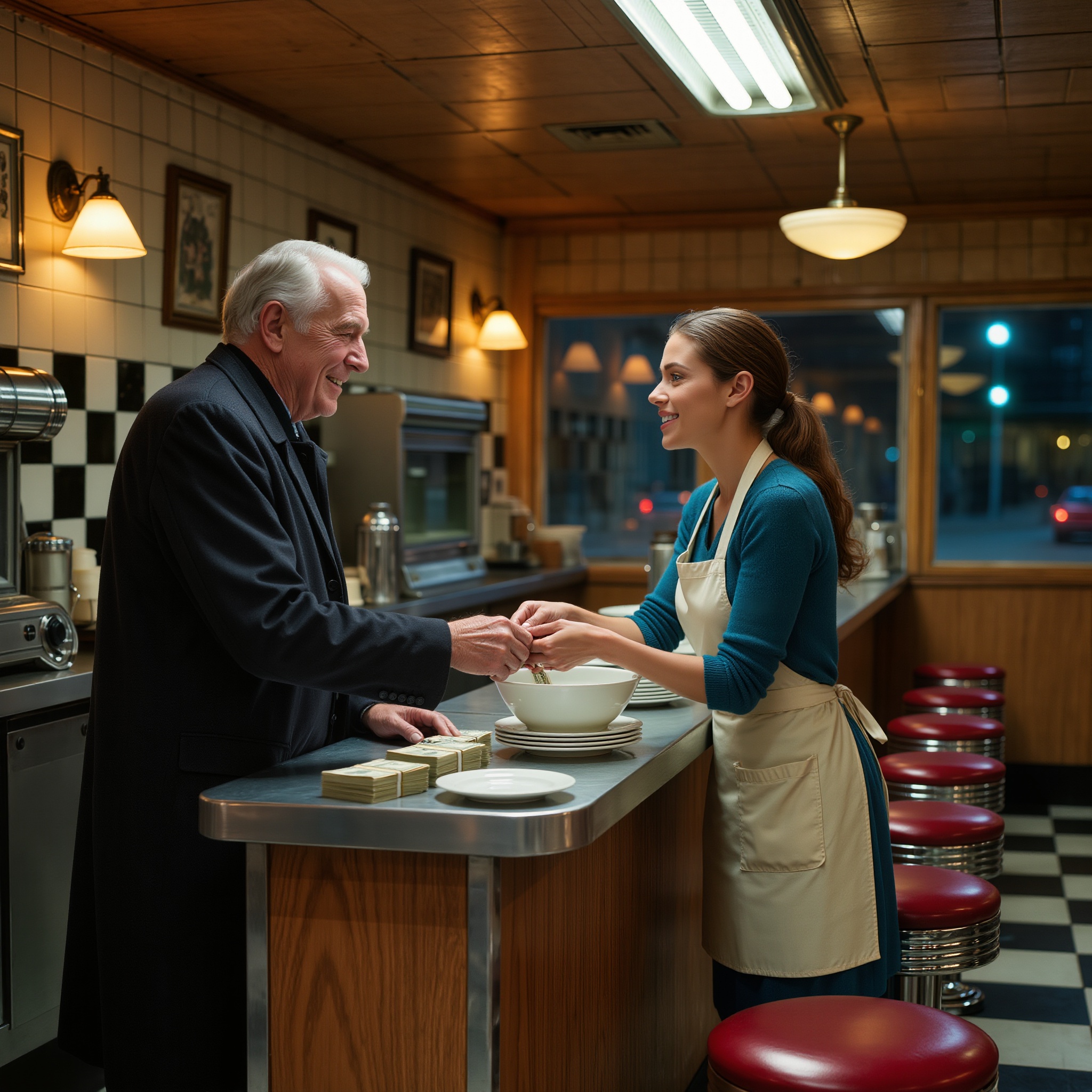
By night, I am the lead dishwasher at the Maple Steel Diner. This job is not temporary. It is permanent, heavy, and real.
Tonight, the kitchen smelled of burnt sugar and old grease. The radio over the swinging door was playing the Guardians game, but the static was winning. I had my head down, arms deep in the industrial sink, steam rising to fog my glasses. My target was a stack of sheet pans, each one bearing the black, carbonized ghost of tonight’s meatloaf special.
I pressed the steel scraper hard, feeling the blade catch on a stubborn patch. The metal shrieked in protest. It was a sound I understood.
My phone buzzed in my back pocket, pressing against the damp fabric of my jeans. I knew without looking that it was nothing.
I’d sent the text three hours ago, right before my shift started. It was to the family group chat, the one named “Cruz Crew” by my sister, Amber:
Got the email. I have an interview for the promotion in Raleigh. It’s in two weeks.
I had checked it on my ten-minute break. All four bubbles were filled in. My mother, Janice. My father, Carl. My sister, Amber. Even her husband, Dave, who rarely read anything.
All seen.
Not one thumbs up. Not one “Good luck.” Just the cold, digital proof of my own invisibility.
“Table four stiffed me again,” Miguel muttered, slamming an empty coffee pot onto the warmer. “A dollar-fifty on a $60 check. What am I supposed to do with that?”
I glanced up from the sink, pushing my glasses back up my nose with a clean wrist.
Miguel was 22, perpetually angry, and probably the closest thing I had to a friend at the diner.
“It’s fine, Miguel,” I said, offering the small smile I reserved for the night shift—the one that didn’t quite reach my eyes but soothed the people around me. “Maybe they had a bad day.”
“We’re all having a bad day, Mac,” he grumbled. “But he refilled the pot. You’re just the only one who doesn’t complain about it.”
I turned back to the pans.
Complaining implied you expected a different outcome.
I didn’t. I just worked.
I worked to pay for my small apartment, my car insurance, and the lingering student loans from a degree my family had insisted was a good backup. I worked so I could afford the data plan that let me see their “seen” receipts.
The diner was hitting its late-night lull. The baseball game had entered the eighth inning, the announcer’s voice a low drone. Only one customer was left at the counter—an older gentleman.
He’d been there for an hour, sitting straight-backed on the red vinyl stool. He wore a gray cashmere cardigan over a crisp white shirt. It looked out of place against the Formica and pulled ketchup bottles, but he seemed perfectly at ease.
He had eaten a simple slice of apple pie and nursed one cup of black coffee. I watched him in the reflection of the steel pastry case as I wiped down the splashback. He wasn’t reading a paper or looking at his phone.
He was just watching.
He watched Miguel wipe tables. He watched Ruth, our manager, count the drawer.
And he watched me, elbow-deep in suds.
There was no judgment in his gaze, just a quiet, unsettling attention.
Finally, he stood, leaving a few bills on the counter. He nodded once—a polite gesture to the room at large—and walked out.
The bell over the door tinkled, a cheerful, high-pitched sound in the greasy air.
“Thank God,” Miguel sighed, moving toward the counter to clear the last spot. “Now we can actually clean.”
He picked up the check, then froze.
“No way,” he whispered.
“What?” I asked, pulling the plug on the sink. The roar of the water draining filled the silence.
“Mac, you gotta see this.”
I dried my hands on my apron, the rough fabric scratching my chapped skin. Miguel was holding a receipt, and tucked beneath it was a stack of cash.
Not ones. Not a twenty.
It was a neat fan of $100 bills. Five of them.
“He must have been drunk,” I said, my voice hollow.
$500.
That was my entire paycheck from Atria Ortho for the week. It was more than my half of the rent.
“He wasn’t drunk,” Miguel said, his eyes wide. He held up the receipt.
The man had paid for his $4 pie and $3 coffee with a ten and left this on the tip line. He hadn’t written a number. He’d scrawled a note in a steady, elegant hand:
Kindness is a rare skill. What’s your name?
My breath caught.
“He left this for me.” I heard myself say it.
“Who else?” Miguel said. “He was watching you all night. Go, go. He just left.”
I didn’t think. I grabbed the money and the receipt, bolted from behind the dish pit, and pushed through the swinging door. The bell chimed violently as I burst onto the sidewalk, the cold Ohio air hitting my steam-dampened face.
“Sir!” I yelled. “Sir, you forgot—”
But he hadn’t forgotten.
He was already inside a car. A beautiful, impossible car.
It was a vintage Packard, the color of old cream, gleaming under the weak streetlights. As I ran toward it, the engine turned over with a low, powerful hum—nothing like the sputtering engines of Fairmont. The car pulled smoothly away from the curb.
“Wait!” I shouted, waving the bills. “This is a mistake!”
The car didn’t stop. It accelerated cleanly, and as it passed under the next streetlight, I saw the license plate.
It was a personalized plate, blue on white:
ALDN-1
ALDN1.
It turned the corner and was gone.
I stood on the empty sidewalk, my chest heaving. The $500 felt hot in my hand, like a stolen thing.
I walked back into the diner, the bell mocking me with its gentle tinkle.
“He’s gone,” I said, walking up to the counter.
Ruth was there now, her arms crossed, her end-of-shift expression firmly in place.
“Gone where?” she asked.
“The man with the car. He left this.”
I laid the $500 on the counter next to the half-full sugar shakers.
“It’s a mistake. He must have meant to leave five or maybe fifty.”
Ruth looked at the money, then at me. She didn’t look surprised. She looked tired.
“And you ran out after him.”
“I tried to give it back.”
She shook her head, a small wry smile playing on her lips.
“Of course you did, McKenzie.”
“He was in a crazy old car,” Miguel piped up. “Looked like a museum piece.”
“That’s him,” Ruth said, nodding. She picked up the bills, counted them, and pushed them back toward me. “The Packard. He comes in maybe twice a year. His name is Alden.”
“And he just… gives away money?” I asked, unable to process it.
“He tips like that often,” Ruth said, her voice dropping. “When he sees someone who deserves it.” She nodded toward Miguel. “He tipped Miguel 300 last year when Miguel’s mom was sick. And he paid for Tasha’s tuition for a semester.”
She looked at me.
“He doesn’t make mistakes, McKenzie. He pays for what he sees.”
She tapped the receipt with the note.
“He asked for your name.”
“I… I don’t understand,” I said.
“There’s nothing to understand,” Ruth said, turning back to her paperwork. “He saw you work. He saw you scrape those god-awful pans and smile at Miguel when he was being a pain. He saw you. Now take the money and put it in your pocket before you drop it in the sink.”
I stared at the bills.
$500 for kindness.
For doing my job.
“Split it with me,” I said, pushing it toward Miguel.
“Nope,” he said, holding up his hands. “He was looking at you. That’s all yours, Mac. But you’re buying me a beer Saturday.”
I finally laughed—a real laugh. It felt rusty.
“Yeah, Miguel. Saturday.”
I tucked the money deep into the front pocket of my jeans. It felt heavy, like a secret.
The rest of the shift was a blur of scouring and rinsing. When I finally clocked out at two in the morning, the street was empty. My car, a ten-year-old Civic with a dent in the passenger door, looked like a pumpkin compared to the cream-colored Packard.
Driving home, I replayed the Cruz Crew chat in my head. I thought about Raleigh. A promotion. A real job. Not a contract. A new city. A new life.
The $500 in my pocket felt less like a tip and more like a sign.
My apartment is small, just a studio over a closed-down laundromat in a nowhere stretch of Fairmont. It’s quiet, which is mostly what I like about it. I cleared the single plate and fork from my dinner—a microwaved bowl of soup I’d eaten six hours ago—and washed them in the small sink.
The movements were automatic: wash, rinse, dry, put away.
I sat at my small desk and opened my laptop. The screen flickered to life, illuminating my face in the dark room.
One new email.
My stomach tightened.
From: Atria Ortho Human Resources, Raleigh Division.
Subject: Your Interview with Atria Ortho.
Dear Ms. Cruz, we are pleased to confirm your final interview…
I read the details. A flight. A hotel. A two-hour panel.
It was real. It was happening.
My chance.
I opened my family group chat again, just to be sure.
Still the same.
Four little circles. Four silent “seen” marks.
My phone pinged and my heart leaped. I grabbed it, thinking, Finally. Mom.
But it wasn’t the group chat. It was a private message—a voice note from Amber.
I pressed play and my sister’s bright, brittle voice filled my silent apartment.
“Hey, Mac. So glad you’re free in two weeks. Listen, Dave’s parents are coming in that weekend—the one you’re flying—so I’m going to need you to clear your schedule. I really need you to be here. The kids miss you. Remember, you’re watching them this weekend too. Don’t be late. Thanks.”
The voice note ended.
It wasn’t a request. It was a statement of fact. An assignment.
I’m going to need you to clear your schedule.
I looked from the Raleigh interview confirmation, to the silent group chat, to the voice note from my sister, who hadn’t even acknowledged my interview but had clearly registered the dates as an inconvenience to her.
“No,” I whispered to the empty room.
“Not this time.”
My hand went to my pocket. The $500 was still there. A warm, solid square.
I pulled it out. The bills were crisp.
I walked to my desk and took a plain white envelope from the drawer. I slid the money inside. With a black marker, I wrote on the front of the envelope two words:
TRANSITION FUND.
I sealed it.
I wouldn’t be cashing this for a beer for Miguel or for groceries. This was different.
This was the first payment on a new life.
I would go to Raleigh. I would get that job.
And I would not be the family help again.
I would not be the sister who cleared her schedule.
I, McKenzie Cruz, was finally going to be seen.
My family operates on a map of silent, one-way transactions. I am the service road everyone uses to get to their own destination, the one nobody pays tolls on.
This is not a new realization. It is a quilt of memories patched together with small, sharp pains.
My high school graduation.
I was on the C list, so I was in the middle of the ceremony. I remember scanning the bleachers, the sun hot on my blue gown. I found my family. My mother, Janice, was waving, but my father, Carl, was already standing up, checking his watch.
They left before I crossed the stage.
Amber, my sister, had called from college needing a ride from the bus station an hour away. My dad left my graduation to get her.
“You know your sister,” he’d said. “She gets anxious waiting.”
I got a ride home with my friend’s parents.
My 25th birthday.
It was a Saturday. I’d hoped for dinner, maybe a cake. When I got to my parents’ house, the living room was buried in bubble wrap, packing tape, and stacks of cheap costume jewelry. It was the year Amber launched her livestream boutique. She’d had a massive sale.
My mother, my father, and even my aunt were all packing plastic earrings into pink mailers.
“Mac. Thank God,” my mother said, not looking up. “Grab a tape gun. We’re drowning.”
I spent four hours sealing boxes. We ordered a pizza at ten.
That was my party.
Their requests are a constant, low hum in my life. The family chat is not for connection. It is a task management system where I am the only employee.
Mac, can you grab milk?
Mac, the boys need new sneakers. I sent the link.
Mac, your father’s printer is out of ink again.
No “How are you?” No “How was your day?”
Just a list of needs.
For five years, my vacation days from Atria Ortho were not for me. They were for Amber’s childcare gaps. I used eight of my ten paid days last year watching my nephews when their daycare was closed for teacher development.
I spent a full Saturday—my only day off from both jobs—driving my mother to three different home goods stores. We were looking for curtains for Amber’s new living room.
Not my mother’s living room.
Amber’s.
“They have to be the right shade of dove gray, McKenzie,” my mother had said, squinting at a fabric swatch. “Amber gets so stressed when the tones clash.”
I sat in the car while she went into the fourth store, my hands gripping the steering wheel, and I just felt blank—the color of unpainted drywall.
That Saturday, two days after the $500 tip, I went to my parents’ house for the obligatory weekend lunch. The transition fund envelope was hidden in my apartment under my mattress, a single seed of a future I was terrified to plant.
I didn’t respond to Amber’s voice note. I just showed up.
The house smelled of pot roast and anxiety. My father was in his recliner, watching a golf game on low volume. My mother was in the kitchen, wiping a counter that was already clean.
“There she is,” my father said, not taking his eyes off the screen. “Running late, Mac.”
“My shift ended at two, Dad. I’ve been asleep for five hours.”
“Tough schedule,” he nodded, still watching the putt.
My mother came out, wiping her hands on her apron.
“Amber isn’t coming. The boys have a cold. She’s exhausted. You should text her.”
“I will,” I lied. “Mom, Dad, I have news. I told you I had an interview.”
“Oh, right,” my mother said, her focus already drifting back to the kitchen. “The Raleigh thing.”
“I got the flight details,” I said, my voice louder than I intended. “It’s a final panel interview for the senior specialist position. They’re flying me out.”
My father grunted.
“Raleigh. That’s a long way. Bad traffic.”
My mother stopped, turned back to me, and for one stupid second, my heart lifted. I thought she was finally going to see me. I thought she was going to say, That’s wonderful or We’re proud of you.
She looked at me, a calculated expression on her face.
“Well,” she said, “that’s fine, but I’m counting on you for the church bake sale next weekend. Just remember to bake the cherry pie, your father’s favorite.”
And there it was.
The promotion. The flight. The new life.
Just an obstacle to be navigated around her need for a pie.
“I’m not baking the pie, Mom,” I said.
The words were quiet, but they hung in the air like smoke.
“What?” She frowned, as if I’d spoken in a different language.
“I can’t. I’ll be packing or preparing.”
“Don’t be silly, McKenzie. It’s just a pie. You can do it after your shift.” She turned and went back to the kitchen.
I stood in the living room. The golf announcer murmured about a sand trap. I was invisible.
My role in this family is not daughter or sister. My role is the filler. I am the person who fills the empty spaces. I fill the childcare gaps. I fill the errand lists. I fill the silence with my compliance.
If I were gone, the only thing they would notice is the hole I left.
The tasks undone.
My father must have sensed the tension. He finally looked at me, his expression disappointed.
“McKenzie, your mother needs that pie. Family is for helping each other. You know that.”
“Is it?” I asked.
The question was bitter, and it surprised me.
“Who helped me pack for college? Who helped me move into my apartment?”
“That’s different,” Carl said, turning back to the TV, his tone dismissive. “Amber needed the car that day. We helped her. That’s what you do. You help.”
You help.
The family motto.
But the translation is wrong. It does not mean we all help each other. It means: McKenzie helps all of us.
I left without eating.
“Don’t forget the pie, honey,” my mother called after me.
But her voice sounded distant, like it was coming from across an ocean.
I drove back to my studio. I didn’t turn on the lights. I sat on my small secondhand sofa and just breathed. The silence of my apartment—which sometimes feels like loneliness—now felt like a sanctuary.
It is the only place I am not required.
I pulled out a piece of paper, a cheap notebook from the diner. I found a pen. My hand was shaking—not from exhaustion, but from a cold, quiet rage.
I wrote a letter to myself.
If they won’t see me, I have to see myself.
I taped the note to the inside of my closet door where I would see it every morning. Then I opened my laptop. The anger had burned away the fog of fatigue. My mind was sharp.
I opened the Raleigh confirmation email. I clicked the link for the hotel.
Then I opened a new tab: Apartment rentals. Raleigh, North Carolina. Near Atria Ortho.
I spent the next three hours scrolling through listings. I bookmarked studio apartments in areas called North Hills and Glenwood South. I looked at floor plans. I compared utilities.
I was not just going for an interview.
I was planning an escape.
I opened my desk drawer. Tucked in the back, beneath old bank statements, was a large manila folder. I pulled it out.
It was my other life.
The one my family had never asked about.
I laid the contents on my bed: my clinical coordinator certificate, a top-performer commendation from Atria Ortho from last quarter, three internal emails from surgeons printed out, praising my efficiency.
“Ms. Cruz’s protocol charts are the clearest I’ve ever used.”
“McKenzie caught a critical scheduling error that would have cost us a full day.”
“She anticipates needs before they become problems.”
These were my assets. This was my value.
This was the proof.
I am not just the family help.
I am a professional.
I put every single paper back into the folder.
This was my armor.
That night, I slept a heavy, dreamless sleep for the first few hours.
Then, just before dawn, I dreamed.
I was standing in a dark hallway. At the end of it was a massive, heavy door made of steel, like a bank vault or a hospital fire door. I pushed it and it didn’t budge. I pushed again, putting my whole body into it. It’s not locked. It’s just impossibly heavy.
Slowly, with a groaning metallic shriek, it began to move. A crack of light appeared.
Not sunlight. It was the clean, bright, sterile white light of a hospital operating room.
It was the light of my future.
I’m not afraid of it.
I’m pushing toward it.
I woke up to my phone pinging.
It was the Cruz Crew chat.
My eyes were blurry. I rubbed them and focused on the screen. It was a new message from my mother.
A picture.
My two nephews, sitting at the kitchen table, their faces covered in red jam and crumbs. The cherry pie I was supposed to bake was half eaten, hacked to pieces on the counter behind them.
The caption from my mother read:
“Who could wait for dessert? Looks like you’re off the hook, Mac. Amber’s boys are little monsters, lol.”
I stared at the picture.
She found someone else to bake the pie. Or maybe Amber bought one.
It didn’t matter.
The task was filled.
I was replaceable in that, too.
I smiled, but it was a sad, tired smile.
“Still the same,” I whispered to the morning light.
I got up, walked to my closet, and looked at the note I taped to the door.
If they won’t see me, I have to see myself.
I opened my laptop and booked my flight to Raleigh.
It was a Tuesday, the week before my flight to Raleigh. Tuesday nights at the Maple Steel were usually dead—just the hum of the coolers and the clack of my scouring pad.
But tonight, a storm front was moving in, and it seemed to have pushed all the town’s frustration through our doors. The air was thick with the smell of wet wool and frying onions.
Miguel was spread thin, handling a six-top of high school kids who were splitting one order of fries six ways and demanding endless refills. I was in the dish pit, my sanctuary.
When the bell on the door chimed, I didn’t look up.
Not until Ruth hissed my name.
“McKenzie. Drop the pans. Table three is giving Miguel hell. Go take the order. You’re calmer.”
I dried my hands on my apron, unclipping my “M” name tag from my work shirt and pinning it to the clean black T-shirt I wore underneath.
The couple at table three were in their 50s, dressed in matching windbreakers. The man was snapping his fingers.
“Service,” he said loudly as I approached.
“Good evening. What can I get for you?” I kept my voice low, steady.
“We’ve been waiting fifteen minutes,” the woman said. “That boy”—she gestured at Miguel—”is ignoring us.”
“I apologize for the wait. It’s a busy night,” I said.
“The coffee is burnt,” the man snapped, pushing his mug toward me. “And this menu is sticky. Don’t you people clean?”
I felt the familiar heat rise in my chest. The urge to apologize, to shrink, to make myself smaller.
But I thought of the note taped to my closet door.
See yourself.
“I will get you a fresh pot of coffee and a new menu,” I said. I didn’t apologize again. I met his gaze. “What did you want to order?”
He looked slightly taken aback.
“I want the meatloaf, but I don’t want the gravy. I want it on the side. And the mashed potatoes better be hot. Not lukewarm. Hot.”
“Meatloaf. Gravy on the side. Hot mashed potatoes. And for you, ma’am?”
“The salad, but no onions. I’m allergic. If I see one onion, I’m sending it back.”
“Cobb salad. No onion,” I repeated. “Understood.”
I turned and walked away. I didn’t rush. I didn’t placate.
I just executed.
I got the coffee. I put the order in, standing by the line cook to ensure the potatoes were steaming and the salad was clean.
When I delivered the food, the man grunted. The woman picked through her lettuce with her fork, searching, finding no onions. She began to eat, her silence a reluctant acceptance.
I was clearing the plates from the now-departed high schoolers when the bell chimed again.
And he walked in.
It was him.
The man from the other night.
The cream-colored Packard must have been parked outside.
He wore the same gray cardigan, or one very much like it. He looked different from everyone else in the diner—not just because of his clothes, but because of his stillness. He absorbed the chaos without becoming part of it.
He didn’t look at the “Seat Yourself” sign. He walked directly to the counter and sat at the same stool as before.
He sat, waiting patiently, as if he had all the time in the world.
After I cashed out the difficult couple—they left a five-percent tip, which I split with Miguel—the diner emptied. The storm had finally broken.
It was just me, Miguel wiping the counters, and the old man.
I walked over with the coffee pot.
“Coffee?”
He looked up. His eyes were a very clear, pale blue.
“Black. Thank you.” He paused, his gaze analytical. “And a slice of the apple pie. If it’s fresh.”
“It is,” I said. “Ruth made it this afternoon.”
I poured his coffee and cut a slice of pie. When I set it down, he didn’t pick up the fork.
He looked straight at my name tag, which just showed the single letter “M.”
“Cruz,” he said. “Correct?”
I froze. My hand was still on the coffee pot.
“I… yes. How did you know?”
“I’ve been in the trust business for fifty years,” he said, as if that explained everything. “You learn to do your research.”
He reached into the breast pocket of his cardigan and pulled out a small, stiff card. It was incredibly thick, cream-colored, like his car.
ALDEN ROYCE
78
That was all it said, along with a ten-digit phone number, embossed, not printed. No company. No logo. No email address.
“The couple at table three,” he said, gesturing with his chin. “They were difficult.”
I glanced at the empty table, now wiped clean.
“It’s part of the job,” I said.
“No,” he said, taking a small bite of the pie. “It isn’t. Enduring rudeness is. But what you did was different. You set a boundary without humiliating them. You enforced a standard. You were clear. You were firm.
“And you were not emotional. That isn’t service, Ms. Cruz. That’s leadership.”
I stared at him.
I had been called helpful my whole life. Reliable. Quiet. Nice.
No one had ever used the word leadership.
It felt foreign, like a coat that was too big for me.
“I just didn’t want them to yell at Miguel,” I said, the truth slipping out.
“And there it is,” Alden smiled, a small, dry movement of his lips. He took another bite of pie. “You protected your team.”
He set the fork down and leaned forward, his expression suddenly serious.
“Tell me, does the name Silas Barrett mean anything to you?”
The coffee pot in my hand tilted. A small splash of hot liquid hit my skin. I hissed—not from the burn, but from the name.
Silas Barrett.
It was a ghost name. A name spoken only in whispers and only in anger, usually by my mother.
“He… he was my maternal grandfather,” I managed. “My mother Janice’s father. He died when I was five or six. I’m not really sure. He was a non-person, a blank spot in the family tree.”
“He was a man of high standards,” Alden said, the words precise. “He hated waste. He hated entitlement. And he hated seeing potential squandered.”
He pushed his pie plate away, the last bite uneaten. He looked at the card in my hand.
“My flight is in one week,” I said, not knowing why I was telling him. “To Raleigh. For an interview. A new job.”
“I know,” he said.
My blood went cold.
“How do you know that?”
“I told you, Ms. Cruz. I’m in the trust business.”
He stood up, pulling a wallet from his slacks.
“But trusts aren’t just about money. They’re about placing faith in the right people.”
He placed two bills on the counter. One was a ten for the pie and coffee. The other was a crisp $100 bill.
“This,” he said, tapping the hundred, “is for the young man—for remembering to refill my coffee the last time, even when I didn’t ask.”
He looked at me.
“If the day comes that you need advice—real advice, not the kind you get from people who need something from you—call that number. I’ll answer.”
He nodded once, and just like before, he walked out. The bell tinkled.
I stood there, my mind spinning.
Silas Barrett.
Leadership.
I know, dude,” Miguel said, walking over and snatching the $100 bill. “A hundred bucks. This guy. Is he your—”
“He’s not,” I snapped, harsher than I intended. “He’s just a customer.”
“A customer who knows your last name,” Miguel said, stuffing the bill in his pocket, but his eyes were sharp. “Ruth said he’s old school. Like, old money rich. Used to be some kind of big-shot finance lawyer. The kind that hides money for billionaires.”
“He said he was in the trust business,” I said, staring at the card. “Alden Royce.”
“Yeah.” Miguel shrugged. “Trusts. Hiding. Same difference. Good for you, Mac. You got a rich guardian angel.”
But it didn’t feel angelic.
It felt unsettling.
He hadn’t asked my name this time.
He’d known it.
He hadn’t just tipped me.
He had tested me.
And he had mentioned Silas Barrett.
I spent the last hour of my shift in a daze. The clatter of plates, the rush of water—none of it registered. All I could hear was that name.
When I got home to my studio, I didn’t sleep. I sat at my desk, the no-logo card in my hand.
I opened my laptop.
I typed “Alden Royce Ohio” into the search bar.
Nothing. A few obituaries for other Aldens. A few generic business listings for Royce-this or Royce-that.
I typed “Alden Royce finance lawyer.” Nothing. “Royce Industrial Holdings.” Nothing.
I tried the phone number. It was a 330 area code, local to Fairmont. But the prefix was old—the kind assigned to landlines decades ago.
It wasn’t listed under any business.
It was a ghost number attached to a ghost.
I gave up. He was a puzzle I couldn’t solve.
And I had a more pressing reality to deal with.
I clicked over to my Raleigh file. I had my flight confirmation, my hotel details. My interview was scheduled for Thursday, nine in the morning.
I spent the next few days in a bubble of preparation. At Atria Ortho, I finalized my project handoff notes for my contract replacement. At the diner, I scrubbed every surface until it gleamed, working on autopilot. At home, I printed my resume on good, thick paper. I dry-cleaned my one good suit.
I rehearsed answers to questions about clinical deployment and patient retention.
I was building my new life, brick by brick.
And then, on Sunday night, exactly three days before my flight, my family tried to tear it down.
My phone buzzed on my nightstand. It was the Cruz Crew group chat.
My stomach tightened.
I had muted it, but the notification badge still showed up.
It was a message from Amber.
Mac, just a reminder. I need you here at 8 a.m. on Thursday. Dave has a client meeting and I have a huge livestream launch. The kids are a handful. Bring snacks.
Thursday.
Thursday at nine a.m.
The day of my flight.
The day of my interview.
I stared at the message.
Just a reminder, as if it had been discussed. As if it were a settled fact.
She hadn’t asked.
She had assigned.
The old McKenzie would have panicked. She would have called Amber, apologizing, trying to reschedule her entire life to fit the childcare gap. She would have looked for flights on Friday. She would have felt the crushing guilt.
But I just didn’t.
I thought of the $500 in the transition fund. I thought of the man snapping his fingers at me and my calm, clear refusal to break.
I thought of Alden Royce, his pale blue eyes, and the word he used.
Leadership.
I opened the chat.
My mother had already replied.
Have fun, Amber. Mac will be there.
My fingers moved over the keyboard. I didn’t write a long explanation. I didn’t apologize. I didn’t offer an alternative.
I typed five letters.
Can’t.
I hit send.
Almost immediately, the three dots appeared. Amber was typing. Then they vanished. My mother was typing. Then they vanished.
My phone started to ring.
Amber’s face flashed on the screen.
I looked at it. I watched it ring. The sound vibrated against the wood of my desk.
I thought about the years of packing her boxes, watching her kids, driving her errands. I thought about my graduation. My birthday.
I declined the call.
It rang again immediately.
My mother this time.
I declined it.
Then the texts started—a flurry of pings.
Amber: What do you mean, can’t?
Mom: McKenzie, call me. This isn’t funny.
Amber: I’m counting on you. This is my job.
Mom: Mac, answer your phone. You’re upsetting your sister.
I took a deep breath. I opened my phone settings. I navigated to the Cruz Crew group chat.
Mute notifications: Always.
I did the same for Amber’s individual contact and my mother’s.
I turned my phone face down on the desk. I picked up my printed checklist for Raleigh.
Suit.
Resume.
Presentation notes.
I checked them off, one by one.
The silence in my apartment was clean, sharp, and absolute.
It was the sound of a boundary being set.
“Welcome to Raleigh-Durham,” the flight attendant’s voice was a cheerful murmur over the intercom.
I stepped out of the jet bridge and into the terminal, and the air felt different. It was warmer, heavier with humidity, smelling of pine and jet fuel.
My phone, which I had switched off airplane mode, remained dark and silent in my hand.
No explosions from the Cruz Crew chat.
No frantic, guilt-ridden voicemails from my mother.
No demands from Amber.
I had left three days ago, and my silence had apparently been met with silence.
It was a terrifying, hollow feeling.
And then, as I stepped into the rental car, it became the purest relief I had ever known.
I had canceled the hotel Atria Ortho had booked. I didn’t want to be a guest.
I needed to be a resident.
I’d used the last of my savings—not the transition fund—to rent a short-term furnished studio online. It was a gamble, paying a deposit on a place I’d never seen. But the ad said: Near Lake Fallon.
The apartment was small, on the third floor of a brick complex. The furniture was blonde wood and beige fabric, impersonal and clean, but the sliding glass door opened onto a tiny balcony that overlooked a stand of towering longleaf pines.
It didn’t face a parking lot.
It didn’t face a brick wall.
I rolled my one suitcase into the room and dropped my backpack by the door. I didn’t unpack. I just stood in the center of the beige carpet, listening to the cicadas and the distant sound of traffic.
I had put my backpack down.
For the first time, I felt the weight lift from my shoulders.
My interview was in thirty-six hours. I spent the first morning jogging—not on a treadmill, but on a damp red-dirt trail that wound around Lake Fallon. It was just a large pond, really, but it was green.
And it was mine.
That evening, I didn’t go to a diner. I sat at the small, wobbly desk, my laptop open, my presentation glowing. I rehearsed it until the sun went down—the clinical data and deployment strategies feeling more real, more me, than any pot I’d ever scrubbed.
Atria Ortho Raleigh was a tower of blue glass and steel. It was not the low-slung brick office in Fairmont. This was the heart.
I walked in, my one good suit feeling inadequate, clutching my portfolio.
The panel was three people, but I knew instantly there was only one person I had to convince.
Dr. Leah Morton, the department head.
She wore surgical scrubs under a white coat, her hair pulled back, and her eyes missed nothing.
“Ms. Cruz,” she started, not bothering with pleasantries. “Your file says you’re an excellent coordinator. This isn’t a coordinator job. This is senior specialist. We’re launching the new kinetic knee recovery device across six satellite clinics in three months. Your predecessor failed.
“Why won’t you?”
The old McKenzie would have shrunk. The old McKenzie would have apologized.
I stood up. I walked to the whiteboard.
“Because you’re thinking about the technology,” I said, picking up a marker. “You should be thinking about the nurses.”
I drew six small circles on the board.
“You’re asking the team at the Garner Clinic—which is understaffed by two—to adopt a new thirty-minute setup protocol. They won’t do it.”
Dr. Morton’s pen stopped.
“They will if I tell them to.”
“They will nod,” I countered, my voice steady. “And then, the first time they have to choose between that protocol and helping a patient to the commode, they’ll skip the protocol. The patient always wins.
“The problem isn’t the device. It’s the workflow.”
I didn’t talk about specs or profits. I talked about human behavior. I talked about the nurse at the Cary clinic who also had to cover reception. I talked about the physical therapy handoff in Apex that was creating a data bottleneck.
I had spent the last week not just reading the tech manuals, but studying the staffing charts and floor plans of all six clinics.
“You integrate this protocol into the existing sterile-tray setup,” I said, tapping the whiteboard. “You prove to the Garner nurses it saves them ten minutes on postop charting. You give them back time, and they’ll give you compliance.”
The interview, scheduled for one hour, lasted two.
When it was over, Dr. Morton walked me to the elevator.
“Everyone else I interviewed,” she said, arms crossed, “talked about ROI. You’re the first person who talked about the nurses. You understand the behavior, not just the theory.”
She pressed the down button for me.
“We’ll be in touch by end of day.”
The email arrived four hours later.
Dear Ms. Cruz,
We are pleased to offer you the position of Senior Clinical Specialist…
I read the numbers. The salary made my vision blur. A relocation bonus. A start date in three weeks.
I sat on the beige carpet of my new, empty room and cried.
It wasn’t a sad cry.
It was the cry of a dam breaking.
My hand went to my phone.
The urge to call my mother, to shout, I did it. I’m a senior specialist, was a physical ache—a lifetime of programming.
But I knew what she would say.
Oh, that’s nice. Did you hear Amber’s new shipment is stuck in customs?
I scrolled past her name. I found the number from the cream-colored card.
I pressed call.
It rang twice.
“Yes,” came his voice. A dry, calm statement. “Mr. Royce.”
“Alden Royce speaking.”
“It’s McKenzie. McKenzie Cruz. From the Maple Steel Diner.”
A pause—so brief I almost missed it.
“I know who you are, Ms. Cruz. You’re in North Carolina. How did the panel go with Dr. Morton?”
My blood didn’t run cold this time.
I felt a strange sense of alignment, as if a gear had clicked into place.
“You knew about the interview.”
“I am in the trust business,” he said. “Good news, I take it?”
“I got the job. I start in three weeks. I… I called to thank you. For what you said about boundaries. It helped me get here.”
“I am glad to hear it,” he said. “But compliments are not why I am a useful person. You’re calling because you’ve won a battle and now you’re worried about the war.”
He was right.
“They’ll try to pull me back,” I whispered. “My family.”
“They will,” he agreed, his voice flat. “Which is why I’ll give you a piece of advice. It is the most important advice you will ever receive.
“Get a new notebook and keep meticulous records of what is yours. Your lease. Your new bank account. Your employment contract. Every interaction. Every text message. Every broken promise. Document it.
“When people are used to treating you like a public utility, they’ll fight you when you start sending them a bill.”
“Document everything,” I repeated, the words solidifying into a plan.
“Good. Congratulations on the job, Ms. Cruz. Use the relocation bonus wisely. We will speak again.”
The line clicked.
I let out a breath I didn’t know I was holding.
I went out and bought a black hardcover notebook that night. I also bought a pack of yellow sticky notes. I wrote a new one and stuck it to the wall above the desk.
Boundaries = self-love + respect for others.
I spent the next two weeks building a life from scratch. I gave my notice to Atria Ortho Ohio. I called Ruth at the diner, who surprised me by cheering.
“Atta girl, Mac,” she’d said. “Go get the world. You’re too good for my pans.”
I needed a place to work. My studio was too quiet. On a rainy afternoon, I found a coffee shop called the North Loop. It was run by a man named Theo, who looked permanently exhausted and made the best espresso I’d ever had.
We didn’t talk much, but he let me sit in a corner booth for six hours straight, fueled by coffee, as I drafted the new standard operating procedures for the kinetic knee.
We became work friends—a silent alliance of people focused on the task in front of them.
The shop became my new office.
I was finalizing a workflow chart when my phone lit up.
The Cruz Crew group chat.
I hadn’t heard from them in two weeks.
My stomach twisted.
It was a message from my mother.
Family barbecue this weekend. Amber’s kids are excited. Mac, we need you here early to help your dad set up the patio tables.
Not: Are you okay?
Not: We haven’t heard from you.
Not: How was the interview you risked our relationship for?
We need you here early to help set up the tables.
My hands were shaking. I looked at the text. I saw Theo behind the counter grinding beans. I saw my laptop open to my new career.
I did not reply.
Thirty seconds later, my phone rang.
My mother.
I took a deep breath. I pressed accept.
“Hello, Mom.”
“McKenzie. Thank God. You weren’t answering. Did you see the text? We need you Saturday.” Her voice was brittle, falsely cheerful.
“I can’t.”
“Mom, don’t start that, McKenzie. I’m not in the mood. Your sister is stressed and we’re having a family day.”
“I can’t,” I said again, my voice stronger. “I’m in Raleigh.”
“What? For the interview. That was weeks ago. Stop being dramatic and come home.”
I closed my eyes. I pictured the new note on my wall.
“Mom, I got the job. I live here now. I have an apartment in Raleigh. I’ve moved. Permanently.”
The silence on the line was heavy and absolute.
I heard a sharp intake of breath.
I waited for congratulations.
I waited for we’re proud of you.
The silence broke and my mother’s voice, now drained of all false cheer, began to complain.
“Well, I don’t know what you expect—permanently. That’s ridiculous. Amber’s sales are down thirty percent, you know. Thirty. She’s just devastated. And now you’re abandoning us right when she needs us. I don’t know what I’m going to tell her about the tables.”
I listened. She hadn’t heard me—or she had, and it didn’t matter. My new life, my career, my entire existence was just an obstacle to her plan for a Saturday barbecue.
I was not a person.
I was the help who had gone on strike.
“It’s just so selfish, McKenzie. After all we—”
“I have to go, Mom,” I said, cutting her off.
“I’m not finished,” she snapped. “I’m trying to tell you—”
I pressed the red end button.
I hung up on my mother.
I stared at my phone, half expecting the world to end.
It didn’t.
Theo put a fresh coffee on my table. I nodded, my hands still shaking, but I was smiling.
That Saturday, I opened the white envelope from my desk—the transition fund, the $500. I walked downtown.
I went into a store where the clothes weren’t on racks, but displayed like art. I bought a charcoal gray suit. It was perfectly cut. It fit like armor.
I paid for it with the five crisp $100 bills.
The last of the diner grease was gone.
I was ready.
I had been at Atria Ortho for six weeks. My new life had started to take on a shape. The charcoal gray suit hung in my closet, no longer an aspiration but a uniform.
My studio apartment, once beige and impersonal, now felt like a fortress. I’d bought a floor lamp with a warm yellow-tinted bulb that made the room feel like a private refuge—a place where I was not required to be anything but myself.
It was on a Tuesday evening, as I was mapping out patient data for the Garner clinic, that my cousin Nora texted.
Nora was the family comet, a relative who blazed through on her own schedule and was gone just as quickly. She wasn’t like my mother or Amber. She was on a cross-country road trip, living out of her hatchback.
Hey, Mac, the text read. In NC. Need a floor for the night.
I told her yes.
She arrived two hours later in a cloud of road dust and patchouli, her arms full of gas station snacks. She walked into my studio, looked around at my small desk, my single, neatly made bed, and my wall of color-coded sticky notes for the Raleigh project.
“Whoa,” she said, her eyes wide. “You actually did it. You escaped.”
We drank cheap beer and she told me about fixing a flat tire in the desert. For the first time in my life, I had stories to trade.
I told her about Dr. Morton, about the satellite clinics, about the North Loop coffee shop.
Later that night, I was on my tiny balcony just breathing the humid air. Nora was inside, scrolling through her phone.
She snapped a picture.
I didn’t think anything of it.
An hour later, my phone—curated into a tool of quiet efficiency—began to explode. It didn’t just vibrate. It felt like it was having a seizure.
Nora had posted the photo to her Instagram story. It was a shot from inside the apartment looking out. It framed my desk, my laptop glowing, the warm yellow lamp illuminating my whiteboard.
It was a picture of a life of quiet, focused work.
She had captioned it:
The home of a person who built her own life. So damn proud of you, cuz.
And she had tagged me.
And she had tagged my mother.
The floodgates opened.
Notifications from relatives I hadn’t spoken to in five years. Aunt Carol:
McKenzie, honey, is that your new place? It’s beautiful.
Uncle Mike:
Is that in North Hills? Must have cost a fortune. You renting or did you buy?
A cousin I barely knew:
Wow, Mac. Big glow up. What’s your job again?
These were the people who had watched me serve as the family pack mule for a decade. The people who saw me clearing plates at every holiday, who never asked me a single question about my life.
My invisibility had been a non-negotiable fact.
Now, this picture—this digital proof of a new, potentially successful life—had made me visible.
They weren’t proud.
They were curious.
They smelled resources.
Then the capstone: a public comment from my mother. Janice—not a text, not a phone call—left a comment on Nora’s story for the entire extended family to see.
So proud of my girl. We always knew she had it in her. Hard work and family values pay off.
I stared at the words.
So proud.
This from the woman whose last words to me were a complaint about her party tables. The woman who hadn’t spoken to me in almost two years about anything other than a demand.
The hypocrisy was so sudden, so blatant, it was almost impressive.
She was staking her claim. She was revising history in real time, painting herself as the supportive mother in front of an audience.
I was still staring at the screen, the fake praise curdling in my stomach, when a new private message pinged.
It was from Nora.
It wasn’t a text.
It was a screenshot.
Nora’s text above it read:
Hey, just so you know what’s happening: my mom just forwarded this to me. They’re already planning. Be careful, Mac.
My fingers fumbled as I opened the image.
It was a text exchange between my sister, Amber, and my mother, Janice, sent just minutes after Nora’s post.
Amber: Did you see Nora’s post? Look at that apartment. That’s not cheap. Look at the windows. That’s a new build.
Mom: I know. I’m commenting on it right now so everyone sees.
Amber: Don’t just comment, Mom. Call her. Look at her desk. She’s working. Ask her what the relocation bonus was and ask if she got stock options. Atria Ortho is a big company. I need to know if she has stocks.
I read the text three times.
I need to know if she has stocks.
The old familiar script. My life was not my life.
It was a set of assets.
My apartment was not a home. It was a line item.
My new job was not an achievement. It was a potential source of income for her.
The cold, transactional nature of it froze the anger in my veins.
This was my family.
Interest equaled inventory.
They were calculating my worth.
Nora left the next morning with a hard hug.
“Don’t let them pull you back into the swamp, Mac. Seriously. They sound like vultures.”
The swamp.
That was exactly what it felt like.
I spent the day at work, my focus shattered. Dr. Morton noticed, asking me if the deployment data was too challenging. I assured her it was fine, but my mind was elsewhere.
It was on that screenshot.
That night, my apartment didn’t feel like a fortress. It felt like a target.
At nine p.m., my phone rang.
Not a text. A call.
The number was blocked, but I recognized the prefix.
The old landline range.
I answered.
“McKenzie Cruz.”
“Ms. Cruz.” Alden Royce’s voice was dry. Immediate. No small talk. “Are you free tomorrow afternoon, say, three o’clock?”
My heart hammered against my ribs.
“Yes. Yes, I can be. Is it about Atria Ortho?”
“No. It is about your grandfather. Be at this address.”
He read it off.
Farlow Pike, Public Notary.
1225 Elm Street.
“Be prompt,” he said.
“A notary’s office? Mr. Royce, what is this?”
“This, Ms. Cruz,” he said, “is a contingency. I believe the time has come for you to see it.”
The line clicked.
The next day, I left work early.
Farlow Pike was not a shining corporate office. It was a small, quiet, street-level suite in a redbrick building downtown, smelling of old paper and furniture polish. A faded American flag stood discreetly in one corner of the lobby.
A receptionist pointed me to a back conference room.
Alden Royce was already there, sitting at a long, dark wood table. He wore a simple dark blue blazer. He was not alone. A man in a suit sat at the head of the table, a briefcase open in front of him. This man was the notary.
“Ms. Cruz. Thank you for coming,” Alden said, gesturing to the chair opposite him.
“What is this?” I asked, my voice tight. “You’ve been watching me. The interview. My apartment.”
“I am the executor of an estate that has an interest in you,” Alden said calmly. “Watching is my job.”
He slid a large, cardboard-backed envelope across the table. It was nine by twelve, stiff and heavy. It was sealed not just with a clasp but with a large, embossed red wax seal. It looked old-fashioned, almost cinematic.
“I am giving this to you now because I suspect you will need it soon,” he said.
I looked at the seal.
“What is it?”
“It is a set of instructions and a key. You are not to open it. Not yet.”
“When, then?”
“You will open it when you are ready to set the final boundary,” Alden said, his pale eyes fixed on me. “You will open it when they force your hand. And they will force your hand.”
He leaned forward.
“I told you I knew Silas Barrett. He was a brilliant man. He was also ruthless—mostly with people who expected something for nothing. He set up this trust and many others with very specific conditions.”
Alden paused, choosing his words.
“He told me something over twenty years ago when we were drafting the documents. He said: ‘Alden, I’m not leaving my legacy to the sweetest of my grandchildren. I’m leaving it to the one who can hold it. The grandchild who knows how to say no is the only one who can be trusted to manage the yes.’”
The breath left my body.
The one who knows how to say no.
All my life, I was the one who said yes.
Yes, I’ll watch the kids.
Yes, I’ll pack the boxes.
Yes, I’ll be there.
My “no” to my family had been a fragile, new thing.
But Silas Barrett had been waiting for it.
I gripped the strap of my bag, my knuckles white. This envelope wasn’t just paper.
It was a past I had been denied.
My mother had painted her father as a monster to be avoided, but Alden was painting him as a strategist.
For the first time, I desperately wanted to know the truth.
I slid the heavy sealed envelope into my work tote. It felt weighty, like a piece of armor.
“They’re already planning,” I said, my voice low. “My cousin posted a picture of my apartment. My sister—she wants to know if I have stock options.”
“I know,” Alden said, standing up. “That is why I called you. Now you have this. Do not use it until you must, but when you must, do not hesitate.”
I walked out of the notary’s office into the blinding Carolina sun. The envelope banged against my hip with every step.
I felt armed.
I sat in my car in the parking lot, the air conditioning blasting. My hand rested on my bag, feeling the rigid outline of the envelope.
My phone buzzed on the passenger seat.
I looked down.
It was a new text message from my mother.
My stomach didn’t drop. I just felt cold.
McKenzie, wonderful news. We’ve all missed you so terribly. We just couldn’t wait. Your father, Amber, and I have booked tickets. We land in Raleigh tomorrow at noon. Send us your address. We’ll stay with you for the weekend. The kids are so excited to see your new place.
I read the text.
We’ll stay with you.
In my one-room studio.
Tomorrow at noon.
No: Can we come?
No: Are you free?
Just an announcement of an invasion.
They weren’t coming to visit. They were coming to audit.
They were coming with empty hands and open mouths to the resource they had just identified.
They were coming to see if I had stocks.
They were forcing my hand.
I looked at the text message. Then I looked at the bag on my passenger seat. I touched the stiff corner of the sealed envelope.
A slow, hard smile spread across my face.
It wasn’t a smile of humor.
It was a smile of pure, crystalline certainty.
“Right on time,” I said to the empty car.
I did not send my address.
I didn’t have to.
At 11:50 a.m. the next day, my apartment buzzer shrieked—a long, demanding, impatient sound that echoed through my small studio.
I buzzed them in.
I stood in the middle of the room, my hands clasped behind my back, and waited. The sealed envelope from Farlow Pike was in my work tote, which sat on my desk like a silent observer.
I heard them on the stairs—a stampede of noise. Loud, complaining voices. The heavy thud of my father’s feet. The sharp, clacking heels of my mother and sister. The whining of my nephews.
The door flew open and they appeared.
It was not a visit.
It was an occupation.
“McKenzie!” my mother, Janice, trilled, her voice two octaves too high. She rushed in, pushing a bakery box at me. “We found it—your favorite. Chocolate.” She kissed the air near my cheek, her perfume overwhelming.
I took the box.
My favorite is strawberry.
It has always been strawberry.
“Hi, Mom.”
Amber pushed past her, her eyes scanning every corner of the room. Her lips were pursed in a thin, judgmental line.
She was calculating.
The two boys, five and seven, shot past her legs like feral animals, immediately spotting my small glass-topped coffee table.
“Where’s the TV?” the older one demanded.
“Carl, look at this. A studio,” my mother said, the word “studio” sounding like an insult.
My father, Carl, filled the doorway, his face already red from the stairs. He was carrying a huge bag.
“Hi, Mac. Place is small,” he said, dropping the bag, which landed with a thud.
“There’s the TV,” Amber said, pointing at my laptop on the desk. “She just has a laptop.”
“No, that’s her work,” my mother said, as if work were a quaint hobby.
“I need the TV!” the younger boy shrieked. He lunged for my laptop.
I moved. It was the first time I had moved from my spot. I stepped in front of the desk, blocking him.
“Stop.”
My voice was not loud, but it cut through the chaos.
The room fell silent for a half-second.
“Hey,” Amber said, her smile fake. “Be nice to your nephews. They’re just excited.”
“The rules are simple,” I said, looking at the boys. “You will not touch the glass table. You will not touch my desk. And you will sit on the floor and read.”
I pointed to a stack of my own books in the corner.
The boys looked at Amber.
She laughed—a brittle, high-pitched sound.
“Oh, Mac, you’re so serious. They’re just kids. Let them be kids.”
“Not in my space,” I said. “Sit, or you’ll wait in the car.”
My father grunted.
“She’s got you there, boys.”
He unzipped his bag and, to my horror, pulled out a small portable television and began looking for a plug. He had brought his football game.
Within ten minutes, my sanctuary was unrecognizable. My father was in my only comfortable chair, the tiny TV blaring the sounds of a pregame show. My nephews were wrestling on my rug, ignoring the books, their dirty sneakers scuffing the floor. My mother was opening my kitchen cabinets, her face a mask of disapproval.
“You don’t have any snacks, McKenzie. Just coffee and rice.”
Amber had seated herself at my small dining table across from me. She had her phone out, a calculator app open.
She was the reason they were here.
This was the audit.
“So,” she began, her voice all business. “This is nice. Really compact.”
“It’s what I need,” I said.
“Right. So let’s just get to it. Mom said you got a big title. Senior Specialist. That sounds important. What’s the base on that? 120?”
I didn’t answer. I took a plate from my cabinet—one my mother had just inspected—and opened the bakery box. I cut a slice of the wrong cake.
“Come on, Mac,” Amber pressed. “Don’t be weird. I’m just asking. Is it 120? 130? What was the relocation bonus? Ten? Fifteen?”
“The benefits are good,” I said, taking a small bite of the dry chocolate cake.
“Benefits?” She scoffed. “Benefits don’t pay the bills. What’s the 401(k) match? Does Atria Ortho give stock options? Are you vested?”
“Amber, that’s enough,” my father said, his eyes glued to the tiny screen. “Let her breathe.”
“I’m just trying to understand her situation, Dad,” Amber snapped. “She’s sitting here in a new city, in a new apartment, and she won’t even tell us if she’s safe. What’s the interest rate on the mortgage?”
I stopped, my fork halfway to my mouth.
“The what?”
“The mortgage. The loan for this place. I hope you got a good rate.”
“I rent,” I said.
Amber stared at me.
“You rent? But Nora’s post—this looked so permanent.”
“It is permanent,” I said. “I live here.”
“But you don’t own it.” The disappointment in her voice was raw, as if my lack of a mortgage were a personal affront.
“She’s smart,” my father suddenly chimed in. “Why buy when you can rent? Especially since you must have a rich boyfriend paying for it all. That’s it, isn’t it? This is all for a man.”
He said it as a statement, a fact he had uncovered. It was the only way he could make sense of it.
I had not earned this.
I had been given it by a man he had never met.
“There is no man, Dad,” I said, my voice flat. “I pay for this. I pay for all of it. With my job.”
A thick, uncomfortable silence descended. My father looked confused. My mother now looked worried. This wasn’t following their script.
My mother swooped in, her face collapsing into practiced lines of sorrow. She sat next to Amber.
“Well, that’s just wonderful, honey. We’re so proud. It’s just… it’s a hard time, you know.” She sighed—a long, tactical sound designed to signal the true purpose of their visit.
“Amber is just struggling so much. Her new supplier, it’s all a mess. And the kids—they need so much.”
Amber, on cue, put her head in her hands. Her voice was muffled.
“I’m ruined, Mac. Just ruined.”
I took another bite of cake. It tasted like ash.
“What is it this time, Amber?”
She looked up. Her eyes were not sad. They were furious. They were the eyes of someone who felt cheated.
“I’m $39,000 in debt. Thirty-nine thousand.”
My father’s game went silent.
“Amber,” my father whispered. “What did you do?”
“It wasn’t me,” she shrieked, and the boys finally stopped wrestling. “It was the lease. The landlord for my new storefront—he’s foreclosing on the building. And the guarantee I signed? It’s all due. The full amount. $39,000. That’s awful, Amber,” I said.
“Awful?” she shot back. “It’s the end of my life, and you’re sitting here with your good benefits and your new suit.”
She stood up, her hands balled into fists.
“You have to help me. You’re the only one who can.”
“What do you want me to do?”
“You have to sell this apartment and help me. Just this one last time.”
The demand hung in the air—absurd and desperate.
“Amber,” I said slowly. “I just told you I rent. I cannot sell an apartment I do not own.”
“Then the stocks!” she yelled, her voice cracking. “The screenshot. It said to ask about stocks. The bonus. The money you’re hoarding. I don’t care where you get it. You have to give it to me.
“I need $39,000, McKenzie. Or I am declaring bankruptcy. Think of the kids.”
The kids in question were now eating the frosting off the cake with their bare hands.
This was it.
The final boundary.
The moment Alden had predicted.
I carefully set my fork down on the plate. I looked at my mother, who was nodding in agreement with Amber. I looked at my father, who just looked tired, already defeated. I looked at my sister, her face blotched and red, her hands held out as if I owed her.
“I’ll think about it,” I said.
The silence that followed was absolute.
It was louder than the football game, louder than the kids shrieking.
It was the sound of a system breaking.
I had never said “I’ll think about it.”
I had only ever said yes or “I’m so sorry.”
“Yes.”
Amber’s mouth opened, then closed.
“What?” she whispered. “What is there to think about? I’m your sister.”
“And it’s a lot of money,” I said, my voice calm, reasonable. “A decision like that requires thought.”
“I don’t have time for you to think. Family has to help family,” my mother chimed in, finding her voice. “Your father and I taught you that.”
“You did,” I said, standing up.
I walked to my desk and picked up my bag—the one with the envelope inside.
I turned to face them, the full weight of my family’s expectations pressing down on me in my tiny, hot apartment.
“Family helps family,” I said. “Or is it: McKenzie helps family?”
“Don’t you dare,” my mother hissed.
“No,” I said. “You’re right. A decision this big, involving this much money and this much family, it has to be done correctly. We can’t just think about it. We have to be official.”
Amber’s eyes lit up. She saw a flicker of hope.
“Official. Yes. A bank transfer, right now.”
“Even better,” I said. “I want witnesses. I want it all documented so there are no misunderstandings about who owes what and why.”
I looked at all of them.
“Tomorrow afternoon, two o’clock, we are all going to an office downtown. A public notary. Farlow Pike.”
My father stood up.
“A notary? McKenzie, what is this? This is a family matter.”
“Exactly,” I said, my hand tightening on the strap of my bag, the stiff edge of the sealed envelope pressing against my fingers. “It’s a $39,000 family matter. And it’s time we made it all legally binding.”
The walk to Farlow Pike’s office was a study in contrasts.
I walked with the steady, quiet pace of someone arriving for a scheduled appointment. My family, trailing behind me, was a chaotic mess of energy.
Amber was vibrating with greedy anticipation, whispering to my mother about interest rates and payment plans. My mother was twisting the strap of her purse, her eyes darting around, sensing a trap she couldn’t yet identify. My father just looked miserable, dragged along to another one of Amber’s dramas.
We entered the quiet, wood-paneled office. The receptionist didn’t even look up, just said, “Conference room. To the left.”
We filed in.
It was the same long, dark table I had seen before. At the far end sat Alden Royce, his hands steepled. He looked as impassive as a granite statue.
At the head of the table sat Mr. Farlow, the notary, with a small digital recorder and a stack of fresh paper.
But there was a new person.
A woman about my age in a perfectly tailored charcoal gray suit that made mine look like a discount-rack find. She had dark hair pulled into a severe, perfect bun and her gaze was sharp and analytical.
She was all business.
My family stopped.
This was not what they expected.
“What is this?” Amber demanded, her voice too loud for the room. “Who are all these people? I thought this was just a notary.”
“Please sit,” Alden said.
His voice was not a request.
My family sat, clustered together on one side of the table. I sat opposite them, next to the strange woman. I placed my work tote on the table in front of me.
“Amber. Janice. Carl,” Alden began. “This is Ivy Tran. She represents the estate. Mr. Farlow is the notary of record, and you are all here at the request of Ms. McKenzie Cruz.”
Amber visibly brightened.
She saw the suits, the table, and thought it was for her.
“Okay, good,” she said, pulling her chair in. “So the $39,000—McKenzie is going to give it to me. We’d prefer a cashier’s check, but a wire transfer is fine.”
Ivy looked at Alden.
Alden looked at me.
He nodded once.
“Ms. Cruz,” he said. “The floor is yours.”
I took a deep breath. I reached into my tote and pulled out the heavy, cardboard-backed envelope. I placed it on the table between us. The red wax seal, embossed with a simple “B,” was unbroken.
My mother stared at it.
“McKenzie, what have you done? What did you sign?” Her voice was thin, nervous.
“I haven’t signed anything, Mom,” I said. “I’m just opening it.”
I broke the seal.
The sound was a dry, tearing noise in the silent room.
Amber leaned forward, her eyes fixed on the envelope as if expecting cash to fall out.
I pulled out the contents.
It wasn’t one document. It was a thick, bound portfolio, the cover a deep legal blue.
I read the embossed gold lettering on the front.
SUPPLEMENTAL ADDENDUM TO THE LAST WILL AND TESTAMENT OF SILAS J. BARRETT.
My father gasped.
My mother stopped breathing.
“What?” Amber snapped. “Who is that? What’s going on?”
“Silas Barrett,” my mother whispered, her face pale. “My father.”
She looked at Alden, her eyes wide with dawning, terrified recognition.
“You. You were his lawyer.”
“I was,” Alden said. “And I am the executor of his trust.”
“What trust?” Amber demanded. “Grandpa hated us. He cut us off. Mom always said—”
“Your mother,” Alden said, “has been misinformed.”
He gestured to the document in my hands.
“I believe Ms. Tran can clarify.”
Ivy spoke. Her voice was like cold steel.
“The North Mill Trust was established by Mr. Barrett fourteen years ago. It is a conditional beneficiary trust with its assets sealed until the primary beneficiary reached the age of thirty.”
Amber’s eyes widened.
“Thirty? I’m thirty-three. Is it me?”
“No, Ms. Devo,” Ivy said without a trace of pity. “The trust was quite specific.” She nodded to me. “Ms. Cruz, if you would please turn to clause seven and read the highlighted portion.”
I found the tab. My fingers felt strange, disconnected.
I read the words into the silence.
“The sole primary beneficiary of the North Mill Trust,” I read, “is my granddaughter, McKenzie Cruz.”
“No!” Amber screamed, standing up so fast her chair screeched on the floor. “That’s impossible. He met her twice. He—he always liked me better. This is a fake. You faked this.”
“Please sit, Ms. Devo,” Ivy said. “Or we will have you removed for trespassing.”
Amber sat, but her face was purple.
My father was just staring at me, his mouth open.
“There’s more,” I said, my voice quiet.
“It’s payable upon my thirtieth birthday, provided…” I swallowed. “Provided two conditions are met.”
I read the conditions.
“Condition one: The beneficiary must demonstrate twelve consecutive months of financial independence, defined as stable housing and income not subsidized by any immediate family member.
“Condition two:” I took a sharp breath. “The beneficiary must provide documented proof of setting firm boundaries against chronic dependent abuse or financial leviation by her immediate family, should such a pattern exist.”
I looked up from the page.
Financial leviation.
The process of having your resources leeched away by others.
My mother was staring at the table, her hands clenched so tightly her knuckles were white.
“We are here today,” Ivy said, taking over, “to certify that Ms. Cruz has met both conditions.”
She opened her own identical blue folder.
“Condition one: Financial independence. We have here Ms. Cruz’s Atria Ortho employment contract, her salary verification, her credit report, and a copy of her apartment lease. She has been independent for twelve months. She qualifies.”
Ivy looked at my family.
“Condition two: The boundary test. This was the trigger. For the past fifteen years, the estate has monitored the communications of the beneficiary, as stipulated by Mr. Barrett.”
“You—you spied on us?” my father whispered.
“We observed,” Alden corrected. “We gathered data. Phone logs. The frequency of requests. The one-sided nature of the family relationship.
“We have records of vacation days used by Ms. Cruz for unpaid childcare. We have logs of bank transfers from Ms. Cruz to her mother and sister with no reciprocation.”
Ivy slid a thin pile of paper across the table.
“And then we have the final proof—texts from the Cruz Crew group, including a demand for childcare that would have required Ms. Cruz to forfeit her career opportunity, followed by Ms. Cruz’s response: ‘Can’t.’ That single word, Mr. Farlow, triggered the final review.
“And yesterday,” Ivy continued, her voice sharp, “a direct, in-person demand for $39,000. The conditions have been unequivocally met.”
Amber was shaking her head, tears of rage in her eyes.
“He wouldn’t,” she said. “Grandpa—he never even sent me a birthday card. He never—he never even—”
“He did,” Ivy said. “Mr. Barrett attempted to contact McKenzie for years. He believed in correspondence.”
She produced another file.
“These,” she said, “are USPS postal records. Certified letters sent from Mr. Barrett’s office to McKenzie Cruz at her permanent address, one every year on her birthday from the time she was sixteen.”
“I—I never got any letters,” I whispered, looking at the log.
“No, you did not,” Ivy said. “But they were received. Mr. Farlow, if you would.”
The notary cleared his throat. He looked at a series of laminated cards.
“We have three certified mail signatures of receipt,” he said. “All of them are clear. The signature is ‘Janice C. Barrett.’”
The air left the room.
I turned my head slowly and looked at my mother.
She was no longer pale. Her face was a dark, mottled red.
She was caught.
Completely and utterly caught.
“Janice,” my father said, his voice a hoarse croak. “You—you were getting letters from him all these years. You told me he—he was a snake.”
My mother shrieked, finally erupting.
“He was trying to cut me out! He was trying to poison my daughters against me, just like he always did. Those letters—they were filled with lies. I was protecting my family. I was protecting McKenzie!”
“You were protecting your access,” Alden said, his voice like ice. “You knew the terms. You knew about the trust. You intercepted a decade of correspondence to keep your daughter isolated, compliant, and available. You kept her as your emergency fund. You kept her as your help.”
He turned his gaze to me. It was the first time I had ever seen anything resembling emotion in his eyes.
It was a cold, hard respect.
“Silas gave me one last task,” he said. “He said he knew your mother. He knew your sister’s nature. He put that boundary clause in as the final test—not just for you, but for them.
“He knew they would one day push you too far. He instructed me to watch. He said, ‘The girl has my steel, Alden. Let’s see if she can find it.’ He wanted to see if you would dare to say no.”
My hands were shaking. I wasn’t looking at the papers anymore. I was looking at my mother’s face—all the years. My graduation. My birthday. The endless errands. The pie.
It wasn’t just carelessness.
It was curation.
It was a concerted effort to keep me small. To keep me in the dish pit. To keep me from ever seeing a letter that might give me a way out.
“And the assets,” Ivy said, shuffling the final page. “The North Mill Trust, now fully vested in McKenzie Cruz, contains controlling shares in Royce Industrial Holdings, liquid cash assets, and the deed and development options on the old mill land. The total value is in the high seven-figure range.”
I felt nothing.
The numbers were just noise.
I was still stuck on the letters.
The grandfather I was told was a monster had been trying to reach me.
The mother I was told was my protector had been my warden.
Ivy stacked the papers neatly. She looked at me, her professional mask slipping for just a second, revealing a small, supportive smile.
“McKenzie,” she said, “your claim is due. The trust is active. You have met every condition.”
The silence in the room was a physical weight.
My mother’s face was a mask of disbelief and fury. My father looked like he had been struck. His gaze moved from me, to my mother, and back again, as if trying to recalibrate his entire world.
Amber was the first to break.
The shock on her face, the rage—all of it dissolved in an instant and was replaced by a new, horrifyingly bright expression.
Calculation.
She didn’t see a long-lost grandfather or a decade of lies.
She saw a solution.
“Seven figures,” Amber whispered, her voice thin. “Seven figures.”
She turned to me, her eyes—moments ago filled with rage—now wide and wet with a performer’s tears. Her entire demeanor shifted. She became the victim. The desperate sister.
“McKenzie,” she said, her voice dropping to a conspiratorial, pleading tone. “Oh, Mac. You see? It’s a miracle. It’s a sign. You were meant to get this money. You were meant to save us.”
She stood up, but this time, she didn’t shriek. She walked around the table, her hands clasped as if in prayer.
“The $39,000,” she said, her voice breaking. “It’s nothing to you now. It’s—it’s a rounding error, right? You can just—you can just pay it, right? We can go to the bank right now.”
She reached out to touch my arm.
I moved my arm.
I looked at her—not at my sister, but at the person who had demanded to know if I had stocks, the person who had seen my new life as inventory.
“No,” I said.
The word was quiet, but it was as final as a gavel.
“What?” she breathed.
“I am not paying the $39,000 debt you incurred by guaranteeing a lease,” I said, my voice clear and steady. I was not speaking to my sister.
I was speaking for the record.
Mr. Farlow, the notary, was already typing, his fingers a quiet click-clack, creating a transcript of my new life.
“But—but you have to,” she shrieked, the mask falling. “I’m your sister. You have millions. What is wrong with you? The children,” she cried, pulling out the last, most powerful weapon in her arsenal.
“My boys. What about my boys? Are you going to let them be homeless? Are you going to let them suffer because you’re—you’re rich and selfish?”
I looked at her.
I thought of the boys, wild and undisciplined, eating cake with their hands in my apartment. I thought of the years I had been their unpaid nanny.
“Children,” I said, my voice still perfectly level, “need boundaries and responsible parents. They do not need an aunt who perpetually rescues them from their parents’ bad decisions.”
“That’s enough,” Ivy said, her voice cutting through Amber’s building wail. “This is not a negotiation, Ms. Devo. This is a clarification.”
She slid a single, crisp sheet of paper toward my family.
“As of this moment,” Ivy said, “all prior financial relationships are void. My client, Ms. Cruz, will no longer be engaging in verbal ‘loans’ or family ’emergency funding.’ Any future request for assistance of any kind must be submitted formally, in writing, via email to my office. It will then be reviewed and, if deemed appropriate, a formal contract will be drafted for consideration.”
“A contract?” my father said, finding his voice. “We’re her family.”
“Precisely,” Alden said, his voice quiet. “And your patterns of behavior are why this is necessary.”
He opened his own briefcase and pulled out a different folder, sliding it to Ivy.
“Mr. Royce and I,” Ivy said, “also need to discuss a few irregularities we found during the discovery process—specifically, two Paycheck Protection Program loan applications from last year.”
Amber’s face went from red to a sickly, mottled white.
“The applications were for ‘Amber Sparkle,’ a sole proprietorship,” Ivy continued, reading from the page. “But the business address listed—the one used to secure the funds”—she tapped the paper—”was McKenzie Cruz’s former apartment address in Fairmont, Ohio.”
“Amber,” my father whispered. “You used my address,” I said, the cold, final piece of the puzzle clicking into place.
“It was just—it was just a technicality,” Amber stammered. “The bank—they needed a real address, not a P.O. box. It didn’t hurt you. It didn’t hurt anybody.”
“It is mail fraud,” Ivy said, her voice flat. “It is a risk of legal entanglement that my client’s estate cannot tolerate. There are no children involved in this, so it is a simple matter of fraud.”
Alden looked at Amber.
“You put her—and potentially her new role at Atria Ortho—at risk,” he said. “We have, of course, already alerted the Small Business Administration that the loans were obtained under potentially fraudulent pretenses and that my client has no knowledge of them. They will likely be in touch.”
Amber looked like she was going to be sick.
“Therefore,” Ivy said, sliding a second document toward Amber, “before you leave this office, you will sign this. It is a cease-and-desist, acknowledging your use of Ms. Cruz’s identity and address, and agreeing to never use her personal information again.
“It is also a no-contact agreement. You will not contact McKenzie Cruz by phone, text, or any other means for the purposes of soliciting money. All communication goes through me.”
My mother finally spoke. She was in a state of shock, but her old instincts were firing. She was looking for a solution.
Any solution but this.
“Carl,” she said, her voice trembling as she grabbed my father’s arm. “Our house. We can—we can mortgage the house. We can get the money for Amber. We’ll fix it ourselves. We don’t need her.”
She spat the last word at me.
My father looked at her, his face a mask of defeat.
“Janice, we don’t need to,” Alden said—not unkindly. “I took the liberty of reviewing your assets, Mr. and Mrs. Cruz, in preparation for this meeting. Your house is already flagged with a credit warning. It’s overleveraged. The guarantee you also signed for Ms. Devo’s lease has already placed a lien on your property. You have no equity left to mortgage. You have no way to fix this.”
The room was silent.
Amber was ruined.
My parents were ruined.
The entire toxic system that I had been propping up had finally, spectacularly collapsed on itself.
I looked at them.
They were my family.
But they were also strangers who had used me, lied to me, and were now looking at me with undisguised hatred.
“I will,” I said, “offer a path to reconciliation.”
They all looked up, a desperate, pathetic flicker of hope in their eyes.
Ivy slid the third and final document in front of me.
“Ms. Cruz is offering the following terms for a potential family reconciliation,” she said. “This is not a negotiation. These are the conditions.”
I looked at them and spoke, letting them hear it in my own voice.
“One: The three of you—Mom, Dad, and Amber—will enter comprehensive family therapy with a therapist approved by my legal team to address financial enmeshment and boundaries.
“Two: Amber will get an independent job—not a livestream—a job with a W-2. And she will provide pay stubs to my lawyer as proof.
“Three:” I said, my voice hardening as I looked at my mother. “I will receive a formal, written apology from you, Mom, for the interception of my grandfather’s letters—an apology that acknowledges the truth.
“And four: You will cease all financial demands. Period.”
I leaned forward.
“If—and only if—you meet all of these conditions consistently for twelve months, then, at that time, I will consider offering structured, contractual assistance. Not before.”
It was my mother who broke.
The shock wore off, replaced by a pure, black, venomous rage.
“Ungrateful,” she shrieked, her voice echoing in the quiet room. “You are an ungrateful, cold-hearted snake, just like him. After everything we did for you. We fed you. We clothed you. We—”
“Janice,” Alden said, his voice quiet but absolute. “Being ‘ungrateful’ is not the same as refusing to pay other people’s debts.”
His words hung in the air.
My mother’s mouth snapped shut.
“The minutes are recorded,” said Mr. Farlow simply.
He took out a heavy metal embosser and a stamp. He pressed his seal onto the transcript, the sound a dull, final thud.
Amber, her face ashen, took the pen Ivy offered her. Her hand was shaking so badly she could barely hold it.
But she signed the cease-and-desist.
She signed the no-contact agreement.
She had no choice.
My father sat, broken—a man who had just seen his entire life revealed as a sham. My mother was silent, her hatred a tangible thing in the air.
They were dismissed.
Ivy gestured to the door.
They filed out, not as a family, but as three separate, defeated individuals.
The door clicked shut, leaving me alone with Alden, Ivy, and the notary.
The notary slid the final document to me. It wasn’t a demand. It was an acceptance—the activation of beneficiary for the North Mill Trust.
I took the pen.
My hand was steady.
I signed my name.
McKenzie Cruz.
“Congratulations, Ms. Cruz,” Ivy said. “The trust is now fully under your control. Our first transfer will be to open your new private bank accounts. How much would you like for the initial withdrawal?”
I looked at the document. I thought of the seven figures. I thought of the transition fund envelope in my apartment, the one with $500 from the diner.
“No withdrawal,” I said.
Alden and Ivy both looked at me.
“I don’t want the cash,” I said. “Not yet. I want to use it. Silas said it was a tool.”
I looked at Alden.
“You said you’re on the board of Royce Industrial Holdings. I want to designate the trust’s priority. I want the first allocation to be a community health fund in partnership with Atria Ortho—to fund the kinetic knee project for uninsured patients.”
Alden stared at me for a full ten seconds.
Then, for the first time, he smiled.
It was a real smile, and it transformed his face.
“He was right,” he said, more to himself than to me. “You have his steel.”
I pushed the signed paper back to the notary.
One signature, and a lifetime completely and irrevocably changed.
The explosion was immediate.
I had assumed the fallout would be private—a quiet, toxic bloom within the family.
I had underestimated Amber’s desperation.
That night, my phone buzzed with a notification from Nora. It was another screenshot.
Amber, blocked from contacting me directly, had taken her war public.
She had posted a long, tear-stained story on her Instagram—a platform she usually used for selling cheap jewelry.
It was a selfie of her. Her eyes red, her makeup smeared.
The caption was a masterpiece of manipulative fiction.
I am so heartbroken. I never thought I would be the person to air family drama, but I am living a nightmare. My own sister, who just inherited millions of dollars, is refusing to help her family. She is letting her own nephews suffer. She would rather see us on the street than spare a single dime. Money has made her a monster. Please pray for us.
The comments were a wasp’s nest, instantly divided.
Amber, stay strong. That’s horrible. What a snake. Blood is supposed to be thicker than water.
And then, from distant relatives who had been at the same holidays, who had watched me serve the turkey:
Wait. McKenzie? That McKenzie? This doesn’t sound like her.
Two sides to every story.
Amber, what did you do?
I didn’t respond.
I didn’t feel rage.
I felt a cold, clear focus.
I saved the screenshot. I forwarded it to Ivy.
I went to bed.
By the time I woke up for my run at five in the morning, the post was gone.
Ivy had already responded, not with a text, but with action.
I found the email she had sent at one a.m.
It was a formal cease-and-desist defamation letter citing North Carolina state law, sent not just to Amber’s email but to the legal department of her social media platform.
The story—and the account it came from—had vanished.
Clarity had become a weapon.
My work—my real work—began.
Alden, true to his word, was not a guardian angel.
He was a director.
He introduced me not as his protégé, but as the new primary stakeholder of the North Mill Trust.
I was invited to a community foundation meeting. A long mahogany table, framed diplomas on the walls, a quiet American flag in the corner. This, Alden had said, gesturing to a room full of Raleigh’s quiet old-money philanthropists, “is where you convert assets to influence.”
I spoke for five minutes. I didn’t talk about money. I talked about Dr. Morton and the kinetic knee. I talked about the nurse at the Garner clinic and the data gap. I proposed a partnership: The North Mill Trust would fully fund the rehabilitation wing at the Atria Ortho community clinic, providing our new recovery devices to uninsured patients.
The board, who had been expecting a request, was stunned by an offer.
It was approved in twenty minutes.
I had turned my grandfather’s legacy into social impact.
The next call I made was to Fairmont, Ohio.
Ruth at the Maple Steel.
“McKenzie,” she’d said, her voice weary. “You’re a ghost. Heard you’re a big shot now.”
“I’m the same, Ruth,” I said. “But I have a question. Is the diner still for sale?”
“Old man Reynolds wants to retire,” she’d confirmed. “He’s selling. Why?”
“The trust is acquiring a thirty-percent stake in the Maple Steel,” I said, reading from the script Ivy had helped me draft. “On two conditions. One: all current staff are retained. Two: the night shift, especially the dish pit, gets a fifteen-percent wage increase, effective immediately.”
There was a long silence.
“You’re buying the diner to give the dishwasher a raise?” she asked.
“I’m investing in a business I know has a good team,” I said. “I’m also promoting Miguel to shift lead, and I’m offering you, Ruth, a position as operational consultant with a full-time salary to manage the transition, if you’ll take it.”
I heard her take a shaky breath.
“Goddamn, Mac,” she said. “You… yeah. Yes. I’ll take it.”
They were the first people who had seen my kindness. The first ones to validate me.
They were the first yes my money would buy.
The emails from my family—now that their direct lines were cut—started arriving in Ivy’s inbox. She had set up a filter.
They were forwarded to me once a day in a single, neat digest.
Ivy called it the “emotional legal file.”
“When you feel guilty,” she’d advised, “read this file. When you start to miss them, read this file. When you wonder if you were too harsh, read it. It is the truth.”
And it was.
The emails were a masterclass in manipulation.
From my mother:
McKenzie, I am your mother. You cannot do this. You cannot block me. I am sitting here sick with worry. Your father is a broken man. You have broken our family. I am writing the apology, but my hands are shaking so much I can’t hold the pen. Please call me. Just call me, honey. I need to hear your voice.
From Amber, sent from a new anonymous email address:
You think you’ve won. You think you’re safe. You and that old bastard and your lawyer. You will never be safe. You owe me. You will always owe me.
From my father:
Mac, please. Just one last time. Amber is—she’s not well. She’s talking about bankruptcy. Your mother isn’t sleeping. Just one last loan, just to get us through. We’ll sign the therapy papers. We’ll sign anything. Just please don’t let us drown.
I read them.
I felt the old, familiar pull—the guilt, thick as mud, trying to drag me back.
Then I would read Amber’s email again.
You owe me.
I deleted the digest.
I went to work.
Six months after the meeting, Dr. Morton called me into her office. The community clinic was a success. Our data from the uninsured patients was providing insights we’d never had. The program was expanding.
“You’re not a specialist, Cruz,” Dr. Morton said, not looking up from a budget sheet. “You’re a strategist. I’m promoting you. Regional program lead. Full oversight of all six clinics, plus the community wing. Don’t make me regret it.”
I walked out of her office as the head of the entire program.
The girl who used to scrub pans was now managing a multi-million-dollar medical deployment.
That night, a call came to my private number—the one I had given my family for emergencies only.
It was my father.
“Dad,” I answered, my heart rate instantly kicking up. “Is it an emergency?”
“No,” he said, his voice small, old. “I—I just… I lied. It’s not an emergency. I just wanted to talk. I… we’re losing the house, Mac. For real this time. The lien. It’s—it’s done.”
I stood on my small balcony overlooking the pine trees. I heard the pain in his voice. I heard the defeat.
And I also heard the request.
The final, desperate attempt to pull me back into the swamp.
“Dad,” I said, my voice gentle but not yielding. “This is not an emergency. This is a financial consequence. This is not a number for you to call for a loan.”
“I know,” he whispered. “I’m sorry. I just—I don’t know what to do.”
“I will respond in writing,” I said, the words tasting like metal.
But they were necessary.
“I’ll send you an email. I have to go.”
I hung up.
And I did send him an email.
It contained a single link to a free online financial-literacy course and another link to a directory of debt counselors in Fairmont.
My phone pinged.
A text from Nora.
Just heard from my mom. Aunt Janice is telling everyone you let your dad go homeless. I told her to shut up. I told her you were the only one who ever had a spine. You’re doing the right thing, Mac. Don’t you dare stop.
I closed my eyes.
Don’t you dare stop.
That night, I couldn’t sleep. I drove through the silent streets of Raleigh in my modest used sedan, the highway signs glowing green in the dark.
In my head, I wasn’t sure where I was going.
My hands, though, knew.
I found myself in Fairmont, a ghost visiting a past life.
I parked behind the Maple Steel. I still had my key.
I let myself in the back door. The smell hit me—steel, hot oil, coffee, maple syrup.
It was the smell of my old life.
But the kitchen was different. It was clean. Spotless. Miguel was running a tight ship. The old cracked pans were gone, replaced by new ones, paid for by the trust.
I stood in the dish pit—in the place where I had been invisible.
I thought of the $500 tip. I thought of Alden sitting at the counter. I remembered his words from our last meeting.
You must hold the boundary, McKenzie,” he’d said. “Not just for you. For them. Rescuing them is not an act of kindness. It is an act of enabling. The boundary is your most valuable asset. It is, in fact, you.”
I was the asset.
Not the money.
Me.
My phone buzzed in my pocket, pulling me from the memory.
It was an email—not from my family.
It was from Ivy.
It was a calendar invitation for the next day, twelve months to the day from our first meeting.
Subject: Final Review – Cruz Family Reconciliation.
Location: Farlow Pike – Conference Room.
Attendees: McKenzie Cruz, Ivy Tran, Alden Royce.
And, confirmed:
Janice Cruz.
Carl Cruz.
Amber Devo.
They had done it.
They had apparently, against all odds, completed the twelve months.
They were coming tomorrow to collect.
I stood in the dark diner, my phone glowing in my hand, and I knew this was the last fight.
This was the one that would determine everything.
The conference room at Farlow Pike was exactly as I remembered it, smelling of old wood, floor polish, and the gravity of binding decisions.
This time, I was the one at the head of the table.
Alden sat to my right.
Ivy sat to my left.
Mr. Farlow, the notary, was at his station, a new digital recorder already blinking a small red light.
On the table in front of me, Ivy had placed two starkly different leather-bound folders.
The first was slender, marked: NORTH MILL TRUST – COMMUNITY ALLOCATION.
The second was thicker, marked: CRUZ FAMILY AGREEMENT – FINAL TERMS.
The door opened.
They filed in.
My family.
But not my family.
They were a delegation from a foreign, broken country.
It had been twelve months.
Twelve months of court-mandated therapy.
Twelve months of Amber working, for the first time in her adult life, as a shift manager at a big-box store—a job Ivy’s team had verified.
Twelve months of my father attending debt counseling.
Twelve months of silence.
They looked different.
My father looked smaller, his clothes too big for him. My mother, Janice, had lines of bitterness etched around her mouth—a permanent scowl of grievance.
But Amber—Amber was the most changed.
The false, brittle brightness was gone. She looked exhausted.
But as she walked in and saw the two folders, a flicker of the old calculation returned.
She glanced at my mother. A small, triumphant smile played on my mother’s lips.
They thought this was their graduation.
They thought they had served their time and were here to collect their reward.
They thought I had finally softened.
They sat.
“Welcome,” Ivy said, her voice as neutral as steel. “We are here to review the terms of the one-year reconciliation agreement.”
“We did it,” my mother said instantly, her voice high and strained. “We did everything. The therapy, the apologies. We did it all. So we’re done. McKenzie is going to… well, she’s going to help.”
Amber was looking at the community allocation folder. I could see her mind working.
Community.
That meant money was moving.
She thought it was moving to her.
“Before we proceed,” Ivy said, “I need to read the addendum to the agreement you are all here to sign today. This is the permanent condition, effective as of this moment.”
She read from a single sheet of paper.
“Should any party—Janice Cruz, Carl Cruz, or Amber Devo—at any point following this meeting engage in public defamation, fraudulent use of identity, or any form of financial or emotional pressure directed at Ms. McKenzie Cruz, a pre-signed restraining order will be filed with the court. All communication will be permanently severed.
“This is not a negotiation. It is a fact. Do you understand?”
Amber’s brief flicker of hope died.
My mother’s smile froze.
“Good,” Ivy said. “Now.”
Alden spoke, his voice quiet.
“Before Ms. Cruz signs her allocation, there is the matter of the final accounting.”
He reached into his briefcase and produced a third folder. This one was not leather-bound. It was a simple beige file.
He slid it onto the table.
“Over the past year,” Alden said, “we have held this in reserve. We felt it was unhelpful to the therapeutic process. But today is a day for absolute clarity. We are not just closing a book. We are auditing it.”
He opened the file.
“First,” he said, “the United States Postal Service report confirming the chain of custody for fourteen years of certified mail—all signed for by”—he looked at my mother—”Janice C. Barrett. Here”—he slid a glossy photo across the table—”is a high-resolution image of your signature on the receipt for the letter containing McKenzie’s original trust notification at age eighteen.”
My mother recoiled as if the photo were a snake.
“Second,” he continued, “the final report from the Small Business Administration regarding the fraudulent PPP loan applications.”
He looked at Amber.
Her breath caught, a small, painful gasp.
“The investigation is now closed. The estate paid the $39,000 back in full on your behalf—not as a gift, but to sever your legal tie to Ms. Cruz. You will find that sum has been attached as a formal lien against any future property you may ever own. You will pay it back to the trust.”
Amber’s face went ashen.
She had thought her debt was to the government.
It was now to me.
“So,” Alden said, his voice dropping, “let’s be clear. You are not here because you have been ‘cured.’ You are here because you have met the bare minimum of a legal agreement under threat of total financial and criminal exposure.”
He closed the folder.
“The floor is yours, McKenzie.”
I looked at them. My mother’s hatred. My father’s shame. My sister’s hollowed-out desperation.
“I am not here to buy your mistakes,” I said, my voice filling the quiet room. “I did not come here today to sign a check for $39,000. I am not your resource. I am not your bank. And I am not your help.”
I pulled the first folder—the community allocation—in front of me.
“I am here to sign what belongs to me and to sign for what I am choosing to build for the community.”
“Family,” my mother began, her voice a whisper.
It was her last, tattered flag.
“Family,” I said, cutting her off, “is built on respect. It is not defined by who has access to your bank account.”
My father had been silent, staring at his hands. Now he looked up. His eyes met mine.
And for the first time in my life, I saw him.
I saw the weak, tired man who had let all of this happen.
“He’s right,” my father said. His voice was a gravelly whisper. “Alden. He’s right. I… I’m sorry, McKenzie. I’m sorry I let you… I’m sorry I let us turn you into the backstop. I’m… I’m going to keep going to the therapy. For me.”
It was the first real apology I had ever received.
It was a crack in the foundation.
“Thank you, Dad,” I said.
Alden watched this exchange, his expression unreadable. Then he looked at Ivy.
“I believe it’s time,” he said.
Ivy dimmed the lights. She turned on a small tablet at the head of the table. A video flickered to life.
It was a man, older, with sharp blue eyes—just like Alden’s, but with a fire in them. He was sitting in an office not unlike this one. The video quality was old, from at least twelve years ago.
“This is for McKenzie,” the man said, his voice a crisp, commanding baritone. “For my granddaughter.”
A graphic appeared.
SILAS BARRETT – RECORDED FOR THE NORTH MILL TRUST.
He was looking right at the camera, as if he were looking right at me.
“I’ve set up a test, McKenzie,” he said. “A lot of hoops. A lot of conditions. By the time you see this, you will be about seventeen. You will have just received this video, and you will have had to say no to your mother to get it.”
My breath hitched.
The letters.
The letters my mother had intercepted.
This was what was in them.
“Your mother,” he said with a dry, humorless smile, “thinks family is an obligation. I think it’s a choice. I’m leaving you a significant amount of capital, and I am doing it with one single instruction.”
He leaned into the camera.
His eyes were so clear.
“If you are watching this, it means you have found your steel,” he said. “It means you said no at the right time to the right people. This wealth—it’s not a reward. It’s a tool. Do not ever use it to save people from their own bad habits.
“Use it to choose your life. Use it to build, not to bail.
“Don’t you dare let them squander you.”
The video ended.
The lights came up.
My face was wet.
I hadn’t even realized I was crying.
I wasn’t crying because I was sad.
I was crying because, for the first time in my entire life, I had been seen. Not as a function. Not as a helper.
As a person.
My grandfather—a man I had never known—had seen me.
I wiped my face, took a deep breath, and pulled the community allocation folder toward me.
I opened it.
“Ivy,” I said, “the terms are correct? Sixty percent of the trust’s liquid assets are to be moved to the Atria Ortho Community Fund, and forty percent are to be placed in the North Mill Shield Account under my sole signature?”
“Correct,” Ivy said. “The Shield Account is inaccessible to any person but you, for any reason.”
I picked up the pen.
“I’m not bailing anyone out, Dad,” I said. “I’m building.”
I signed the paper.
I signed away more than half my inheritance to fund the rehabilitation clinics.
I signed the other portion to a fortress account.
I was protecting my future by giving my money a purpose.
Then I was done.
My family had watched this, their faces a mixture of confusion and horror. They had just seen me, with a single signature, move millions of dollars away from them.
“McKenzie,” my mother whispered. “What… what’s left?”
“What’s left,” I said, “is this.”
I pulled the second folder—the Cruz Family Agreement—to the center of the table. I placed the pen on top of it.
“This is the final document,” I said. “It outlines your agreement to no contact unless invited. It confirms your acceptance of the therapy. It confirms Amber’s lien. It confirms that you will never, for the rest of your lives, ask me for money.”
I looked at Amber.
I looked at my mother.
“Sign it,” I said. “Or leave. If you walk out that door without signing, the restraining order is filed, the lien is called due in full, and I will have my father legally declared a dependent, and I will move him into a facility of my choice.”
My father looked at me, horrified.
I looked at him.
“It’s your choice, Dad,” I said. “Who are you with?”
Amber looked at my mother. I could see the final desperate struggle—all the years of “family first,” all the enabling, all the shared toxic beliefs. They were weighing it against the final, absolute closed door of the money.
Amber reached for the pen.
My mother tried to grab her hand.
“Amber, no. Don’t. Don’t let her do this to us.”
“She’s already done it, Mom,” Amber said, her voice a ragged tear. “It’s gone. Don’t you see? The money is gone.”
She grabbed the pen.
She signed.
My father, his hand shaking, signed.
Next.
My mother—with a low, animal sound of defeat—signed last.
I stood up.
I put on my coat.
I thanked Mr. Farlow.
I thanked Ivy.
I turned to Alden. He was already standing, a small, proud smile on his face.
I walked to the door. I paused, my hand on the handle. I looked back at the three of them—sitting at the long, dark table, three broken people trapped in the consequences of their own choices.
“The boundary is here,” I said, my voice clear. “I’m happy on this side.”
I walked out.
The door clicked shut behind me, and as I walked down the hall, I heard it.
The final, satisfying heavy thud of Mr. Farlow’s certified stamp hitting the paper.
It was the sound of a heartbeat finally finding its correct and proper rhythm.
News

My husband said, ‘You should move somewhere else to live.’ With no money, I was forced to go to my husband’s company to work as a cleaner to support my children. Until one day, the secretary hurried over and whispered, “Hurry, hide under the desk. You need to hear the truth!”
Serena Hayes dipped her mop into the gray, soapy mess. The water was hot, but her hands had been freezing…

‘She’ll learn a lesson,’ my dad said after leaving my 8-year-old daughter alone at the airport while my entire family flew to Disney. In the family group chat, the message was simply: ‘Come pick her up. We’re about to board.’ My mother added coldly, ‘Don’t make us feel guilty.’ The moment their plane landed…
“She’ll learn a lesson,” my dad said, like he was talking about forgetting a homework assignment and not abandoning…
At my son’s 35th birthday party, he grabbed the microphone and announced in front of everyone: ‘This party was paid for entirely by my future father-in-law, my mother didn’t contribute anything at all.’ I calmly stood up and walked out. That night, I quietly rearranged my entire financial plan, transferring the company I had painstakingly built to someone else. The next morning, when I woke up, I saw… ’76 missed calls.’
My son humiliated me in front of two hundred people by saying I had not even paid for his cake….

This Christmas, my name is not on my family’s guest list. In their eyes, I am just an “invisible” daughter. I quietly booked first-class tickets to take my grandmother to Paris. On Christmas Eve, I calmly informed them and presented the family trust papers that I had rearranged.
This Christmas, I am not on the guest list of my own family. In their eyes, I am still the…

‘Sir, that boy lives with me,’ I said loudly when I saw the portrait in the mansion. I work as a cleaner in New York. I know him!
I clean houses for a living. Not the life I imagined when I left Wyoming for the East Coast with…

‘Move out. You have two days.’ – My parents gave my apartment to my brother right at his engagement party… I used to think my parents truly cared about me, until they publicly gave my apartment to my twin brother – the apartment I had put $30,000 into, which was my entire savings. The moment everyone applauded to congratulate them was also the moment I realized that, for them, everything between us had ended from that day on.
My parents gave my apartment to my brother at his engagement party in a leafy suburb just outside Chicago, without…
End of content
No more pages to load