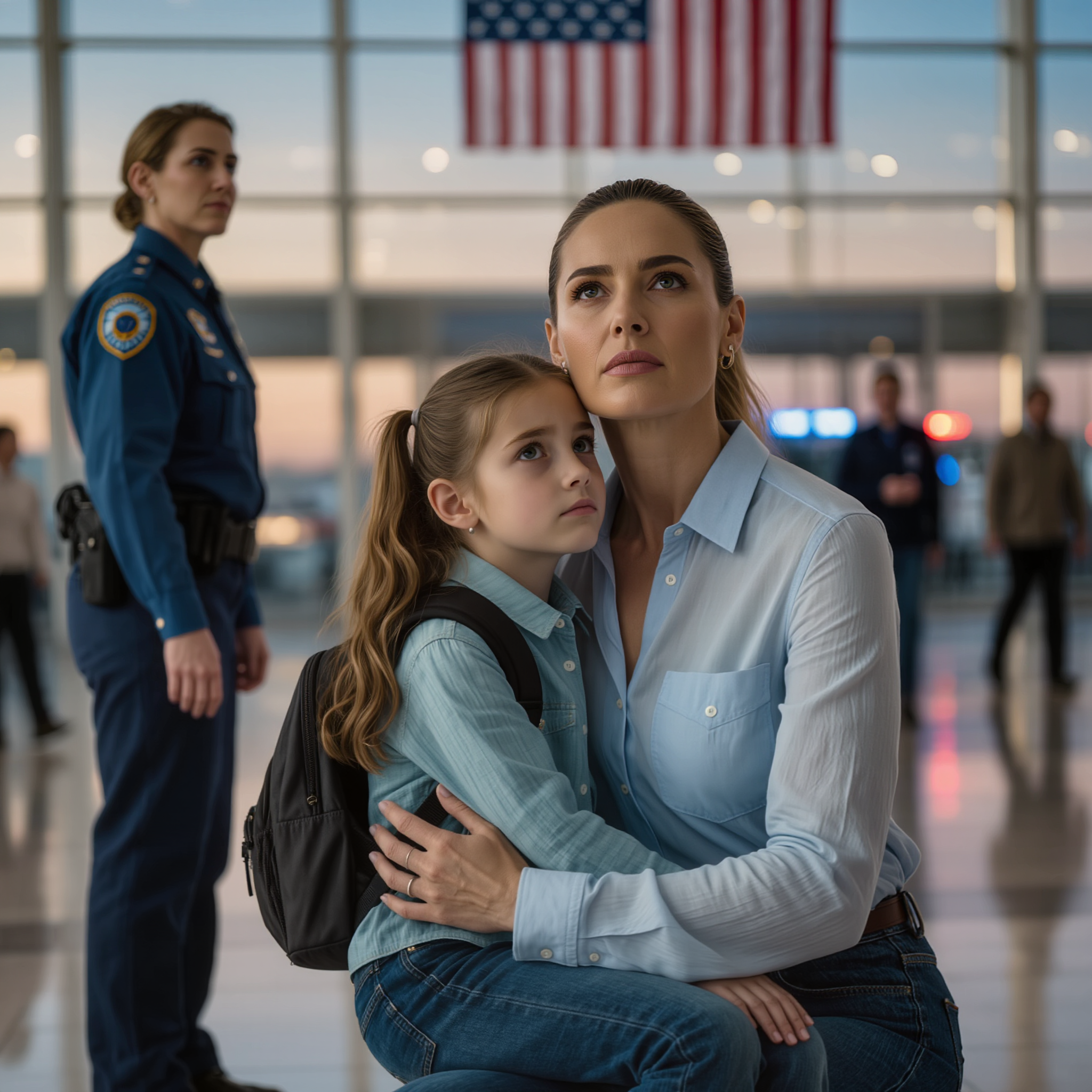
“She’ll learn a lesson,” my dad said, like he was talking about forgetting a homework assignment and not abandoning an eight-year-old child in the middle of John Glenn Columbus International Airport.
He said it as he adjusted his leather carry-on strap and shifted his first-class boarding pass from one hand to the other, while somewhere beyond TSA my daughter sat alone on a plastic chair, feet not even touching the floor.
In the family group chat, the message came through like a bullet.
Come pick her up. We’re about to board.
No context. No apology. Just an order.
Thirty seconds later, my mother added, like she was tightening a knife:
Don’t make us feel guilty. She’ll learn a lesson.
I was in a glass-walled conference room on the twenty-second floor of an office tower in downtown Columbus, staring out over the gray smear of the Scioto River and the winter skyline. My boss was talking about quarterly projections; my coworkers were nodding like bobbleheads. Fluorescent lights buzzed overhead. My phone—facedown beside my notebook—vibrated once, then again, then again.
I shouldn’t have checked it.
Company policy said no phones during meetings. I was the one who usually followed the rules, the reliable project manager who color-coded her spreadsheets and stayed late to fix other people’s mistakes.
But something in my chest went tight. That primitive, animal part of me that doesn’t care about PowerPoints or corporate policy suddenly sat up and started screaming.
I flipped my phone over.
Family Group Chat.
Come get her. We’re about to board.
For three full seconds, it didn’t compute. I just stared at the words, my brain lagging behind reality.
Come get who?
Board what?
Then my mother’s message appeared.
Don’t make us feel guilty. She’ll learn a lesson.
The blood drained out of my face so fast my ears rang.
They had left my eight-year-old daughter alone at the airport while they boarded a flight to Orlando.
My heartbeat roared in my ears, drowning out my boss’s voice, the hum of the projector, the faint whoosh of the HVAC.
I didn’t text back.
I didn’t ask what they meant.
I already knew.
My chair scraped loudly against the floor as I shoved it back.
“Amber?” my boss said, frowning. “Everything okay?”
“No,” I heard myself say, my voice coming from somewhere far away. “My daughter. I have to go.”
I grabbed my keys, my bag, my phone. The spreadsheet on the table blurred as my eyes filled.
“Amber, we’re in the middle of—”
“It’s an emergency,” I said. “I’m sorry.”
Something in my face must have convinced him, because he stopped mid-sentence and just nodded once.
“Go,” he said. “We’ll figure it out.”
I didn’t wait for anyone else to speak.
I walked out of that conference room, out of the sleek open-concept office with its exposed brick and stupid kombucha tap, and stabbed the elevator button with shaking fingers.
By the time I reached the parking garage, I wasn’t walking anymore.
I was running.
The air outside was sharp and wet, that particular Ohio mix of sleet and exhaust and river wind. My fingers fumbled the keys. I yanked open the door of my beat-up Honda Civic and collapsed into the driver’s seat.
My hands were shaking so badly I had to wrap both of them around the steering wheel to steady myself.
An eight-year-old. Alone. In an airport.
Her backpack was pink with princess stickers. She still needed help tying some of her sneakers. She slept with a stuffed rabbit she’d had since she was two.
And my family had decided she needed to “learn a lesson.”
I turned the key.
I don’t remember every detail of the drive to the airport. I know I took the freeway. I know I probably ran a red light. I know my speedometer hovered at a number I’m not proud of.
What I remember is the feeling—pure panic, icy and electric, racing up and down my spine. My stomach twisted like I might throw up. My vision tunneled in and out as I merged into traffic.
Images kept slamming into my mind like a slideshow I couldn’t stop.
Bella sitting at the gate, small and alone.
Bella’s big brown eyes shining with tears she refused to let fall because she hated crying in front of people.
Strangers brushing past, suitcase wheels inches from her sneakers.
A disembodied voice over the loudspeaker calling boarding groups while my parents walked away.
“She’ll learn a lesson,” my dad had said.
What kind of lesson do you learn at eight years old when the people who are supposed to protect you simply decide not to?
Green highway signs blurred past—EASTON / AIRPORT, EXIT ONLY—reflective in the flat gray light.
I gripped the steering wheel tighter.
All I could think was: My baby is alone. My baby is scared.
And my family did this to her.
To understand how we got there, you have to understand my family. Because this did not come out of nowhere. They had been showing me who they were for years. I had just been too hopeful, too desperate to belong, to see it clearly.
Last Christmas was a perfect example.
We were at my parents’ split-level in the suburbs outside Columbus, in one of those neighborhoods where every yard looked copy-pasted and every SUV had the same elementary school magnet. Fake snowflakes twinkled in the front yard. An inflatable Santa waved in the cold Ohio wind. Inside, the smell of ham and cinnamon rolls hung heavy over the sound of a Hallmark movie playing on mute while Mariah Carey begged for us for Christmas from a Bluetooth speaker.
My niece Emma—my sister Lisa’s daughter—sat in the center of the living room like the sun, and the rest of us orbited around her. She tore into gifts with the confidence of a kid who has never had to wonder if there will be enough.
An iPad.
A brand-new pink bike with glittery streamers.
Enough American Girl dolls and outfits to open a pop-up store.
Every time she squealed, the room erupted—laughter, clapping, phones up recording.
My daughter Bella, same age as Emma, sat quietly on the edge of the chaos, cross-legged on the carpet, her back against the couch, hands folded in her lap. Waiting.
When her turn finally came, her “pile” was small.
Three paperback books.
A sweater in soft gray, the kind my mother called “classic.”
One sweater.
The living room looked like a toy store had exploded on Emma’s side and run out of inventory by the time it reached Bella. My daughter ran her fingers over the sweater, trying to smile, trying to convince herself it was enough, the way quiet kids always do.
Then Emma shrieked over yet another doll, shrill and delighted, and I watched Bella’s face fall in real time. The brightness in her eyes dimmed; her shoulders curled in, just a fraction.
My chest burned.
My mother noticed me watching.
She glided over in her Christmas apron, hand warm and firm around my elbow.
“Come help me in the kitchen,” she said lightly, already steering me away from the mountain of toys and the thin little stack in front of Bella.
In the kitchen, she pulled a casserole out of the oven like nothing was wrong.
“Bella’s so quiet and serious,” she said in a low voice. “She doesn’t need all that stimulation. Books are better for her type of personality.”
Her type of personality.
Translation: Emma matters more.
I swallowed hard, anger gathering hot behind my ribs.
“What is ‘her type of personality’ exactly?” I asked.
Mom gave me that tight, patient smile I’d seen my whole life.
“Don’t start, Amber,” she said. “You’re always so sensitive. We love Bella. We just know what’s best for her.”
I looked back into the living room. Bella sat on the carpet with the sweater folded neatly in her lap while Emma rode her new bike in circles around the coffee table.
Bella smiled when Emma zoomed past, but it was small and brittle.
I should have said more.
Instead, I took a breath and let my mother’s words shove me back into silence.
It had been the same pattern for years.
When Emma turned eight, my parents went all out. They rented a bouncy castle for the backyard, hired a princess character from one of those party companies downtown, booked a face painter, and invited what felt like half the elementary school. There were themed goodie bags, a dessert table that could have been on Pinterest, custom cupcakes, balloon arches, and a professional photographer to “capture the memories.”
The photos went up on Facebook with a caption about “Our precious girl! #blessed.”
When Bella turned eight a few months later, I called my parents, hope already fighting with dread in my chest.
“Do you guys want to help with her birthday?” I asked. “Maybe do something special?”
My mother sighed theatrically into the phone.
“Oh, honey, we’re exhausted from Emma’s party,” she said. “That took so much out of us. Let’s just do cake at Sunday dinner, okay? She’s a simple girl. She doesn’t need all that fuss.”
Bella’s “party” ended up being a grocery-store sheet cake plopped on the same old oak table after a regular Sunday meal. No balloons. No friends from school. No decorations. Just family, some of them barely looking up from their phones when the lights dimmed.
Bella sat up a little straighter when my mother carried the cake out, eight candles flickering.
Before she could even draw a breath, Emma elbowed her aside.
“Let me help!” she yelled, already leaning over the frosting.
She blew out all the candles in one big dramatic gust while everyone laughed and clapped at her “enthusiasm.”
I watched my daughter’s smile fade, the disappointment so small and so sharp it hurt worse than a scream.
My parents clapped. Somebody made a joke about Emma’s lung power.
No one noticed Bella’s face but me.
Every family dinner was a variation on the same theme.
We’d sit around that long oak table I grew up at, dishes passed back and forth, the game murmuring on the TV in the background. And my mother would pick my daughter apart like she was a project that needed fixing.
“She’s so skinny. Are you feeding her enough?”
“Why doesn’t she talk more? She seems sad all the time.”
“Does she have any friends? You should push her to be more outgoing. She’s too in her head.”
Meanwhile, my sister’s kids were “spirited” when they threw tantrums, “all boy” when my nephew Jake broke something, “strong-willed” when Emma refused to share.
Bella, who preferred books and drawing and quiet corners, was “concerning.”
One night, while we rinsed dishes at the sink and the kids watched a movie in the living room, I tried to talk to my mother about it.
“Mom, you treat them differently,” I said, keeping my voice low. “Emma gets everything. Bella gets… scraps. You can’t tell me you haven’t noticed.”
She paused, hands in the sudsy water, and gave me a look like I’d just insulted her in public.
“You’re being overly sensitive,” she said sharply. “We love all our grandchildren equally. Maybe you’re projecting your own insecurities onto Bella.”
There it was.
The twist.
Somehow this wasn’t about the way Bella’s face fell at every slight; it was about my supposed “issues.” My “sensitivity.” My failure to be the easy, grateful daughter she wanted.
“We do so much for you,” she added, turning back to the sink. “For Bella. And this is the thanks we get? Accusations?”
Shame crawled up my spine, hot and sticky.
Maybe I was making a big deal out of nothing.
Maybe I was imagining it.
Maybe I was the problem.
Looking back, I know that’s exactly what she wanted me to think.
So when my parents insisted that Bella join their big Florida trip, I should have known better.
They own a vacation house outside Orlando, in a gated community lined with palm trees and identical beige stucco. They’d been talking about a “big family trip” for months.
My sisters. Their husbands. All the kids.
“We’re all going to Disney World!” my father announced at Sunday dinner one night, his voice booming over the clatter of dishes. “We got a great deal on flights into MCO. The whole gang. It’s going to be magical.”
Bella’s eyes lit up instantly.
“I don’t know…” I started, my stomach tightening. “I have a major project at work that week. My boss—”
My mother cut me off with a flick of her hand.
“Amber, don’t be ridiculous. We raised you, didn’t we?” she said. “We can handle one little girl at Disney. We know the Orlando airport like the back of our hand.”
My sister Lisa chimed in from across the table.
“Don’t be that mom who never lets her kid do anything,” she said. “She’ll be fine. It’s Disney, not the wilderness.”
Bella looked at me with so much hope it hurt.
“Please, Mom,” she whispered. “I’ve never been anywhere like that. Only in movies.”
I should have trusted my gut.
But I was so tired of being called overprotective. So tired of being told I was the problem.
So I took a breath and said the word that changed everything.
“Yes.”
We had a serious talk before the trip, at my small kitchen table in my two-bedroom rental near downtown.
“You promise you’ll take care of her?” I asked, looking from my mother to my father. “I mean it, Mom. She’s my whole world.”
My mother looked offended.
“Of course, she’s our granddaughter,” she said. “What kind of people do you think we are?”
Spoiler: exactly the kind I was about to find out.
I went to the bank and pulled out three thousand dollars in cash. Airfare. Disney tickets. Meals. Souvenirs. Extra for whatever came up. More than enough.
My mother folded the bills into her wallet without counting.
“That should cover it,” she said, like I’d just handed her a grocery coupon.
Apparently, gratitude wasn’t in her vocabulary.
The morning they left, the Ohio sky was dull winter gray, streets slushy and wet.
I walked Bella to the car in our apartment parking lot, our breath puffing in little white clouds. She wore her favorite purple dress under a puffy pink jacket, her backpack covered in princess stickers. Her small carry-on had a matching tag.
“I love you, baby,” I said, kneeling to straighten her zipper. “Be brave, okay? Have fun. Take lots of pictures for me.”
“I love you, Mommy,” she said. “I’m going to see the castle.”
I hugged her so tightly I worried I might never let go.
Then I watched their SUV pull away, brake lights flashing at the end of the lot before turning out of sight.
My stomach twisted.
Something was wrong. My instincts were screaming. Turns out they were better than my hope.
I couldn’t go because of work. We had a product launch that week, and my boss had been crystal clear that time off was not an option.
“You’re my strongest project manager,” he’d said. “I need you here.”
So I rode the elevator up every morning, sat in sleek conference rooms with floor-to-ceiling windows, pretended to care about KPIs, and tried not to picture TSA lines and boarding passes.
Apparently, I should have worried more.
Fast-forward to that conference room.
Quarterly reports on the screen.
My boss pointing at a bar graph.
My phone buzzing.
Come get her. We’re boarding now.
Don’t make us feel guilty. She needs to learn a lesson.
I stared at the messages, my brain trying and failing to slot them into some version of reality that didn’t involve my child sitting alone in an airport.
They had bought Bella’s ticket in economy.
They were flying first class.
I knew that part already. My mother had bragged about it.
“Your father and I are too old for coach on long flights,” she’d said. “Our backs can’t take it. We’ll pay to upgrade. The kids will be fine in economy. They’ll sleep.”
In that conference room, the rest of the story wrote itself.
Eight-year-old Bella, scared to sit alone with strangers while her grandparents and aunts relaxed behind a curtain with legroom and free drinks.
Bella crying.
Bella begging not to be separated.
And my family deciding the best solution was simple:
Leave her.
Abandon her at the gate and board the plane because their comfort mattered more than her safety.
My hands shook so badly I almost dropped my phone.
“I have to go,” I blurted, louder than I meant to.
My boss frowned.
“Amber, we’re in the middle of—”
“It’s an emergency,” I said. “My daughter.”
He searched my face, then nodded once.
“Go,” he said. “We’ll cover.”
I grabbed my coat and ran.
The drive to the airport was a smear of snow-flecked highway and panic.
Traffic lights, exits, billboards—none of it registered. My heart pounded so hard it hurt; my fingers cramped around the steering wheel. Tears blurred the road.
In my mind, Bella was everywhere—alone at the gate, standing by a window, sitting on the floor with her backpack in her lap. Every version of her was terrified.
I pulled into the short-term lot too fast, fishtailed, slammed the car into park across two spaces, and sprinted inside, boots slipping on polished tile.
The terminal hummed with the usual airport noise—roll-aboards clattering, overhead announcements echoing, coffee machines hissing, people everywhere.
I scanned every cluster of seats, every gate.
Then I saw them.
Two police officers in dark uniforms standing near a bank of chairs, and between them, small and shaking, my daughter.
Her face was blotchy and red. She hugged her backpack to her chest like a life jacket.
“Bella!” I yelled, shoving through a knot of travelers, nearly knocking a man’s briefcase out of his hand.
Her head snapped up.
For a second, she just stared, like she wasn’t sure I was real.
Then she ran.
Her sneakers squeaked on the tile as she launched herself across the space, collided with me so hard I lost my balance, and wrapped her arms and legs around me like a koala.
“Mommy,” she sobbed against my neck, her voice shredding. “They left me. Everyone left me.”
My knees gave out.
I dropped to the floor with her in my arms in the middle of the terminal and held on like I could weld her back into my rib cage.
“I know, baby,” I whispered, tears spilling hot and fast. “I’m here. I’ve got you. I’m so, so sorry.”
We clung to each other and cried.
A police officer stepped closer. His name tag said MARTINEZ.
“Ma’am, are you this child’s mother?” he asked, his tone firm but not unkind.
“Yes,” I said, tightening my hold on Bella. “I came as soon as they texted me.”
“What text?” he asked, pulling out a notepad.
My fingers fumbled as I pulled out my phone and handed it to him.
He read the messages, his jaw tightening.
His partner, a woman with a tag that read CHEN, knelt so she was eye-level with Bella.
“Sweetheart,” she said softly, “you’re safe now. Your mom’s here.”
Bella only buried her face deeper into my shoulder.
“I don’t ever want to fly again,” she hiccuped.
Officer Martinez looked at me.
“Can you tell me what happened?” he asked.
I took a shaky breath and tried to hold myself together long enough to make sense.
“They insisted she go on a family trip,” I said. “My parents. My sisters. I gave them three thousand dollars—cash—for her ticket, Disney, everything. They were flying first class. They bought her an economy ticket and…” My throat closed. “She got upset about sitting alone, and they decided to just leave her and board anyway.”
Officer Chen’s face hardened.
“Ma’am, what your family did is illegal,” she said quietly. “This isn’t a misunderstanding. This is child abandonment. Airports are extremely dangerous for an unaccompanied eight-year-old. She could have been trafficked, kidnapped—anything.”
The air seemed to leave the room.
“We’re going to take you both to a security office so we can get full statements,” Officer Martinez said. “We’ve already contacted Orlando. Airport police there will meet the flight when it lands. Everyone traveling with your daughter will be detained for questioning.”
“My family,” I said, numb.
He nodded once.
“Yes, ma’am. This is serious.”
The next few hours felt like a nightmare I couldn’t wake up from.
In a small, windowless security office with humming fluorescent lights and scuffed linoleum, I sat in a hard chair with Bella curled on my lap like she was three again.
Her head rested under my chin; her fingers clutched my shirt. Every time the door opened, she flinched.
Officer Martinez typed as I talked.
“They pushed me to let her go,” I said. “They said I was overprotective. I finally agreed and gave them money. They promised to take care of her.”
I showed him my banking app with the ATM withdrawal. The text from my mother: That should cover it.
I showed him the messages from that morning.
Come pick her up. We’re boarding.
Don’t make us feel guilty.
“They’re all on the same flight?” he asked.
“Yes,” I said. “My parents, my sisters, their husbands, their kids. They flew out of here to Orlando. They have a house near Disney.”
He nodded grimly.
“Orlando PD has officers at the gate,” he said. “They’ll be escorted off the plane and brought in for questioning. This isn’t going away with a phone call and a ‘sorry.’”
At one point, Officer Chen brought Bella a juice box and a small bag of chips from a vending machine.
“Thank you,” I whispered.
She sat in the chair opposite us, her eyes kind.
“Bella,” she said softly, “can you tell me what happened when you got to the gate?”
Bella’s voice was tiny, muffled against my shirt.
“Grandma said I was being a baby,” she whispered. “I didn’t want to sit by myself with strangers. I wanted to sit with them. She said big girls don’t cry about sitting alone.”
Tears spilled down her cheeks again.
“Then everyone got in line,” she said. “They gave the lady their tickets and walked down the tunnel. Grandma said, ‘Your mom’s coming. You’re fine. Stop crying.’ And then they left. I kept asking where they were. And then a lady in a vest asked where my grown-ups were, and I said I didn’t know.”
Officer Martinez’s fingers flew over the keyboard.
“You did the right thing telling someone,” Officer Chen said. “You were very brave.”
Bella just clung tighter.
My phone buzzed over and over on the table—calls, texts, voicemails stacking up.
I didn’t touch it.
Hours later, Officer Martinez finally leaned back.
“The flight landed a while ago,” he said. “Orlando airport police have your family in custody for questioning. Formal charges are being filed for child abandonment and child endangerment.”
My throat went dry.
“Okay,” I said.
He glanced at my phone.
“You’re going to hear from them,” he said. “My advice? Don’t answer. Let everything go through law enforcement or attorneys.”
I nodded.
Let them sweat.
Let them feel a fraction of what they’d just done to my daughter.
By the time we got home, the winter sky was black and the streets gleamed under the sodium glow of the streetlights.
Bella fell asleep in the car, exhausted from crying, her head lolling to the side.
I carried her up the stairs to our second-floor apartment, her body heavy and limp in my arms. I tucked her into bed, brushed damp hair off her forehead, and sat there on the edge of the mattress, watching her breathe.
Rage rose in my chest like a tide.
How dare they.
How dare my own parents, my own sisters, do this to my child.
And the worst part?
I wasn’t even surprised.
The signs had been there all along. The favoritism. The gaslighting. The way my feelings—and Bella’s—never weighed as much as Emma’s comfort or my parents’ image.
I had ignored them.
I wasn’t ignoring anything anymore.
The next morning, pale winter light filtered through the blinds.
Bella woke up quiet and flat.
No cartoons.
No chatter.
She just sat at the wobbly kitchen table clutching her stuffed rabbit, its fur worn thin from years of love. Dark circles smudged the skin under her eyes.
“Baby,” I said softly, sitting across from her. “Do you want to talk about yesterday?”
She stared at the table for a long time.
“I don’t ever want to see them again,” she said finally, in a voice too old for eight.
My heart cracked.
“Who, sweetheart?” I asked, though I already knew.
“Grandma. Grandpa. Aunt Lisa. Aunt Sarah. Everyone,” she said. “They made me feel like I wasn’t wanted.”
Tears burned my eyes.
“I understand,” I said. “And you never have to see them again if you don’t want to. What they did was so, so wrong, Bella.”
She looked up at me, eyes raw.
“Really? I don’t have to?”
“Really,” I said, steady. “This is your choice. And I’m going to make sure they understand they don’t get to treat you like that.”
We spent the day together.
I called in sick—something I almost never did—and stayed home.
We watched animated movies under a blanket on the couch.
We ordered pizza from the place three blocks over.
We existed in a small, safe bubble where no one told us we were overreacting, where no one acted like my child was second-tier.
My phone buzzed non-stop on the counter.
I ignored every call.
That evening, while Bella made a bubble beard in the bath and hummed softly to herself, I finally picked up my phone.
Dozens of messages.
My mother, each text more frantic than the last.
Answer your phone.
This is ridiculous.
You’re overreacting.
Tell the police this is a misunderstanding.
We could have put her on the next flight.
We didn’t abandon her.
My father had sent one.
Family doesn’t do this to family.
I stared at it until my vision blurred.
Family also doesn’t abandon eight-year-olds at airports, but apparently that rule only applied to me.
Lisa had sent paragraph-long texts about how Bella was “fine,” how I was “destroying the family over nothing,” how “kids are resilient” and “she’ll barely remember this.”
Nothing.
They called leaving my daughter crying at a gate nothing.
I blocked every number.
Then I called my best friend, Rachel.
We’d met years ago as new hires at the same company, bonded over bad coffee and an even worse manager. She lived ten minutes away in a little bungalow in an old Columbus neighborhood with her own daughter, also named Emma—different Emma. Better Emma.
When I told her what happened, there was a beat of silence.
Then she exploded.
“They left Bella alone at the airport?” she shouted. “Are you kidding me? Those monsters. Amber, that’s not just messed up. That’s criminal. Whatever you need, whatever you decide to do, I’m here. You are not overreacting.”
Rachel’s outrage felt like a life raft.
Any reasonable person was horrified.
I wasn’t crazy.
They were wrong.
The next day, my phone rang with an Orlando area code.
“Ms. Hayes? This is Detective Collins with Orlando Police Department,” a calm female voice said. “I’m calling about the incident with your daughter.”
I swallowed.
“Yes,” I said. “How… what happens now?”
“Your parents and siblings were detained at the airport and questioned,” she said. “They’ve been released pending charges. They are being charged with child abandonment and child endangerment. Given they’re first-time offenders, the likely outcome is fines and probation rather than jail time, but the charges are serious. There will be court dates in your jurisdiction. You may be called to testify.”
“Okay,” I said. My voice sounded small in my own ears.
“We’re also recommending a no-contact order for your daughter,” she added. “If the court grants it, they will be legally prohibited from contacting her. Any violation could result in additional charges.”
The knot in my chest loosened just a fraction.
“Good,” I said. “I don’t want them anywhere near her.”
Over the next week, more calls and messages trickled in—from numbers I didn’t recognize now that I’d changed mine.
Aunt Carol, in a voicemail, lamenting that I was “tearing the family apart.”
Cousin Jennifer, in a long text, telling me I was “unreasonable” and needed to “think of your parents’ feelings.”
My mother’s friend Patricia, calling to say I should “forgive and forget” because “life is too short to hold grudges.”
Not one person asked if Bella was okay.
Not one person said, “What they did was wrong.”
Every message was about me fixing it, me keeping the peace, me swallowing what they’d done for the sake of “family.”
I blocked every new number as it came in.
I blocked them on social media.
I built a wall around Bella and me and locked the gate.
At work, I sat down with my boss and told him what had happened and what was coming—court dates, therapy appointments, meetings with lawyers.
“What they did crosses every line,” he said, his usually hard face softening. “Take the time you need. We’ll manage.”
His support meant more than I could say.
Bella started therapy that week.
The officers had recommended a child trauma specialist named Dr. Sanders whose office was in a renovated Victorian near Ohio State’s campus. Inside, the ceilings were high, the walls were painted soft colors, and shelves were lined with picture books, art supplies, and stuffed animals.
Dr. Sanders didn’t push Bella to talk. She sat cross-legged on the rug and drew with her. Sometimes they built with blocks. Sometimes they played quiet card games. Slowly, Bella started sharing.
Progress was slow.
Bella had nightmares.
She panicked if I was even a few minutes late for pickup.
She refused to let me out of sight in stores.
The damage would take time.
But at least now, somebody besides me was helping her carry it.
Weeks passed.
The arraignment came.
Rachel watched Bella so I could go to court.
The Franklin County courthouse downtown was all marble floors and echoing footsteps. After going through security, I found the right courtroom and slipped into a seat on the back bench, my palms damp.
My family sat together at the defense table.
My mother looked smaller, her perfectly styled hair pulled back too tight. My father’s jaw was clenched; his shoulders were stiff. Lisa and Sarah sat beside them, their husbands in the row behind.
When my mother saw me, she moved like she might stand, but their lawyer touched her arm and whispered something. She sank back down, her eyes finding mine across the room, pleading.
I looked away.
I wasn’t there to make her feel better.
The judge came in. We all stood.
The clerk read out the charges.
“Count one: child abandonment. Count two: child endangerment.”
“How do the defendants plead?” the judge asked.
Their lawyer rose.
“On behalf of my clients, Your Honor, we enter pleas of not guilty.”
Of course.
The judge set a trial date and laid out the conditions of their release.
“All defendants are ordered to have no contact with the minor child, Bella Hayes,” he said. “Any violation will result in immediate arrest. Is that understood?”
“Yes, Your Honor,” the lawyer answered.
I saw my father’s hands clench into fists.
No birthdays.
No Christmas.
No second chances.
As people shuffled out of the courtroom, my mother called softly.
“Amber, please. Can’t we talk?”
“No,” I said, not slowing.
My father’s voice followed.
“You’re destroying this family.”
I turned just enough to meet his eyes.
“I’m holding you accountable,” I said. “There’s a difference.”
In the parking lot, I sat in my car for a long moment, hands on the wheel, heart racing.
This was really happening.
Criminal charges.
Court dates.
My parents and sisters as defendants.
I didn’t feel guilty.
I didn’t feel conflicted.
I felt certain.
They deserved this.
When I picked Bella up from Rachel’s, she ran straight into my arms.
“How did it go?” Rachel asked.
I crouched so I was eye-level with Bella.
“The judge said they have to stay away from us,” I said gently. “They’re not allowed to contact you at all.”
Bella thought for a second, then nodded.
“Good,” she said. “I don’t want to see them anyway.”
That night, after she went to bed, curiosity got the better of me.
From a new account with a different last name, I looked up my mother on Facebook.
There it was.
A long, dramatic status about being “persecuted by my own daughter,” about how “one mistake shouldn’t define a person,” about how “family should forgive.”
The comments were full of strangers and acquaintances lining up to soothe her.
“You’re such a good grandma.”
“Your daughter is so ungrateful.”
“Kids today don’t respect their parents.”
I wanted to reply with screenshots of the texts. Photos of Bella sobbing in that airport office. Copies of the charges.
Instead, I closed the app.
Let them believe whatever they wanted.
Fighting with people in the comments wasn’t going to help Bella sleep.
A few weeks later, a letter arrived from my parents’ lawyer.
Heavy cream paper. Fancy letterhead.
I opened it at the kitchen counter while Bella colored at the table, humming under her breath.
Dear Ms. Hayes,
This correspondence concerns the sum of $3,000 provided to Margaret and Thomas Hayes…
They wanted the money back.
Not just what was left over.
All of it.
Their argument, if you could call it that, was that since Bella hadn’t gone on the trip, I should reimburse them for “trip preparation expenses”—meaning their tickets, their hotel upgrades, their whatever-else, all paid for out of the money I’d handed over for my daughter.
I read the letter twice.
Then I laughed out loud in my tiny Columbus kitchen.
They had abandoned my child at an airport and now wanted me to write them a check to even it out.
When I showed Rachel, she didn’t laugh.
“You need a lawyer,” she said.
That’s how I ended up sitting in a small office with a woman named Patricia Morgan, a family lawyer with a reputation for being gentle with her clients and brutal in court.
Her office smelled like coffee and toner. Framed degrees lined one wall; a bookshelf of casebooks lined another.
After I told her everything, she leaned back and steepled her fingers.
“What they did is unconscionable,” she said. “But this letter? It gives us leverage.”
“Leverage how?” I asked.
“We file a counterclaim,” she said. “They took three thousand dollars from you for a specific purpose: your child’s care and trip expenses. Not only did they fail to provide that, they abandoned her and then refused to return the money. We can ask for the full amount back plus therapy costs and court fees.”
“Can we do that while the criminal case is going on?” I asked.
“Absolutely,” she said. “Criminal handles the crime. Civil handles the money. You have texts, bank records, police reports. It’s a strong case.”
“Do it,” I said.
If they wanted to fight about money, fine.
We’d fight.
Patricia filed the counterclaim.
Their lawyer called.
“If your client drops her claim,” he said, “my clients are willing to drop theirs.”
Patricia smiled, the kind of smile I wouldn’t want aimed at me.
“Your clients abandoned an eight-year-old after taking money to care for her,” she said. “My client is owed restitution. Our settlement demand is three thousand plus therapy costs plus court fees. Otherwise, see you in court.”
They refused.
Fine.
We’d let a judge decide.
The criminal trial came months later.
By then, Bella was doing better. Therapy helped. Time helped. Our apartment felt less like a bunker and more like a home again.
Still, walking into that courtroom and seeing my family at the defense table made my stomach twist.
The prosecution started with the basics—security footage from the airport, testimony from the gate agent, the texts blown up on a screen.
Officer Martinez testified.
“In my years working with airport security,” he said calmly, “I have never seen a family deliberately abandon a child at a gate and board a flight without them. Usually, when a child is missing, the family is frantic. In this case, they boarded knowing she was alone.”
You could feel the jury bristle.
When it was my turn to testify, my legs felt like they were made of wet paper as I walked to the stand.
I swore to tell the truth.
The prosecutor had me walk through everything—the pressure to let Bella go, the money, the promises, the messages.
“How has this affected your daughter?” he asked.
I swallowed.
“She has nightmares,” I said. “She panics if I’m late. She’s in therapy and probably will be for a long time. She went from being a confident, happy kid to a child who is always waiting for someone to walk away. My family stole her sense of safety.”
A few jurors shook their heads, eyes soft.
The defense attorney tried to spin it as a “misjudgment.”
“Isn’t it possible your family simply misjudged how upset your daughter would be?” he asked.
“They sent messages saying they were leaving her and boarding the plane,” I said. “That’s not a misjudgment. That’s a choice.”
My mother took the stand next.
She cried.
She dabbed her eyes with a tissue. Her voice shook at all the right places.
“I never meant for this to happen,” she said. “We thought Bella would be fine. We didn’t realize she’d be so upset. By the time we understood, it was too late to turn back.”
The prosecutor approached, holding a printed screenshot.
“Mrs. Hayes,” he said, “you texted your daughter that morning, ‘Don’t make us feel guilty. She needs to learn a lesson.’ What lesson did you believe an eight-year-old would learn from being left alone at the gate of one of the busiest airports in the region?”
“I just meant she needed to be more independent,” my mother said. “We didn’t abandon her. We left her near security where someone would see her.”
He lifted the enlarged screenshot toward the jury.
“You also wrote, ‘Come get her. We’re boarding now,’” he said. “You gave Ms. Hayes here only minutes to reach an airport that is at least twenty minutes from her office with no warning. That’s not leaving a child ‘near security.’ That’s abandoning her and hoping someone else will pick up the pieces, isn’t it?”
My mother floundered.
“I thought Amber was closer,” she muttered.
“But she wasn’t,” he said. “And you knew that.”
He shifted.
“Ms. Hayes gave you three thousand dollars for her daughter’s expenses, correct?” he asked.
“Yes,” my mother said.
“And with that money, you and your husband purchased first-class tickets for yourselves and an economy ticket for Bella,” he continued. “Is that right?”
She hesitated.
“We have back problems,” she said. “We needed the extra space.”
“How much more expensive were the first-class tickets?” he asked, already holding the printed receipts. “About eight hundred dollars each?”
She nodded.
“And Bella’s ticket?”
“One hundred and eighty,” she whispered.
“So with the money meant for this child,” he said, turning back to the jury, “you purchased a cheap economy seat for her and upgraded yourselves, then boarded the plane and left her alone at the gate when she protested. Is that accurate?”
The room was very, very quiet.
My mother flushed.
“I suppose,” she said.
He let the silence hang.
My father tried to sound calm and reasonable when he testified.
“We love our granddaughter,” he said. “It was a terrible misunderstanding. We never intended to hurt her.”
Under cross-examination, the prosecutor didn’t let him off the hook.
“When your granddaughter was crying at the gate, why didn’t you sit in economy with her?” he asked.
“Because we had paid for first class,” my father said, like the words made sense out loud.
“So your comfort was more important than an eight-year-old’s safety,” the prosecutor said.
“That’s not what I’m saying,” my father snapped.
“Then what are you saying?” the prosecutor asked.
He didn’t have an answer.
Lisa and Sarah tried to distance themselves.
“I thought Mom and Dad had a plan,” Lisa said. “I didn’t know they were going to leave her.”
“But you saw Bella crying at the gate,” the prosecutor said. “And you boarded the plane anyway.”
“I thought someone would stay,” she said weakly.
It was flimsy, and the jury knew it.
The trial lasted several days.
The jury deliberated for less than two hours.
“On count one, child abandonment,” the foreperson read, “we find the defendants guilty.
“On count two, child endangerment, we find the defendants guilty.”
My mother sobbed.
My father stared straight ahead, but his hands shook.
Sentencing came weeks later.
The prosecutor argued for the harshest penalties allowed.
“The trauma inflicted on this child is severe and ongoing,” he said. “The defendants were not acting in a moment of panic. They were calm. They chose their comfort over an eight-year-old’s safety.”
The defense begged for leniency, pointing to their age, their lack of criminal history, their “deep love of family.”
The judge listened.
“What the defendants did was reprehensible,” he said finally. “They took money intended for a child’s care, spent it to upgrade their own experience, and when that child became inconvenient, they left her behind. However, given that they are first-time offenders and considering sentencing guidelines, I am sentencing Margaret and Thomas Hayes to supervised probation, substantial community service, mandatory parenting classes and counseling, and fines. Lisa Patterson and Sarah Miller, along with their spouses, will receive probation, community service, and fines.”
My mother sagged in relief.
No jail.
Just rules. Conditions. Money.
Part of me was disappointed.
Patricia leaned toward me.
“The civil case is where we really hit them,” she whispered.
The judge wasn’t done.
“Furthermore,” he said, “all defendants are prohibited from any contact with the minor child, Bella Hayes. A permanent protective order is granted, effective immediately. Any violation will result in immediate arrest. Do you understand?”
Their lawyer nodded, jaw tight.
Permanent.
By the time Bella was old enough to decide for herself, she’d be an adult.
As we left the courtroom, my mother called after me one more time.
“Amber, please, can’t we talk?”
I didn’t turn around.
“We’re done,” I said.
And I meant it.
The civil hearing about the money was set for a later date.
It was held in a smaller courtroom. Less formal. No jury.
My parents looked older. The months of court and publicity had taken a toll. My mother had lost weight. My father’s hair seemed grayer.
A tiny, traitorous part of me felt bad.
A much larger part remembered Bella’s terrified sobbing at the airport.
“Ms. Hayes, you may speak,” the judge said.
I stood.
“Your Honor,” I said, my voice steady, “I gave my parents three thousand dollars for my daughter’s trip expenses. That money was for her plane ticket, her park tickets, her food, and anything else she might need. Instead, they purchased a cheap economy ticket for her, first-class tickets for themselves, hotel upgrades, and other comforts. Then they abandoned her at the airport and refused to return any portion of that money. I am asking for the full amount back, plus therapy and court costs.”
The judge turned to my parents.
“Is that accurate?” he asked.
Their lawyer stood.
“Your Honor, my clients used a portion of that money in good faith,” he said. “They purchased a ticket for the child and used the remaining funds on trip planning and family accommodations. They provided services.”
“How much was the child’s ticket?” the judge asked.
“One hundred and eighty dollars,” the lawyer said.
“And the remaining two thousand eight hundred twenty dollars?”
“Used for hotel upgrades, transportation, and other trip-related expenses,” the lawyer said. “For the family overall.”
The judge’s eyebrows rose.
“Were those expenses specifically for the child?” he asked.
“Not exclusively,” the lawyer admitted.
“So they used money given for the child’s expenses mainly for themselves,” the judge said dryly.
“Your Honor, the trip did not occur as planned due to the child’s behavior,” the lawyer added quickly. “She became upset. My clients were placed in an impossible situation—”
The judge’s face hardened.
“Counselor, are you arguing that an eight-year-old is responsible for being abandoned at an airport by four adults?” he asked.
“No, Your Honor,” the lawyer said, flustered. “Of course not. I only meant—”
“I’ve heard enough,” the judge said.
He turned back to me.
“Ms. Hayes, do you have documentation showing you provided this money?”
Patricia handed over a copy of my bank withdrawal and the texts discussing the cash.
I showed him the messages on my phone.
He read them carefully, his frown deepening.
“Mrs. Hayes, Mr. Hayes,” he said, looking over his glasses at my parents. “You wrote, ‘Come get her. We’re boarding now,’ and, ‘Don’t make us feel guilty. She needs to learn a lesson.’ What lesson, exactly, do you believe an eight-year-old learns from being abandoned?”
My mother’s eyes filled with tears.
“We made a mistake,” she whispered.
“It was more than a mistake,” he said. “It was a breach of trust and a misuse of funds.”
He turned back to Patricia.
“What are the total damages you’re seeking?” he asked.
“Three thousand dollars, plus therapy costs to date and court fees,” Patricia said. “Approximately five thousand total.”
The lawyer stood again.
“Your Honor, that is excessive,” he said. “The child is fine—”
“The child is in therapy because of their actions,” Patricia snapped. “These are real costs my client incurred because her parents traumatized her daughter.”
The judge nodded once.
“I’ve seen enough,” he said. “Judgment for the plaintiff. The defendants are jointly liable for five thousand dollars, payable within thirty days. Case closed.”
He banged the gavel.
My mother burst into tears.
My father’s mouth thinned.
I felt a grim, cold satisfaction.
They’d pay every penny.
As we left the courtroom, my father tried one last time.
“Amber, this is ridiculous,” he said in the hallway. “We’re family.”
I stopped and faced him.
“No, Dad,” I said. “Family doesn’t do what you did. You stopped being family when you left Bella crying at that airport.”
“She’s fine,” he insisted. “You need to stop being dramatic.”
That word.
Dramatic.
They’d used it my entire life to sand down my feelings until they didn’t matter.
“I’m done,” I said simply. “Don’t contact me. If you need to reach me, go through my lawyer. But as far as I’m concerned, we’re finished.”
I walked away without looking back.
Patricia fell into step beside me.
“That went well,” she said. “They have thirty days to pay. If they don’t, we garnish wages.”
“Will they pay?” I asked.
“Oh, they’ll pay,” she said. “No one wants wage garnishment on record. Too embarrassing.”
She was right.
Just under a month later, a check arrived in the mail.
Five thousand dollars.
No note.
No apology.
Just ink on paper.
I deposited it immediately.
Then I started planning.
Because that money had always been meant for one thing.
Bella’s trip.
Only this time, I was going to be the one taking her.
That evening, I sat Bella down at the kitchen table.
She’d been doing better. Therapy was working. The nightmares were less frequent. The panic attacks shorter. Dr. Sanders said we were making solid progress.
“Baby,” I said, sliding into the chair beside her, “remember how Grandma and Grandpa were supposed to take you to Disney?”
She stiffened.
“Yeah,” she said cautiously.
“Well,” I said, “they had to pay back all the money they took from us. And I have an idea about what to do with it.”
Her eyes widened.
“What?”
“How would you like to go to Disney?” I asked. “Just you and me. We’ll fly first class. We’ll stay at the best hotel. We’ll spend a whole week doing everything you wanted to do before. No one will leave you. Not for a second.”
I watched her face carefully, ready to back off if it was too much.
Instead of fear, I saw something else.
Excitement.
“Really?” she whispered. “Just us?”
“Just us,” I said. “And this time, I promise, nobody will leave you behind.”
She threw her arms around my neck.
“Can we really afford it?” she asked. “I know money is hard.”
The fact that my eight-year-old worried about money broke my heart.
“We can definitely afford it,” I said. “This is the money that was supposed to be for your trip anyway. We’re just using it the way it was meant to be used.”
Planning the trip became our project.
We spent evenings on the couch with my laptop open between us, scrolling through Disney websites.
We watched videos of the Magic Kingdom, Epcot, Hollywood Studios, Animal Kingdom.
We made lists of rides and characters and snacks.
Bella circled pictures in brochures, wrote out schedules in colored markers, highlighted must-do rides like it was a mission.
I watched her transform from a scared, withdrawn child into someone who could feel real excitement again.
This trip was more than a vacation.
It was us walking back into the place where they’d planned to make her feel unwanted and claiming it as ours.
I booked a room at Disney’s Grand Floridian Resort & Spa—the white Victorian-style hotel on the monorail line with a view of Cinderella’s Castle.
First-class flights both ways.
Character dining.
Photo packages.
Everything I’d wanted for her in the first place.
The total was almost exactly the settlement amount.
Perfect.
As departure approached, I noticed Bella growing anxious.
Not the fun, buzzy kind of nervous.
The fragile kind.
“What’s wrong, baby?” I asked one night as we folded clothes into her suitcase.
She bit her lip.
“What if something goes wrong?” she whispered. “What if they’re there? What if they stop us?”
I pulled her into my lap, even though she was getting tall for it.
“Nothing is going to go wrong,” I said firmly. “They can’t stop us. They’re not allowed to contact us, remember? There’s a protective order. And even if they tried, I wouldn’t let them. You and I are doing this together. No one else.”
She studied my face.
“You promise?” she asked.
“I promise,” I said. “You are my priority. Not them. Not anyone else. You.”
She took a deep breath and nodded.
“Okay,” she said.
The morning we left, the airport looked different.
It was the same terminal, same TSA lines, same coffee smells and overhead announcements.
But this time, we were walking side by side.
I stood with Bella at the first-class check-in counter, our suitcases at our feet.
The agent smiled.
“Headed to Orlando?” she asked.
“Yes,” I said. “Just the two of us.”
Bella squeezed my hand.
At security, I knelt so we were eye-level.
“We’re going through together,” I said. “You’re not going anywhere without me. At any point. If anyone tries to separate us, you say no and look for me. Okay?”
She nodded, gripping my fingers so tightly they ached.
We put our bags on the belt, walked through the scanner together, slipped our shoes back on.
At the gate, I showed Bella our boarding passes.
“See?” I said. “Same row. Seats right next to each other.”
“What if they separate us?” she asked quietly.
“They won’t,” I said. “And if anyone even tries, I’ll make such a scene that the whole airport will stop what they’re doing. You are not going anywhere without me. Got it?”
A small, real smile tugged at her mouth.
“Got it,” she said.
When they called first-class boarding, Bella’s eyes widened.
We walked down the jet bridge together. A flight attendant greeted us warmly.
“Welcome aboard,” she said. “First time flying first class?”
Bella nodded, shy but intrigued.
“Well, you’re in for a treat,” the attendant said. “Cookies, juice, movies, and very comfy seats.”
Our seats were huge compared to the cramped rows I’d flown in my whole life. Wide cushions. Leg rests. Personal screens. Little lights you could angle just so.
Bella explored every button like she’d just discovered a spaceship.
“This is amazing,” she whispered.
I felt tears prick the corners of my eyes.
This was how it should have been from the beginning.
As the plane took off, Bella pressed her face to the window.
“Mommy, look,” she said. “Everything’s getting so small.”
I squeezed her hand.
We were doing this.
We were rewriting the story.
The flight attendants spoiled us with warm cookies and tiny bottles of sparkling water. Bella watched movies, drew little castles in her notebook, peeked over the seat to quietly marvel at the fancy bathroom.
She didn’t panic when I got up to use the restroom. She watched me go down the aisle and watched me come back.
We landed in Orlando in the early afternoon.
As soon as we stepped outside the sliding doors, the Florida air wrapped around us—warm and humid, heavy with the smell of sunscreen and jet fuel. Palm trees lined the roads outside the terminal.
Our rental car was waiting.
Bella pressed her face to the window the entire drive, eyes wide at the palm trees, the billboards screaming about parks and water slides and character dinners.
When we pulled up to the Grand Floridian, she actually gasped.
White buildings with red roofs. Manicured lawns. The monorail gliding silently past. The lobby with its crystal chandeliers, marble floors, and a live pianist playing Disney songs on a glossy grand piano.
“Is this real?” she whispered, her voice echoing softly in the vast lobby.
“It’s real,” I said. “And it’s all for us.”
Our room was a suite with two beds, a little sitting area, and a balcony overlooking the Seven Seas Lagoon.
From the balcony, Cinderella’s Castle rose in the distance, its spires catching the pink-gold of late afternoon.
“Mommy,” Bella breathed, pressing her hands to the railing. “I can see the castle.”
“I know,” I said. “Pretty amazing, right?”
She turned and threw her arms around me.
“This is the best day ever,” she said. “Thank you for bringing me. Thank you for not leaving me.”
The words cut and healed all at once.
That night, we explored the resort.
We rode the monorail just for fun, watching the park lights come on in the distance. We ate dinner at a casual place where Bella got chicken nuggets shaped like Mickey, because apparently everything here was shaped like Mickey.
By the time I tucked her into the crisp hotel sheets, she was the good kind of exhausted, her eyes heavy but her smile still soft and bright.
“Mommy,” she said, voice sleepy, “this is better than if they took me.”
“How so?” I asked.
“Because with them, I would have felt like a burden,” she said simply. “Like I was in the way. With you, I never feel that. I feel wanted.”
My heart broke. And it mended.
“You are wanted,” I said. “You are the most important person in my whole world. Don’t ever forget that.”
“I won’t,” she murmured. “And I’m glad it’s just us. Even if none of the bad stuff happened, I think I’d have more fun with just you.”
She fell asleep with that thought hanging in the air like a blessing.
We woke up early the next morning for our first full day at the Magic Kingdom.
Bella put on the new blue princess dress we’d bought for the trip. She twirled in front of the mirror, skirt fanning out, sequins catching the light.
“I look like a real princess,” she whispered.
“You are a real princess,” I said. “My princess.”
We had breakfast at the hotel and then took the monorail to the park.
Walking down Main Street U.S.A. with the castle ahead, I watched Bella’s face instead of the scenery.
Her eyes were huge. Her mouth parted in this little silent “wow.”
This was what childhood was supposed to look like.
We rode everything she pointed at.
We spun in teacups until we were dizzy and laughing.
We flew with Peter Pan over a glowing miniature London.
We floated through It’s a Small World and sang along, even when the song stuck in our heads for hours.
We met characters, took too many photos, and yes, I bought the ridiculous balloon shaped like Mickey’s head because she looked at it like it was a piece of the moon.
We ate churros, Mickey ice cream bars, popcorn, cotton candy. Nutrition took a backseat for once.
By mid-afternoon, we were on a bench in the shade, sharing a melting ice cream.
“I’m glad they didn’t come,” Bella said quietly, watching a parade roll past, music thundering.
“I’m glad it’s just us.”
I pulled her against my side.
“Me too, baby,” I said. “This is our trip. Our memories.”
The week blurred into a carousel of colors and laughter.
We visited every park.
We did character meals where princesses knelt and talked to Bella like she was the center of the universe.
We stayed up late to watch fireworks explode over the castle, music swelling as lights danced across the sky.
I watched her transform day by day.
The tightness in her shoulders eased. The way she flinched at sudden noises faded. When I stepped away for a second in a crowded store, she watched me, but there wasn’t that wild edge of panic in her eyes anymore.
By the end of the week, she walked taller.
On our last night, we watched the fireworks from our balcony.
The lagoon was dark and still. The castle glowed. Fireworks burst and bloomed over it, reflecting off the water.
Bella slid her hand into mine.
“Mommy,” she said softly, “this was the best week of my whole life.”
“Mine too,” I said.
And it was.
Because it wasn’t just about Disney.
It was about proving to her—and to myself—that she mattered. That she deserved good things. That not everyone would leave.
The flight home was bittersweet.
We were sun-kissed and tired, our bags stuffed with souvenirs and crumpled maps and bits of magic.
Bella fell asleep before takeoff, her head on my shoulder, our first-class seats reclined.
I looked down at her peaceful face and felt an overwhelming surge of gratitude.
We’d gone through something awful.
And we were building something better on the other side.
Rachel picked us up at the airport and drove us back to Columbus.
“How was it?” she asked, glancing at us in the rearview.
“Perfect,” I said. “Exactly what we needed.”
Bella spent the drive chattering to Rachel’s daughter, Emma, about rides and fireworks and which princess was the nicest in person.
Later that evening, after Bella was tucked into her own bed with Max snoring at her feet, I did something I’d been planning.
I created a new Facebook account with my privacy locked down and my last name changed.
I posted three photos:
Bella grinning in her first-class seat.
Bella hugging Mickey in front of the castle.
The two of us on our balcony at the Grand Floridian, the castle glowing behind us.
The caption was simple.
Sometimes the best family is the one you choose. Thank you to everyone who supported us.
I tagged Rachel and a handful of people who had actually shown up.
Within an hour, there were comments.
“So happy for you two.”
“You both deserve everything good.”
“This made my day.”
I didn’t mention my parents.
I didn’t have to.
Everyone who mattered already knew.
The next morning, Rachel called.
“Did you see your mom’s Facebook?” she asked.
“No,” I said. “I don’t follow her anymore.”
“She posted something about ‘people who flaunt vacations to hurt their family,’” Rachel said. “And Lisa commented about ‘people who never let things go.’”
I felt anger flash through me.
Then it fizzled out.
“Let them post whatever they want,” I said. “It doesn’t change anything. They can’t touch what we had.”
“You’re right,” Rachel said. “Just wanted you to know.”
I thanked her and went back to flipping pancakes.
Bella was at the table drawing a picture of the castle, humming to herself.
We were not going to let their bitterness touch our joy.
Over the following weeks, life settled into a new rhythm.
Bella’s therapy sessions dropped from twice a week to once.
Dr. Sanders smiled more in our parent check-ins.
“This Disney trip was incredibly healing,” she said. “Creating positive memories in a place tied to something scary is powerful. You did something really important for her.”
“I just wanted her happy,” I said.
“Mission accomplished,” she replied.
Bella started doing better in school, too.
One afternoon, her teacher pulled me aside at pickup.
“I don’t know what happened over break,” she said, “but Bella seems like a different kid. More engaged. More confident. It’s wonderful.”
“We had a really good trip,” I said.
Sometimes, good things really do leave fingerprints.
I noticed I felt different, too.
For years, I’d been twisting myself into knots to make my family see Bella, to make them see me. Now that we’d closed that door, I wasn’t carrying their expectations anymore.
I could just be Bella’s mom.
It felt lighter than I ever imagined it could.
One Saturday afternoon, months after the trip, we were at the grocery store.
Fluorescent lights, sticky cart handles, kids whining in every aisle. Back to normal life.
Bella walked beside the cart, comparing Fuji and Honeycrisp apples like she was choosing between colleges.
I reached for a bag of Honeycrisps.
And saw her.
My mother.
Two aisles over, pushing a cart with Lisa.
They looked older. Smaller somehow. Lisa’s face was tighter around the mouth.
For a second, our eyes met across the produce section.
My heart didn’t pound this time.
I didn’t freeze.
Bella tugged my sleeve.
“Mom, what about these apples?” she asked, holding up a bag.
“Those look perfect, baby,” I said, keeping my voice even.
She followed my gaze and saw them.
I felt her body go tense.
“It’s okay,” I murmured. “They can’t come near us. The judge said so.”
My mother and Lisa leaned their heads together, whispering, glancing back.
For a moment, I thought they’d be mature enough to just turn and go down another aisle.
Of course they weren’t.
They started walking toward us.
My protective instincts flared hot.
I shifted, placing myself slightly in front of Bella.
They stopped about ten feet away—close enough to make a point, far enough to not technically break the order.
“Don’t,” I said, lifting a hand. “You’re not allowed to contact us. We’re just shopping. Go somewhere else.”
“This is a public place,” my mother said, voice icy. “We have every right—”
“Then use it somewhere else,” I cut in. “The protective order says no contact. That includes approaching us in public.”
Lisa rolled her eyes.
“You’re being ridiculous,” she muttered. “We have as much right to be here as you do.”
Technically true.
Completely irrelevant.
I could feel Bella pressed into my back, her small hand clutching my shirt.
My mother’s eyes flicked to her.
For a heartbeat, I searched her face for something—regret, softness, love.
I saw none of it.
Just annoyance.
Like Bella was a problem she thought she’d already decided to ignore.
She turned to Lisa and said, loud enough for me to hear, “Some people hold grudges forever. It’s exhausting.”
The casual cruelty of it stole my breath for a second.
No acknowledgment.
No apology.
Just our pain dismissed as a “grudge.”
Something in me clicked into place.
“Let’s go, Bella,” I said, leaving our cart where it was.
We walked straight to the exit.
In the car, I knelt so we were eye-level.
“Are you okay, sweetheart?” I asked.
Bella’s eyes were shiny.
“Why didn’t Grandma even look at me?” she asked. “Why did she act like that?”
How do you explain to a child that some adults are incapable of love that isn’t about themselves?
“Because some people are so focused on being right that they forget how to be kind,” I said softly. “That’s about them, not you.”
“But I didn’t do anything wrong,” Bella said, her voice breaking.
“I know,” I said. “You didn’t do a single thing wrong. They made terrible choices, and now they’re angry there are consequences. That’s not your fault.”
She nodded, but I saw how deeply it cut.
That night, I called Dr. Sanders and booked an extra session.
In therapy, Bella was quiet for a long time.
Then she said something that shredded me.
“If Grandma loved me,” she whispered, “she would have at least smiled at me, right?”
Dr. Sanders looked at her with so much gentleness it hurt.
“Bella,” she said, “sometimes adults make choices that have nothing to do with the children in their lives. Your grandmother’s choices tell us about her, not about you.”
“But she looked at me like I wasn’t there,” Bella said, tears running freely now. “It hurt.”
“I know it did,” Dr. Sanders said. “And it makes sense that it hurt. That doesn’t mean you’re unlovable. It means she’s not capable of the kind of love you deserve.”
Afterward, in the hallway, Dr. Sanders said to me, “That encounter was a setback, but you responded well. Just keep reinforcing that their behavior is not a reflection of her worth.”
I nodded, even though part of me wanted to drive to my parents’ house and scream until my voice broke.
Weeks passed.
Bella slowly regained the ground she’d lost.
One night, as we stood on our little porch watching fireflies spark in the yard, she said, “Mom, I don’t think about them as much anymore.”
“No?” I asked.
“No,” she said. “I used to think about them every day. Wonder if they missed me. Wonder if they felt bad. Now I mostly just think about us and how happy we are.”
It felt like winning a war we hadn’t chosen to fight.
That summer, we drove to the Carolina coast and gave Bella her first glimpse of the ocean.
She ran into the waves like they’d been waiting specifically for her.
We built sandcastles, walked the boardwalk, ate ice cream that melted faster than we could keep up with.
“No fancy resort,” I said one night, watching her dig her toes into the sand as the sky turned orange.
“I like this better,” she said. “Disney was magic. This is peaceful.”
I knew exactly what she meant.
One afternoon on the beach, she asked, “Do you think they ever think about me?”
“I think they probably do,” I said carefully. “But I also think they mostly think about how they feel wronged, not about how they hurt you. They’ve always been best at feeling sorry for themselves.”
“That’s sad,” she said.
“It is,” I agreed. “But you can’t make people care the right way. You can only decide how much space they get in your life.”
“They don’t get any space in my life,” Bella said firmly.
“Good,” I said. “Because you deserve people who show up for you, not people you have to beg to care.”
She seemed content with that.
Time did its slow, relentless work.
Another school year. Another art show. More honor rolls. More confidence.
One evening while we cooked dinner, Bella said, “Mom, you know what’s weird?”
“What?” I asked.
“I used to be scared I wasn’t good enough for them,” she said. “But now I know they weren’t good enough for us.”
The clarity in her voice was like sunlight.
“That’s exactly right,” I said. “It took me a long time to learn that. I’m glad you learned it younger.”
“I learned it from you,” she said.
“We learned it from each other,” I answered.
Bella’s ninth birthday came.
Last year, her eighth had been overshadowed by court and nightmares.
This year, when I asked what she wanted, she said, “Can we have a party with just my real friends?”
Her list was all people who showed up. Kids from school. The neighbor girl down the hall. Rachel’s Emma.
Not a single blood relative.
We made the backyard into an art studio. Easels in the grass. Canvases, paint, smocks. We ordered too much pizza. There was a cake with her favorite colors swirling across it like a galaxy.
She laughed the whole afternoon.
Watching her blow out her candles, surrounded by people who genuinely liked her, I felt overwhelming gratitude.
We’d come a long way from that airport chair.
As years passed, the airport became a scar instead of an open wound.
Bella started fourth grade.
Then fifth.
She joined clubs. Got into the school art show. Helped kids who were being picked on.
One night at the kitchen table, bent over a science project, she said, “Remember how you said some things happen for a reason?”
“I remember,” I said.
“I don’t think what they did happened for a reason,” she said thoughtfully. “I think it just happened. People make bad choices. But how we responded—that’s the part that matters. They chose to be cruel. We chose to be strong. Their choice doesn’t define us. Ours does.”
Nine years old.
Already holding wisdom some adults never reach.
“That’s absolutely right,” I said.
We kept building our own traditions.
Picking out a Christmas tree together from a lot strung with cheap lights.
Decorating it with mismatched ornaments and way too much tinsel.
Baking more cookies than two people needed and delivering plates to neighbors.
Volunteering at the local animal shelter, walking dogs on cold mornings, playing with cats in small rooms that smelled like bleach and hope.
Christmas mornings became just us.
Pajamas and presents and cinnamon rolls. No performance. No comparison. No trying to read my mother’s mood like a weather report.
“This is what I wanted last year,” Bella said one Christmas, wrapping tinsel around Max’s neck while he wagged happily.
“What’s that?” I asked.
“This feeling,” she said. “Of everything being right.”
“Me too, baby,” I said.
On New Year’s Eve, we sat on our little porch, bundled in blankets, watching fireworks over the neighborhood.
“What’s your resolution?” she asked.
“To keep doing exactly what we’re doing,” I said. “Building a happy life together.”
“What’s yours?”
“To keep being happy and making good art,” she said.
“That’s a perfect resolution,” I said.
“You’re cheesy,” she laughed.
“But true,” I answered.
She hugged me as the sky lit up.
“I love you, Mom,” she said. “Thank you for always choosing me.”
“Always, baby,” I said. “Every single time.”
As fireworks crackled overhead, I realized something simple and enormous.
We were okay.
Not because justice had been perfect or because my family had learned anything.
We were okay because we had chosen each other, over and over again.
They’d tried to teach Bella a lesson by leaving her at that airport.
They had.
Just not the one they intended.
She learned she deserved better.
So did I.
And every day we woke up in our little apartment, fed the dog, packed lunches, argued about bedtimes, laughed at stupid memes, worked on art projects at the kitchen table—we proved it.
Every single day.
News
My husband said, ‘You should move somewhere else to live.’ With no money, I was forced to go to my husband’s company to work as a cleaner to support my children. Until one day, the secretary hurried over and whispered, “Hurry, hide under the desk. You need to hear the truth!”
Serena Hayes dipped her mop into the gray, soapy mess. The water was hot, but her hands had been freezing…
At my son’s 35th birthday party, he grabbed the microphone and announced in front of everyone: ‘This party was paid for entirely by my future father-in-law, my mother didn’t contribute anything at all.’ I calmly stood up and walked out. That night, I quietly rearranged my entire financial plan, transferring the company I had painstakingly built to someone else. The next morning, when I woke up, I saw… ’76 missed calls.’
My son humiliated me in front of two hundred people by saying I had not even paid for his cake….
This Christmas, my name is not on my family’s guest list. In their eyes, I am just an “invisible” daughter. I quietly booked first-class tickets to take my grandmother to Paris. On Christmas Eve, I calmly informed them and presented the family trust papers that I had rearranged.
This Christmas, I am not on the guest list of my own family. In their eyes, I am still the…
‘Sir, that boy lives with me,’ I said loudly when I saw the portrait in the mansion. I work as a cleaner in New York. I know him!
I clean houses for a living. Not the life I imagined when I left Wyoming for the East Coast with…

‘Move out. You have two days.’ – My parents gave my apartment to my brother right at his engagement party… I used to think my parents truly cared about me, until they publicly gave my apartment to my twin brother – the apartment I had put $30,000 into, which was my entire savings. The moment everyone applauded to congratulate them was also the moment I realized that, for them, everything between us had ended from that day on.
My parents gave my apartment to my brother at his engagement party in a leafy suburb just outside Chicago, without…

When my son got married, I didn’t tell my daughter-in-law and my son that the house they were living in belonged to me. And I’m glad I did that, because right after the wedding, my daughter-in-law and her mother…
It was a quiet Sunday afternoon in our suburb outside Phoenix, Arizona. I was in the kitchen making coffee, listening…
End of content
No more pages to load