
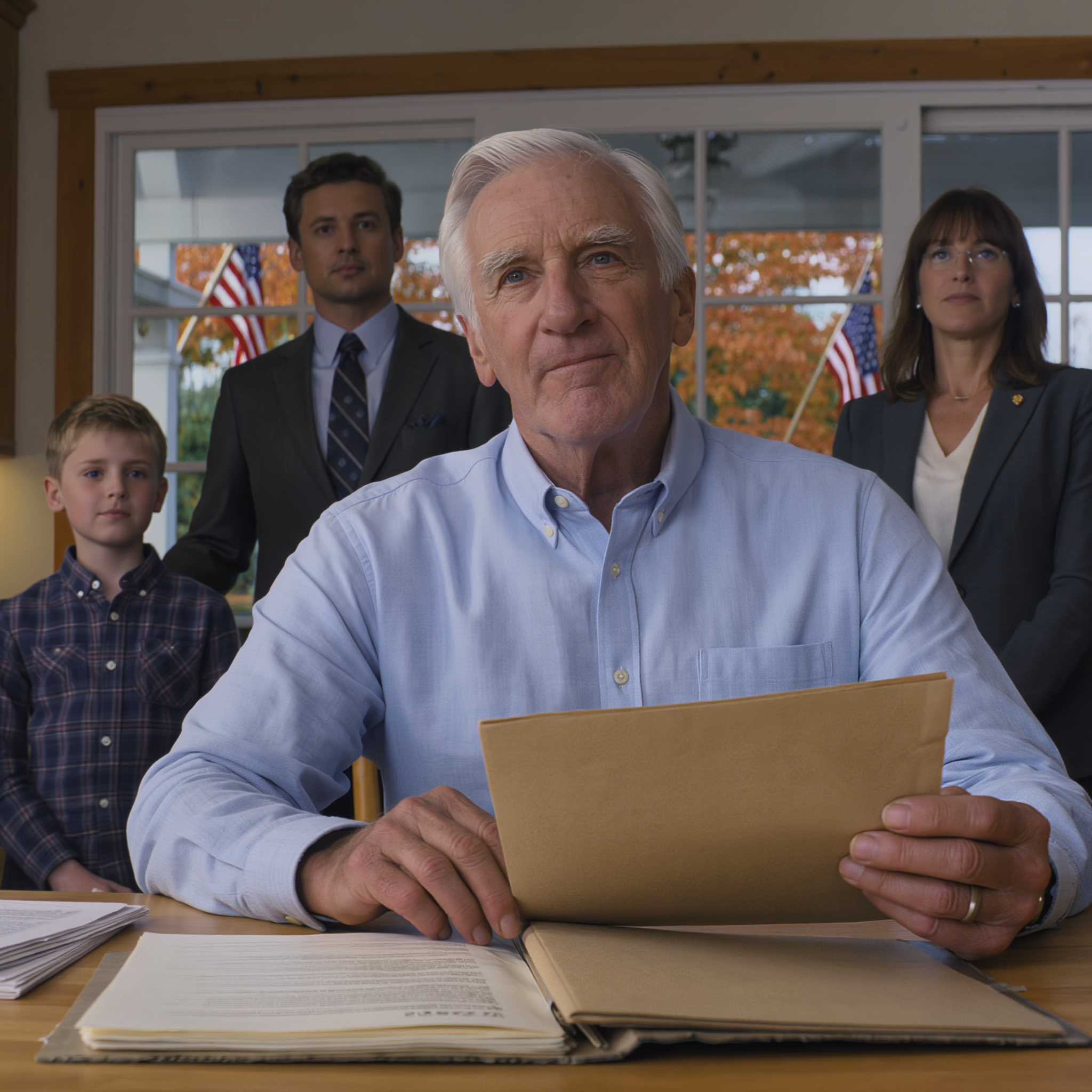
My son Brandon stood in my kitchen in north Phoenix, legal papers spread across the oak table where I’d fed him breakfast for eighteen years. The afternoon sun coming through the Arizona windows made the white pages glow like something holy. They weren’t.
This was my son: a cardiovascular surgeon at a prestigious hospital in downtown Phoenix, a man who’d been too busy to visit his dying mother even once during her eight-year battle with Alzheimer’s, now demanding that I hand over our $2.8 million family home.
Three months earlier, I had buried my wife Margaret alone.
Brandon had been too busy to attend her funeral. Too busy to even know the day she passed. Now he was back in my house with his lawyer wife Jennifer’s legal strategy and his medical degree as weapons against his grieving father.
I was supposed to break down. I was supposed to beg. I was supposed to be the helpless old man they clearly expected—confused, emotional, grateful for their “help.”
Instead, I smiled and pushed my chair back from the table.
“Let me get you something first, son,” I said.
I walked down the familiar hallway to my study, past Margaret’s photographs on the wall, past the framed commendations from the Phoenix Fire Department. My legs shook, but not from fear. From the realization that the moment I’d been preparing for, quietly, methodically, for eight long years, had finally arrived.
What I brought back would destroy both their careers forever.
Because while Brandon and Jennifer had been busy polishing their professional reputations, I’d been busy too.
I’d been building evidence.
If this were one of those online stories, this is where they’d tell you to subscribe to learn how I turned the tables. But this isn’t a story designed for clicks. This is my life.
I remember the exact moment everything changed.
October 15, 2016.
Margaret had been forgetting little things. Car keys. Doctor’s appointments. Our anniversary. At first we laughed it off, the way long-married couples do.
Then we sat in a small, bright exam room at Metropolitan Hospital. Fluorescent lights hummed overhead. The city buzzed somewhere beyond the window. Dr. Susan Chen, a neurologist with kind eyes and a voice that never rushed, folded her hands and said the words that cracked my world in half.
“Early-stage Alzheimer’s.”
I heard Margaret’s sharp inhale more than my own. It was like the air had been knocked out of both of us.
Brandon was finishing his surgical residency at Johns Hopkins in Baltimore at the time. Two years earlier, he’d married Jennifer, a successful corporate lawyer who worked for a high-powered firm that dealt with estate planning and corporate law, first in New York and later in Phoenix.
Jennifer had never been close to us. She’d grown up wealthy in Connecticut. Her parents had a lake house, a Manhattan apartment, and a long list of opinions on how successful people should behave. She often said that “family drama” was too complicated and that “healthy boundaries” were the key to a good life.
When I called Brandon that night about Margaret’s diagnosis, I sat at the kitchen table in our Phoenix home and stared at the desert dark outside.
“Dad, I’m so sorry,” he said. “I’ll visit soon. I promise. Jennifer and I just need to figure out our schedules.”
The next day, he called back with a different message.
“Dad,” he began, clearing his throat, “Jennifer thinks it’s better to let the professionals handle this. She’s worried about exposure to the situation, and I don’t want to upset her.”
That was the beginning.
That was the first day Jennifer’s name slid between me and my son like a wall.
That was the beginning of eight years of Jennifer’s influence over every family decision that mattered.
The bills started immediately. Twenty-three thousand dollars a month for Margaret’s care. Home health aides, medications, occupational therapy, memory specialists. It added up faster than I could track.
I’d been making sixty-eight thousand a year as a fire department training officer for the Phoenix Fire Department, working toward my captain’s promotion. The math was simple.
I couldn’t do both.
So I chose her.
On November 3, 2016, I submitted my resignation. Thirty-four years of service. Pension benefits. The respect of my crew. All of it gone with a signature and a forced smile as I told them it was “time” and that Margaret needed me.
That first year, I called Brandon one hundred twenty-seven times. I kept count. It gave me something to hold on to when the days blurred together.
He returned maybe twenty of those calls.
He was always rushed. Always apologetic. And almost always, I could hear Jennifer’s voice somewhere in the background.
“Dad, I want to help,” he would say, “but Jennifer thinks it’s better if we maintain some boundaries. She says it’ll be less confusing for Mom if we don’t visit irregularly.”
Boundaries.
That became Jennifer’s favorite word.
In one of the rare calls Brandon answered in 2018, I could hear tension in his voice.
“Dad, I’m ashamed seeing Mom like this,” he said. “I remember her being so strong.”
He hesitated, and I could hear Jennifer murmur something in the background.
“And now Jennifer says I should focus on our future instead of dwelling on the past.”
“Brandon,” I said quietly, “she’s not the past. She’s your mother. And she’s still here.”
“I know, Dad,” he said, “but it’s just hard.”
Thanksgiving 2017, I set three places at the table in our Phoenix dining room anyway.
Margaret’s good days were fewer and farther between by then, but that day she’d been clearer. She wore her best blue dress—the one Brandon always said made her eyes sparkle when he was a teenager.
“When is Brandon coming?” she asked every ten minutes as I basted the turkey.
At 4:30 p.m., my phone buzzed.
“Sorry, Dad,” Brandon’s text read. “Jennifer planned something last minute. Give Mom my love.”
I found out later what “something” meant. Jennifer’s Instagram showed them at an upscale resort in Miami, lounging by a pool, champagne glasses in hand. The caption read:
Escaping family drama to enjoy real life. #grateful #nostress
When I confronted Brandon about it a week later, he grew defensive.
“Dad, Jennifer didn’t want me going back while Mom wasn’t well,” he said. “She said it would affect my career focus.”
By 2019, Margaret’s condition had worsened significantly.
In one of the few video calls Brandon attempted that year, Margaret—on a rare lucid afternoon—asked about her grandchildren.
Children that had never existed because Jennifer “wasn’t ready for kids” with all this “family instability.”
Brandon cut the call short when Margaret repeated the question.
“Mom, I don’t want Jennifer to see you like this,” he said. “She thinks it’s better to keep distance to avoid heartbreak.”
The medical bills kept climbing.
Home health aides. Therapy. Medications. Medical supplies. I refinanced our house twice, burning through retirement savings we’d spent decades building.
When I sent Brandon copies of the major medical bills, hoping he’d offer help, his responses were clinical.
“Dad, have you looked into state assistance programs?” he texted once. “Jennifer researched some options online.”
State assistance. For his mother. The woman who’d worked two jobs to help pay for his medical school.
Christmas 2020 was devastating.
Margaret had been asking for Brandon for weeks. I decorated the house exactly like she used to—white lights around the porch, her favorite ceramic snowman on the mantel—hoping for a miracle visit.
On Christmas Eve, I called Brandon.
“Son, your mother’s having a really hard time,” I said. “She keeps asking for you. Could you drive up for just one day?”
There was a pause.
“Dad, Jennifer booked us a ski trip to Aspen,” he said finally. “She says I need to stop enabling your emotional dependency and focus on our marriage.”
That night, Jennifer’s Instagram showed them toasting champagne in a luxury ski lodge, the Rocky Mountains behind them.
Her caption read:
Finally learned to put our relationship first. #boundaries #selfcare
The recording started in 2021.
I didn’t set out to be strategic at first. I just needed something to help me remember what people said when my days were filled with medications, doctor’s visits, and Margaret’s fading memories.
So I began documenting everything.
The missed calls.
The excuses.
Margaret’s tears when Brandon didn’t come.
One particularly painful call in 2022 stuck with me so sharply that I replayed it for months.
“Dad, I know I should visit more,” Brandon said quietly, “but every time I think about coming, Jennifer reminds me how toxic the situation is. She says watching Mom deteriorate isn’t good for my mental health.”
“What about your mother’s mental health, Brandon?” I asked.
There was a long silence.
“I know, Dad,” he finally said, “but Jennifer says professionals can handle it better than family.”
May 2022, Brandon missed Margaret’s sixty-fifth birthday for a couple’s retreat Jennifer had planned.
January 2023, when Margaret fell and broke her hip, I spent three nights in the hospital with her, sleeping in an uncomfortable chair by her bed.
Brandon sent flowers with a card signed by both him and Jennifer.
Thinking of you both — Brandon and Jen.
Jennifer had never met Margaret in the eight years they’d been married.
By Margaret’s final year, she’d stopped eating regularly. In her lucid moments, she would look toward the door with heartbreaking hope.
“Where’s my boy?” she’d ask. “I want to see my boy.”
The last voicemail I left Brandon was on February 10, 2024.
“Brandon, your mother is dying,” I said, my voice shaking. “The doctors say maybe days left. She’s been asking for you constantly. Please, son. Please come home.”
He called back three days later.
“Dad, I’m so sorry I missed your call,” he said. “Jennifer and I were at a medical conference in Orlando. How’s Mom doing?”
I stared at the wall.
“She died yesterday, Brandon,” I said. “Your mother died yesterday.”
The silence on the line stretched so long I thought the call had dropped.
“Oh, God,” he whispered. “Dad, I—Jennifer said it wasn’t that serious yet. Why didn’t you make it clearer?”
Five hundred sixty-three missed calls said otherwise.
He couldn’t make the funeral either.
“Jennifer thinks it would be too traumatic for me,” he said. “Given my guilt over not visiting more.”
So I buried my wife of forty-two years alone, in a small cemetery on the edge of Phoenix, surrounded by neighbors who’d watched me fight this battle without my own son’s support.
That was the day I knew exactly what I had to do.
Three weeks after Margaret’s funeral, Brandon called—not to check on me, not to share memories of his mother, but to discuss what Jennifer called my “property management crisis.”
I was sitting in Margaret’s favorite burgundy recliner in the living room, the one she’d spent her final months in. Her reading glasses were still on the side table. Her crossword puzzle book sat open to a half-finished grid.
“Dad, Jennifer and I have been talking about your situation,” Brandon said.
Those were his opening words.
Not, “How are you holding up?”
Not, “I miss Mom.”
A clinical assessment, delivered with his wife’s authority behind it.
“I’m grieving, Brandon,” I said. “That’s normal when you lose your wife.”
“It’s been three weeks, Dad,” he replied. “Jennifer did some research. She says prolonged grief can indicate cognitive decline, especially in men your age. She thinks we need to take action.”
Action.
Jennifer had been researching me like a legal case.
I was sixty-two years old, not ninety-two. I still mowed my own lawn. I still drove at night. I still did the crossword in ink.
“Age isn’t the only factor, Dad,” Brandon continued. “Jennifer pointed out that the stress of caregiving, the financial strain, the isolation—these things damage executive function. She’s concerned about your ability to make sound decisions.”
I pressed the record button on my phone.
Some instinct I couldn’t explain told me this conversation needed to be preserved.
“What kind of decisions worry Jennifer, son?” I asked.
“Well, for starters, you’re sitting on nearly three million dollars in real estate while drowning in medical debt,” he said. “Jennifer ran the numbers. That house is worth $2.8 million, Dad. She says you could downsize, clear your debts, set yourself up properly.”
Jennifer had done her homework.
Property values. My financial vulnerability. The most efficient extraction method.
“This house is my home, Brandon,” I said quietly. “It’s where your mother and I built our life together.”
“And that’s exactly the kind of emotional thinking that concerns Jennifer,” he replied. “You’re not being rational, Dad. You’re letting sentiment override financial logic.”
Sentiment.
Jennifer was calling my love for Margaret “sentiment.” And Brandon was parroting her words.
“Your mother died in this house, Brandon,” I said. “In our bedroom. Holding my hand. You think I should just sell that away?”
“Dad, Mom is gone,” he said. “Jennifer says clinging to physical spaces isn’t healthy. It’s actually a symptom of complicated grief that can progress to serious cognitive problems if untreated.”
Every word sounded rehearsed, like Jennifer had coached him.
“Are you saying I’m mentally incompetent?” I asked.
“I’m saying Jennifer thinks you’re showing signs of impaired judgment,” Brandon replied. “And as a doctor, I have to agree. The responsible thing would be to transfer the property into competent hands before you make irreversible mistakes.”
“Competent hands,” I repeated. “You mean yours and Jennifer’s.”
“Dad,” he said, “Jennifer has a law degree and financial planning experience. I’m a doctor. We understand asset management better than someone in your emotional state.”
The recording device captured every word. His tone. Jennifer’s influence. The complete absence of empathy for a man who had just lost his wife.
“So what exactly are you both proposing?” I asked.
“Sign the house over to us,” Brandon said. “Jennifer will set up a trust, make sure you get the psychiatric care you clearly need. You can keep living there, of course, but under proper supervision.”
Supervision.
Like I was a patient in his hospital.
“And what if I refuse?” I asked.
The pause on the line was telling.
When Brandon spoke again, I could almost hear Jennifer coaching him.
“Dad, Jennifer researched the legal requirements,” he said. “As a medical professional, I’d be obligated to report cognitive decline in an elderly patient, especially one who’s demonstrated poor judgment about finances and self-care.”
“You’re saying you’d have me declared mentally incompetent,” I said.
“Jennifer thinks we should have you properly evaluated by qualified professionals first,” Brandon replied. “If they determine you can’t manage your affairs safely, then yes, guardianship proceedings might be necessary.”
Guardianship.
Jennifer’s legal background was speaking through my son’s mouth now.
“Brandon, I took care of your mother for eight years while you were building your career with Jennifer,” I said quietly. “I managed everything. And now you think I’m incompetent.”
“That’s exactly Jennifer’s point, Dad,” he said. “She says the stress of caregiving has clearly affected your cognitive function. You’re not the same person you were eight years ago, and we can’t ignore that.”
He was right about one thing.
I wasn’t the same person I’d been eight years before.
But not in the way Jennifer thought.
“I need time to think about this,” I said.
“Of course,” Brandon replied. “But Dad, Jennifer says not to take too long. She’s concerned that every day you delay getting help, your condition could deteriorate further.”
My condition.
Jennifer had diagnosed me through Brandon, found me guilty of grief, and prescribed signing away my home as treatment.
“I’ll call you soon, Brandon,” I said.
“Good,” he replied. “And Dad—Jennifer wants you to know this is coming from a place of love. We’re trying to protect you from making mistakes you’ll regret.”
Love.
After eight years of Jennifer keeping Brandon away from his dying mother, she was calling attempted theft love.
I hung up the phone and stopped the recording.
Twenty-four minutes and twelve seconds of my son systematically dismantling my competence under his wife’s direction.
But what struck me wasn’t Brandon’s cruelty.
It was his complete surrender to Jennifer’s agenda.
Every argument was hers.
Every justification came from her research.
Even his medical authority was being wielded at her instruction.
The boy I’d raised to think for himself had become someone else’s weapon.
I sat in Margaret’s chair for a long time, thinking about the son I’d raised versus the man Jennifer had molded.
Brandon had always been easily influenced, even as a teenager. Coaches. Teachers. Friends’ parents. I’d hoped marriage would give him a backbone.
Instead, it turned him into a scalpel Jennifer wielded.
Then I picked up the phone and called Patricia Miller.
“Patricia, it’s Richard Wilson,” I said when her assistant put me through. “I need to discuss urgent legal matters regarding my son and his wife.”
The war Jennifer had started was about to end very differently than she’d planned.
Patricia Miller’s office in downtown Phoenix felt like a sanctuary that day.
I’d been there dozens of times over the years for mundane things—updating wills, notarizing documents, asking dumb questions about homeowner’s insurance. But this visit carried a different weight.
Finality.
“Richard, I’m so sorry for your loss,” Patricia said as she closed the door behind me. “Margaret was wonderful.”
“Thank you,” I replied. “She always said you were the only lawyer who treated people like humans instead of billable hours.”
I placed my phone on Patricia’s desk and hit play.
Twenty-four minutes of Brandon and Jennifer’s coordinated assault on my mental competence filled the quiet office.
Patricia’s expression darkened with each passing minute. Her pen, which had been poised over a legal pad, went still halfway through.
“Jesus, Richard,” she said softly when it ended. “This isn’t just elder abuse. It’s a calculated legal and medical conspiracy. Your daughter-in-law has clearly researched guardianship law while your son provides the medical justification.”
“Can they actually succeed?” I asked.
“They can try,” Patricia said. “But it would require multiple independent medical evaluations, court hearings, substantial evidence of cognitive impairment. Jennifer’s law background gives her dangerous knowledge, but from what I’ve observed in our meetings, their case would be difficult to prove.”
Some of the tension left my shoulders.
“What are my options?” I asked.
Patricia opened her legal pad again.
“We could wait and defend,” she said, “but given their level of coordination, I’d recommend offense. Document everything. Build a comprehensive record of their behavior. And consider protecting your assets before they can challenge your competence.”
I thought about the eight years of evidence sitting in my filing cabinet at home—missed calls, broken promises, documented abandonment, all while Jennifer actively encouraged Brandon’s absence.
“Patricia,” I said slowly, “what if I told you I had eight years of evidence showing Brandon abandoned his dying mother at his wife’s direction? Phone records, recordings, financial documents proving I handled everything alone while Jennifer kept him away.”
Her pen stopped moving again.
“That would be devastating to their credibility,” she said. “Elder abandonment orchestrated by a lawyer spouse using a doctor husband as the instrument. That’s career-ending territory.”
“And what if I wanted to sell the house?” I asked. “Completely.”
She looked up sharply.
“You’re right to consider that,” she said cautiously. “Though if you’re considering what I think you’re considering—”
I’d been mulling it since Margaret’s funeral.
Our empty house had begun to feel like a mausoleum. Every room echoed with memories and absence. But that wasn’t the only reason.
I’d realized something else.
Brandon was right about one thing.
I wasn’t the same man I’d been eight years earlier.
I was stronger.
And I was done being manipulated.
“I want to sell the house, Patricia,” I said. “To the Alzheimer’s Research Foundation. Margaret always said if her suffering could help other families, it would give her illness meaning.”
Patricia’s eyes widened.
“Richard, that’s a $2.8 million donation,” she said. “Are you certain?”
“I’ve never been more certain of anything,” I replied.
“And Brandon and Jennifer?” she asked.
I smiled grimly.
“They can find out with everyone else.”
We spent two hours working through the details.
The house would transfer to the Alzheimer’s Research Foundation at fair market value, funding a new research wing at Metropolitan Hospital in Margaret’s name. I’d retain residence rights for one year while I determined my next steps.
“There’s one more thing,” I said as we finished the paperwork.
“Of course,” Patricia said.
“I want Brandon and Jennifer to learn about this sale in a very specific way,” I told her.
And I explained my plan.
Patricia listened with growing amazement, then leaned back in her chair.
“Richard, that’s… well, it’s certainly poetic justice,” she said. “But are you prepared for the public nature of this confrontation?”
“Patricia,” I said quietly, “Jennifer researched how to steal my house using Brandon’s medical degree as leverage. Brandon threatened to have me declared incompetent so they could inherit property I was supposedly too mentally ill to manage. I think some public accountability is exactly what they both deserve.”
She nodded slowly.
“Jennifer’s legal career could be seriously damaged by this exposure,” Patricia warned.
“Good,” I replied. “She spent eight years keeping Brandon away from his dying mother, then tried to steal from his grieving father. Her career deserves to be damaged.”
I signed the papers transferring ownership to the foundation effective in thirty days.
The announcement would be made at the hospital’s annual fundraising gala, an event Brandon never missed—always networking for private practice clients—while Jennifer worked the room for potential legal contacts.
“One question, Richard,” Patricia said as I stood to leave. “Are you prepared for the possibility that this destroys your relationship with Brandon permanently?”
I paused, my hand on the back of the chair.
“My relationship with Brandon was destroyed eight years ago,” I said. “When he chose Jennifer’s comfort over his mother’s love. I’m just making that destruction official.”
Driving home along the familiar Phoenix streets, past the fire station where I’d worked half my life, I felt something I hadn’t experienced in months.
Clarity.
Margaret would have supported this decision completely. She’d always believed in fighting for what was right, especially when it was difficult.
That evening, I began organizing eight years of evidence.
Phone records.
Medical bills.
Recordings of Brandon’s excuses and Jennifer’s influence.
Every missed call. Every broken promise. Every Instagram post showing their luxury lifestyle while Margaret suffered.
The hunter was about to become the hunted.
And Jennifer’s legal expertise was about to work against her in ways she’d never anticipated.
Margaret’s old sewing room became my war room.
Eight years of documentation covered every surface—stacks of printed emails, manila folders, spiral notebooks with my own careful handwriting. But now I was organizing it differently.
Not just Brandon’s abandonment.
Jennifer’s orchestration of it.
The smoking gun was my old phone’s voicemail archive.
I’d kept every message, thinking someday I’d delete them for storage space.
Now I understood why I’d never been able to press delete.
The earliest recording was from November 2016, a month after Margaret’s diagnosis.
“Hey, Dad, Brandon here,” the message began. “Jennifer and I talked, and she thinks it’s better if we don’t visit regularly. She says inconsistent contact might confuse Mom more. We’ll check in by phone instead.”
Even then, it was “Jennifer thinks” and “Jennifer says.”
By 2018, the pattern was unmistakable.
Every excuse came filtered through Jennifer’s research or Jennifer’s concerns.
I spent three days creating a timeline.
Brandon’s words on one side.
Jennifer’s Instagram posts on the other.
Christmas 2019, Brandon’s voicemail said:
“Jennifer planned a wellness retreat for my mental health. She’s worried about my depression over Mom’s condition.”
Jennifer’s Instagram that same day showed her in a white robe at a desert spa outside Sedona.
Sometimes you have to choose your happiness over family drama. #selfcare #boundaries
The hospital visitor logs were devastating when cross-referenced with Jennifer’s social media.
During Margaret’s six hospitalizations, the visitor logs at Metropolitan Hospital showed my name forty-three times. Our home health aide visited seven times. Mrs. Davis, our next-door neighbor, came twice.
Brandon’s name appeared zero times.
But Jennifer posted forty-seven times from restaurants, spas, and social events during those same hospitalization periods—always with Brandon beside her. Wine tastings in Napa Valley. Broadway shows in New York while visiting legal clients. Long weekends in Las Vegas.
As his mother lay in hospital beds, Brandon smiled in Jennifer’s photos.
But I needed to understand their vulnerabilities beyond just family abandonment.
So I researched them the way they had researched me.
Jennifer worked at Morrison, Blake & Associates, a prestigious firm in downtown Phoenix handling corporate law and estate planning. Her LinkedIn profile listed recent promotions and high-profile clients. The firm’s website emphasized “family values” and “ethical excellence,” with several recent posts highlighting their pro bono work with elder-care advocacy.
Brandon’s hospital profile emphasized his “compassionate patient care” and “family-centered approach” to medicine. His department had recently launched a caregiver support initiative for families dealing with chronic illness.
The irony took my breath away.
I started making strategic phone calls.
First, to Dr. Susan Chen, Margaret’s neurologist.
“Mr. Wilson, I’ve been thinking about you since Margaret’s passing,” she said. “How are you managing?”
“Dr. Chen, I need to ask you about something delicate,” I said. “It involves Brandon and his wife, Jennifer.”
I explained their coordinated threats. Their plans to have me declared incompetent. Their attempt to force me into signing over the house.
Dr. Chen listened without interruption.
“Mr. Wilson,” she said finally, “in eight years of treating your wife, I met Brandon exactly once—at the initial consultation. I remember asking about family support, and he said his wife thought professional distance was healthier for everyone involved.”
“Did you document that?” I asked.
“We document all family dynamics,” she replied. “Your wife’s file shows you attended every appointment, every emergency, every consultation. The absence of her son was notable, especially given his medical background.”
“Would you provide a statement about that?” I asked.
“If it helps protect you from what sounds like medical and legal coercion combined,” she said, “absolutely.”
Next, I called Fire Chief Mike Anderson.
“Richard Wilson,” he said when he picked up. “How have you been since Margaret’s passing?”
I explained Brandon and Jennifer’s scheme.
Mike’s reaction was immediate and, for a moment, unprintable.
“That manipulative little—” he bit the word off. “Sorry, Richard. But I remember when you resigned to care for Margaret. Jennifer came to the retirement party briefly. Spent the whole time checking her phone and complaining about the depressing atmosphere. Brandon barely stayed ten minutes.”
“Would you document that?” I asked.
“Damn right,” he said. “And Richard, half the department remembers how proud you were of Brandon’s career. How many times you made excuses for why he couldn’t visit Margaret. We all knew something was wrong.”
The character witnesses mounted quickly.
Our family doctor.
Our financial adviser.
Neighbors who’d watched me carry Margaret to the car when she refused to walk, who’d dropped off casseroles and quietly taken out my trash when I forgot.
All of them were shocked—but not entirely surprised—by the coordinated nature of Brandon and Jennifer’s scheme.
But my breakthrough came from an unexpected source.
Mrs. Davis from next door knocked on my door Thursday evening, her gray hair pinned back, worry etched across her face.
“Richard, I hope you don’t mind,” she said, clutching a manila folder, “but I’ve been worried since that incident with the real estate agent. I did some research on your daughter-in-law.”
“What kind of research?” I asked.
“Well, my nephew works at Morrison, Blake & Associates,” she said. “He says Jennifer’s been bragging about coming into a significant family inheritance soon. She’s already been shopping for houses in Scottsdale, telling colleagues her husband’s father is finally being realistic about his limitations.”
The pieces clicked together.
This wasn’t just about the house.
Jennifer had been planning and bragging about stealing from me while I was still grieving my wife.
“Mrs. Davis, would your nephew be willing to document what Jennifer said at work?” I asked.
“Oh, Richard,” she said, shaking her head sadly, “it’s worse than that. She apparently sent emails about it. My nephew works in IT. He’s seen the firm’s internal communications about potential conflicts of interest when lawyers inherit property through family legal actions.”
Friday evening, I called Brandon.
Time to let him think he was winning while I gathered the last pieces of evidence.
“Son,” I said when he picked up, “I’ve been thinking about what you and Jennifer said. About the house. About my mental state.”
I made my voice smaller, shakier.
“I’m glad you’re being rational about this, Dad,” Brandon said, relief obvious. “I’m scared, Brandon,” I said. “Maybe Jennifer’s right. Maybe I’m not thinking clearly anymore.”
I could almost hear him exhale.
“It’s okay, Dad,” he said. “Jennifer’s already contacted some estate planning specialists. We’re going to take care of everything.”
“Of course she has,” I murmured.
“Jennifer found a really good elder law attorney who specializes in these transitions,” Brandon continued. “She’s confident we can have everything transferred smoothly.”
“When do you want to move forward?” I asked.
“Soon, Dad,” he replied. “Jennifer says the longer we wait, the more opportunity there is for you to make mistakes that could complicate the legal process.”
“Okay, son,” I said. “Whatever you and Jennifer think is best.”
After hanging up, I sat in Margaret’s chair and smiled for the first time in what felt like forever.
They thought they’d won.
Brandon was probably already telling Jennifer about my “surrender,” and she was probably already planning how to spend my money.
They had no idea that every conversation was being recorded, every threat documented, and every piece of evidence organized for maximum impact.
The trap was set.
Now, I just had to wait for them to walk into it at the hospital fundraising gala, where Jennifer’s legal colleagues and Brandon’s medical colleagues would witness their complete destruction.
Two weeks later, Brandon made his move.
I was sitting on Margaret’s memorial bench in our neighborhood park—a simple wooden bench with a small brass plaque bearing her name—when I saw his silver BMW turn onto our street.
I watched from a distance as the car pulled into my driveway.
Two people climbed out.
Jennifer stepped from the passenger seat first. Tall. Blonde. Tailored designer suit that probably cost more than most people’s monthly mortgage. She moved with the predatory confidence of someone about to close a profitable deal.
A real estate agent followed, carrying measuring equipment and a leather portfolio.
Even from two blocks away, I could see Jennifer directing the operation like a general commanding troops.
I stayed on the bench, watching through the oak trees as they walked around my property.
Jennifer pointed out features with proprietary confidence, taking photos with her phone. The agent measured the yard while Jennifer peered through the windows like she was already planning renovations.
Mrs. Davis was in her front yard garden, close enough to overhear their conversation.
“Perfect,” I murmured.
I walked home slowly, timing my arrival for maximum impact.
“Dad, there you are,” Brandon called out with forced cheerfulness as I walked up the driveway. “I’d like you to meet Linda Patterson from Premium Properties. Jennifer found her. She specializes in these kinds of family transitions.”
Linda extended a manicured hand.
“Mr. Wilson, your son and daughter-in-law have explained your situation,” she said. “I’m very sorry for your loss.”
My situation.
Jennifer had briefed her thoroughly, painting a picture of an incompetent old man whose family was heroically rescuing him from his own poor judgment.
“Thank you,” I said quietly. “Though I’m confused about why you’re here.”
Jennifer stepped forward smoothly.
“Richard, we discussed this with Brandon,” she said. “The house sale, remember? I researched several agents, and Linda has excellent reviews for handling estate transitions.”
She spoke to me like I was a confused child, her lawyer’s training evident in every controlled word.
“But Jennifer,” I said, “I never agreed to sell the house.”
Brandon and Jennifer exchanged a look, the kind attorneys share when a witness isn’t cooperating with the predetermined narrative.
“Dad,” Brandon said patiently, “we had a very clear conversation about this. You said you were scared, that you couldn’t handle the house anymore, that you wanted Jennifer and me to take care of everything.”
The gaslighting was textbook.
Public. Confident. Designed to make me question my own memory while establishing their version of events for witnesses.
“I’m sorry,” I said louder now, “but I think there’s been a misunderstanding. This is my home. My wife just died here three months ago. I’m not selling anything.”
Linda looked uncomfortable, shifting her weight from foot to foot, but Jennifer stepped in again, her tone saccharine.
“Richard, this is exactly what we’ve been worried about,” she said. “The confusion. The memory issues. Dr. Wilson explained that grief can sometimes affect cognitive function in older adults.”
Jennifer’s legal training was showing. She was building a public record of my alleged incompetence while positioning herself as the concerned family member.
Mrs. Davis had stopped pretending to garden. She was watching openly now, her face pinched with concern.
“I’m not confused,” I said clearly. “I never agreed to any sale.”
“Dad, please,” Brandon interrupted, embarrassment creeping into his voice. “You’re making this harder than it needs to be.”
“Making what harder?” Mrs. Davis called from her yard, stepping closer to the property line.
Jennifer turned on her professional charm.
“Just some family financial planning, Mrs. Davis,” she said smoothly. “We’re helping Richard make some necessary transitions.”
“I’ve lived next to Richard and Margaret for twenty years,” Mrs. Davis replied. “Richard’s one of the sharpest men I know.”
Jennifer’s smile tightened.
“I’m sure he was, Mrs. Davis,” she said. “But grief can change people significantly.”
“Richard,” Mrs. Davis said, ignoring Jennifer, “do you want to sell your house?”
“No,” I said, clearly and loudly enough for everyone to hear. “I absolutely do not.”
Brandon’s face flushed red.
“Dad, you’re not thinking rationally,” he said in a low voice. “You’re embarrassing yourself.”
“I think we should reschedule,” Linda interrupted, already backing toward her car. “This might not be the right time.”
As Linda drove away, Jennifer’s composure finally cracked—just a hairline fracture, but visible.
“This isn’t over, Richard,” she said, her voice low and sharp. “Brandon’s medical assessment stands, and I’ve already researched the legal options available to us.”
Mrs. Davis was still watching from a few feet away. I knew she’d remember every word of Jennifer’s threat.
“We’ll see about that,” I said calmly. “We’ll see about that.”
Jennifer’s public humiliation in front of Mrs. Davis triggered a sophisticated damage-control campaign.
Within days, she was working every angle to protect both her legal career and their inheritance plan.
It started with social media.
Jennifer, who usually posted sparingly about family, suddenly became the devoted daughter-in-law. She shared filtered black-and-white photos of Margaret from old family gatherings, with captions about “honoring those we lose” and “supporting loved ones through difficult transitions.”
Photos appeared of her and Brandon at various charity events with captions about “the challenges of supporting family through cognitive decline” and “making hard decisions with love and professional expertise.”
The posts were masterfully crafted.
To anyone who didn’t know the truth, she looked like a woman heroically managing a complex family crisis—part legal expert, part devoted family member.
But Jennifer’s real strategy was more insidious.
Three days after the real estate incident, Dr. Chen called me again.
“Mr. Wilson,” she said, “I’ve been seeing some concerning activity in professional forums. Your daughter-in-law has been posting in legal groups about medical-legal coordination in elder-care cases.”
“What do you mean?” I asked.
“She’s discussing your situation in private attorney networks,” Dr. Chen explained, “seeking advice about family members who resist appropriate intervention. She’s building a legal coalition while Brandon builds a medical one.”
My blood ran cold.
This wasn’t just theft.
It was a coordinated professional conspiracy.
“Dr. Chen, is that ethical for Jennifer?” I asked. “Is it legal for Brandon?”
“It’s legally questionable for Jennifer,” she said carefully. “For Brandon, it crosses multiple medical ethics boundaries. He’s discussing a family member’s mental health in professional forums without consent.”
That evening, Mrs. Davis knocked on my door with more disturbing news.
“Richard,” she said, stepping into my living room, “my nephew at Morrison, Blake & Associates says Jennifer’s been quite busy. She’s apparently consulted with three different elder law specialists and has been telling colleagues that her father-in-law’s competency case will be an interesting learning experience.”
“Learning experience,” I repeated.
“She’s treating your situation like a case study,” Mrs. Davis said, shaking her head. “My nephew says she’s been researching guardianship law extensively and has already identified two physicians willing to evaluate you for cognitive decline.”
The trap was closing faster than I’d anticipated.
Jennifer wasn’t just planning to steal my house.
She was turning it into a career advancement opportunity.
That same evening, Patricia called.
“Richard, the legal community is small,” she said. “Word is spreading that Jennifer Wilson is shopping around for attorneys willing to pursue an aggressive guardianship case. She’s apparently promised it will be straightforward because she has medical backing from her husband.”
“How much time do I have?” I asked.
“If Jennifer files a petition,” Patricia said, “the preliminary evaluation process could begin immediately. And she’s smart. She’s building a paper trail of your alleged incompetence while positioning herself as the reluctant but responsible family member.”
The next morning, I started making strategic calls of my own.
First, to Helen Rodriguez, our longtime financial adviser.
“Helen, I need a favor,” I said.
“Anything,” she replied. “What’s going on?”
“Can you arrange a press conference for a major charitable donation?” I asked.
“Richard, what are you planning?” she said.
“A $2.8 million donation to Alzheimer’s research,” I said. “In Margaret’s name. I want maximum publicity, media coverage, hospital administration present.”
There was a beat of stunned silence.
“That’s incredible, Richard,” she said finally. “When?”
“Next Friday,” I replied. “The hospital’s monthly board meeting. I want it announced in front of the entire medical staff and any legal community members who might be present.”
My second call was to Mike Anderson.
“Mike, I need you to spread the word through the first responder community,” I said. “Richard Wilson is making a major announcement next Friday at Metropolitan Hospital. Anyone who knew Margaret should attend.”
Word spread through the hospital faster than gossip in a firehouse.
A $2.8 million donation was major news, especially from a retired firefighter.
The hospital’s development office arranged press coverage and VIP attendance. Local Phoenix media outlets RSVPed. The board chair moved other agenda items to make room.
Jennifer found out Tuesday morning when a colleague at Morrison, Blake mentioned seeing the hospital’s press release about a “major donor announcement” tied to Alzheimer’s research.
Brandon called me that afternoon, panic barely concealed under a thin layer of professional calm.
“Dad, Jennifer saw something about an announcement at the hospital,” he said. “Something involving Mom’s name.”
“That’s right, son,” I said evenly. “I thought it was time to honor your mother properly.”
“What kind of announcement?” he demanded.
“You’ll find out Friday,” I said. “I hope you and Jennifer can both attend. The entire cardiac surgery department has been invited, along with several legal professionals from the community.”
The silence stretched for forty seconds.
“Dad, please tell me you’re not making major financial decisions without consulting Jennifer and me first,” he said.
“Why would I need to consult you, Brandon?” I asked. “Jennifer said I was mentally incompetent, remember?”
Another long pause.
“Dad, we need to talk before Friday,” he said. “Jennifer thinks—”
“I’m afraid I’m too busy this week preparing my presentation,” I interrupted. “See you Friday, son.”
I hung up and smiled.
Jennifer’s legal expertise was about to work against her in ways she’d never anticipated.
Her professional network would witness her complete destruction, along with Brandon’s medical colleagues.
The hunter had become the hunted.
Thursday night, the evening before my announcement, I sat in Margaret’s chair one final time, surrounded by eight years of evidence.
Tomorrow would destroy both Brandon’s medical career and Jennifer’s legal reputation.
Tonight belonged to the careful accounting of their coordinated betrayal.
The manila folders were labeled by year, each documenting another layer of Jennifer’s orchestrated abandonment campaign.
I opened 2016 first, the year everything began.
One hundred twenty-seven calls from me to Brandon. I’d counted them twice, then had Patricia’s assistant verify them from the phone company records.
His return-call rate: eighteen percent.
And only when Jennifer wasn’t directing his responses.
The voicemails told the real story.
November 2016:
“Dad, Jennifer researched Alzheimer’s care, and she thinks family visits during early stages can actually increase confusion. We should let the professionals handle it.”
December 2016:
“Dad, Jennifer’s concerned about my emotional health. She says watching Mom deteriorate isn’t good for my career focus.”
Jennifer’s influence was documented from day one.
Medical bills from 2016 totaled $127,000.
Brandon and Jennifer’s financial contribution: zero.
I moved to the 2017 folder, cross-referencing Brandon’s excuses with Jennifer’s social media activity.
Thanksgiving week, Brandon’s voicemail claimed:
“Jennifer planned a wellness retreat for my mental health.”
Jennifer’s Instagram from that same trip showed them at a luxury resort.
Sometimes you have to choose happiness over family drama. #selfcare #boundaries
Forty-three photos from their “wellness retreat” while Margaret spent Thanksgiving asking why her son wouldn’t come home.
2018 brought Margaret’s first major hospitalization for pneumonia.
Six days in ICU while she fought for her life.
The visitor logs showed my name forty-three times. Our home health aide visited seven times. Mrs. Davis brought flowers twice.
Brandon’s name: zero entries.
But Jennifer’s Instagram showed their location throughout Margaret’s crisis—wine tastings in Napa Valley while his mother was on a ventilator.
By 2019, Jennifer’s strategy was fully developed.
She’d convinced Brandon that his mother’s illness was toxic to their marriage and his career.
The evidence was in their own messages.
A saved text from Jennifer to Brandon, screenshot from his phone years ago:
Your dad is manipulating you with guilt. My research shows that prolonged exposure to dementia patients can cause secondary trauma in family members. We need to maintain boundaries for our mental health.
Brandon’s response:
You’re right. I’ll tell Dad we can’t visit as much.
Jennifer’s reply:
Not “can’t visit as much.” We need complete space until she’s stabilized. I’ve talked to other lawyer wives who’ve dealt with similar situations.
She’d researched abandonment strategies like drafting a legal brief.
2020 and 2021 showed the pattern perfected.
Every holiday excuse came filtered through Jennifer’s “professional recommendations.”
Christmas 2020, Brandon claimed Jennifer’s therapist recommended avoiding “family trauma” during the holidays.
Jennifer’s Instagram that Christmas read:
Learned to prioritize our relationship over family drama. Best decision ever. #selfcare #boundaries
The financial devastation was staggering.
$563,000 in total medical expenses over those years.
All while Jennifer posted about designer purchases and luxury vacations funded by Brandon’s surgical income.
But the cruelest evidence was Jennifer’s manipulation of Brandon’s guilt.
In a recorded phone call from 2022, Brandon finally admitted the truth.
“Dad, I want to visit Mom,” he said, “but Jennifer says it’s not healthy for me. She researched caregiver burnout and thinks I’m showing symptoms just from the phone calls. She made me promise to prioritize our marriage.”
“Brandon, you haven’t visited your mother in six years,” I said.
“I know, Dad,” he replied, “but Jennifer says that proves I’m making the right choice for my mental health.”
Jennifer had convinced Brandon that abandoning his dying mother was therapeutic.
The final folder contained the smoking gun.
Jennifer’s own words, captured during a speakerphone conversation in 2023.
Brandon had called about Margaret’s fall, and I’d heard Jennifer coaching him in the background.
“Tell him we can’t afford to get emotionally involved,” she said. “Remind him that as a doctor, you need to maintain professional distance even with family.”
When Brandon hesitated, Jennifer’s voice came clearly through the phone.
“Brandon, we’ve discussed this,” she said. “Your mother’s condition is deteriorating anyway. Getting attached now will just make it harder when she dies. Think about our future.”
Our future.
While Margaret lay broken and scared in a hospital bed, Jennifer was calculating inheritance timelines.
I’d compiled seventeen character-witness statements documenting my mental competence and Brandon’s absence.
Dr. Chen’s medical notes showed Margaret asking for Brandon during every appointment in her final year.
Fire Chief Anderson’s statement detailed my thirty-four years of exemplary service and sound judgment.
But the most damning evidence was the recorded threats.
Twenty-four minutes of Brandon and Jennifer’s coordinated plan to have me declared incompetent so they could steal my house.
The moral accounting was complete.
Eight years of Jennifer’s orchestrated abandonment, documented with legal precision.
Margaret deserved justice.
Tomorrow, she would finally get it.
Friday morning arrived crisp and clear, the kind of desert morning Margaret always loved.
I dressed carefully in the navy suit she’d bought me for our fortieth anniversary. The irony wasn’t lost on me that I was wearing it to defend her memory against our own son and his wife.
Metropolitan Hospital’s main conference room was larger than I expected. Helen had outdone herself.
Local news cameras lined the back wall. The hospital’s entire board sat in the front rows, along with department heads and senior medical staff. The room buzzed with low conversation and the rustle of paper programs.
I spotted Brandon and Jennifer immediately.
They sat with the cardiac surgery team. Jennifer’s designer suit and confident posture suggested she expected a routine family-donation ceremony. Brandon looked tense, but Jennifer appeared composed, probably viewing this as another networking opportunity.
Dr. Michael Thompson, Brandon’s department head, sat a few seats away. Dr. Sarah Chen, the hospital’s chief of staff, was taking notes near the front. Several attorneys from Morrison, Blake & Associates were scattered through the crowd—likely Jennifer’s colleagues, curious about the family inheritance case she’d been hinting about.
Helen introduced me warmly, emphasizing my years of service with the Phoenix Fire Department and my extraordinary dedication as a caregiver during Margaret’s eight-year battle with Alzheimer’s.
I stepped up to the podium and looked out at forty-three people—mostly medical and legal professionals—who understood both the cost of Alzheimer’s and the importance of family support.
“Thank you all for coming,” I began. “My name is Richard Wilson. Three months ago, I lost my wife, Margaret, to Alzheimer’s disease after an eight-year battle. Today, I’m announcing a $2.8 million donation to establish the Margaret Wilson Memorial Research Wing here at Metropolitan Hospital.”
Applause filled the room.
I saw Brandon’s face register shock, then confusion. Jennifer’s expression remained controlled, but her eyes sharpened. She was calculating what this meant for her inheritance plans.
“This donation represents the sale of our family home,” I continued. “The house where Margaret and I built our life together. Where we raised our son Brandon. And where she passed away peacefully in my arms.”
I gestured toward Brandon.
Several colleagues smiled at him, assuming this was a proud family moment.
“But this donation is about more than research funding,” I said. “It’s about honoring true caregivers—the family members who sacrifice everything for their loved ones, often without recognition or support.”
Dr. Thompson nodded approvingly.
“Over eight years,” I went on, “I learned that caregiving isn’t about professional credentials or medical knowledge. It’s about showing up day after day, year after year, even when it’s difficult. Even when it costs you everything.”
The room grew quieter.
People could feel the shift.
“Unfortunately,” I said, “not everyone understands this responsibility. Some people believe professional credentials can substitute for personal commitment. Others use their legal expertise to justify abandonment.”
Jennifer’s composure cracked slightly.
“Three weeks ago,” I said, “my son Brandon and his wife Jennifer called to discuss my mental competence. They suggested my grief indicated cognitive impairment. They recommended I sign over my house to them—for my own protection.”
Murmurs rippled through the audience.
Dr. Thompson’s expression shifted from warm approval to something much colder.
Jennifer’s colleagues from Morrison, Blake sat up straighter.
“Brandon felt that as a medical professional, he was qualified to diagnose my mental state over the phone,” I said. “Jennifer, as a practicing attorney, researched the legal requirements for having me declared mentally incompetent.”
I reached into my jacket and pulled out my phone.
“I’d like to share part of their coordinated plan with you,” I said.
Brandon shoved his chair back.
“Dad, this isn’t appropriate,” he said. “We should talk about this privately.”
“Please, Dr. Wilson,” Dr. Chen said sharply from the front row. “Let your father finish.”
I hit play.
Brandon’s voice filled the conference room, clinical and cold, Jennifer’s influence woven through every phrase.
“Dad, Jennifer thinks you’re showing signs of impaired judgment,” the recording played. “The responsible thing would be to transfer the property into competent hands before you make irreversible mistakes.”
“Competent hands?” my recorded voice replied. “You mean yours and Jennifer’s?”
“Dad, Jennifer has a law degree and financial planning experience,” Brandon’s voice said. “I’m a doctor. We understand asset management better than someone in your emotional state.”
Jennifer’s voice was audible in the background.
“Tell him about the legal options, Brandon,” she whispered. “Remind him about guardianship proceedings.”
The recording continued for three excruciating minutes.
Brandon’s medical threats.
Jennifer’s legal strategy.
Their coordinated plan to steal my house while I grieved my wife.
When it ended, the silence was almost physical.
Jennifer’s colleagues were staring at her with thinly veiled shock.
“Now,” I said quietly, “I’d like to provide context for their professional assessment of my competence.”
I opened my presentation folder.
“During Margaret’s eight-year illness,” I said, “I called my son Brandon five hundred sixty-three times. He returned ninety-seven of my calls—a response rate of seventeen percent. But the real story is in the voicemails he left.”
I pressed play again.
Brandon’s voice from 2017:
“Dad, Jennifer researched Alzheimer’s care,” the recording said, “and she thinks family visits during early stages actually increase confusion.”
Then, on the screen behind me, we displayed Jennifer’s Instagram post from that same week—a screenshot enlarged for everyone to see.
Sometimes you have to choose happiness over family drama. #boundaries #selfcare
Gasps rippled through the room.
“Over eight years,” I said, “Margaret was hospitalized six times. These visitor logs show I was present for every admission, every procedure, every consultation. They also show that Dr. Wilson visited his dying mother exactly zero times.”
Several people turned to look at Brandon.
His face was flushed crimson. Jennifer’s jaw was clenched.
“The financial cost of Margaret’s care totaled $563,000,” I continued. “I paid every penny, while Dr. Wilson and his wife posted about luxury vacations and designer purchases funded by his surgical income.”
I held up printed screenshots.
“These posts from Mrs. Wilson’s Instagram,” I said, “were made during Margaret’s most critical episodes. This wine tasting in Napa Valley was posted while Margaret was in ICU with pneumonia. This designer shopping spree was during the weekend she broke her hip.”
Jennifer’s colleagues were now openly staring at her. One was taking notes—likely on behalf of their firm’s ethics committee.
“But perhaps most telling,” I said, “is how Mrs. Wilson orchestrated this abandonment using her legal expertise.”
I played another recording.
Jennifer’s voice, coaching Brandon:
“Your dad is manipulating you with guilt,” she said. “My research shows prolonged exposure to dementia patients causes secondary trauma. We need complete space until she’s stabilized.”
The room erupted in shocked whispers.
Jennifer shot to her feet.
“This is a violation of privacy,” she said sharply. “Those recordings were made without consent.”
“Actually, Mrs. Wilson,” Patricia’s voice came calmly from the back of the room, “in Arizona, single-party consent applies to recording conversations. Your husband consented by participating in the calls.”
Jennifer turned, recognizing her professional equal—and enemy.
“Furthermore,” Patricia added, “what we’ve just heard suggests a coordinated attempt at financial elder abuse, using both legal and medical authority.”
I continued.
“When Margaret was dying,” I said, “I left Brandon a voicemail explaining she had days to live. He called back three days later to learn she’d already passed. His excuse? Jennifer had convinced him that his mother’s death wasn’t imminent enough to interrupt their vacation plans.”
Dr. Chen stared at Brandon with open disgust.
“Dr. Wilson,” she said, “is this accurate?”
Brandon’s voice was barely a whisper.
“Dad, Jennifer thought—” he began.
“Dr. Wilson,” Dr. Thompson interrupted, standing now, his face rigid. “I think we need to discuss your employment status. My office. Now.”
Jennifer finally lost her composure.
“This is character assassination,” she said. “Richard is clearly having a mental breakdown and making up stories. He’s weaponizing his grief—”
“Mrs. Wilson,” one of her colleagues called from the other side of the room, “perhaps you should stop talking. You’re making this worse.”
The attorney from Morrison, Blake & Associates was already on his phone, likely contacting their firm’s managing partners.
“I’m finishing now,” I said calmly.
“The Margaret Wilson Memorial Research Wing will open next year,” I continued, “funded by the home where she spent her final years, surrounded by people who actually cared about her.”
I stepped back from the podium.
“Thank you.”
The applause was scattered and uncertain at first.
But several people stood to shake my hand afterward. Nurses from the Alzheimer’s unit. A young resident with tears in her eyes. A hospital board member who said quietly, “Your wife deserved better from your son. I’m glad you’re honoring her this way.”
As I headed for the exit, Jennifer cornered me in the hallway, her professional mask finally gone.
“You’ve destroyed us both, Richard,” she hissed. “Brandon’s career, my practice—you’ve ruined everything.”
“No, Jennifer,” I said quietly. “You destroyed yourselves. I just documented it.”
Brandon appeared beside her, eyes red for the first time in eight years.
“Dad, I’m sorry,” he said, voice breaking. “Jennifer convinced me that staying away was better for everyone, and I was too ashamed to see Mom deteriorating. I—”
“It’s too late for apologies, Brandon,” I said. “Your mother died asking for you.”
They watched me walk away.
Mrs. Davis was waiting for me in the parking lot, tears streaming down her face.
“Richard,” she said, grabbing my hands, “Margaret would be so proud. You honored her memory. You stood up for yourself.”
For the first time in months, I felt something like peace.
Six months later, I stood in the Margaret Wilson Memorial Research Wing, watching technicians install the final piece of equipment.
The gleaming laboratory stretched across three thousand square feet on the hospital’s third floor. Glass walls. State-of-the-art imaging machines. Quiet rooms for family counseling.
All of it funded by the sale of our family home.
Dr. Chen had been appointed director.
She found me that morning, standing in front of the dedication plaque.
“Richard, this is remarkable,” she said softly. “Margaret would be overwhelmed by what you’ve accomplished.”
“She always said,” I replied, “that if her suffering could help other families, it would give her illness meaning.”
The aftermath of that day at the hospital had been swift.
Dr. Thompson suspended Brandon pending a medical board review.
The hospital’s ethics committee launched a formal investigation into his abandonment of family responsibilities while using his medical authority for personal gain.
Jennifer’s legal career imploded even faster.
Morrison, Blake & Associates terminated her partnership after the state bar’s ethics board opened their investigation. Her professional reputation was destroyed almost overnight. No firm wanted an attorney who’d orchestrated elder abandonment and attempted financial elder abuse.
But the most unexpected consequence came two months after the announcement.
Brandon called on a Tuesday evening.
“Dad,” he said quietly, “Jennifer left me.”
I sat at my small kitchen table in my new downtown Phoenix apartment and waited.
“She said the scandal destroyed her career,” he continued, “and she couldn’t be married to someone who let his father humiliate her publicly.”
I felt a flicker of something—not quite sympathy, but recognition of his pain.
“Dad,” he said, his voice cracking, “I realize now how much Jennifer influenced my decisions. I was ashamed of seeing Mom deteriorate, and Jennifer made it easy to stay away. I know it’s too late, but I’m sorry.”
“Brandon,” I said, “your mother died asking for you. That can’t be undone.”
“I know,” he whispered. “But, Dad… could we—could we maybe try to rebuild something? I want to volunteer at the research wing. Maybe help other families avoid what happened to us.”
I considered his request carefully.
The research wing needed volunteers.
His medical background could be useful.
But trust, once shattered, isn’t restored by a single apology.
“Brandon,” I said slowly, “we can start with the volunteer work. But our relationship—if there ever is one again—will be earned, not inherited.”
“I understand, Dad,” he said. “I’ll do whatever it takes.”
I moved into a comfortable apartment downtown, walking distance from Metropolitan Hospital, where I now worked part-time as a patient advocate for families facing dementia diagnoses.
The Margaret Wilson Memorial Research Wing published promising early results in drug therapies that might slow Alzheimer’s progression. Families who once felt as lost as I had now had a place to go, a team that understood both the science and the heartbreak.
Some boundaries, once established, protect what matters most.
Others, carefully reconstructed over time, might offer a fragile hope for redemption.
But Margaret’s name, engraved in bronze on that research wing wall, was a reminder of the choice I’d made—and the line I was never willing to let anyone cross again.
News

My husband said, ‘You should move somewhere else to live.’ With no money, I was forced to go to my husband’s company to work as a cleaner to support my children. Until one day, the secretary hurried over and whispered, “Hurry, hide under the desk. You need to hear the truth!”
Serena Hayes dipped her mop into the gray, soapy mess. The water was hot, but her hands had been freezing…

‘She’ll learn a lesson,’ my dad said after leaving my 8-year-old daughter alone at the airport while my entire family flew to Disney. In the family group chat, the message was simply: ‘Come pick her up. We’re about to board.’ My mother added coldly, ‘Don’t make us feel guilty.’ The moment their plane landed…
“She’ll learn a lesson,” my dad said, like he was talking about forgetting a homework assignment and not abandoning…

At my son’s 35th birthday party, he grabbed the microphone and announced in front of everyone: ‘This party was paid for entirely by my future father-in-law, my mother didn’t contribute anything at all.’ I calmly stood up and walked out. That night, I quietly rearranged my entire financial plan, transferring the company I had painstakingly built to someone else. The next morning, when I woke up, I saw… ’76 missed calls.’
My son humiliated me in front of two hundred people by saying I had not even paid for his cake….

This Christmas, my name is not on my family’s guest list. In their eyes, I am just an “invisible” daughter. I quietly booked first-class tickets to take my grandmother to Paris. On Christmas Eve, I calmly informed them and presented the family trust papers that I had rearranged.
This Christmas, I am not on the guest list of my own family. In their eyes, I am still the…

‘Sir, that boy lives with me,’ I said loudly when I saw the portrait in the mansion. I work as a cleaner in New York. I know him!
I clean houses for a living. Not the life I imagined when I left Wyoming for the East Coast with…

‘Move out. You have two days.’ – My parents gave my apartment to my brother right at his engagement party… I used to think my parents truly cared about me, until they publicly gave my apartment to my twin brother – the apartment I had put $30,000 into, which was my entire savings. The moment everyone applauded to congratulate them was also the moment I realized that, for them, everything between us had ended from that day on.
My parents gave my apartment to my brother at his engagement party in a leafy suburb just outside Chicago, without…
End of content
No more pages to load